
🪄 AI Summary
Heading 1
Heading 2
Heading 3
Heading 4
Heading 5
Heading 6
Lorem ipsum dolor sit amet, consectetur adipiscing elit, sed do eiusmod tempor incididunt ut labore et dolore magna aliqua. Ut enim ad minim veniam, quis nostrud exercitation ullamco laboris nisi ut aliquip ex ea commodo consequat. Duis aute irure dolor in reprehenderit in voluptate velit esse cillum dolore eu fugiat nulla pariatur.
Block quote
Ordered list
- Item 1
- Item 2
- Item 3
Unordered list
- Item A
- Item B
- Item C
Bold text
Emphasis
Superscript
Subscript
Private equity firms rarely lack expertise. They lack a visible record of it. A sound YouTube strategy for private equity turns partner thinking, sector knowledge, and operating experience into searchable video that business owners, intermediaries, and limited partners can find on their own time. The goal is not reached for its own sake. It is credible with a small, senior audience, produced with compliance in mind.
Quick Answer
Define three audiences, publish a few repeatable formats built on partner and operator expertise, route every video through compliance review, and measure inbound conversations, not views.
At a Glance
Why a Private Equity Firm Would Use YouTube at All
Many partners ask whether YouTube is too consumer-facing for institutional work. I understand the concern. My answer is that YouTube is a search engine and a library, and senior people use both.
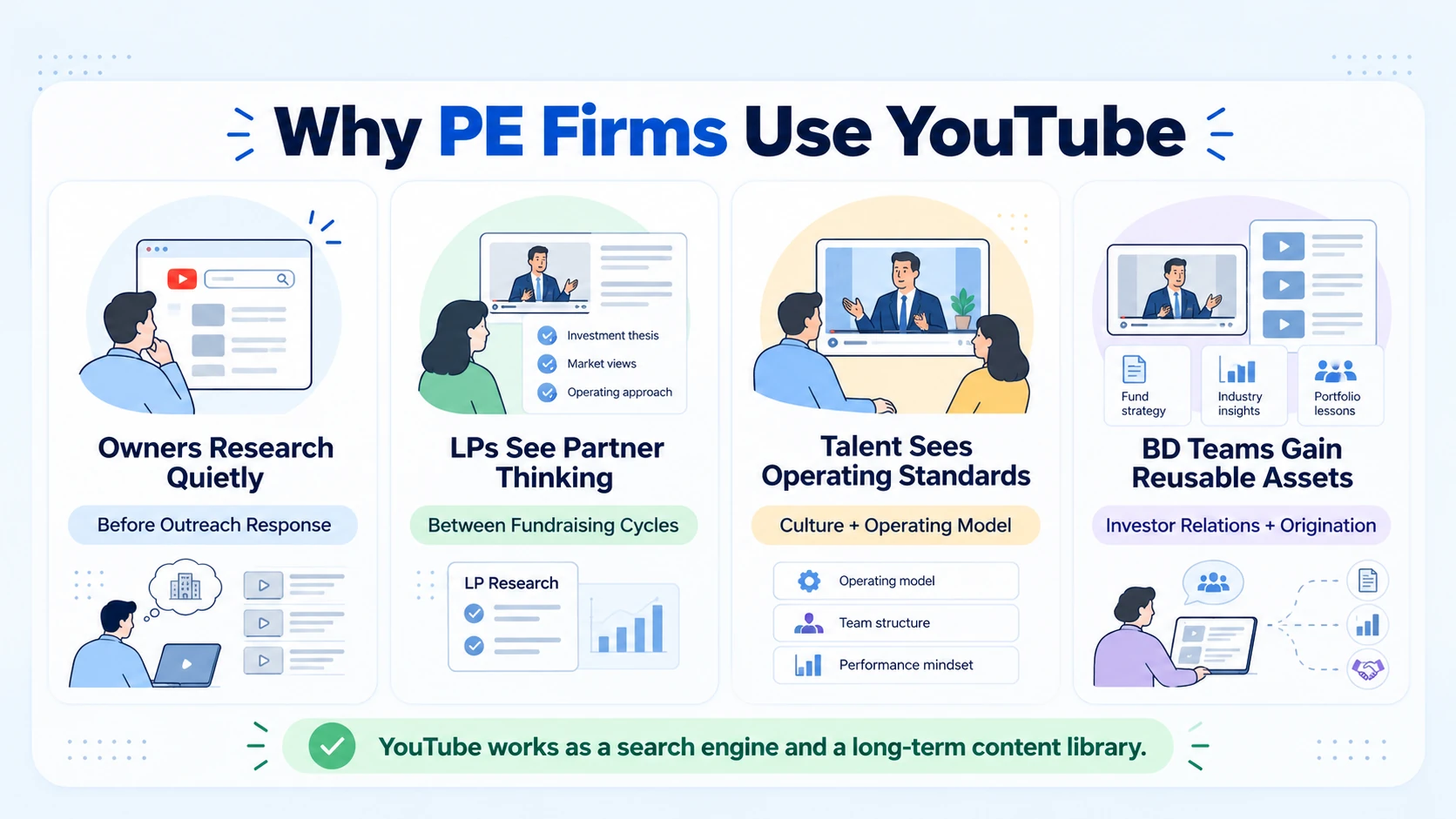
Gartner's research on complex B2B purchases found that buyers spend only about 17% of their purchase time meeting suppliers. That study covers technology and services purchases, not private equity deal sourcing, so I use it as an analogy. Senior decision-makers research quietly before they take a meeting, and a library of clear, credible video is one place they do it.
The audience's habits are changing too. Edison Research's Podcast Consumer 2026 study reports that 37% of weekly podcast consumers name YouTube as the service they use most for podcasts. If your firm records conversations with operators or founders, YouTube is where a large share of that audience listens and watches.
Here is what a channel can do for a firm:
- Give owners of potential targets a way to judge your approach before they respond to outreach.
- Give LPs a view into partner thinking between fundraising cycles.
- Give recruits and operating partners a sense of culture and standards.
- Create reusable assets for investor relations and business development teams.
The Three Audiences and What Each Wants
Do not try to serve everyone with one video. Decide which audience a video is for before you write the brief.
My own preference is to start with owners of target businesses, because it ties most directly to origination. LP-facing content usually needs the tightest review, so I add it second.
Compliance First: Build Review Into the Workflow
This part is not optional, and it is not my area of legal expertise. Advisers registered with the SEC are subject to the Marketing Rule under the Investment Advisers Act. A summary of the adopting release notes that, depending on the facts, social media postings by an associated person could be treated as the adviser marketing its services. Testimonials, endorsements, and performance references carry specific conditions.
I am not a lawyer, and your obligations depend on your registration status and structure. What I can say from a production standpoint is how to make review easy:
- Share the brief and outline with compliance before recording.
- Avoid performance figures, return claims, and portfolio results in unscripted conversation unless approved.
- Keep a record of approved versions and final captions.
- Remember that captions, thumbnails, and descriptions are also published content.
- Agree in advance which partners may speak on which topics.
A workable YouTube strategy for private equity builds this into the calendar. When compliance review takes three days, schedule recording at least a week before the target publish date.
Formats That Fit a Private Equity Channel
For firms that already host a podcast, the podcast repurposing playbook for private equity explains how to turn each episode into several assets, and the guide to podcast editing for private equity covers what to expect from the edit.
Set Up the Channel in Seven Steps
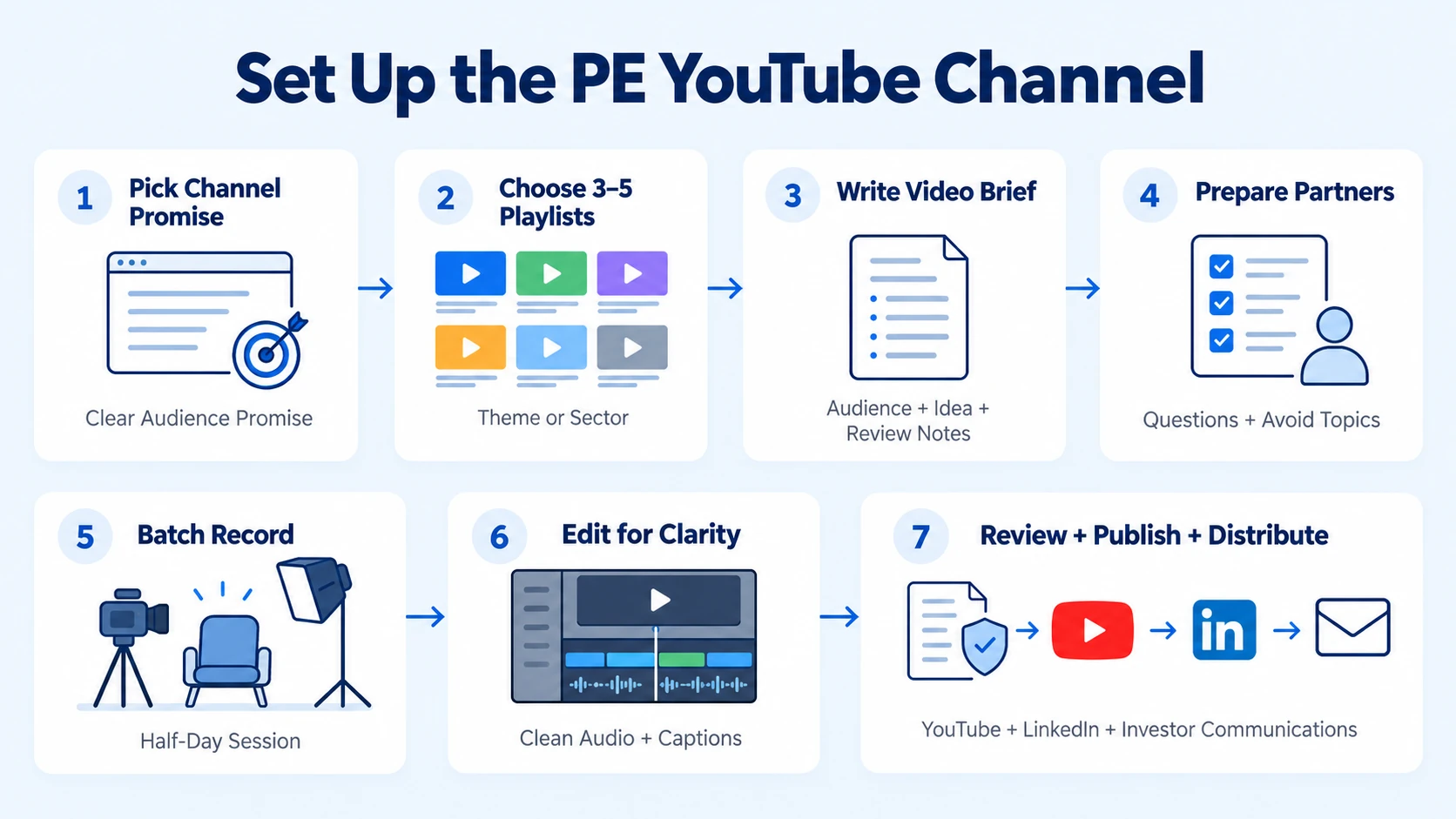
- Pick a clear channel promise. For example: "How operators and owners think about growth, transitions, and partnership."
- Choose a limited playlist structure. Three to five playlists by theme or sector are enough. Playlists help viewers binge related videos.
- Write a short brief for each video. Name the audience, the single idea, and the compliance considerations.
- Prepare partners before recording. Share questions in advance and agree on topics to avoid.
- Record in batches. A half-day session can yield several videos with a consistent look. Our pre-production checklist for founder videos works for partners as well.
- Edit for clarity, not flash. Clean audio, clear captions, restrained graphics. The standard should feel institutional.
- Review, publish, and distribute. Post on YouTube, then share excerpts on LinkedIn and in investor communications where appropriate.
How to Brief a Partner Video
Partners are busy and often unsure what a good video brief looks like. I use a one-page format so the conversation stays focused and the edit has a clear target.
Three habits help partners on camera:
- Share the questions a few days ahead, but do not script every line. Natural answers hold attention better.
- Ask for one real example per answer, described without confidential detail.
- Stop recording when the point is made. A tight six-minute answer beats a rambling fifteen-minute one.
In my experience, the strongest partner videos sound like a good conversation with a thoughtful peer. They do not sound like a pitch deck read aloud. Our overview of video editing for private equity explains how we shape raw footage into that kind of clarity.
Package for Search Without Losing the Tone
Titles on YouTube are read as questions. I would write for the owner who is typing a problem into search, not for a peer firm.
For more on search mechanics, see YouTube SEO basics for B2B channels and our notes on thumbnails that earn clicks.
Use Shorts as an Introduction, Not the Main Product
Shorts can be useful for introducing a partner or an idea to people who would not search for it. YouTube's help page confirms that vertical or square uploads up to three minutes are categorised as Shorts. That gives you room for a complete answer to a single question.
I treat Shorts for PE as short excerpts of a longer, reviewed video. That keeps the compliance process simple, because the source material has already been approved. Our overview of YouTube Shorts strategy for B2B brands covers hooks and cadence in more detail.
A 90-Day Plan
After 90 days, review which videos prompted conversations with owners or advisors. Retire what did not.
Measure What Matters to a PE Firm
Views are a weak measure for a firm whose audience is small and senior. I prefer a short list of signals:
- Search visibility: are your videos appearing for topic queries relevant to your sectors?
- Watch behaviour: average view duration and returning viewers in YouTube Studio.
- Inbound references: how many first conversations with owners or advisors mention a video?
- Internal use: do partners send videos before or after meetings?
- Talent signals: do candidates refer to the channel in interviews?
Attribution will be imperfect, so ask directly. Our guide to attribution for video and podcast content explains how to combine imperfect signals. For a view of how firms use video to build inbound interest, read how private equity firms use video to build inbound pipelines.
Common Mistakes
Most weak channels fail for avoidable reasons, and a YouTube strategy for private equity is no exception:
- Publishing polished brand films with no clear audience.
- Letting every partner have a different on-camera style and set.
- Using the channel for fundraising language rather than education.
- Skipping compliance until the edit is finished.
- Treating the channel as a one-time project instead of a library.
- Ignoring portfolio founders, who are often your best storytellers.
Who Should Produce It
Most firms do not need a full in-house studio to run a YouTube strategy for private equity. They need a dependable partner who understands the tone and the review process. The options are an internal marketing hire, a boutique production company, or an ongoing partner who handles full end-to-end production, creation from scratch, editing, packaging, and distribution.
Komet Media works with private equity and venture firms on full end-to-end video production from scratch, video editing for private equity, YouTube video editing, and podcast production. For firms in the New York area, we also support full video creation from scratch, video editing services in New York, and podcast editing in New York. Our typical retainers sit around $2,500 to $5,000, shaped by volume, production difficulty, turnaround, and distribution needs. That is a working range, not a fixed package.
Conclusion
A YouTube strategy for private equity is a long game built on clarity, consistency, and care. It works when the firm decides who it is speaking to, produces a few repeatable formats, and treats compliance as part of the workflow, not an obstacle at the end. Editing creates the asset. Consistent distribution gives it a chance to support origination, LP trust, and recruiting. If you want to talk through what a sustainable cadence looks like for your firm, you can book a call.
FAQ
What is a YouTube strategy for private equity?
It is a plan for using YouTube to share a firm's expertise with owners, intermediaries, LPs, and talent. It covers audience, formats, compliance review, publishing rhythm, and measurement. The aim is credibility and inbound conversations.
How much does a private equity YouTube channel cost to run?
Cost depends on volume, production difficulty, and whether you need strategy and distribution support. Komet Media's typical retainers are around $2,500 to $5,000. In-house hires and project-based productions price differently, so compare scope and not only fees.
How often should a PE firm publish videos?
Two to four long videos a month plus short excerpts is a reasonable start. Choose a rhythm the partners can sustain, since consistency matters more than volume. See our YouTube posting cadence guide.
How long before the channel produces results?
Plan for at least a quarter before you judge. Search visibility and warm inbound references usually appear gradually. Review signals monthly and adjust.
What deliverables should a video partner provide?
Full end-to-end production from scratch, edited long videos, short excerpts, captions, thumbnails, and consistent branding. A good partner also supports concepts, scripts, briefs, review workflows, and distribution to LinkedIn and email.
Should we use a freelancer or an agency?
A freelancer can work for a small number of videos with clear direction. An ongoing agency partner suits firms that need consistency, backup, and repurposing. Compare the two in our guide to freelancer vs agency for B2B.
Can a PE firm run this without hiring a video team?
Yes, a YouTube strategy for private equity can run lean. Many firms rely on one internal owner, one or two partners on camera, and an external editing partner. Build compliance review into the plan from day one.
Does Komet Media work with private equity firms?
Yes. We work with private equity and venture firms on full end-to-end creation from scratch, editing, repurposing, and distribution. Compliance review remains the firm's responsibility, and we build our delivery schedule around it.