
🪄 AI Summary
Heading 1
Heading 2
Heading 3
Heading 4
Heading 5
Heading 6
Lorem ipsum dolor sit amet, consectetur adipiscing elit, sed do eiusmod tempor incididunt ut labore et dolore magna aliqua. Ut enim ad minim veniam, quis nostrud exercitation ullamco laboris nisi ut aliquip ex ea commodo consequat. Duis aute irure dolor in reprehenderit in voluptate velit esse cillum dolore eu fugiat nulla pariatur.
Block quote
Ordered list
- Item 1
- Item 2
- Item 3
Unordered list
- Item A
- Item B
- Item C
Bold text
Emphasis
Superscript
Subscript
Most B2B teams upload a video, cross their fingers, and wonder why it gets 47 views. The answer is almost always the same: no strategy behind the metadata, no understanding of how the YouTube algorithm evaluates relevance, and no system for turning one video into compounding search traffic. This guide covers YouTube SEO basics for B2B channels from the ground up, keyword research, metadata optimization, engagement signals, tools, and the content repurposing moves that separate channels that grow from ones that stall.
TL;DR
- YouTube SEO for B2B is a compound traffic strategy, not a one-time upload task
- Title, description, audience retention, and topical authority are the four pillars that determine ranking
- YouTube ranks as one of the top social media marketing channels for B2B in 2025, your buyers are already there
- Optimize every video on upload, then repurpose transcripts and clips to reinforce your topical authority across channels
Why YouTube SEO Basics for B2B Channels Are Different From B2C
B2C YouTube is built on discovery, a viewer stumbles onto a video about espresso machines, gets hooked, subscribes. B2B YouTube is built on search intent and trust. Your buyer is not browsing. They are actively researching a problem they need to solve before a committee meeting. That distinction changes everything about how you approach YouTube SEO basics for B2B channels.
70% of B2B buyers report watching videos throughout their sales journey. They are not just watching at the awareness stage, they are watching demo breakdowns, comparison videos, founder interviews, and customer success stories all the way through to a purchase decision. That means your channel needs to cover the full buyer journey with dedicated content, not just top-of-funnel explainers.
71% of B2B research starts with a generic query before transitioning to branded queries. This is critical for your keyword strategy. Your future customer types "how to automate sales outreach" before they ever type your product name. If you own that generic keyword on YouTube, you are the brand they encounter first. That is the awareness-to-pipeline flywheel that founder-led B2B channels are built on.
The other distinction: B2B audiences have longer consideration cycles. A B2C buyer watches a three-minute review and clicks to buy. A B2B buyer watches your founder explain a workflow, bookmarks the video, shares it with their team, and comes back two weeks later. Viewer satisfaction has replaced raw watch time as the primary ranking signal in 2026, which actually favors B2B content, a buyer who watches 80% of your 12-minute product walkthrough sends a stronger positive signal than someone who abandons a viral B2C video at the 30-second mark.
The practical implication: stop optimizing for volume. Optimize for the right buyer finding the right video at the right point in their journey.
How to Do Keyword Research for B2B YouTube Channels
Keyword research for B2B YouTube is different from Google keyword research. Volume is secondary. Buyer intent is primary. Start inside YouTube itself. Type your topic into the YouTube search bar and collect the autocomplete suggestions, these represent real queries real people are typing right now. For a SaaS product, that might look like "how to [category problem]," "best [category] tool for [use case]," or "[competitor] alternative." Every autocomplete result is a potential video. Reliable tools include VidIQ, TubeBuddy, Ahrefs, SEMrush, Google Trends, and YouTube's own autocomplete feature for identifying high-potential keyword opportunities.
Here is how the primary tools compare for B2B keyword research:
TubeBuddy is built as an optimization engine, it helps you make the most of the content you are creating. VidIQ leans more toward ideation, helping you figure out what to make in the first place.
For B2B SaaS teams, the keyword research process looks like this:
- List your core product use cases and pain points
- Type each one into YouTube autocomplete and collect 10-15 suggestions
- Run those terms through VidIQ or TubeBuddy to check search volume and competition
- Prioritize terms with clear buyer intent over high-volume generic terms
- Build a 90-day content calendar around clusters of related terms, not individual keywords
Target keywords where competition is manageable and intent is specific. "CRM for remote sales teams" beats "CRM" every time for pipeline-focused B2B channels.
At Komet Media, every video we produce for B2B clients—whether created from scratch or repurposed—starts with this keyword mapping step. You cannot optimize what you have not planned for.
How to Write YouTube Titles and Descriptions for B2B Audiences
Your title is the single most important piece of video metadata optimization you control. Video titles serve as the primary signal for YouTube's algorithm to understand content relevance and user intent. For B2B titles, lead with the problem, not the solution. "How to Cut SaaS Onboarding Time by 40%" outperforms "Our New Onboarding Feature Walkthrough", even if both videos cover the same ground. The first speaks to a buyer's search intent. The second speaks to your internal roadmap.
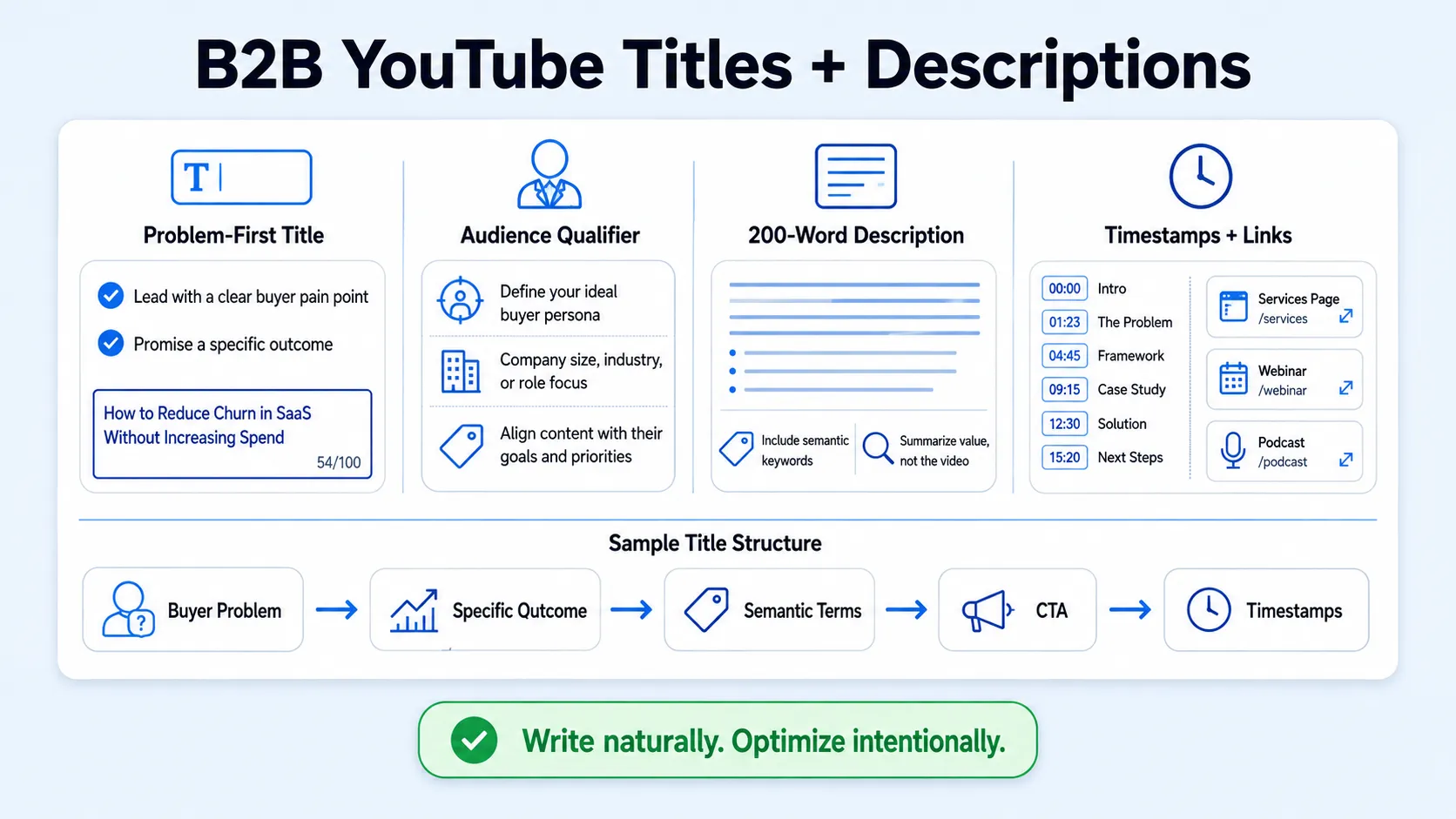
Title formula that works for B2B:
- [Problem-first or outcome-first framing]
- [Specific audience qualifier, if relevant]
- [Power word or number where it fits naturally]
For descriptions, write for two audiences simultaneously: the YouTube algorithm and your buyer. Video descriptions around 200 words, with strategic keyword placement in titles, consistently perform best in search rankings.
Structure your descriptions like this:
- First 2-3 sentences: repeat the core keyword naturally, summarize the video's exact value
- Middle section: include 3-5 related semantic terms your buyer would recognize
- Call to action: link to your services page, a related webinar, or your podcast for further education
- Final section: timestamps and any relevant links
Tags still exist but carry minimal algorithmic weight in 2026. Long descriptions with keyword variations used to drive organic search. Today the algorithm reads context and ignores keyword stuffing.
Write naturally. Optimize intentionally.
The Most Important YouTube SEO Ranking Factors for B2B Video Content
The most important YouTube SEO factors center around audience engagement signals, optimized video content structure, and strategic keyword implementation. For B2B channels specifically, four signals matter most.
Click-Through Rate (CTR): Your thumbnail and title together determine whether a buyer clicks. A high CTR tells the YouTube algorithm that your video matches what searchers want. Custom thumbnails, closed captions, and video lengths between 8-9 minutes consistently perform best in search rankings. For B2B, your thumbnail should show a human face or a clear text overlay stating the specific outcome, not a stock graphic.
Audience Retention: Audience retention is the single strongest signal YouTube uses for ranking and recommendation. Strong retention varies by length: 65-75% for videos under 5 minutes, 50-60% for 5-10 minutes, 40-50% for 10-15 minutes, and 35-45% for videos over 15 minutes. Educational how-to content, which is the core B2B format, tends to hold viewers well through the first half of a video.
Topical Authority: The algorithm now reads your entire channel as a knowledge graph. A channel with 20 videos all on B2B growth ranks better for each individual keyword than a channel with 20 videos on 20 different topics. Niche depth beats breadth. Every time.
Session Contribution: Session contribution, how much your video extends the average YouTube session, is now the leading signal for long-form ranking, which is why playlists and series formats outperform single-shot uploads. Build playlists around buyer journey stages and link between related videos with end screens. YouTube videos that rank in the top three search positions have a significantly higher average engagement rate of 2.65%.
Use YouTube Studio to monitor your retention curves weekly and identify the exact timestamps where viewers drop off, then restructure your scripts around those moments.
Closed Captions, Transcripts, and Metadata That B2B Channels Ignore
Most B2B teams skip this entirely. It is a significant missed opportunity. Search engines cannot watch videos, but they can read captions and transcripts. Adding closed captions makes your video content discoverable and helps you rank for relevant searches. YouTube videos with captions experience 7.32% more engagement than those without. This engagement signals to search engines the value of the content, which can contribute to improved rankings.
For B2B SaaS content specifically, captions carry additional weight because your product has proprietary terminology, specific use case language, and industry vocabulary that buyers actually search for. When those terms appear in your captions and video transcripts, they become indexable metadata that supports semantic search and helps YouTube connect your video to the right query.
The metadata checklist for every B2B YouTube upload:
- Title: Primary keyword in the first 60 characters, outcome-first framing
- Description: 150-200 words minimum, keyword in first sentence, timestamps, related links
- Closed captions: Human-reviewed, not raw auto-generated (inaccurate captions can actively harm credibility)
- End screens: Link to a related video or playlist relevant to the next buyer journey stage
- Cards: Deploy at the 20% and 60% timestamps to reduce drop-off
- Playlist assignment: Every video lives inside at least one thematic playlist
A key component of a YouTube SEO strategy is harnessing the power of your video's text in the form of transcripts, closed captions, subtitles, and dubs.
At Komet Media, we build caption and transcript workflows into every production cycle, not as an afterthought, but as a core SEO deliverable. These same transcripts then feed podcast show notes, blog posts, and LinkedIn content through a content repurposing system.
How to Build Topical Authority and Rank B2B YouTube Videos Higher Over Time
One great video rarely ranks long-term without channel authority behind it. YouTube SEO basics for B2B channels means building a system, not optimizing individual uploads. Topical authority on YouTube works the same way it does on Google. The YouTube algorithm evaluates your channel's entire content history to determine how authoritative you are on a given subject. Building channel authority through regular publishing, community engagement, and strategic optimization creates sustainable competitive advantages in YouTube's evolving landscape.
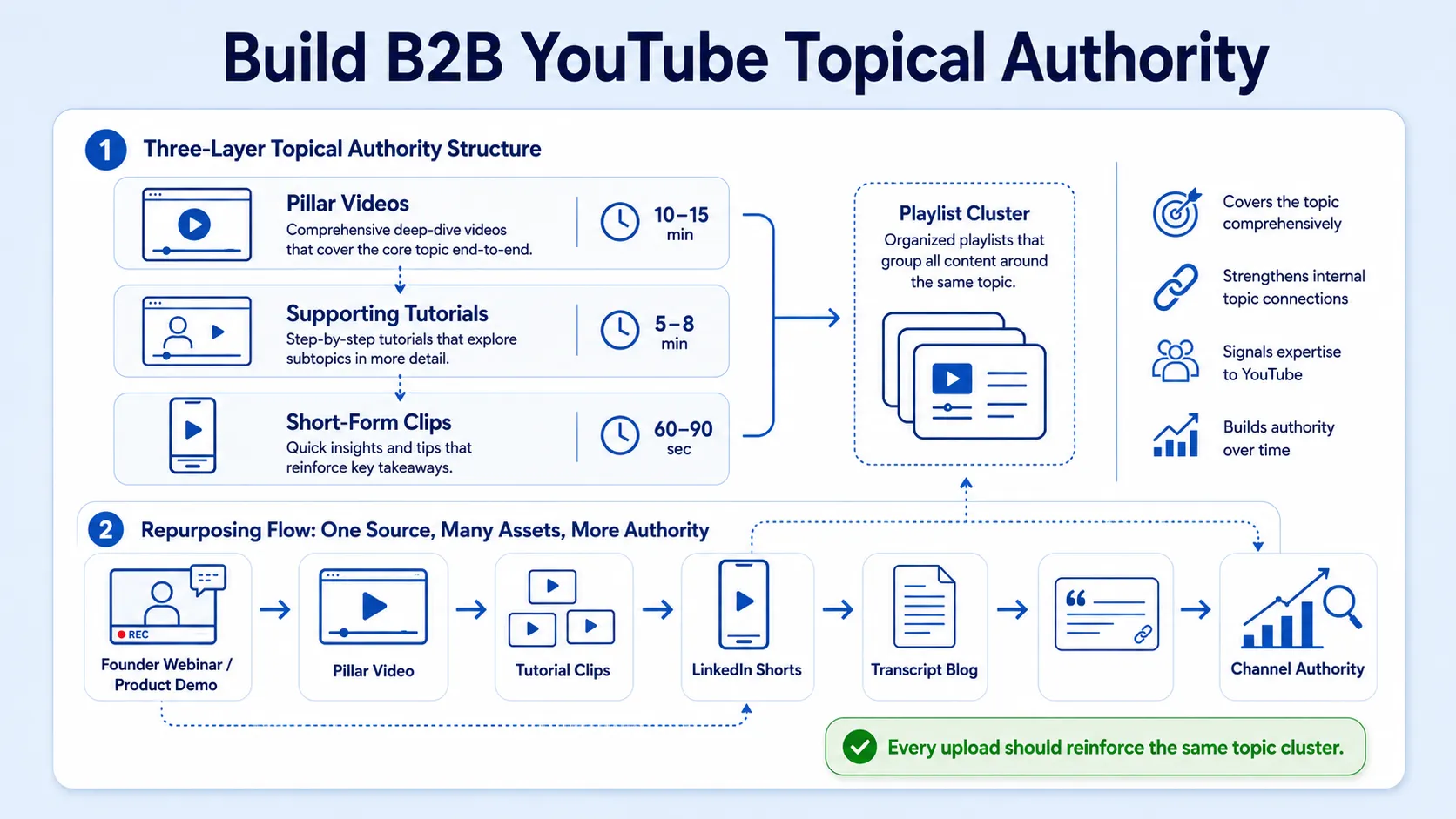
For B2B SaaS and funded tech teams, this translates to a specific content architecture:
- Pillar videos: 10-15 minute deep dives on core use cases (these anchor your topical authority)
- Supporting videos: 5-8 minute tutorials, FAQs, and specific feature walkthroughs (these capture long-tail keywords)
- Short-form clips: 60-90 second cuts from pillar content distributed on LinkedIn and YouTube Shorts (these drive impressions and surface new audiences)
This is where content repurposing becomes a force multiplier. A single founder webinar or product demo becomes a pillar video, three supporting clips, LinkedIn short-form posts, a podcast episode, and a transcript-driven blog post, all pointing back to the same channel and reinforcing the same topical cluster. ChatGPT, Claude, and Perplexity now cite YouTube transcripts in their answers. Videos that get cited in AI search responses see 20 to 40 percent more YouTube impressions, which then feeds back into ranking.
This is the newest B2B flywheel: optimize your transcripts for semantic search and AI citation, and you capture impressions from both YouTube search and AI-powered discovery simultaneously. The publishing cadence that works for most B2B teams is one pillar video per week, two to three short-form clips, and one playlist update. Consistency matters more than frequency. The algorithm considers video freshness, channel authority, and historical performance when making ranking decisions.
Connect your YouTube video editing and your short-form video editing into one production workflow. When both formats feed the same topical cluster, every upload compounds the authority of every other video on the channel.
Conclusion
YouTube SEO basics for B2B channels come down to four consistent actions:
- Research before you record: map every video to a buyer intent keyword before a single frame is shot
- Optimize on upload: title, description, captions, and playlist placement are non-negotiable for every video
- Build topical depth: 20 videos on one niche outrank 20 videos on 20 topics, every time
- Repurpose relentlessly: your transcripts, clips, and short-form assets compound your channel's authority across platforms
YouTube is not a social media channel for B2B teams. It is a search engine that your buyers use to evaluate whether to trust you before they ever book a demo. Treat it accordingly.
Want to turn your existing webinars, podcasts, and demos into a B2B video system, or create high-impact original content from scratch? Komet Media provides both video production and content repurposing to drive your pipeline. Talk to us here.
Frequently Asked Questions
Q1: What is YouTube SEO and why does it matter for B2B companies?
YouTube SEO is the practice of optimizing your videos, channel, and metadata so they appear in YouTube and Google search results for relevant queries. For B2B companies, it matters because your buyers actively search YouTube during their evaluation process, a well-optimized channel puts your product in front of buyers before they ever visit your website.
Q2: How long does it take for YouTube SEO to show results for a B2B channel?
Most B2B channels see measurable search impression growth within 60-90 days of consistent, optimized publishing. Ranking on competitive keywords typically takes four to six months of building topical authority through a cluster of related videos, not a single optimized upload.
Q3: What is the best video length for B2B YouTube content?
For B2B, 8-12 minutes tends to perform best, long enough to demonstrate credibility and cover a topic thoroughly, short enough to hold a busy buyer's attention. Educational how-to content averages strong retention in this range, which feeds directly into YouTube's ranking signals.
Q4: Does YouTube SEO also help B2B videos rank on Google?
Yes. Google regularly surfaces YouTube videos in its search results, especially for how-to and tutorial queries. Optimizing your video metadata, closed captions, and transcripts improves your visibility in both YouTube search and Google's video results, two search engines for the price of one optimization pass.
Q5: Should B2B teams use TubeBuddy or VidIQ for YouTube SEO?
Both tools serve different needs. TubeBuddy is better for optimizing videos during the upload workflow, with keyword research embedded directly inside YouTube Studio. VidIQ is stronger for content ideation and competitive keyword analysis. Most serious B2B channels use both.
Q6: How does content repurposing connect to YouTube SEO for B2B channels?
Repurposing long-form content, webinars, podcasts, demos, into YouTube videos feeds your topical authority faster than creating from scratch. Each video reinforces the same semantic cluster, each transcript adds indexable text, and each short-form clip drives additional impressions. It is the most efficient B2B video growth system available.