
🪄 AI Summary
Heading 1
Heading 2
Heading 3
Heading 4
Heading 5
Heading 6
Lorem ipsum dolor sit amet, consectetur adipiscing elit, sed do eiusmod tempor incididunt ut labore et dolore magna aliqua. Ut enim ad minim veniam, quis nostrud exercitation ullamco laboris nisi ut aliquip ex ea commodo consequat. Duis aute irure dolor in reprehenderit in voluptate velit esse cillum dolore eu fugiat nulla pariatur.
Block quote
Ordered list
- Item 1
- Item 2
- Item 3
Unordered list
- Item A
- Item B
- Item C
Bold text
Emphasis
Superscript
Subscript
Your buyers are drowning in content. Every scroll through LinkedIn, every inbox, every webinar invite competes for the same finite resource: attention. The attention economy and B2B video are now inseparable topics for any founder, marketing head, or growth team serious about the pipeline. For B2B SaaS brands, AI-native companies, and funded tech startups, Komet Media delivers a complete video system—offering full end-to-end video production from scratch (including strategy, scripting, filming, and creation) alongside advanced repurposing and editing—designed to capture attention and convert interest into pipeline. This guide breaks down exactly what the attention economy means for your video strategy, why B2B buyers are harder to reach than ever, and how to build scroll-stopping creative that earns trust and drives demand. No fluff. Just what works.
TL;DR
- Attention is now the scarce resource in B2B marketing, making specialized video systems essential for B2B SaaS, AI, and tech startup growth.
- 70% of B2B buyers watch video during their purchasing journey, making video the default language of the buyer.
- Short, specific, and platform-native video wins. Generic content loses budget.
- Full end-to-end production from scratch as well as content repurposing from webinars, podcasts, and demos via Komet Media provides maximum leverage for B2B tech teams.
What Is the Attention Economy in B2B Marketing?
The concept predates digital marketing by decades. Nobel laureate Herbert Simon laid the groundwork in 1971 when he wrote that "in an information-rich world, the wealth of information means a dearth of something else: a scarcity of whatever it is that information consumes. What information consumes is rather obvious: it consumes the attention of its recipients. Hence a wealth of information creates a poverty of attention."
That insight is the foundation of the attention economy. In practice, it means that when supply of content explodes, the value of any single piece collapses unless it earns the right to be noticed. For B2B marketers, this is not an abstract idea. It is your budget problem, your pipeline problem, and your positioning problem all rolled into one. When the supply of artifacts grows faster than the capacity of users to evaluate and adopt them, competitive dynamics shift from production scarcity to attention scarcity, and realized outcomes become increasingly concentrated.
Translation: the teams that understand how attention works will capture a disproportionate share of buyer mindshare, regardless of how much competitors publish. The attention economy and B2B video intersect at a specific pressure point: decision-makers are not passive. They are actively filtering. Your content either gets through or it gets scrolled past. There is no middle ground. Cognitive load is real. When a VP of Marketing or a Head of Growth opens LinkedIn, they are processing job posts, vendor pitches, peer commentary, and industry news simultaneously. The creative that cuts through is not the loudest. It is the most relevant, the most specific, and the most immediately clear about what is in it for them.
For B2B SaaS and funded AI/tech startups in particular, the stakes are higher. Your product is often complex. Your buyer is sophisticated and skeptical. And your sales cycle is long. Komet Media helps these teams create original videos from scratch—handling strategy, scripting, and full production—while also turning existing technical demos, webinars, and founder insights into high-retention video assets that reduce cognitive load, demonstrate product value, and build the trust that eventually converts to a demo request.
Why B2B Buyers Are Harder to Reach with Video Than Ever Before
The volume problem is real and it is worsening. 89% of businesses now use video as a marketing tool, and 68% of those who don't plan to use it in 2025. Every one of those businesses is competing for the same buyer attention. More video supply with flat buyer attention capacity is a math problem that produces lower returns for undifferentiated content.
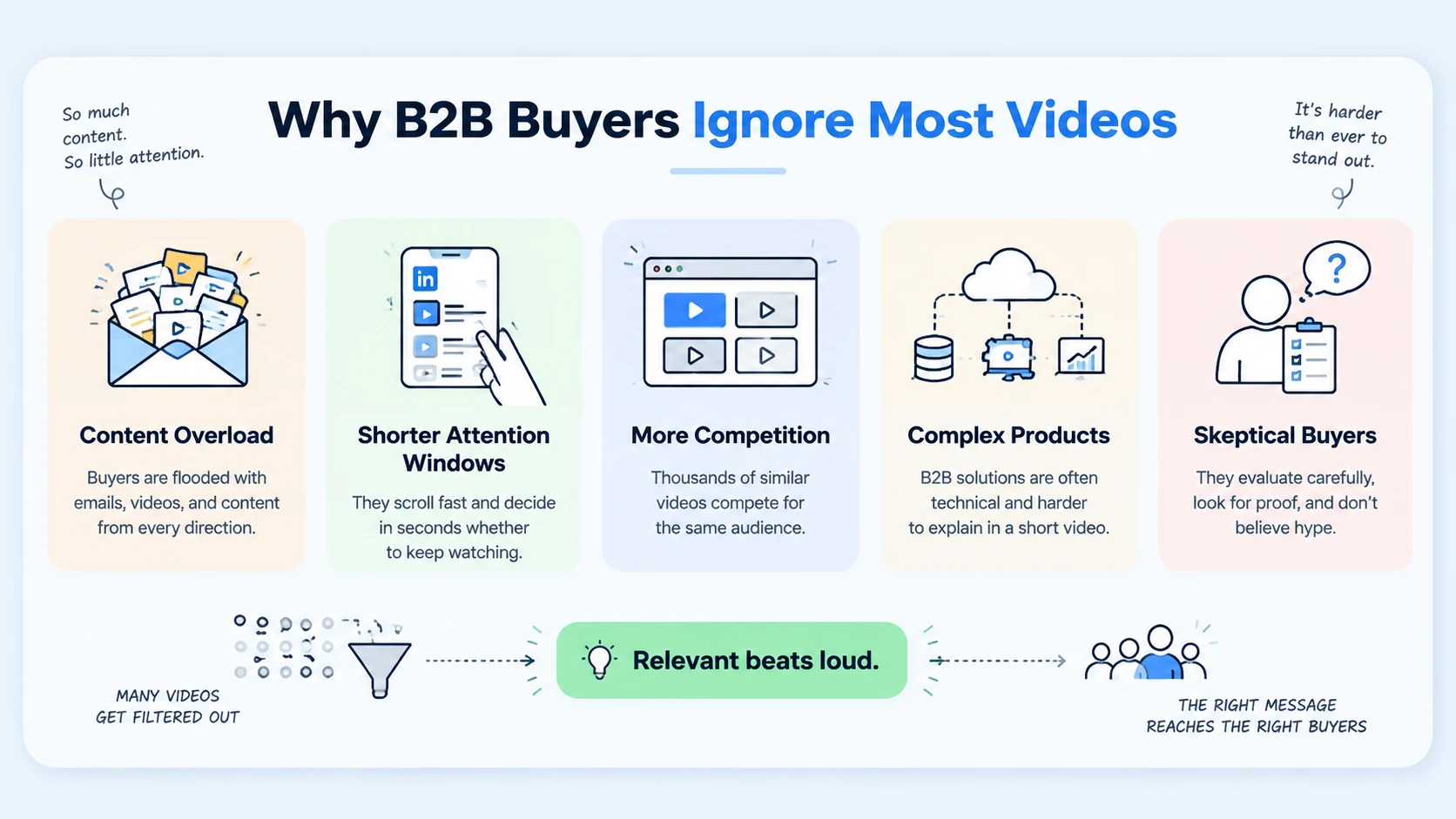
The 2026 B2B Trends Research Report reveals that static, one-dimensional assets are no longer sufficient to engage sophisticated buyers. To capture attention and drive conversions, marketers must embrace dynamic, interactive, and platform-native formats that meet audiences where they are. The buyer behavior data compounds this. The average length of B2B marketing videos consumed has decreased from 6 minutes in 2022 to 4 minutes and 15 seconds in 2025, showing that attention windows are shrinking even as content volume grows.
73% of B2B decision-makers prefer to watch product demo videos rather than read whitepapers or brochures, yet most SaaS teams still treat their demo as a sales-only asset locked behind a calendar invite. The platform dynamic adds another layer of difficulty. 82% of B2B marketers are now prioritizing short-form video content to engage prospects. Platforms like TikTok, Instagram Reels, and YouTube Shorts have conditioned buyers to expect concise, visually compelling, and easily digestible information.
B2B buyers do not switch off consumer behavior when they open a work browser. The same pattern recognition that scrolls past a slow Instagram Reel also scrolls past a slow product explainer. The attention economy punishes sameness. If your video looks, sounds, and structures itself like every other SaaS explainer, it will be processed and dismissed in under two seconds.
The buyers who matter most to you—founders evaluating platforms, VPs approving budget, growth leads comparing vendors—are the most time-scarce and therefore the most ruthless filters in your market. Komet Media’s end-to-end production, video editing, and growth services provide SaaS, AI, and startup teams with both original video assets and a consistent publishing cadence needed to cut through the noise. Understanding this is step one. Building for it with Komet Media is step two.
How the Attention Economy Shapes a Smarter B2B Video Strategy
The attention economy and B2B video strategy are not separate planning tracks. Attention constraints should directly determine what you make, how long it is, and where you put it.
The strategic framework has three layers:
- Platform-native first: Create video in the format native to where your buyer actually spends time, not the format easiest to produce.
- Repurpose ruthlessly: A single webinar, podcast episode, or founder interview contains 8 to 15 short-form clips. Surface them on LinkedIn, YouTube Shorts, and in sales sequences.
- Stage-specific positioning: Map video type to funnel position. Awareness needs education. Consideration needs specifics. Decisions need proof.
Videos used at the awareness stage generate 31% more leads than blog posts or whitepapers. That is not a marginal difference. That is a structural advantage for teams willing to prioritize video at the top of the funnel.
At Komet Media, I see this play out repeatedly with SaaS, AI, and tech startup teams. Whether producing original videos from scratch or extracting short-form assets from long-form content, strategic video drives pipeline. Your webinars, podcasts, product demos, and events contain rich insights, and Komet Media’s end-to-end B2B video services—covering strategy, creation, editing, and repurposing—unlock these assets without adding internal production overhead.
A substantial piece of cornerstone content, like a research report or in-depth webinar, serves as the hub, then atomized into various spokes, short videos, infographics, social media posts, and articles, that drive traffic back to the core asset from multiple channels. This is how you produce volume without burning out your team.
Best Practices for B2B Video Marketing in the Attention Economy
The attention economy and B2B video best practices overlap almost entirely. Both demand speed, specificity, and a clear value exchange in the first three seconds.
Hook architecture: Lead with the problem or the outcome. Never lead with your company name or product category. A buyer scrolling through LinkedIn does not stop for "Hi, we're [Company Name] and we help B2B teams..." They stop for "Your demo is not converting because buyers don't understand what they're looking at in the first 60 seconds."
Format by platform:
Videos under 30 seconds show 200% higher completion rates compared to longer formats on LinkedIn, though educational content between 60 and 90 seconds also performs well. Native LinkedIn videos (uploaded directly rather than linked) outperform YouTube links by 5x, making native uploads essential for LinkedIn strategy.
Subtitles are not optional: Videos with subtitles see a 28% higher completion rate among B2B audiences compared to videos without subtitles. Most LinkedIn videos are watched on mute. If your message requires audio, it is losing most of its audience before your hook lands.
Social proof integration: Videos featuring customer testimonials see 31% higher engagement compared to standard product videos. Replace feature explanations with outcome stories. Buyers trust buyers more than they trust vendors.
Quality signals trust: 89% of consumers say video quality affects brand trust. For B2B brands where credibility closes deals, low-quality video actively damages trust.
This is where production consistency and strategy pay dividends. Komet Media’s full end-to-end production, short-form video editing, and video marketing services are custom-built for B2B SaaS, AI-native companies, and funded tech startups to create original videos from scratch and maintain consistent, high-retention video output without the hassle of hiring in-house.
How Long Should B2B Marketing Videos Be to Hold Attention?
This is the most common question I get from SaaS founders and marketing heads, and the answer is not a single number. It is a function of platform, funnel stage, and format. Viewer behavior changes based on format and runtime, especially in B2B environments where attention is limited and buyers are evaluating quickly. Videos under 60 seconds have the highest completion rates across all platforms. Engagement drops sharply after the 2-minute mark for most B2B audiences. Short-form videos (15–30 seconds) saw a 48% lift in click-through rate year over year. 52% of B2B buyers say they prefer concise videos that "get to the point quickly."
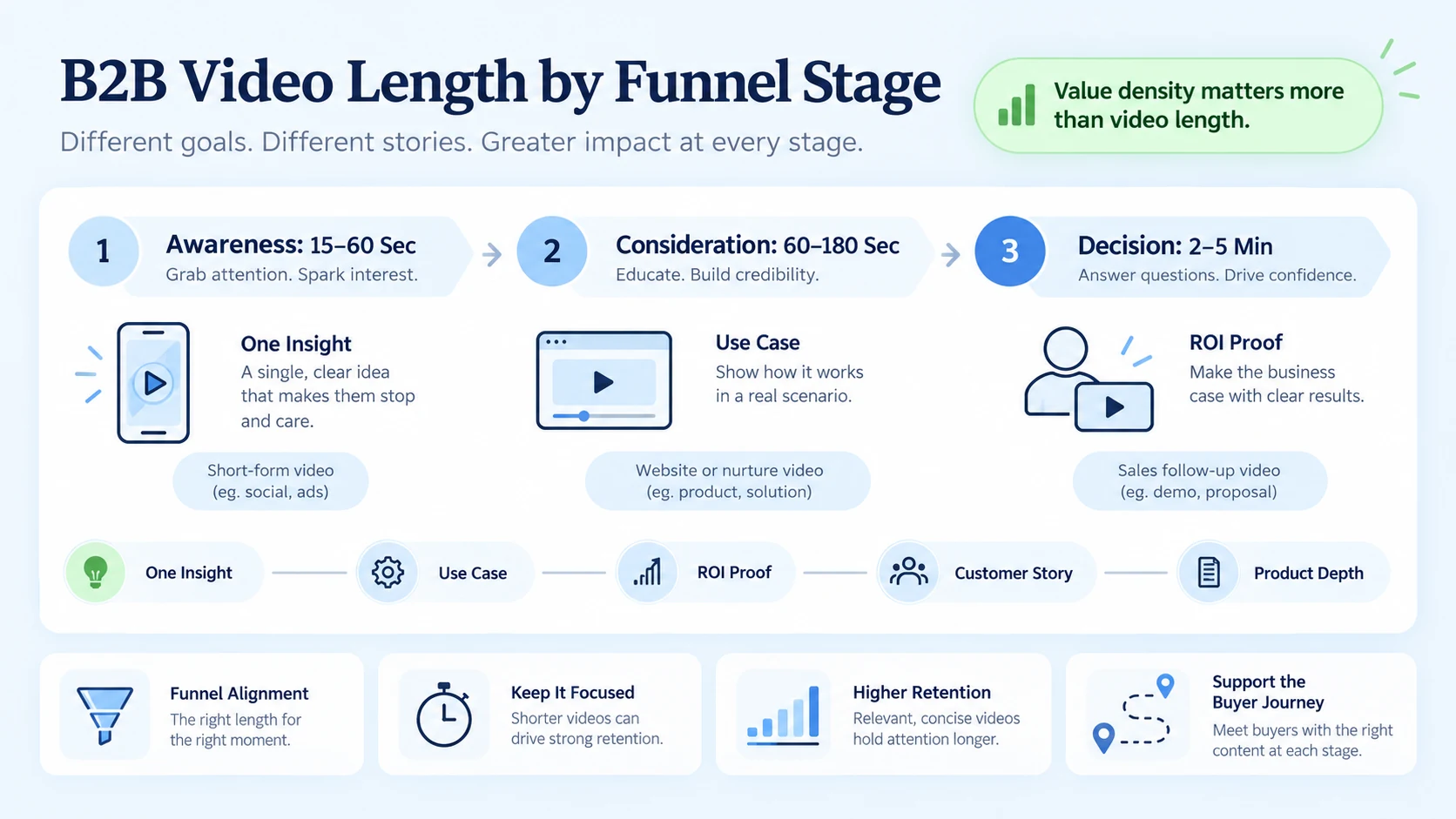
The practical framework by funnel stage:
- Awareness (LinkedIn, YouTube Shorts): 15–60 seconds. One idea. One insight. One CTA implied by the content itself.
- Consideration (website, email): 60–180 seconds. Specific feature benefit or use case. Buyer-role-specific framing.
- Decision (sales sequences, demo follow-up): 2–5 minutes. Product depth, ROI proof, customer story.
Viewers watch longer-form videos if there is legitimate value. The drop-off point for B2B-created video is at the moment the audience does not clearly see the value in the first 15–30 seconds of every video, rather than at the 10-minute mark.
This reframes the length debate entirely. Length is not the variable. Value density is the variable. A 90-second video produced from scratch or edited by Komet Media that delivers three specific technical or business insights will hold a decision-maker far longer than a 60-second video that says nothing concrete.
On average, explainer videos hold viewer attention for 3 minutes and 45 seconds, while product demos average 5 minutes and 20 seconds, suggesting that buyer tolerance scales with specificity and context.
What Types of B2B Videos Get the Most Engagement and Pipeline Impact?
Not all video formats earn equal returns. The attention economy and B2B video engagement data point to clear winners by goal. Webinars outperform all other formats for lead quality in B2B, with 69% of B2B marketers identifying webinars as their top-performing video type. But webinars only reach people who register. The short-form clips extracted from webinars reach everyone else.
By goal:
Personal profiles generate 8x more engagement than company pages on LinkedIn. Posts from individual profiles receive 8x the engagement of identical content from company pages. This gap is widening, not closing, and fundamentally reshapes how B2B organizations should allocate their LinkedIn content investment.
This is the core argument for founder-led growth video. When a founder or executive appears on camera with a direct, specific point of view, it activates a trust signal that no brand logo can replicate. Decision-stage videos that focus on ROI and pricing details see a 39% higher engagement rate than generic sales videos. Specificity is the differentiator at every stage.
Over 52% of B2B marketers cite video as the content type generating the highest ROI, and Wyzowl's 2026 report found that 83% of marketers report that video has directly increased sales. The returns are real. The question is whether your video is built to capture them. Komet Media’s full end-to-end video creation, video editing services, and content repurposing workflows are built specifically to help B2B SaaS, AI native companies, and funded tech startups extract pipeline value through both original content creation and repurposed assets.
Conclusion
The attention economy and B2B video are not a trend to monitor. They are the operating conditions your growth strategy must be built for in 2026.
Key takeaways:
- Attention is finite. Content volume is infinite. Specificity and relevance are the only filters that matter.
- B2B organizations using video report 27% higher marketing-qualified lead (MQL) rates than those that don't.
- Short-form extraction from existing long-form content is the highest-leverage, lowest-cost video strategy available to SaaS and AI/tech teams.
- Founder-led, platform-native video—supported by Komet Media’s end-to-end video production from scratch alongside repurposing—builds the trust that converts decision-makers into buyers.
Ready to build a video system around your pipeline goals? Talk to the Komet Media team.
Frequently Asked Questions
Q1: What is the attention economy, and why does it matter for B2B video?
The attention economy is the framework, first articulated by Herbert Simon, that treats human attention as a finite, scarce resource. For B2B SaaS, AI, and tech teams, it means every piece of content competes for limited buyer bandwidth. Partnering with a specialized B2B video agency like Komet Media—which provides end-to-end video production from scratch (including strategy, scripting, and creation) as well as editing and repurposing—ensures your videos are designed around these attention constraints to outshine competitors.
Q2: How does video help B2B buyers make decisions faster?
On average, B2B video content shortens the sales cycle by 23%. Video reduces cognitive load, demonstrates product value visually, and surfaces social proof in a format buyers actually consume. It replaces multiple back-and-forth email exchanges with a single, well-produced clip.
Q3: Which platforms should B2B SaaS teams prioritize for video in 2026?
LinkedIn has emerged as the dominant B2B video platform, with video engagement up 44% year over year and the platform now used by 70% of B2B video marketers. YouTube remains the go-to for long-form educational content and vendor research. Use both, with native uploads on LinkedIn for organic reach.
Q4: Does video quality actually affect B2B pipeline outcomes?
Yes. 89% of consumers say video quality affects brand trust, and for B2B tech brands where credibility closes deals, low-quality video actively damages trust. Komet Media applies a strict B2B editorial and production standard across all original video creation and editing—incorporating strategic scripting, branded overlays, motion graphics, and crisp captions—to protect brand authority and drive conversions.
Q5: What is the best way to repurpose long-form content into short-form video?
Start with your highest-performing webinars, podcast episodes, or recorded demos. Identify moments where a specific insight, a customer result, or a product capability is clearly explained in under 90 seconds. Clip, caption, reformat for the target platform, and distribute natively. One webinar can produce 8 to 15 usable clips.
Q6: How does founder-led video support B2B demand generation?
Personal profiles generate 8x more engagement than company pages on LinkedIn. Posts from individual profiles receive 8x the engagement of identical content from company pages. Komet Media helps SaaS founders and tech executives produce videos from scratch and package their authentic POV into high-performing video clips, building personal brands that earn organic reach and warm up pipeline before sales outreach begins.