
🪄 AI Summary
Heading 1
Heading 2
Heading 3
Heading 4
Heading 5
Heading 6
Lorem ipsum dolor sit amet, consectetur adipiscing elit, sed do eiusmod tempor incididunt ut labore et dolore magna aliqua. Ut enim ad minim veniam, quis nostrud exercitation ullamco laboris nisi ut aliquip ex ea commodo consequat. Duis aute irure dolor in reprehenderit in voluptate velit esse cillum dolore eu fugiat nulla pariatur.
Block quote
Ordered list
- Item 1
- Item 2
- Item 3
Unordered list
- Item A
- Item B
- Item C
Bold text
Emphasis
Superscript
Subscript
Most PE firms know video works. Few know how to use it strategically. Whether you're raising a new fund, updating LPs, or building brand authority with management teams and sellers, video editing for private equity is now a core communications function, not a nice-to-have. This guide covers every video type your firm needs, how to edit them properly, and how to turn existing content into a repeatable asset system that builds trust with the right capital partners before you ever get on a call.
TL;DR
- Video editing for private equity serves four distinct audiences: LPs, management teams, deal prospects, and the broader market.
- Editing decisions (pacing, captions, structure) directly affect how credible your firm looks to institutional investors.
- LinkedIn video is the highest-leverage distribution channel for PE firms in 2026.
- Komet Media produces video content both by repurposing existing recordings (like AGM footage and panels) and by building full custom productions from scratch (including scripting and recording guidance) for firms without an existing library.
How Private Equity Firms Actually Use Video Content
The PE industry has a trust problem that PDFs cannot solve. LPs, management teams, and potential sellers are all doing digital due diligence before they ever respond to an email. They're scanning LinkedIn, reading thought leadership articles, and expecting data-driven transparency before they consider a conversation. Video is the fastest format to close that gap.
The firms using video well are doing it across four use cases:
- LP communications: Quarterly update videos and AGM recap clips that convey performance context and management confidence without requiring an in-person meeting.
- Fund marketing and capital raise: Firm overview videos and GP intro clips that anchor the fundraising narrative in something more personal than a pitchbook.
- Deal sourcing: Short-form thought leadership that shows management teams and sellers what it looks like to work with your firm.
- Brand authority: LinkedIn content from partners and principals that builds visibility in target sectors over time.
The firms that get it right stop trying to make videos about themselves. The most effective video content in private equity is built around third-party validation, portfolio executives, founders, and management teams speaking to the firm's value-add, not the GP narrating its own track record. Most firms don't have a content problem. They have a content-capture problem. The expertise is already there.
Panel appearances, internal presentations, LP Q&As, and market commentary calls are all raw material. The editing work is structuring that material into something distributable. Video builds trust faster than photos and "About Us" blurbs. Yet, out of 284 capital providers attending DealMAX 2025, only 56 have video on their websites. That gap is a competitive opening.
What Kind of Videos Do Private Equity Firms Need?
Different audiences need different video formats. Here's how to think about the core video types:
Each of these offers a unique opportunity to connect with investors, potential sellers, and your broader network. The most neglected formats tend to be thought leadership clips and portfolio company stories, which are also the highest-leverage for deal flow and LP retention. Once created, video content can work everywhere: website, LP decks, deal emails, recruiting.
A single 3-minute portfolio company interview can be cut into a LinkedIn clip, a website hero asset, and an email attachment for an LP update, all from the same source recording. That's the repurposing logic that makes video economical for lean GP teams.
Video Editing for Investor Presentations and LP Updates
Editing investor-facing video is different from consumer content. The standard is institutional, not viral. Every editing choice sends a signal about how your firm operates. Here's how to approach it:
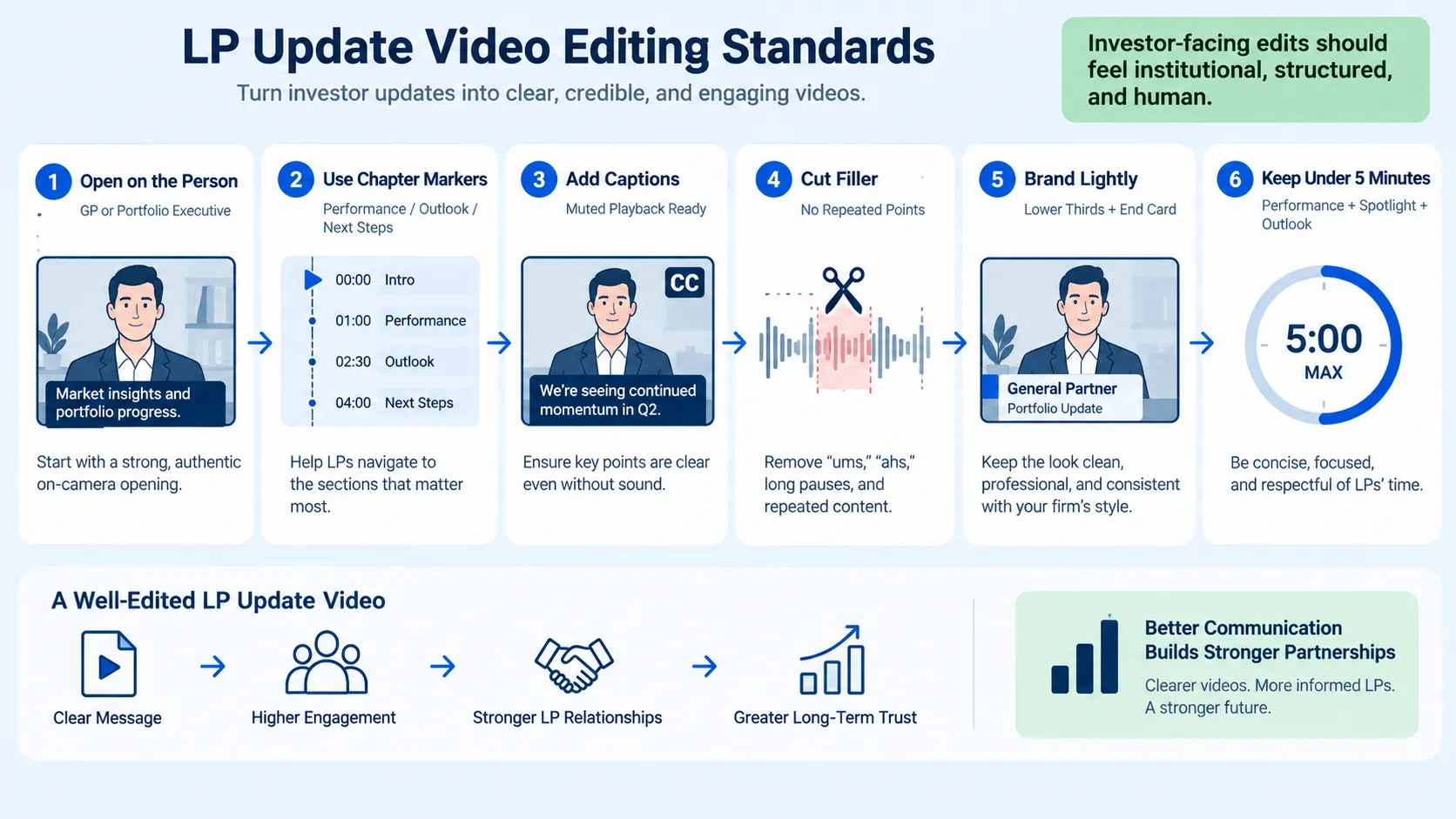
- Open on the person, not the logo: Institutional LPs respond to human faces and conviction, not animated intros. Start with the GP or portfolio executive speaking directly.
- Use chapter markers or title cards: For LP update videos over 2 minutes, add on-screen text markers that signal structure (Portfolio Performance, Market Outlook, Next Steps). LPs watch on muted playback in transit.
- Add captions unconditionally: Review videos for missing subtitles or inconsistent color grading. These are issues that can be fixed during editing to improve quality, no reshooting needed.
- Cut ruthlessly between points: PE decision-makers have zero tolerance for filler. If a speaker restates a point, cut the restatement.
- Brand without overdoing it: Lower-thirds with the speaker's name and title, a consistent color palette, and an end card with firm contact info. That's sufficient.
- Keep LP updates under 5 minutes: Structure them as performance summary, portfolio spotlight, and forward outlook. Anything longer should be a written quarterly letter, not a video.
In investor settings, investors evaluate more than fund performance. They evaluate organizational discipline. A well-structured presentation reinforces strategic clarity, performance transparency, and institutional control. The editing quality of your LP video directly shapes that perception.
For pitch videos specifically, an effective private equity narrative demonstrates its value through faster-moving first meetings, deeper follow-up conversations, and reduced need to re-explain the strategy. Later indicators include higher LP conversion rates and shorter diligence cycles. When the narrative lands, LPs often repeat the firm's positioning verbatim, which signals message stickiness.
What a Strong Private Equity Pitch Video Must Include
A pitch video is not a slide deck with a voiceover. It's a condensed version of the GP's conviction, track record, and differentiation, delivered in a way that earns a second meeting. Every strong PE pitch video contains these six components:
- The team: Faces, names, and why these specific people have the right to win in their sector. Credibility is established in the first 20 seconds.
- The thesis: One clear statement of what the firm believes that others don't. Investment thesis clarity is a primary driver of LP confidence.
- The edge: Proprietary deal flow, operational capabilities, or sector depth. Make it specific, not generic.
- The track record: One or two portfolio company outcomes told as a narrative, not a MOIC table. Context matters more than the multiple alone.
- The ask: Fund size, target close, and what the LP relationship looks like. Vagueness here kills conversion.
- The close: A single, clear next step, a deck, a data room link, or a meeting request.
LP panels reviewing private equity fund pitches see 400+ decks every year and eventually invest in only 10. That's a 40:1 success ratio. Video gives you a medium where differentiation is visible, not just claimed. A GP who communicates clearly on camera is already ahead of the fund that sends a 60-slide PDF. The pitch video is not a replacement for the pitchbook. It's the first filter. Edit it to earn a deeper conversation, not to close the fund.
LinkedIn Video for PE Firms: Distribution and Editing Standards
LinkedIn is the only platform that matters for PE video distribution. LinkedIn is considered the top B2B video channel, and 8 in 10 teams identify it as their primary medium for sharing video. For PE firms trying to reach LPs, management teams, and deal intermediaries, the audience concentration is unmatched. The engagement data is clear.
LinkedIn video experienced a 36% year-over-year increase in both watch time and uploads in 2025. Native LinkedIn videos average a 5.60% engagement rate in 2025, which represents significant growth from previous years. Financial services companies see strong video performance when they explain complex market trends in 60–90 second clips. Editing for LinkedIn specifically means applying different standards than website or pitchbook video:
- Vertical or square format: 9:16 or 1:1 outperforms 16:9 on LinkedIn's feed. Reformat accordingly when repurposing longer content.
- Captions are non-negotiable: The majority of LinkedIn video is consumed without audio.
- Hook in the first 3 seconds: Video success depends heavily on the first three seconds, hook viewers immediately with a bold question, surprising statistic, or direct statement.
- Strip the intro: Cut any animated logo openers for LinkedIn. Start on the speaker or the key statement.
- Keep it under 90 seconds for thought leadership: Longer formats work for structured series, not standalone clips.
Short-form videos drive 30% more engagement and are now essential for reaching decision-makers in financial services. The short-form video editing process at Komet Media is built around this exact workflow: taking GP panel appearances, webinar recordings, and market commentary calls—or creating video content from scratch via scripting, remote recording guidance, and full production—to deliver platform-native clips with captions, proper formatting, and a clear hook.
Building a Repeatable Video System for PE Fund Marketing
One-off videos don't build brand authority. A system does. The firms that treat brand, content, and video as strategic levers, not repair jobs, are the ones who will look differentiated two years from now. Here's how to build one:
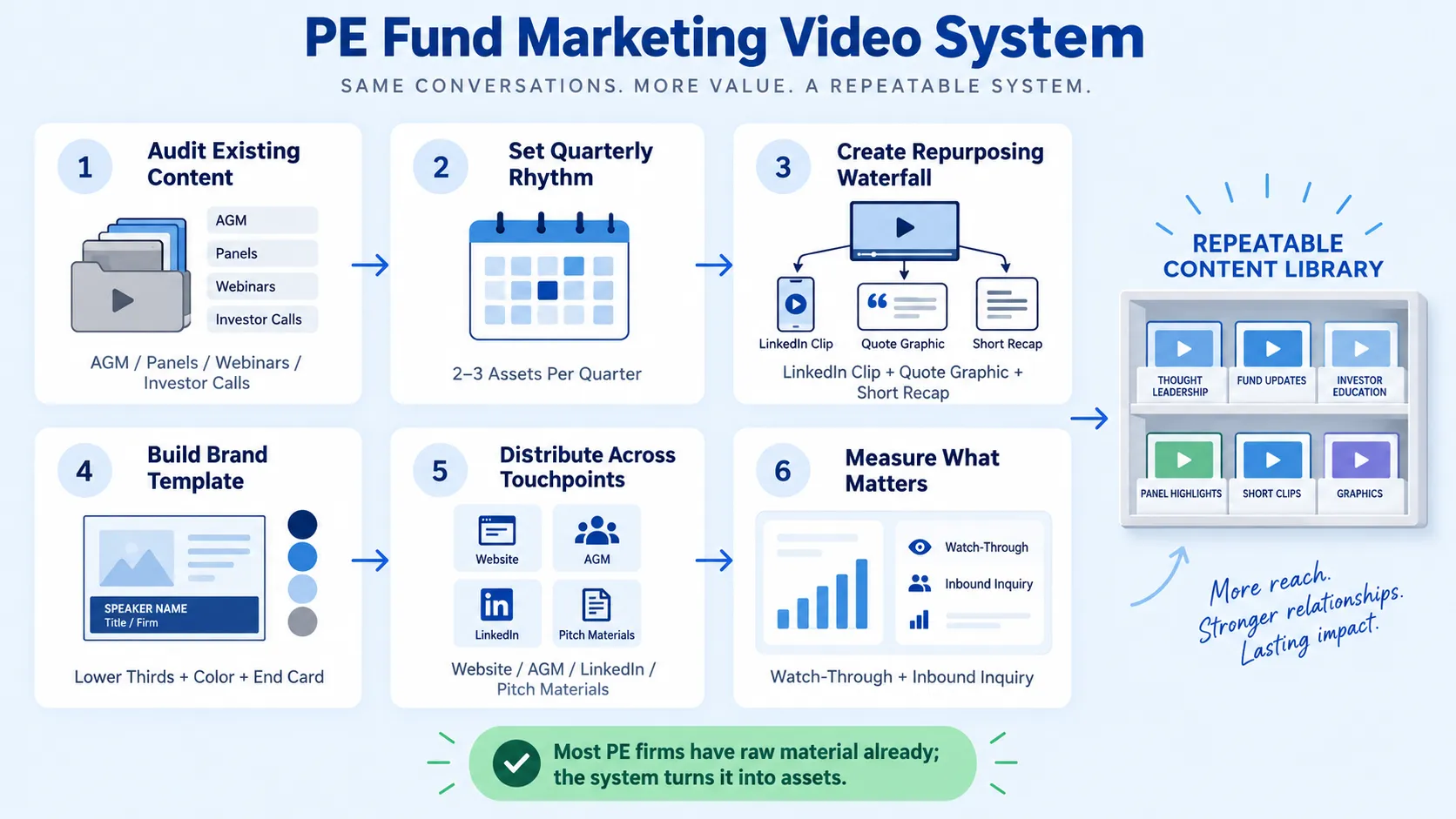
- Audit existing content: Identify every recording your firm has: AGM footage, conference panels, webinar replays, investor calls. These are your raw assets.
- Establish a quarterly production rhythm: Commit to a minimum of two to three video assets per quarter. An LP update, a thought leadership clip, and one portfolio spotlight is a complete quarter.
- Create a repurposing waterfall: Every long-form recording produces a 90-second LinkedIn clip, a quote graphic, and a short-form summary. One source, three assets.
- Build a brand template: Consistent lower-thirds, color grading, font choices, and end card. Apply it to every video so the library looks cohesive.
- Distribute across touchpoints: Video content should feed your website, your AGM, your LinkedIn strategy, and your pitch materials.
- Measure what matters: Watch-through rate on LP updates, LinkedIn engagement on thought leadership clips, and inbound inquiry rate from the firm overview video.
A conference panel can become several LinkedIn posts. An internal presentation can become an article. A recurring question from founders can become a video, webinar, or thought leadership piece. The video editing services and content repurposing workflow at Komet Media are built around both this extraction logic and building custom video assets entirely from scratch—handling concepting, scripting, and recording guidance when no source content exists.
LPs are becoming more vocal about performance expectations, with 28% noting that investment performance has fallen below their expectations. In that environment, communication quality becomes a proxy for firm quality. A GP that communicates clearly and consistently through video signals the kind of organizational discipline that LPs are increasingly screening for before they commit capital.
Conclusion
Video editing for private equity is no longer a branding exercise. It's an investor relations function, a deal sourcing tool, and a brand authority system, all running simultaneously.
Key takeaways:
- Prioritize LP update videos, firm overviews, and thought leadership clips as your three core formats.
- Edit for institutional credibility: captions, structure, clean pacing, and a human face in the first frame.
- LinkedIn is your primary distribution channel; reformat and edit every video for native performance there.
- Build a repurposing system so every AGM, panel, and webinar becomes a multi-asset content library.
Whether your firm has recordings sitting unused or is starting entirely from scratch with no existing video assets, Komet Media helps PE firms and serious B2B teams build short-form video assets through both content repurposing and full-service creation from concept to delivery.
Frequently Asked Questions
Q1: What is video editing for private equity and why does it matter?
Video editing for private equity refers to professionally producing and post-producing video content for LP communications, fund marketing, deal sourcing, and thought leadership. It matters because institutional investors now conduct digital due diligence before any conversation, and video is the fastest format for establishing credibility at that stage.
Q2: How long should a private equity firm overview video be?
A firm overview video should run 90–120 seconds. It needs to cover who you are, your investment thesis, your edge, and a clear call to action. Anything longer risks losing the LP before they reach the differentiation message.
Q3: Should PE firms use captions on their videos?
Yes, unconditionally. Most LinkedIn video is consumed without audio, and LP update videos are often reviewed during travel or in meetings. Captions also improve accessibility and search indexing on platforms that support transcript indexing.
Q4: What's the difference between a pitch video and a firm overview video?
A firm overview video introduces the firm to a broad audience and works on the website and LinkedIn. A pitch video is capital-raise specific, it speaks directly to prospective LPs, includes track record context, fund details, and a specific ask. Both formats should exist independently.
Q5: Can existing content like webinars and conference panels be repurposed into PE video assets?
Yes, and it is a very efficient path for many firms. A 45-minute panel appearance can produce three to five 60–90 second LinkedIn clips, an AGM-ready highlight reel, and a firm website asset. However, if your firm has no existing recordings, Komet Media also creates video content completely from scratch—managing concept research, scripting, recording guidance, and full post-production.
Q6: How often should a PE firm publish video content on LinkedIn?
Two to four times per month is a sustainable and effective cadence for most mid-market PE firms. Prioritize consistency over volume. One well-edited thought leadership clip per week builds more compounding brand authority than a burst of five posts followed by two months of silence.