
🪄 AI Summary
Heading 1
Heading 2
Heading 3
Heading 4
Heading 5
Heading 6
Lorem ipsum dolor sit amet, consectetur adipiscing elit, sed do eiusmod tempor incididunt ut labore et dolore magna aliqua. Ut enim ad minim veniam, quis nostrud exercitation ullamco laboris nisi ut aliquip ex ea commodo consequat. Duis aute irure dolor in reprehenderit in voluptate velit esse cillum dolore eu fugiat nulla pariatur.
Block quote
Ordered list
- Item 1
- Item 2
- Item 3
Unordered list
- Item A
- Item B
- Item C
Bold text
Emphasis
Superscript
Subscript
Running a podcast for a private equity firm is not the same as running a hobbyist show. Your listeners are fund managers, limited partners, and institutional allocators who will judge your firm's credibility by the quality of what they hear. This guide covers everything about podcast editing for private equity: why it matters, how to do it right, what tools to use, and how to turn every episode into a deal-flow and LP communications asset.
TL;DR
- PE podcast audiences are high-value, time-scarce professionals who will abandon poor audio instantly.
- Target −16 LUFS for Apple Podcasts and −14 LUFS for Spotify; get loudness wrong and platforms penalize you.
- Episodes between 25–45 minutes perform best for finance audiences focused on deal flow narrative and thought leadership.
- Every recording should feed a content repurposing workflow: audiograms, show notes, clips, and transcriptions.
How Private Equity Firms Use Podcasts to Build Trust and Drive Deal Flow
Private equity firms, portfolio companies, and investment funds face complex challenges. Amid unprecedented economic and geopolitical uncertainty and rising stakeholder expectations, firms are under exceptional pressure to deploy capital and deliver returns. Podcasts have emerged as one of the most credible channels for addressing that pressure publicly. Winning in today's PE environment requires sharper value creation and a clearer, data-backed edge. The firms that win will build systems, not slogans. A well-produced podcast is one of those systems. Here is what PE podcasts actually do for a firm:
- LP investor communications: A consistent show signals operational maturity and gives LPs a window into fund manager thinking between capital calls.
- Deal flow narrative: Potential targets and co-investors hear how you evaluate businesses, which self-selects better deal conversations.
- Portfolio company branding: Featuring portfolio company operators positions your firm as a value-add partner, not just capital.
- Thought leadership content: Episode-by-episode, you are building a searchable record of your investment thesis and market views.
- Talent attraction: Analysts and operators research firms before they apply. A sharp podcast is a hiring signal.
Forward-thinking PE firms are on a mission to support capital raisers and brand builders by providing valuable resources for both, using their podcast to highlight creative minds and strategic thinkers who are redefining how private market firms connect with audiences, build trust, and tell their stories.
As these pressures continue to converge, leading PE firms are reimagining their traditional business processes and seeking diversified investment opportunities, which includes drastic changes to how they communicate externally and compete for LP commitments.
Podcast editing for private equity is where that communication either lands or fails. The strategic opportunity is real. Private equity rebounded in 2025 with over 9,000 transactions totaling $1.2 trillion in value , meaning more firms are competing for attention from the same pool of institutional capital. Audio thought leadership is a low-cost, high-trust differentiator.
What a Private Equity Podcast Should Sound Like: Audio Standards for Financial Services
A PE podcast listener is not tolerant. They consume content on AirPods between meetings, in cars, and on morning commutes. Any friction in the listening experience is attribution of carelessness to your firm. Podcast editing services address the gap between raw recordings and professional productions. While recording technology has become more accessible, editing requires a combination of technical expertise, creative judgment, and attention to detail. The audio profile for a professional financial services podcast should hit these benchmarks:
Apple Podcasts recommends −16 LUFS (±1 dB); Spotify's podcast guidance is −14 LUFS; the broad industry convention for podcasts is −16 LUFS. Since podcasts are often listened to in noisy environments like commuting or the gym, consistent loudness is critical for intelligibility. Over-compressed dialog sounds harsh and fatiguing. Listeners on earbuds notice aggressive compression immediately, it makes speech sound unnatural and hard to listen to for extended periods.
For a PE audience specifically, tone matters as much as loudness. The edit should feel deliberate and unhurried. Dead air from genuine thinking is acceptable. Rambling tangents and filler words are not. Edit for the listener: cut real distractions but leave pauses and personality intact. A fund manager who sounds composed and precise builds more credibility than one who sounds like a TED talk performance coach.
Podcast Editing Best Practices for Finance Industry Audio Post-Production
Good audio post-production follows a fixed order of operations. Skipping steps creates compounding problems. Think of your editing workflow as an assembly line. You start with the raw materials (your recordings) and pass them through a series of stations, each refining the audio until it is ready for distribution. Jumping ahead or skipping steps can lead to a messy final product. Here is the right sequence for podcast editing for private equity content:
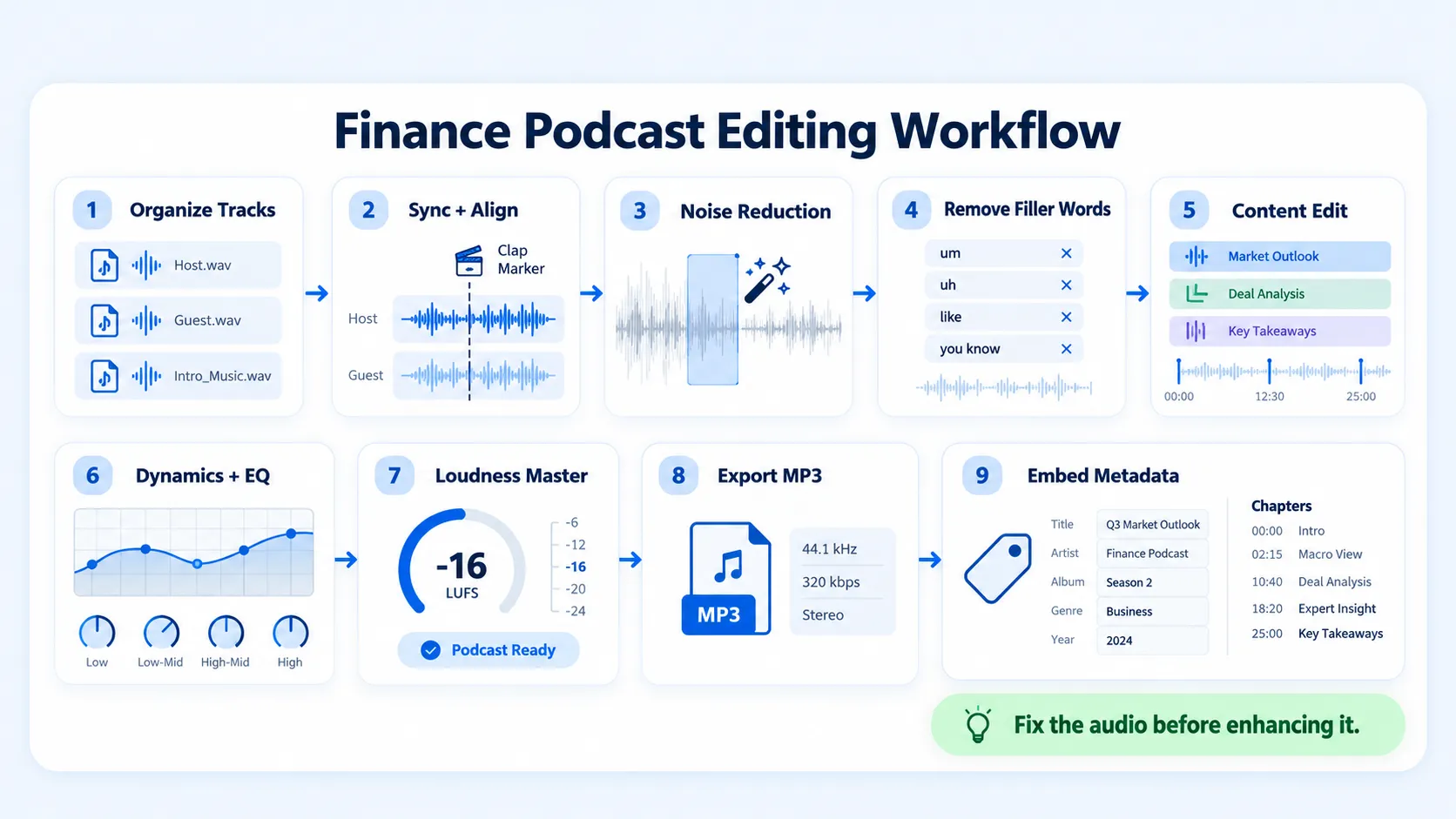
- Organize tracks: Name files with episode number and guest name. If recording remote guests, confirm each participant recorded a separate local track via Riverside.fm or Squadcast.
- Sync and align: Use a synchronized clap or audio cue at the top of each session to align multi-track recordings.
- Noise reduction pass: Fix before enhancing: repair hiss, hum, click, and level jumps before applying EQ or compression. Use your DAW software's spectral repair tools or plugins like iZotope RX.
- Remove filler words: Cut "ums," "uhs," "you knows," and long false starts. In financial services podcasting, verbal filler undermines subject-matter authority more acutely than in casual formats.
- Content edit: Remove redundant explanations, digressions, and off-record commentary. Keep the deal flow narrative tight.
- Dynamics and EQ: Apply dynamic range compression at 2:1 to 4:1, high-pass filter below 80 Hz to remove rumble, and boost presence in the 2–4 kHz range for voice clarity.
- Loudness master: Measure integrated LUFS and true peak before export. Hit your platform target.
- Export: Export your file in a high-quality, compressed format. MP3 at 192 kbps stereo is the industry standard, a great balance of quality and file size.
- Embed metadata: Add ID3 tags: episode title, artist (your podcast name), episode number, artwork, and description. Add chapter markers for key topics discussed.
According to a 2025 survey of independent podcasters, almost 20% of creators hire an editor to handle post-production, but in financial services, the case for outsourcing is stronger. Your partners' time is not spent in a DAW.
Best Podcast Editing Software for Corporate Finance and PE Content
DAW software choice depends on whether your team edits in-house or works with a dedicated agency. Here is how the main options stack up for finance teams:
For beginners, online platforms like Descript or Riverside offer accessible entry points. Professionals will prefer full DAWs like Audition or Audacity for granular control. Descript is particularly well-suited for PE teams because it allows non-technical editors to cut content using a transcript view, making filler word removal fast and non-destructive. For firms where a partner reviews edits before publishing, this workflow is significantly faster than waveform-based editing.
At Komet Media, we handle the full audio production chain—from creating content from scratch to complete post-production and editing—so your managing directors stay in front of ideas, not timelines.
How Long Should a Private Equity Podcast Episode Be?
Length is a strategic decision, not a technical one. PE audiences are sophisticated and time-constrained. They will not sit through a 90-minute episode to extract 20 minutes of usable insight. The data from top-performing PE podcasts in 2026 points to a clear range:
- Shows where each episode has a defined theme and runs around 35 minutes perform well for the morning commute and allow listeners to dip in and out at their leisure.
- High-rated PE podcasts averaging 24 minutes also perform strongly , particularly for LP-facing content where the goal is regular, digestible touchpoints rather than deep dives.
- Long-form episodes (60+ minutes) work when the guest is a marquee name, a sector-defining operator, a top-decile fund manager, or a recognized LP spokesperson.
Recommended episode lengths by content type:
Whatever length you choose, commit to it consistently across episodes. Defining publishing timelines maintains audience trust, and for PE, that trust extends to how LPs perceive your operational discipline.
Content Repurposing Workflow: Turning PE Podcast Episodes into Pipeline Assets
The episode is not the endpoint. For B2B content marketing in financial services, the recording session is the raw material for a full distribution stack. This is the repurposing workflow we build for serious PE and financial services teams at Komet Media. Every published episode should generate:
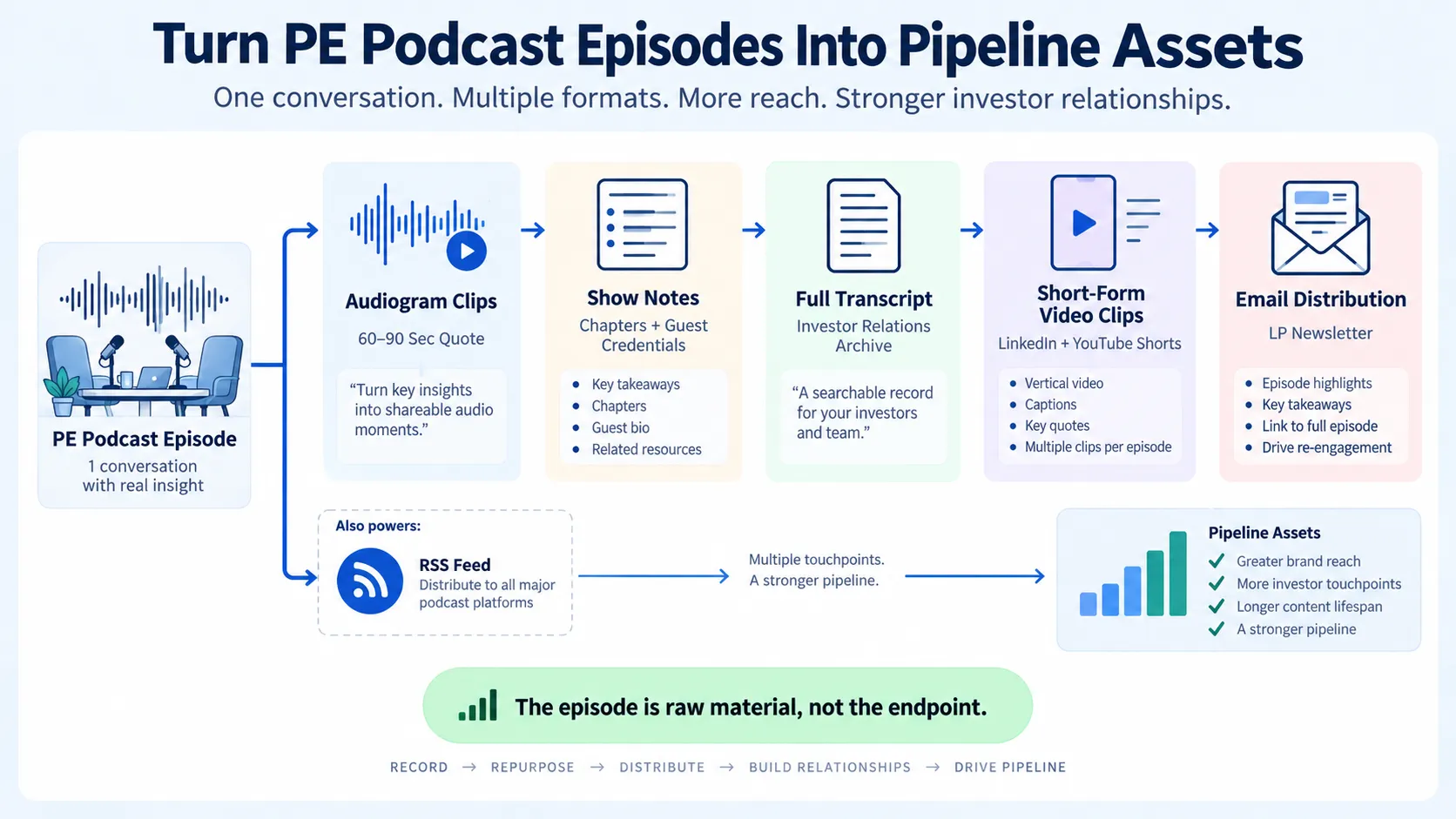
- Audiogram clips (60–90 seconds): Pull the sharpest quote from the episode, add waveform animation and captions, and distribute to LinkedIn. This is the highest-ROI format for capital markets storytelling on social media.
- Show notes optimisation: Structured show notes with chapter timestamps, guest credentials, and key takeaways improve RSS feed distribution ranking and Apple Podcasts Connect and Spotify for Podcasters discoverability. Use relevant keywords in your titles, descriptions, and tags to help listeners find your content.
- Full transcript: A verbatim transcript, lightly edited for readability, supports investor relations documentation and serves as source material for blog posts and LP newsletters. Visit our podcast transcription service for details on how we handle this.
- Short-form video clips: Record video alongside audio and cut 90-second clips for LinkedIn and YouTube Shorts. Editors now repurpose audio into video-friendly clips as a standard deliverable.
- Email distribution: A short episode summary for your LP newsletter, with a link to the full episode on Apple Podcasts Connect and Spotify for Podcasters.
With 4.61 million podcasts competing for 584.1 million global listeners in 2025, projected to climb well past 600 million by 2026, quality production is not optional. The firms that build a full repurposing system around each episode get significantly more return from the same recording time. Our podcast marketing service and podcast show notes work sits directly downstream of editing, the edit informs every piece of derivative content that follows.
Conclusion
Podcast editing for private equity is a precision discipline with material consequences for firm credibility.
- Audio standards matter: hit −16 LUFS for Apple Podcasts, −14 LUFS for Spotify, and export at MP3 192 kbps minimum.
- Keep episodes between 25–45 minutes for most content types; match length to audience intent.
- Remove filler words and dead air aggressively, PE listeners equate verbal discipline with intellectual discipline.
- Every episode should generate audiograms, optimised show notes, a transcript, and at least one short-form video clip for a complete content repurposing workflow.
If you want a production partner who understands financial services podcasting end to end, talk to the Komet Media team.
Frequently Asked Questions
Q1: How do private equity firms use podcasts differently from consumer brands?
PE firms use podcasts primarily for LP investor communications, deal flow narrative, and thought leadership positioning, not entertainment. Episodes function as long-form trust signals to institutional allocators and potential co-investors, and are typically distributed through curated channels rather than mass podcast directories.
Q2: What is the correct loudness target for a private equity podcast?
Apple Podcasts recommends −16 LUFS (±1 dB); Spotify's podcast guidance is −14 LUFS. For a single master file, target −16 LUFS integrated with a true peak of −1 dBTP. This satisfies Apple's spec and sits within acceptable range for Spotify playback normalization.
Q3: How do I remove filler words from a finance podcast recording?
Use Descript's transcript editor to identify and delete filler words non-destructively, or do a manual listen-through pass in your DAW software with your timeline zoomed in. For PE content, prioritize removing every "um," "uh," and false start. Verbal precision is a credibility signal for financial services professionals.
Q4: How long should a private equity podcast episode be?
LP update episodes work best at 20–25 minutes. Deal thesis or operator interviews should run 35–50 minutes. Avoid exceeding 60 minutes unless the guest commands that level of attention from your specific audience. Consistency in episode length matters as much as the length itself.
Q5: What should a private equity podcast episode include in its show notes?
Strong show notes for financial services podcasting include: guest name and firm, episode summary (3–5 sentences), timestamped chapter markers, key quotes, and links to referenced reports or portfolio companies. Optimised show notes improve RSS feed distribution ranking and surface the episode in Apple Podcasts Connect and Spotify for Podcasters search.
Q6: Should a PE firm produce their podcast in-house or outsource it?
Hiring a professional editor is a solid option, and outsourcing could be the difference between building a long-running show and giving up altogether. For PE firms, the economics are straightforward: a partner's hourly rate makes DIY audio post-production an expensive use of firm time. Outsourcing to a specialized B2B agency like Komet Media preserves partner time while guaranteeing consistent quality across every episode, whether building content from scratch or repurposing existing recordings.