
🪄 AI Summary
Heading 1
Heading 2
Heading 3
Heading 4
Heading 5
Heading 6
Lorem ipsum dolor sit amet, consectetur adipiscing elit, sed do eiusmod tempor incididunt ut labore et dolore magna aliqua. Ut enim ad minim veniam, quis nostrud exercitation ullamco laboris nisi ut aliquip ex ea commodo consequat. Duis aute irure dolor in reprehenderit in voluptate velit esse cillum dolore eu fugiat nulla pariatur.
Block quote
Ordered list
- Item 1
- Item 2
- Item 3
Unordered list
- Item A
- Item B
- Item C
Bold text
Emphasis
Superscript
Subscript
If you're running marketing for a B2B SaaS, AI, or funded tech startup, LinkedIn video is no longer optional. LinkedIn Video Trends for B2B in 2026 have shifted the platform from a text-first professional network into the highest-signal video channel for reaching decision-makers. Video creation is up 27% and video views are up 36% year over year. Buyers are watching. The question isn't whether to invest, it's how to do it in a way that builds pipeline, not just impressions. This guide breaks down what's actually working right now.
TL;DR
- Video posts hold a 5.90% engagement rate in Q2 2026 , beating text and link posts by a significant margin.
- The single highest-return move on LinkedIn is a native upload that hooks viewers in the first 1–3 seconds and carries captions.
- Short-form (30–90 seconds), founder-led content, and repurposed webinar/podcast clips are the top-performing formats.
- Personal profiles, not company pages, are the primary distribution engine for B2B video in 2026.
What Are the Top LinkedIn Video Trends for B2B in 2026?
LinkedIn paid video grew nearly 30% year-over-year in Q3 2026, thanks in part to more creator partnerships and better measurement tools. But the organic side is just as significant for B2B SaaS, AI, and tech teams with lean marketing budgets. Here's what's defining LinkedIn Video Trends for B2B in 2026:
- Founder-led video: Personal profiles generate 8x more engagement than company pages, and posts from individual profiles receive 8x the engagement of identical content from company pages. Founders and executives posting directly outperform branded accounts at every stage.
- Native upload dominance: Native uploads are viewed roughly 52% longer than the same clip posted as a link, with about 42% more visibility. Sharing a YouTube link is leaving a lot on the table.
- Edutainment format: The content type getting the best results right now is what researchers call "edutainment": educational content that's also genuinely engaging, using humor, storytelling, or strong visuals to make product information interesting.
- LinkedIn Live growth: LinkedIn Live videos receive 7x more reactions than standard video uploads, achieving 29.6% engagement rates compared to text posts hovering around 4%.
- Content creation from scratch and repurposing: B2B SaaS, AI, and tech teams are creating video content both from scratch (handling strategy, scripting, and production) and by converting webinars, demos, and podcasts into short clips. Our content creation and short-form video services exist precisely for this complete workflow.
- AI-driven algorithm shifts: By August 2025, LinkedIn implemented large language models to understand content context and reasoning rather than just processing numerical engagement features, meaning authentic expertise now directly drives distribution.
78% of B2B marketers now use video, and 56% plan to increase their investment in the next 12 months. The baseline has risen. Standing still means falling behind.
How to Use LinkedIn Video for B2B Lead Generation in 2026
Video on LinkedIn isn't brand awareness theatre. Done right, it fills the pipeline. Here's the framework I use with B2B SaaS, AI, and funded tech teams:
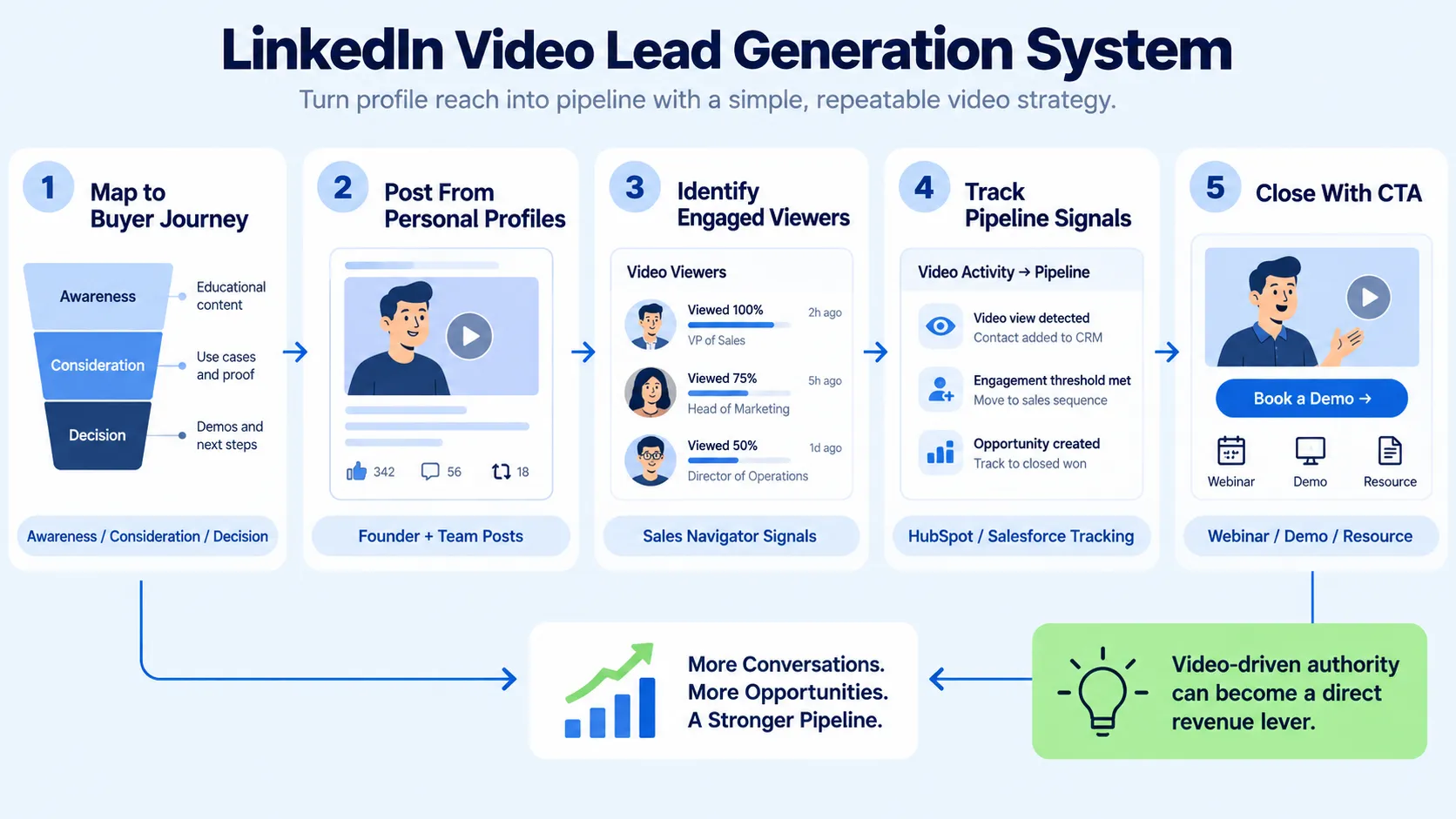
- Map video to the buyer journey: Awareness-stage clips educate on problems; consideration-stage clips demo solutions; decision-stage clips feature customer proof. Use LinkedIn Analytics to see which stages are converting.
- Post from personal profiles first: Personal profiles receive 65% of LinkedIn feed allocation, while company pages receive just 5%. Founder and team member profiles should be the primary publishing vehicle, with the company page amplifying.
- Use Sales Navigator to identify engaged viewers: Prospects who watch multiple videos and visit your profile are warm signals. Pair Sales Navigator retargeting with video content to accelerate deal cycles.
- Track the right metrics: Inbound attribution matters, if new leads mention your LinkedIn content during discovery calls, that's your clearest signal that video is building a real pipeline. For B2B teams with HubSpot or Salesforce, you can track which prospects watched your content before a sales conversation began.
- Close the loop with a CTA: Every video should point somewhere, a webinar registration, a demo request, or a specific resource. Never end a video without directing the viewer to the next step.
B2B buyers retain 95% of a message when it's delivered via video, compared to just 10% via text. That retention gap is your competitive advantage if you're willing to use it. Inbound leads close at 14.6% versus 1.7% for outbound , which means video-driven authority building isn't a soft play, it's a direct revenue lever.
LinkedIn Video vs. Static Posts for B2B Engagement in 2026
The format debate is settled. Here's how the numbers stack up across content types as of Q2 2026:
Source: Socialinsider LinkedIn Organic Benchmarks, Q2 2026.
Video beats text posts by roughly 50% in engagement rate, and that gap compounds over time as the algorithm increasingly rewards dwell time over surface-level clicks. LinkedIn's "Depth Score" now measures how long users engage with content, not just whether they clicked, and posts containing off-platform links see significantly reduced distribution.
For B2B SaaS, AI, and tech teams choosing between formats: documents and video are complementary, not competing. Use video for story and trust-building; use documents for frameworks and tactical breakdowns. Rotate them to avoid the reach suppression that comes from posting the same format consecutively.
Emotionally resonant videos generate 44% higher view-through rates and 2x more completions, and video versus static ads produces a 26% lift in brand favourability and a 19% lift in purchase intent. Static content cannot deliver that kind of buyer-side shift.
How Long Should B2B LinkedIn Videos Be in 2026?
Length is one of the most misunderstood variables in LinkedIn Video Trends for B2B in 2026. The platform allows up to 10 minutes, but the algorithm rewards something much shorter.
LinkedIn videos under 60 seconds have a 26% higher completion rate than longer formats. And completion rate is what the algorithm scores, LinkedIn ranks on completion rate, not raw watch time. A 60-second clip watched to the end outperforms a 600-second clip dropped at 90 seconds every time. The structure within that window matters just as much as duration:
- Hook in seconds 1–3: Videos that auto-play with captions capture attention in silent-scroll mode. Under 90 seconds, with a clear hook in the first three seconds, performs best.
- Captions always: Add captions since 75–85% of social media videos are watched with sound off.
- 9:16 vertical format for the mobile video feed; 1:1 square for standard feed posts.
- One idea per video: Founders in B2B SaaS, AI, and tech trying to cram a full demo into 60 seconds lose viewers. Pick one insight, one objection, one customer outcome.
For repurposed content, webinars, podcasts, demo recordings, trim to the single sharpest 45–75 seconds rather than posting longer cuts. Buyers won't wait. Give them the payoff immediately.
What Types of LinkedIn Videos Get the Most B2B Leads?
Not all video content converts equally. From working with B2B SaaS, AI, and funded tech teams, these are the formats that drive actual pipeline:
- Founder POV clips: A founder explaining a product truth, a market insight, or a customer outcome in under 90 seconds. Authentic, no polish required, LinkedIn Creative Labs specifically reports large lifts for "Expert Takes" and "Human Touch" creative approaches, noting that production value is not the only lever; framing and message structure can materially shift engagement and dwell time.
- Micro-demos: 45–60 second clips showing a single use case or feature benefit, not a full walkthrough. Effective for keeping technical buyers engaged mid-funnel.
- Customer proof clips: Testimonial excerpts, either filmed or repurposed from recorded calls, that speak directly to outcomes like time saved, revenue added, or churn reduced.
- Event and webinar clips: 87% of B2B marketers use LinkedIn for marketing, while 89% use it for lead generation, and event content is one of the fastest ways to build a video library fast. A single webinar can yield 8–12 standalone video assets.
- Trend commentary: Founders reacting to a market shift or industry stat in 30–60 seconds. High shareability, strong thought leadership signal.
- Sales enablement snippets: Short clips that answer common objections, designed to be shared by AEs in outbound sequences via Sales Navigator.
Company decision-makers at director level and above contribute to 46% of total video likes and shares. Target content toward their problems, not your product features.
How to Optimize LinkedIn Videos for the 2026 Algorithm
LinkedIn's 2026 algorithm changes represent the most significant shift in how B2B content gets distributed since the platform embraced its creator economy ambitions in 2023.
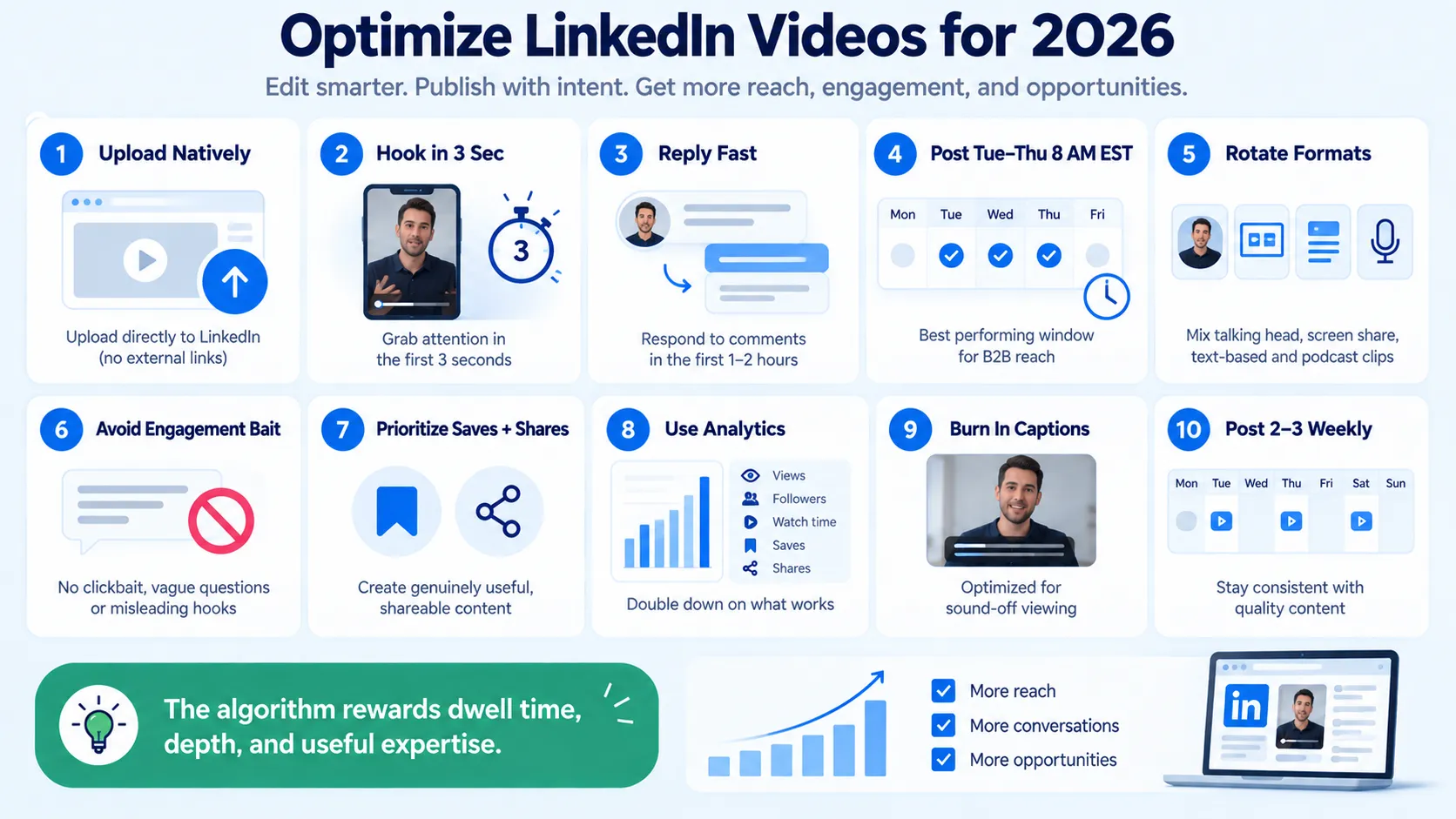
Here's how to work with it, not against it:
- Upload natively: Never link out to YouTube or Vimeo. Native video gets the algorithmic boost; linked video gets penalized by up to 60% in reach.
- Hook within 3 seconds: The algorithm tests your content on a small sample first. If early viewers scroll past, distribution stops. A sharp hook prevents this.
- Respond to comments fast: Responding within 15 minutes of posting triggers a significant algorithmic boost by signaling active engagement.
- Post during decision-maker windows: Publish during decision-maker planning windows: 8 AM EST on Tuesday through Thursday.
- Rotate formats: Rotate formats to avoid the 20% reach suppression from posting the same format consecutively.
- Avoid engagement bait: Tactics like "Comment YES if you agree" and reaction polling are now detected and penalized.
- Prioritize saves and shares: Dwell time, comment depth, saves, and private shares all factor into LinkedIn's Depth Score ranking signal.
- Enable Creator Mode: This unlocks access to LinkedIn Analytics with deeper video metrics, including audience demographics and content-to-profile conversion rates.
- Burn in captions: Not just for accessibility. The algorithm recognises on-screen text and uses it for topic classification.
- Batch and systematize: Consistency beats virality. Teams posting 2–3 videos weekly via our video editing services outperform teams chasing single viral moments.
Common Mistakes B2B Brands Make with LinkedIn Video Content
Most B2B teams don't fail at LinkedIn video because of bad production. They fail at strategy. Here are the most costly errors:
- Posting from the company page only: Company page organic reach dropped roughly 60–66% between 2024 and 2026. Every video published exclusively on the brand page is fighting with a 5% feed allocation. Get your founders and team leads posting.
- Making ads instead of content: Promotional-first video gets suppressed. The algorithm specifically boosts educational and how-to video content over promotional material.
- Ignoring completion rate: Most teams track views. The algorithm tracks completion. A 500-view video watched fully outperforms a 5,000-view video dropped at 10 seconds.
- Skipping captions: Silent scrolling is the default. No captions means no message lands for the majority of viewers.
- Inconsistent posting: Companies that post weekly see 2x higher engagement. Sporadic posting resets algorithmic trust every time.
- Long-form for top-of-funnel: Saving the good stuff for a 10-minute explainer nobody finishes. Compress insights into short clips; let longer formats serve retargeted, engaged audiences only.
- No full-cycle video system: Failing to combine video creation from scratch with repurposed existing content leaves potential on the table. A structured video marketing strategy builds new assets from the ground up while turning recordings into 10+ LinkedIn assets.
Conclusion
LinkedIn Video Trends for B2B in 2026 point in one clear direction: short, native, human, and consistent wins. The teams pulling ahead are not spending more, they're being more intentional.
Key takeaways:
- Video posts hold a 5.90% engagement rate in Q2 2026, outperforming text and link posts decisively.
- Optimal length is 30–90 seconds for organic; 15–30 seconds for paid.
- Founder and team-led video from personal profiles generates 8x more engagement than company page posts.
- The algorithm rewards native uploads, dwell time, saves, and fast comment responses, not reach hacks.
Whether you need video content created completely from scratch or built from existing assets, Komet Media builds and manages the entire video engine for your team.
Frequently Asked Questions
Q1: How often should B2B teams post LinkedIn videos in 2026?
Post consistently, 2–3 videos per week, and engage with comments in the first 60 minutes to boost algorithmic reach. Consistency signals topic authority and keeps the algorithm distributing your content to relevant audiences.
Q2: Does LinkedIn video work for B2B lead generation or just brand awareness?
Video drives both. When paired with a clear CTA, viewer retargeting via LinkedIn Ads, and CRM tracking through HubSpot or Salesforce, video content becomes a measurable pipeline asset, not just a visibility play.
Q3: Should I use vertical (9:16) or horizontal (16:9) video on LinkedIn?
Use 9:16 vertical format for LinkedIn's mobile video feed to maximize discoverability. For standard feed posts, 1:1 square or 16:9 landscape both work. Match the format to the placement, not just personal preference.
Q4: Can I repurpose webinar or podcast recordings into LinkedIn videos?
Yes, and this is one of the highest-leverage moves available to B2B SaaS, AI, and tech teams. A single 60-minute webinar can yield 8–12 standalone clips. Our podcast editing and short-form video editing services handle this end to end.
Q5: Is LinkedIn Live worth investing in for B2B?
LinkedIn Live produces 24x more reactions than standard posts , making it one of the highest-engagement formats on the platform. It suits product launches, expert panels, and AMA sessions, formats where real-time interaction builds buyer trust faster than polished pre-recorded content.
Q6: Does production quality matter for B2B LinkedIn video?
Good lighting and clear audio matter. Cinematic production does not. LinkedIn Creative Labs reports large lifts for "Expert Takes" and "Human Touch" creative approaches, noting that production value is not the only lever, framing, message structure, and authenticity can materially shift engagement and dwell time.