
🪄 AI Summary
Heading 1
Heading 2
Heading 3
Heading 4
Heading 5
Heading 6
Lorem ipsum dolor sit amet, consectetur adipiscing elit, sed do eiusmod tempor incididunt ut labore et dolore magna aliqua. Ut enim ad minim veniam, quis nostrud exercitation ullamco laboris nisi ut aliquip ex ea commodo consequat. Duis aute irure dolor in reprehenderit in voluptate velit esse cillum dolore eu fugiat nulla pariatur.
Block quote
Ordered list
- Item 1
- Item 2
- Item 3
Unordered list
- Item A
- Item B
- Item C
Bold text
Emphasis
Superscript
Subscript
Every quarter, someone on a B2B growth team asks whether video is actually worth the budget. In 2026, the data doesn't just answer that question, it makes it harder to defend not investing. This guide compiles the most current B2B Video Content Statistics and Benchmarks (2026) from Wyzowl, Vidyard, Wistia, LinkedIn, and Forrester, so your team can make decisions grounded in evidence, not assumption.
TL;DR
- 70% of B2B buyers watch video during their purchase decision process.
- 91% of businesses use video as a marketing tool in 2026.
- Videos under one minute hit a 65% completion rate; videos over 20 minutes drop to 20%, per Vidyard's benchmark of nearly one million B2B videos.
- Companies using video grow revenue 49% faster than non-users.
What Are the Latest B2B Video Marketing Statistics for 2026?
The headline number is hard to ignore. 91% of businesses use video as a marketing tool in 2026, the highest figure ever recorded, up from 89% in 2025. That adoption rate isn't speculative.
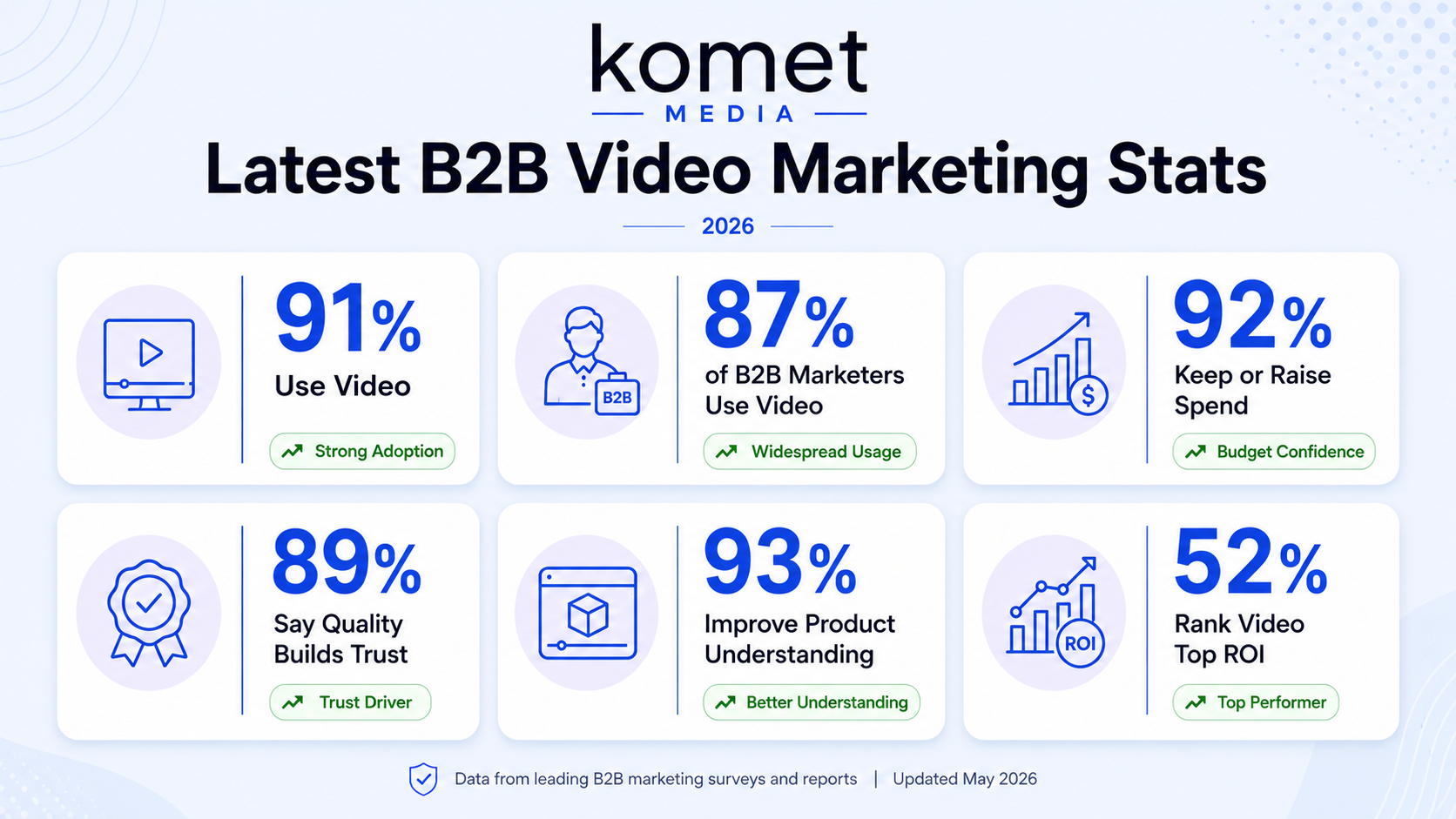
87% of B2B marketers integrate video into their marketing strategies, according to the Content Marketing Institute. Budget confidence tracks with adoption. 92% of marketers plan to spend the same or more on video in 2026, even as budgets tighten in some sectors, reflecting video's proven effectiveness.
And on the demand side: 84% of consumers want to see more videos from brands in 2026, a figure consistent to within 8% for the last eight years. Trust is accelerating the shift. 89% of consumers say video quality impacts their trust in a brand.
For B2B SaaS teams specifically, that trust signal is the difference between a buyer booking a demo and quietly moving to a competitor's website. 93% of video marketers say video has helped them increase user understanding of their product or service, which is the clearest argument for using product demos, explainers, and founder-led clips to shorten the education gap in long B2B sales cycles.
One data point that separates high-performing teams from the rest: 81% of teams share videos on LinkedIn, followed closely by YouTube at 76%. If your video marketing strategy isn't anchored to those two platforms, you're swimming against the current.
The AI tailwind is also reshaping production economics. 63% of video marketers have used AI tools to create or edit marketing videos, up significantly from the prior year, per Wyzowl 2026. That compression in cost and timeline changes the calculus for founders and lean marketing teams who previously saw consistent video as out of reach.
Key stat: 52% of B2B marketers identify video as their highest ROI content type.
How Effective Is Video for B2B Lead Generation in 2026?
Video's lead generation impact shows up across the entire funnel. 85% of video marketers say video has helped them generate leads. 83% say video has directly increased sales. Those aren't soft brand metrics, they're outcomes that map directly to pipeline.
At the landing page level, the effect is concrete. Landing pages with embedded video see up to 86% higher conversion rates than those without. For B2B SaaS companies running paid campaigns, that single change, adding a product walkthrough or founder video to a landing page, can redefine what the same ad spend returns.
Email performance follows the same pattern. Emails that include video previews or thumbnails can see click-through rates increase by up to 300% compared to static emails, according to Campaign Monitor data. Given that most SaaS teams are already running nurture sequences, this is a low-friction win.
On the buyer side, B2B buyers watch an average of 7 videos during their buying process. That means a single well-placed video is rarely enough, buyers expect a portfolio. 72% of B2B buyers report that video content from vendors influences their vendor shortlist decisions. Get on that shortlist before your competitor does, and the deal dynamics shift entirely.
58% of B2B decision-makers say they trust video content from brands more than blog posts. This is why Komet Media's work isn't just about production, it's about building the kind of short-form video asset library that keeps a brand visible across every stage of a buyer's self-directed research journey.
Key stat: 65% of executives visit a vendor website after viewing their video, and 39% contact the vendor directly.
B2B Video Content Benchmarks 2026: Engagement, Completion, and Platform
The benchmark data here is what separates informed teams from those running on gut feel. Let's go platform by platform.
LinkedIn Video:
Video content on LinkedIn saw a 5.90% average engagement rate in Q1 2026, above the platform's overall average of 5.20%. Native LinkedIn videos outperform YouTube links by 312%, so uploading directly to the platform is non-negotiable.
However, video views declined 36% year-over-year across every page size on LinkedIn, which signals that volume alone isn't the answer. Quality and format fit matter more than ever.
Video Completion Rates (Vidyard benchmark, ~1M B2B videos):
Wistia Play Rate Context:
Videos on homepages, video galleries, and product pages get the highest play rates, and viewers generally get about halfway through them.
CRM integration gap:
Less than half of marketers connect their video platform to their CRM or email marketing tool to track video analytics alongside their other marketing data, a measurable missed opportunity for pipeline attribution. 74% of companies measure video ROI through engagement metrics, focusing on views, view rates, and average watch time.
But leading organizations go further, tying video consumption to pipeline influence and revenue. If your video editing services aren't connected to downstream metrics, you're leaving the strongest part of the ROI argument on the table.
What Percentage of B2B Buyers Watch Video Before Purchasing?
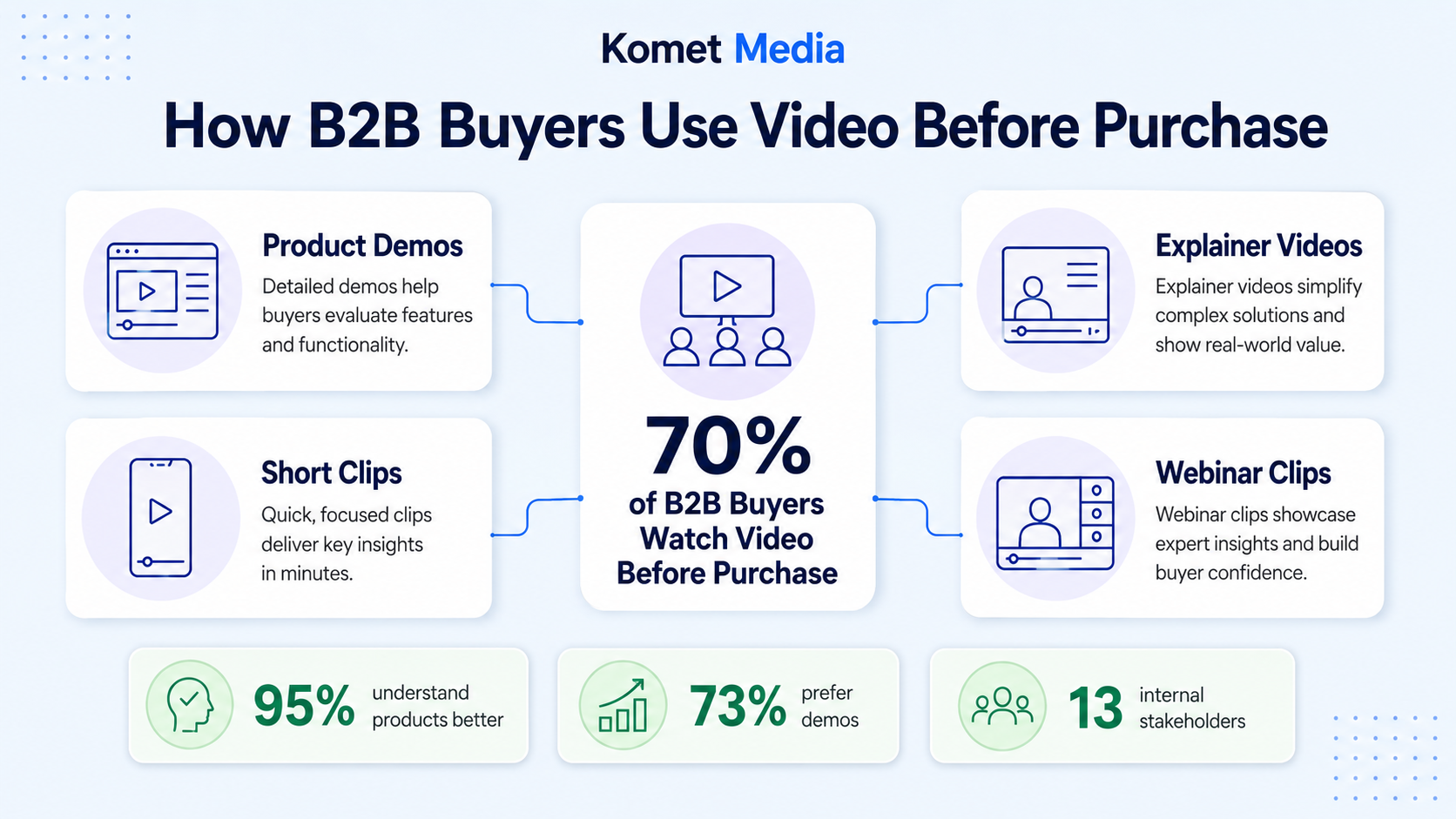
This is the question that should settle every internal debate about video investment. 70% of B2B buyers watch video content during their purchase decision process. That's not fringe behavior, it's majority buyer behavior, meaning the absence of video is a competitive disadvantage by default. 96% of B2B buyers prefer video content for learning about products and services, with video consistently outperforming text and static images across engagement metrics. The generational dimension matters here.
Millennials and Gen Z now account for 71% of B2B buyers, up from 64% in 2022. These buyers are digital-first and video-native. They research independently before ever engaging in sales. 82% of B2B buyers say they watch more business-related videos now than they did two years ago.
What are they watching? 73% of B2B decision-makers prefer to watch product demo videos rather than read whitepapers or brochures. 62% of B2B buyers say they watch explainer videos to better understand a product before moving further in the sales process.
The buying committee complexity compounds this. Forrester's 2025 Buyers' Journey Survey found that the average B2B purchase now involves 13 internal stakeholders and 9 external participants. Each of those stakeholders consumes content independently. A podcast or webinar repurposed into short clips can reach the CFO, the IT lead, and the end user, without requiring a separate content strategy for each.
Key stat: 95% of B2B buyers say video helps them better understand products and services.
Average B2B Video Engagement Rates and Optimal Video Length in 2026
Length and format decisions directly determine whether a video gets watched or skipped. Here's what the data says in 2026.
Optimal length by platform and format:
The most effective B2B video length is between 30 seconds and 2 minutes, according to 71% of marketers surveyed by Wyzowl in 2026. Vidyard's benchmark data from nearly one million B2B videos confirms this: videos under one minute achieve a 65% completion rate, while videos over 20 minutes see completion rates drop to 20%. The average B2B video length has compressed from 168 seconds in 2024 to just 76 seconds in 2026, reflecting both algorithm preferences and the reality that buyers want clarity fast.
One often-missed tactic: videos with subtitles see a 28% higher completion rate among B2B audiences compared to videos without subtitles. Captions are no longer optional, most LinkedIn video is consumed silently on mobile. Videos under 30 seconds show 200% higher completion rates on LinkedIn compared to longer formats, though educational content between 60–90 seconds also performs well.
For short-form video editing that actually performs, the rule is simple: front-load value, close the loop fast, and match length to the buyer's stage, not to what's convenient to produce.
B2B Video ROI Statistics vs. Other Content Formats in 2026
The ROI case for video is the strongest it's ever been. 82% of marketers say video marketing has given them a good ROI, a dominant result that has held consistently across multiple survey years. Businesses using video experience 49% faster revenue growth than those that do not. When stacked against other content formats, video consistently ranks first. More than half of B2B marketers say video delivers the highest ROI of any content type, yet less than a quarter allocate the majority of their content budget to video. That gap is where the opportunity lives.
Video ROI vs. other content types:
According to Forrester's 2026 predictions for B2B marketing leaders, buyer trust will be the defining variable in B2B competition over the next eighteen months. Video is the fastest trust-building format available, which means its ROI advantage isn't just about views, it's about compressing sales cycles. 82–88% of video marketers report video accelerates the decision-making process, particularly for complex B2B solutions. For SaaS and funded tech teams, repurposing existing content, webinars, podcasts, demos, into short clips is the highest-leverage move. It extracts pipeline value from assets you've already paid to create, without requiring a net-new production budget.
What Types of Video Content Work Best for B2B Audiences?
The format question is really a funnel question. Match format to stage, and performance follows.
- Awareness: Animated explainers, founder thought leadership, short educational clips. 68% of B2B marketers use explainer videos at the top of the funnel to introduce their products or services.
- Consideration: Product demos and live-action walkthroughs. Product demo videos are used by 57% of companies during the consideration stage, compared to 29% using case study videos at the same stage.
- Decision: Customer testimonials and case studies. Videos featuring customer testimonials have a 44% higher conversion rate in the decision stage than videos without testimonials. According to Demand Gen Report, 97% of B2B buyers say peer reviews and testimonials are the most reliable type of content when evaluating a product or service. Testimonial video closes that gap between written proof (easy to discount) and lived experience (hard to fake). Webinars remain the highest-converting video format, with 73% of B2B marketers rating them highly effective.
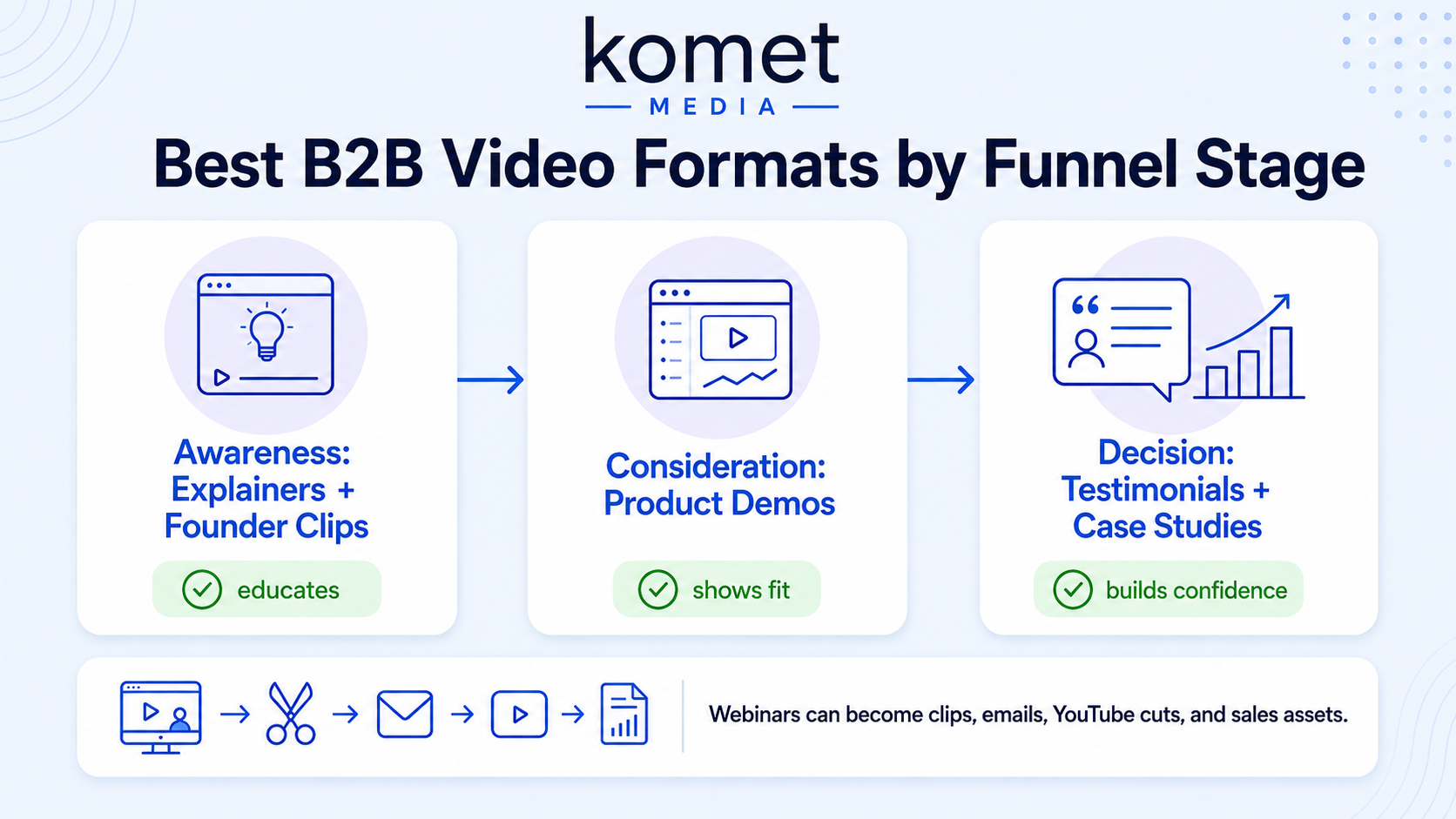
The compounding play: a single webinar, properly repurposed, can yield LinkedIn clips, email snippets, Instagram reels, YouTube Shorts, and sales enablement assets, all from one recording session. That's what I help teams execute at Komet Media's services.
Personalization accelerates performance. 38% of B2B buyers say they are more likely to watch videos if the content is personalized to their industry. Videos that address specific buyer pain points see a 41% higher watch-through rate than generic product videos.
Key insight: The formats most resistant to AI commoditization, real customer testimonials, on-camera executive content, and original product demos, are the ones that produce the strongest B2B pipeline outcomes.
Conclusion
The B2B Video Content Statistics and Benchmarks (2026) tell a clear story:
- Video is now table stakes, 91% adoption means your absence is visible, not your presence.
- Buyer behavior has shifted permanently. 70% of B2B buyers watch video before purchasing, and 95% say it helps them understand products better.
- Short-form wins on engagement; testimonials win at the decision stage. Match format to funnel stage.
- ROI leads all content types, but most teams still underinvest relative to the returns they report.
- LinkedIn and YouTube are the two non-negotiable distribution channels for B2B video in 2026.
If you're sitting on webinar recordings, podcast episodes, or founder Q&As that haven't been repurposed, you're leaving a pipeline on the table. Let's talk about what Komet Media can do for your team.
Frequently Asked Questions
Q1: What percentage of B2B buyers watch video before making a purchase decision?
70% of B2B buyers watch video content during their purchase decision process. 96% prefer video for learning about products and services, making it the dominant format for self-directed buyer research in 2026.
Q2: What is the average B2B video engagement rate on LinkedIn in 2026?
LinkedIn video posts averaged a 5.90% engagement rate in Q1 2026. Native LinkedIn videos outperform YouTube links by 312%, so always upload directly to the platform rather than sharing an external link.
Q3: How long should B2B marketing videos be for best results?
It depends on the funnel stage. The most effective B2B video length overall is between 30 seconds and 2 minutes, according to 71% of marketers surveyed by Wyzowl. Demos and case studies on YouTube can run 5–10 minutes effectively.
Q4: Which video format delivers the highest conversion rate for B2B?
Customer testimonial videos achieve a 44% higher conversion rate in the decision stage than videos without testimonials. Webinars remain the highest-converting format overall, with 73% of B2B marketers rating them highly effective.
Q5: What is the ROI of B2B video marketing compared to other content types?
More than half of B2B marketers say video delivers the highest ROI of any content type. Companies using video also grow revenue 49% faster than non-users, making it the single highest-leverage content investment for most B2B teams.
Q6: How has B2B video consumption changed from 2025 to 2026?
Adoption reached 91% in 2026, up from 89% in 2025, matching the all-time high. Average B2B video length has compressed from 168 seconds in 2024 to 76 seconds in 2026, reflecting faster-paced buyer attention and platform algorithm preferences for short, dense content.