
🪄 AI Summary
Heading 1
Heading 2
Heading 3
Heading 4
Heading 5
Heading 6
Lorem ipsum dolor sit amet, consectetur adipiscing elit, sed do eiusmod tempor incididunt ut labore et dolore magna aliqua. Ut enim ad minim veniam, quis nostrud exercitation ullamco laboris nisi ut aliquip ex ea commodo consequat. Duis aute irure dolor in reprehenderit in voluptate velit esse cillum dolore eu fugiat nulla pariatur.
Block quote
Ordered list
- Item 1
- Item 2
- Item 3
Unordered list
- Item A
- Item B
- Item C
Bold text
Emphasis
Superscript
Subscript
Most B2B SaaS teams invest in video and podcasts, then report on downloads and views and hope the CFO doesn't ask hard questions. The problem isn't the content. It's the absence of a measurement system that connects that content to the pipeline. Attribution for video and podcast content is the discipline that closes that gap, and in 2026, the tools and frameworks to do it right are fully available. This guide gives you the exact models, UTM structures, platform configurations, and dark social workarounds to prove what your content is actually doing for revenue.
TL;DR
- Single-touch attribution systematically undercounts video and podcast influence, multi-touch models are non-negotiable for B2B content.
- UTM Parameter Tracking, CRM-synced video platforms, and self-reported attribution work together as a three-layer measurement stack.
- Dark social hides a significant portion of podcast and video influence, GA4's direct traffic bucket is your baseline signal.
- Podcast-influenced deals close faster and at higher contract values when tracked correctly inside HubSpot CRM or Salesforce Marketing Cloud.
How to Track Attribution for Video Content in B2B
The foundation of attribution for video and podcast content is structured data, not intuition, flowing from your video platform into your CRM. Build dedicated video ROI dashboards in your CRM, track influenced pipeline as your primary metric, and compare win rates and deal velocity for video-influenced versus non-video-influenced deals. Views are a vanity metric. Pipeline contribution is the goal.
For YouTube-hosted content, YouTube Studio Insights gives you watch time, traffic sources, and audience retention by video. However, it doesn't natively connect to your CRM. The fix is UTM-tagged links in every video description and card CTA, which feed into Google Analytics 4 and then surface in HubSpot CRM or Salesforce Marketing Cloud as campaign touchpoints. For gated or conversion-focused video, Wistia Video Analytics and Vidyard are the platforms built for this.
Vidyard's HubSpot integration pushes video view data directly into the CRM, logging engagement on contact activity timelines, including video name, percentage watched (25/50/75/100%), embed URL, and date, and this data feeds into lead scoring, list segmentation, workflow triggers, and custom attribution reports.
Wistia's integration offers deeper engagement analytics, including person-level heatmaps on contact timelines showing exact sections watched and rewatched, and HubSpot forms can be embedded directly into Wistia videos with webinar data syncing automatically.
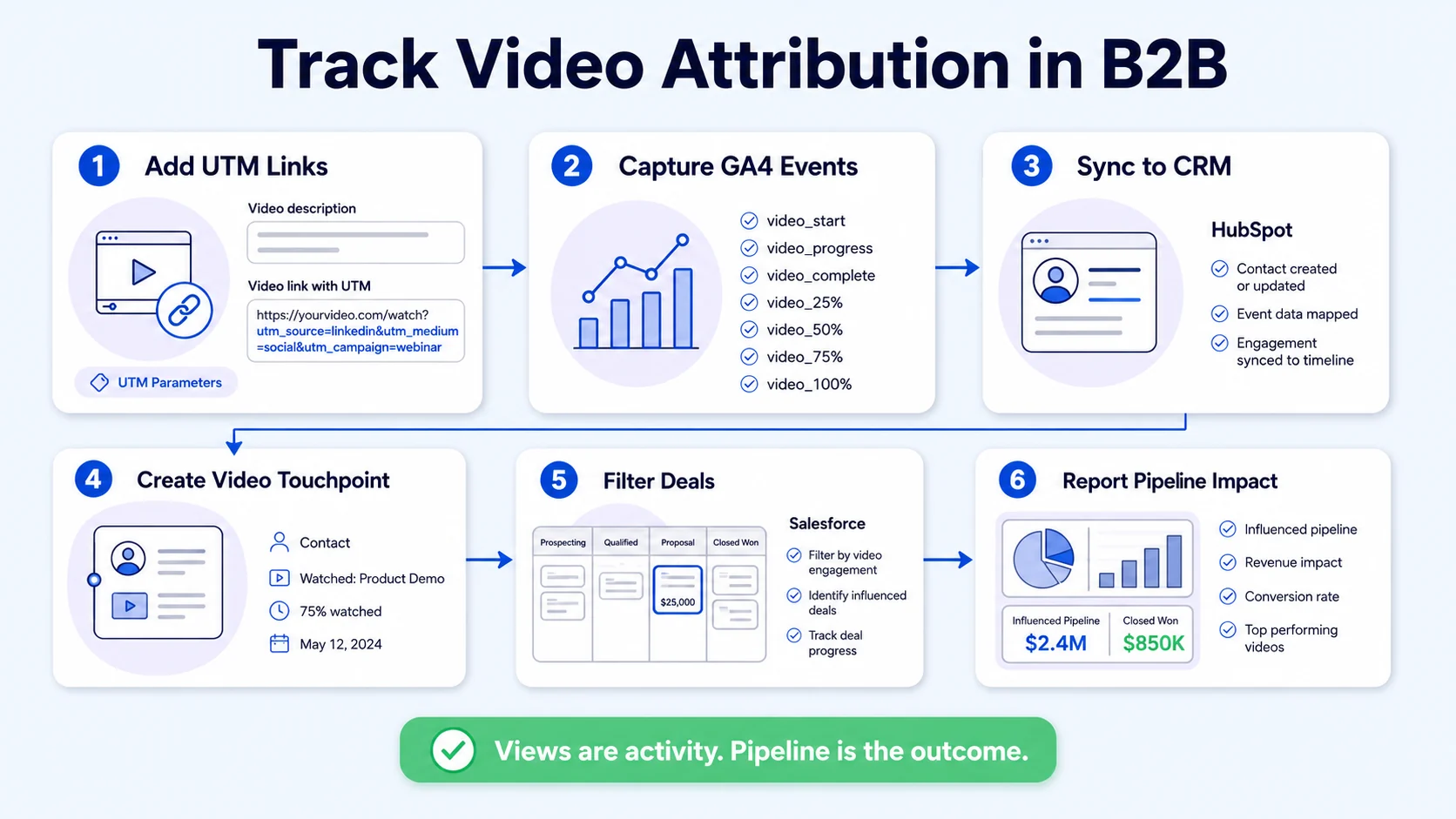
The step-by-step process to connect YouTube-sourced leads to your CRM:
- Add UTM parameters to every link in video descriptions: utm<span style="font-style:italic;">source=youtube, utm</span>medium=video, utm<span style="font-style:italic;">campaign=[campaign</span>name].
- Enable GA4 Enhanced Measurement to capture video interaction events on your site.
- Push GA4 data to HubSpot CRM via the native integration or a connector like Zapier.
- Create a "Video Touchpoint" custom property in HubSpot and trigger it when a contact arrives from a video UTM source.
- Build a pipeline report filtering for deals where Video Touchpoint is populated.
Under 25% of B2B marketers rate their video measurement practices as "fair" according to 6sense, a systematic approach to video attribution is a genuine competitive advantage.
Attribution Models for Video and Podcast Marketers Explained
Multi-touch attribution is the process of assigning value to each marketing and sales touchpoint that influences a customer's decision. For video and podcast specifically, this matters because a prospect might watch three product videos over six weeks before booking a demo, and none of those views will get credit under a last-touch model.
Here's how the primary attribution models apply to B2B video and podcast content:
Attribution isn't an analytics project, it's a budget allocation project. Every month you rely on single-touch attribution, you systematically over-invest in "deal closer" channels like paid search while under-investing in the awareness and nurturing channels, content, email, organic, that create purchase intent in the first place. Multi-touch attribution is essential when deals involve long cycles, multiple stakeholders, and 6–15+ touchpoints tied to CRM revenue. That description fits almost every B2B SaaS buying journey.
For most B2B teams, a W-shaped or position-based model is the practical starting point; it credits podcast discovery, mid-funnel video engagement, and demo conversion without requiring the data volume that algorithmic models demand.
Best Attribution Tools for B2B Video Campaigns 2026
The right Content Analytics Platform depends on where your video lives and how tightly it needs to connect to revenue data.
Tool choice depends on your stack: GA4 covers the basics, while platforms like Dreamdata, HubSpot, Rockerbox, LeadsRx, and factors.ai link attribution to pipeline and revenue. Most B2B teams use both YouTube and Wistia: YouTube for organic discovery and Wistia for conversion-focused video hosted on their own website. That hybrid approach gives you reach attribution (YouTube Studio) alongside pipeline attribution (Wistia + CRM).
For podcast-specific analytics, Spotify for Podcasters and Transistor FM provide audience retention curves and device data, but they don't connect to CRM natively. The bridge is always UTM-tagged episode links in show notes, which we cover in the next section.
If you're running short-form video as part of a broader content distribution system, the platform setup above gives you the measurement infrastructure to prove its pipeline contribution, not just its view count.
What UTM Parameters to Use for Podcast Links and Video Content
As marketing touchpoints multiply, UTM tracking becomes the foundation for multi-touch attribution, by tagging every channel consistently, you can trace the complete customer journey from first click to conversion. For podcast attribution specifically, give every episode a dedicated landing page with UTMs on every link so you can see exactly where traffic and conversions begin.
The recommended UTM structure for podcast episodes:
- utm<span style="font-style:italic;">source, the platform (e.g., spotify, apple</span>podcasts, transistor)
- utm_medium, always podcast
- utm<span style="font-style:italic;">campaign, episode identifier (e.g., ep</span>47<span style="font-style:italic;">saas</span>attribution)
- utm<span style="font-style:italic;">content, link location (e.g., show</span>notes, bio<span style="font-style:italic;">link, guest</span>share)
- utm_term, guest name or topic tag (optional, useful for guest-to-pipeline tracking)
For video content:
- utm<span style="font-style:italic;">source, platform (youtube, wistia, linkedin</span>video)
- utm_medium, video
- utm_campaign, campaign or series name
- utm<span style="font-style:italic;">content, video title or CTA type (demo</span>request<span style="font-style:italic;">cta, description</span>link)
Teams that standardize UTM naming conventions see a 29% improvement in campaign attribution accuracy, per CXL Institute's 2025 research. Consistency matters more than complexity. Use lowercase, use underscores, and enforce conventions with a shared naming doc. 30% of companies skip UTM markup in over 30% of their campaigns, per Improvado's 2025 research, the result is fragmented data and attribution that systematically undercounts your best-performing content.
For podcast marketing and podcast production, the UTM structure above combined with a dedicated episode landing page gives you the first-party data layer that makes every other attribution tool work correctly.
How Dark Social Affects Podcast and Video Attribution Accuracy
This is where most B2B attribution models quietly break down, and where the real influence of podcast and video content gets invisible. 84% of all B2B content is shared through private channels, dark social, rather than public social networks, based on RadiumOne's research across 940 million users. When a VP of Engineering shares your podcast episode in a Slack thread, your analytics sees zero. When a buying committee forwards your product demo to three colleagues via email, GA4 logs it as direct traffic.
B2B buyers now complete 70–80% of their purchase journey before ever engaging with a sales representative, according to Gartner 2025/2026 research. For video and podcast content specifically, formats that often live outside your tracked website environment, this dark social problem is acute.
Traditional attribution tools completely miss dark funnel channels such as Slack conversations, LinkedIn DMs, podcast mentions, community recommendations, and word-of-mouth. Self-reported attribution fills that gap by capturing the channels and moments that actually influenced the buying decision but left no digital footprint.
Practical tactics to surface dark social influence from video and podcast content:
- Add "How did you hear about us?" to every demo request and contact form, with "Podcast" and "Video" as explicit options.
- In GA4, segment your direct traffic by landing page, filter out homepage and branded pages, and what remains, direct traffic to deep content pages, is overwhelmingly dark social shares.
- Use branded short links (Bitly or Rebrandly) for podcast show notes so that when someone shares the link privately, you still capture click data.
- Track spikes in branded search volume or direct traffic during and after podcast appearances on external shows.
Self-reported attribution is one of the highest-leverage tactics available, because it surfaces signals that no software-based model can detect.
Measuring ROI from Podcast Sponsorships and Content in B2B
Without attribution, podcast marketing falls in the category of top-of-funnel channels that get cut when budgets shrink, not because it fails, but because you can't prove it works.
The measurement framework for podcast advertising and content ROI runs across three layers:
Layer 1, Direct attribution: UTM-tagged show notes links, dedicated episode landing pages, and promo codes tied to specific episodes. Every click from a listener is traceable.
Layer 2, Influenced pipeline: Track podcast touches in your CRM with fields for podcast engagement (first touch and influenced) and episode or guest names, then report on monthly influenced pipeline and quarterly closed-won deals that included a podcast touchpoint.
Layer 3, Velocity and deal quality: Track velocity impact demonstrating how podcast-engaged prospects close faster, and present executives with a quarterly pipeline impact report showing total influenced revenue, not download charts. 59% of B2B decision-makers listen to podcasts during work hours, meaning your episodes reach prospects while they're actively evaluating solutions. 75% of B2B decision-makers listen to podcasts, with 51% listening daily.
The most important CRM configuration for podcast ROI:
- Create a custom "Podcast Touchpoint" property on the Contact object in HubSpot CRM.
- Tag it with: episode name, guest name, and whether it was a first-touch or influenced touch.
- Associate podcast-sourced contacts to open opportunities.
- Build a report: Deals where Podcast Touchpoint is populated, filtered by Closed Won.
- Calculate influenced ARR and average deal velocity versus non-podcast deals.
If reporting stops at downloads, leadership sees a media line item. If reporting shows account engagement, sales usage, and pipeline touchpoints, the show starts to earn a place in the demand generation budget.
Common Mistakes in Video and Podcast Attribution Tracking
Most B2B teams make the same five attribution errors, and each one systematically undervalues their content investment.
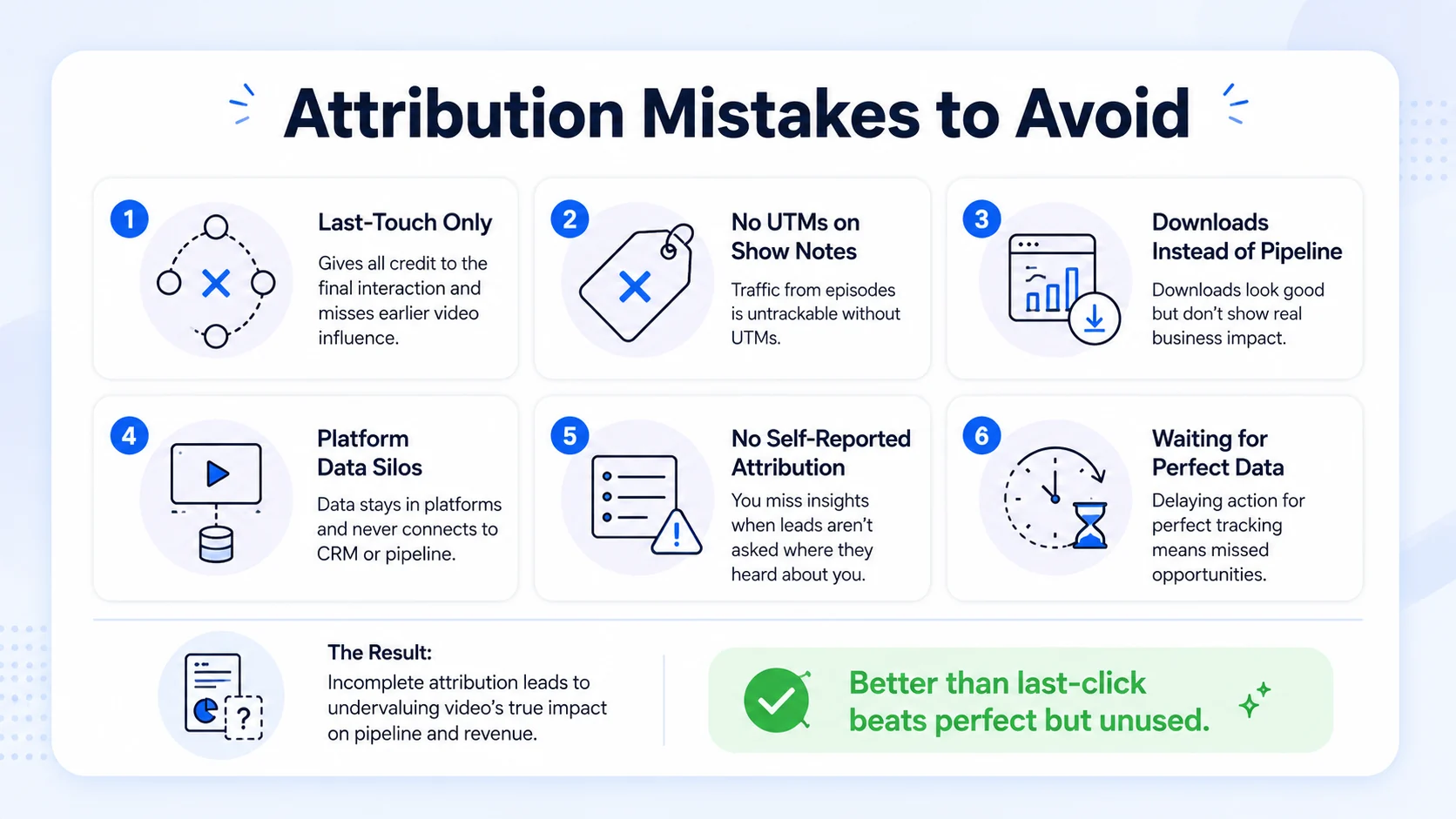
Mistake 1, Relying on last-touch only: 67% of B2B marketing teams still rely on last-touch attribution, per Visionary Marketing's March 2026 analysis. Combined with the Forrester benchmark of 27+ touchpoints across 6–12 month sales cycles, single-touch attribution credits 1 out of 7 touches on average, leaving 86% of the journey with zero credit.
Mistake 2, No UTMs on podcast show notes: Every episode link without a UTM is attribution data you'll never recover. Start with UTM-tagged landing pages for every episode, when guests share their episode, you're tracking first-touch attribution; when listeners click through show notes, that's mid-funnel engagement.
Mistake 3, Measuring downloads instead of pipeline: Most B2B companies can't connect their podcast investments to pipeline. They track downloads, celebrate growth metrics, and hope for the best. Meanwhile, boards demand proof of revenue impact, not vanity statistics.
Mistake 4, Treating video platforms as silos: YouTube Studio Insights and Spotify for Podcasters don't talk to your CRM on their own. Without a UTM-to-CRM workflow, every view and listen is invisible to your revenue intelligence stack.
Mistake 5, No self-reported attribution layer: Use simple form fields like "How did you hear about us?" with a controlled Podcast option, this captures self-reported attribution tied to real contacts. This is the only method that captures dark social influence from podcast and video content.
Mistake 6, Waiting for perfect data: Attribution is inherently imperfect, no model captures 100% of buyer influence. The goal is "better than last-click," not "perfect."
The video marketing services and video editing services you invest in are only as defensible as the attribution system behind them, which is why getting the measurement layer right is as important as the content itself.
Conclusion
Attribution for video and podcast content is a revenue intelligence problem, not a technical one. Here's what the best B2B teams in 2026 do differently:
- They use multi-touch attribution models, W-shaped or position-based, to capture the full buyer journey across video and podcast touchpoints.
- They build a three-layer measurement stack: UTM Parameter Tracking for direct attribution, CRM integration via Wistia Video Analytics or Vidyard for influenced pipeline, and self-reported attribution to surface dark social.
- They report on influenced ARR and deal velocity, not views, downloads, or completion rates.
- They treat attribution setup as a pre-production requirement, not an afterthought.
If you're producing video or podcast content without a clear pipeline measurement system behind it, reach out to Komet Media, we build the full system, from content to attribution.
Frequently Asked Questions
Q1: What is multi-touch attribution for podcast marketing?
Multi-touch attribution for podcast marketing is the practice of assigning revenue credit to every touchpoint in a buyer's journey that involves podcast content, from first listen, to episode shares, to show notes clicks, rather than crediting only the last interaction before a deal closes. It connects podcast activity to CRM opportunities and pipeline.
Q2: How do I attribute leads from YouTube to my CRM?
Add UTM parameters (utm<span style="font-style:italic;">source=youtube, utm</span>medium=video, utm_campaign=[name]) to every link in video descriptions and CTAs. Enable GA4 Enhanced Measurement, connect GA4 to HubSpot CRM or Salesforce, and create a custom "Video Source" property on Contact records. Any lead who arrives via a YouTube UTM is automatically tagged and attributable to that video asset.
Q3: What UTM parameters should I use for podcast show notes links?
Use five parameters: utm<span style="font-style:italic;">source (the podcast platform, e.g., spotify), utm</span>medium=podcast, utm<span style="font-style:italic;">campaign (episode identifier), utm</span>content (link placement, e.g., show<span style="font-style:italic;">notes), and optionally utm</span>term for guest name tracking. Apply this structure to every clickable link in every episode, including guest-shared links using a branded short URL.
Q4: How does dark social affect podcast attribution accuracy?
Dark social causes podcast influence to appear as "direct" traffic in GA4, because listeners share episode links in Slack, email, or WhatsApp without referral tags. The fix is a three-part approach: UTM-tagged branded short links for all episode assets, a "How did you hear about us?" field on all inbound forms, and monitoring branded search volume spikes after episode publications.
Q5: Which attribution model is best for B2B video content?
For most B2B SaaS teams, a W-shaped (position-based) model is the best starting point, it assigns weighted credit to video first touch, mid-funnel engagement (such as a product demo view), and the final conversion touchpoint. This reflects how video actually works in a multi-stakeholder buying journey without requiring the data volume that algorithmic models need.
Q6: What is the difference between Wistia and YouTube for B2B video attribution?
YouTube delivers organic reach and discovery data through YouTube Studio Insights, but doesn't natively connect to your CRM. Wistia Video Analytics provides person-level engagement heatmaps, in-video lead capture forms, and direct HubSpot integration, making it the stronger choice for conversion-stage video attribution. Most B2B teams use YouTube for top-of-funnel distribution and Wistia for pipeline-connected video on owned channels.