
🪄 AI Summary
Heading 1
Heading 2
Heading 3
Heading 4
Heading 5
Heading 6
Lorem ipsum dolor sit amet, consectetur adipiscing elit, sed do eiusmod tempor incididunt ut labore et dolore magna aliqua. Ut enim ad minim veniam, quis nostrud exercitation ullamco laboris nisi ut aliquip ex ea commodo consequat. Duis aute irure dolor in reprehenderit in voluptate velit esse cillum dolore eu fugiat nulla pariatur.
Block quote
Ordered list
- Item 1
- Item 2
- Item 3
Unordered list
- Item A
- Item B
- Item C
Bold text
Emphasis
Superscript
Subscript
If you run a SaaS team or lead growth at a funded startup, short-form video is no longer a brand awareness experiment. Buyers are watching. Decision-makers are scrolling LinkedIn before they book a demo. The question isn't whether to use short-form video, it's whether your team is building it intentionally or leaving a pipeline on the table. This piece pulls the most relevant data for B2B teams in 2026 so you can make smarter bets on where to invest, what formats convert, and which platforms are actually moving the needle.
TL;DR
- Short-form video is the highest-engagement format across B2B buyer journeys in 2026
- LinkedIn video outperforms text posts for decision-maker reach at every funnel stage
- Videos under 90 seconds consistently see higher completion rates in B2B contexts
- Repurposing existing content (webinars, podcasts, demos) into short clips remains the highest-ROI production path for SaaS teams
What Percentage of B2B Buyers Watch Short-Form Video Before Making Decisions?
The buyer research phase has shifted. Before a prospect books a demo or replies to an outreach, they are watching content, specifically short-form video content from founders, product teams, and brand channels. This is one of the most consequential behavioral changes in B2B marketing over the past three years.
Wistia's 2025 State of Video report confirms that video has become a dominant format in business content consumption, with short-form clips earning significantly higher engagement than long-form alternatives at the awareness stage.
What this means practically for SaaS teams:
- Founder-led clips: Short videos where a founder explains a problem or product decision earn outsized trust with cold audiences
- Product explainers: Sub-90-second clips demonstrating a single feature outperform full demo recordings for early-stage engagement
- Social proof snippets: Customer story clips shared on LinkedIn consistently appear in feeds at the research stage
The buyer journey in B2B is longer than in B2C, but the touchpoints are faster. A decision-maker may spend 40 seconds watching a LinkedIn video before they ever read a case study. If that 40 seconds lands, it earns the next click. If it doesn't, the opportunity is gone.
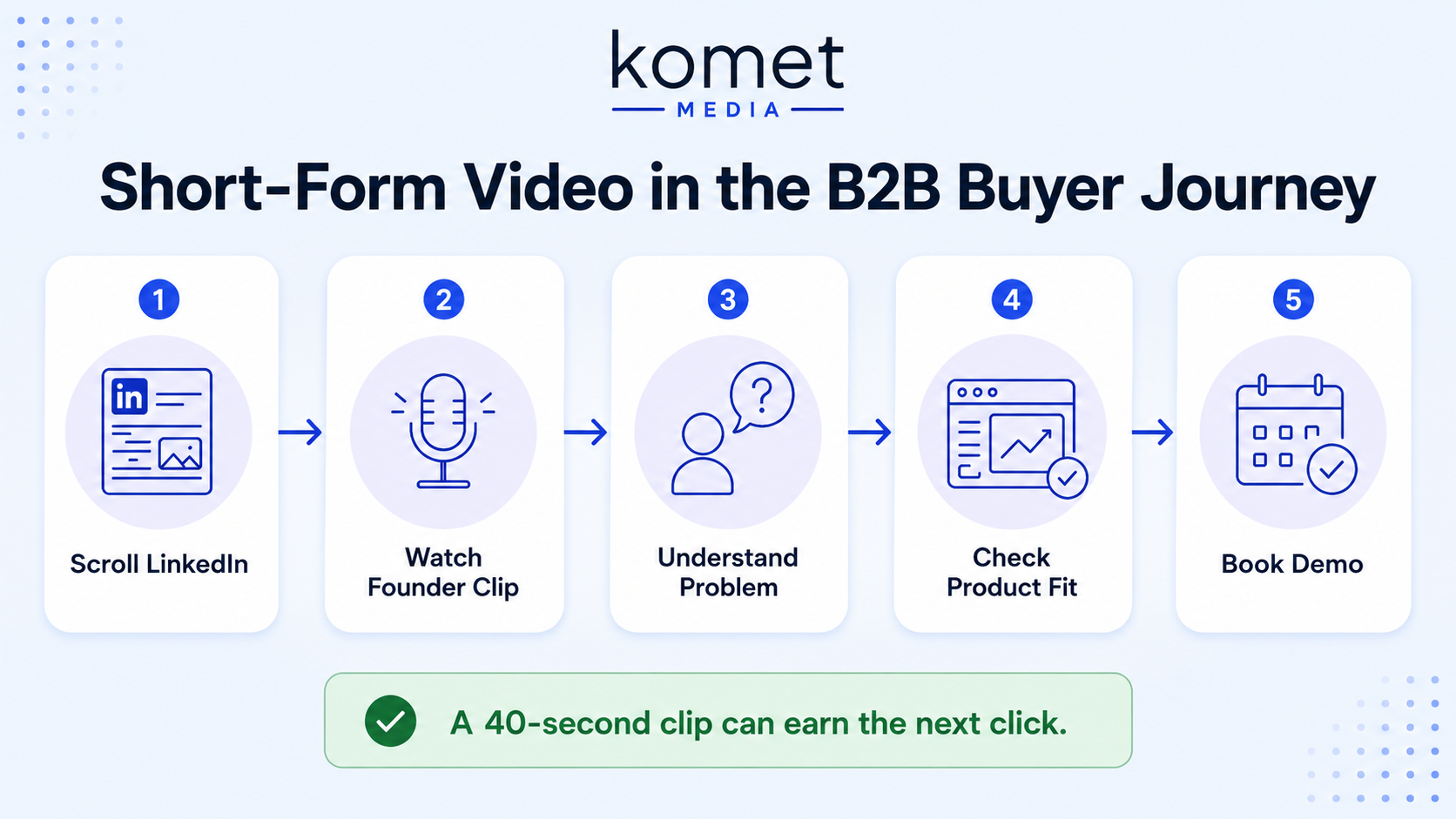
For SaaS teams specifically, the implication is straightforward: your product knowledge, founder thinking, and customer results already exist. They're sitting inside webinar recordings, podcast episodes, and sales call replays. Turning that material into short, punchy clips is not a content volume play. It is a buyer education play. The teams treating it that way are seeing it show up in the pipeline.
Short-form video content that addresses a specific buyer problem in under 60 seconds is consistently among the highest-performing formats for B2B awareness and top-funnel demand generation.
The production barrier has also dropped. Teams do not need broadcast-quality equipment. They need clarity of message, a consistent output cadence, and a deliberate repurposing workflow. That's where Komet Media's short-form video editing service sits for most of the SaaS teams we work with.
Short-Form Video ROI for B2B Marketing in 2026: Which Platforms Deliver
Measuring ROI from short-form video in B2B has historically been difficult because attribution is messy. A prospect watches a LinkedIn clip, gets curious, Googles the brand, and books a demo. The video gets zero credit in most CRMs. That attribution gap has caused many teams to underinvest, even when their pipeline tells them otherwise.
Here is how the main platforms compare for B2B teams:
LinkedIn remains the highest-confidence platform for B2B video ROI. The audience is self-selected by professional role and industry. A clip posted by a founder or executive reaches the right people without paid amplification, particularly when it addresses a specific pain that their buyers care about.
YouTube Shorts functions differently. It creates lasting discoverability. A short clip explaining a common SaaS problem can drive search traffic for months, functioning as a top-of-funnel asset rather than a feed-dependent post.
Wistia's video marketing research consistently shows that shorter videos retain viewers at significantly higher rates than longer recordings, which supports the case for breaking down webinars and demos into focused clips rather than posting full recordings.
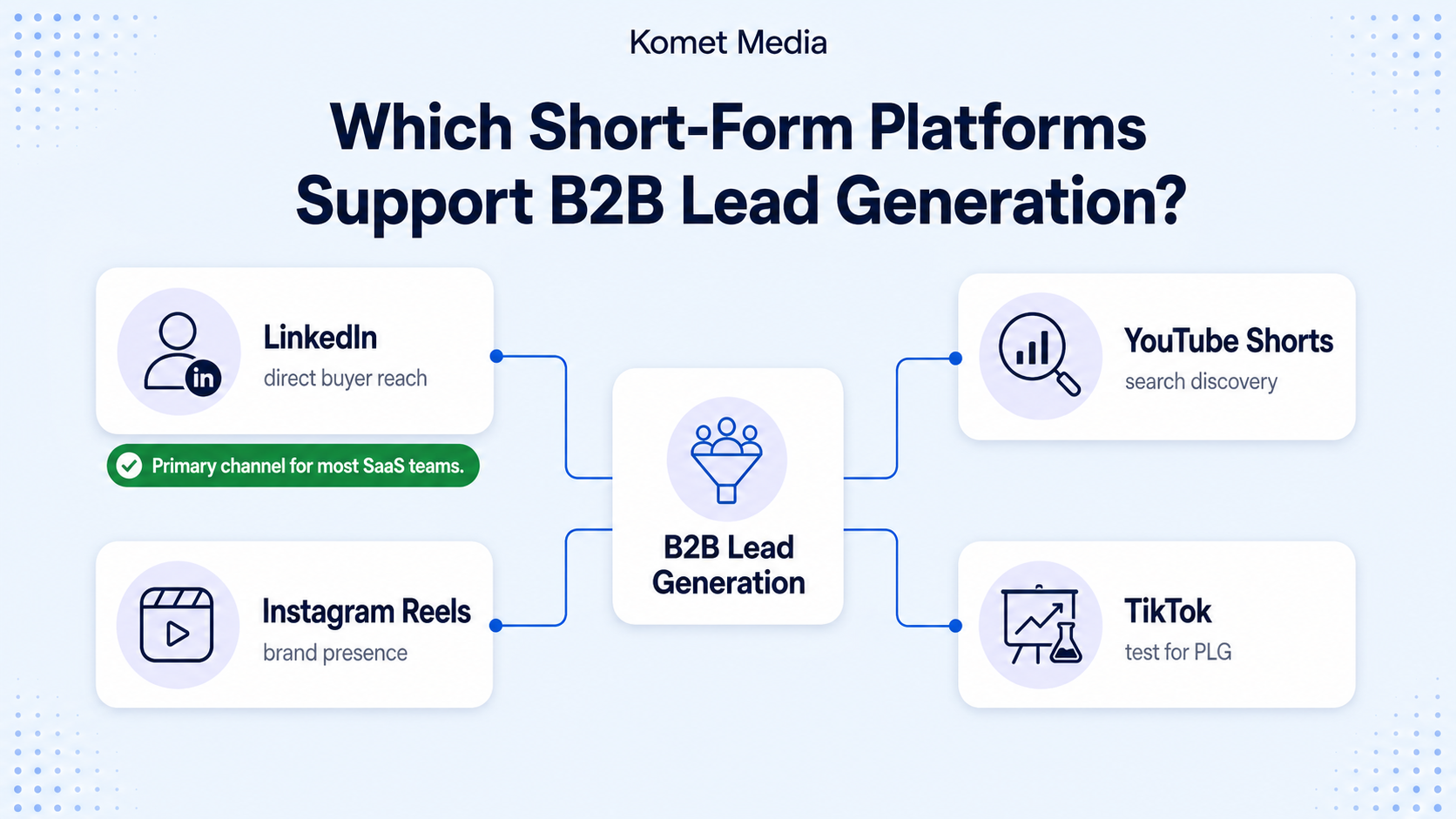
For most B2B SaaS teams, the right answer is LinkedIn as the primary distribution channel with YouTube Shorts as a secondary discovery layer. Instagram Reels matters for hiring and culture. TikTok is worth testing if you're targeting younger buyers or PLG motions. Building the content once and distributing across platforms is the efficient path.
How Long Should a B2B Short-Form Video Actually Be for Maximum Engagement?
Length is one of the most debated variables in B2B video strategy. The honest answer: it depends on the goal, but the data points are consistently shorter than most teams expect.
General guidelines supported by platform behavior and completion rate data:
- LinkedIn video for awareness: 30 to 90 seconds performs best for cold audiences
- Product explainer clips: 60 to 120 seconds if walking through a specific feature or use case
- Thought leadership takes: 45 to 75 seconds for opinion-led content from founders or executives
- Customer story snippets: 30 to 60 seconds for social proof clips distributed at the research stage
The underlying reason is simple. B2B buyers are not consuming video in a relaxed, entertainment mindset. They are scrolling LinkedIn between meetings. If a video does not communicate value in the first five seconds, they move on. Length is secondary to hook quality, but shorter videos give weaker hooks less runway to fail.
Wistia's engagement data shows a clear inverse relationship between video length and completion rate. The longer the video, the fewer people finish it. For awareness content, completion rate is a meaningful signal.
Where teams get this wrong: they conflate educational content with long content. A 90-second clip can educate a buyer on an integration, a pricing model, or a feature they didn't know existed. It does not need to be a 10-minute walkthrough to do real work in the funnel.
At Komet Media's video marketing service, the starting point with every SaaS client is identifying the specific moment in the buyer journey each clip is meant to serve. That informs format, length, and platform simultaneously. The mistake most teams make is producing content first and asking where it fits later.
What Short-Form Video Platforms Actually Work for B2B Lead Generation?
The platform question matters more than most teams admit. Producing great video on the wrong platform is a waste of your team's time and your budget.
For B2B lead generation specifically, platform selection should follow audience concentration and buyer intent. Here is the practical breakdown:
- LinkedIn is the clear primary platform for B2B lead generation with video. Founders and executives who post consistently with native LinkedIn video see measurable increases in inbound connection requests, DM volume, and demo requests. The algorithm rewards video content with reach that text posts rarely match. It is also the only major platform where professional identity is the core data point, meaning your content reaches people by job title and company type.
- YouTube Shorts functions as a discovery engine. Short clips that answer search-intent questions ("how to reduce SaaS churn," "what is a PLG motion") can generate sustained organic traffic long after posting. Unlike LinkedIn, the content is not feed-dependent. It compounds over time.
- Instagram Reels supports brand awareness and thought leadership for founders visible outside pure B2B circles. It also supports recruiting and culture content. Direct lead generation is less reliable here without paid support.
- TikTok for Business is worth acknowledging. Enterprise adoption is slower, but younger SaaS buyers and growth practitioners are active on the platform. For teams targeting PLG motions or developer audiences, it has shown early results for some B2B brands. It is a test budget, not a primary channel.
One point often missed: B2B lead generation from short-form video is rarely direct. The video creates familiarity. Familiarity earns trust. Trust converts when the buyer is ready. Teams that measure video success purely on immediate click-through miss the compounding effect on inbound pipeline over 60 to 90 days.
If your team is running webinars or podcasts, those long-form assets are the source material for this entire distribution system. The clips live downstream of your existing content engine.
Short-Form Video Engagement: B2B vs B2C Comparison
The common assumption is that B2C audiences are more engaged with video because the content is more entertaining. The data is more nuanced.
B2B video engagement looks lower by volume. But volume is the wrong metric. A B2B clip watched by 400 CFOs at mid-market SaaS companies outperforms a B2C clip watched by 40,000 consumers when your product costs $50K per year.
The meaningful engagement signals in B2B are shared within professional networks, saves, DM responses from target personas, and profile visits from decision-makers. These are soft signals that rarely show in platform analytics dashboards but matter more than view counts.
B2C video benefits from entertainment value and emotional hooks. B2B video benefits from insight density and problem specificity. The best B2B short-form video feels like it was made for a very specific person facing a very specific problem. Generalist content gets scrolled past. Specific content stops the right buyer cold.
Are B2B Companies Seeing ROI from TikTok and Instagram Reels?
The short answer: some are, most are not yet measuring it correctly.
TikTok and Instagram Reels are underutilized in pure B2B SaaS contexts, but that does not mean they are irrelevant. The more accurate frame is that they serve different functions than LinkedIn in a B2B content system.
Where Reels and TikTok do generate real returns for B2B teams:
- Brand search volume: Founders who build a visible presence on Instagram often see an increase in branded search queries, which lifts SEO-driven demo requests
- Hiring pipeline: Engineering and marketing talent actively uses both platforms; culture clips and behind-the-scenes content perform well for recruiting
- Community recognition: SaaS practitioners follow each other across platforms; being visible outside LinkedIn reinforces credibility across the buyer committee
- Retargeting audiences: Pixel-based retargeting with Instagram Reels ads remains one of the more cost-efficient ways to stay in front of warm B2B audiences
The ROI question often fails because teams apply B2C metrics to B2B video on these platforms. Measuring TikTok clips by follower growth is the wrong lens. Measuring them by the quality of inbound conversations, brand recognition in discovery calls, and hiring funnel improvement is more accurate.
Komet Media's Instagram marketing services are built for exactly this context: B2B teams that need social presence to support the pipeline, not go viral. The content strategy is different. The production standards are the same.
For funded SaaS teams specifically, the bar for Instagram and TikTok investment should be: does this build brand surface area with buyers, candidates, and investors? If yes, it earns a budget alongside LinkedIn, not instead of it.
How Are VC Firms and Funded Startups Using Short-Form Video for Investor Relations and Deal Flow?
This is one of the most underexplored applications of short-form video in B2B, and one of the highest-leverage for funded and pre-IPO teams.
VC firms are increasingly active on LinkedIn and YouTube with short-form content. The reason is straightforward: the best founders are now evaluating investors based on their thinking, track record, and thesis clarity before taking meetings. A partner who publishes regular short-form video on portfolio building, market theses, or founder lessons creates inbound deal flow without outreach.
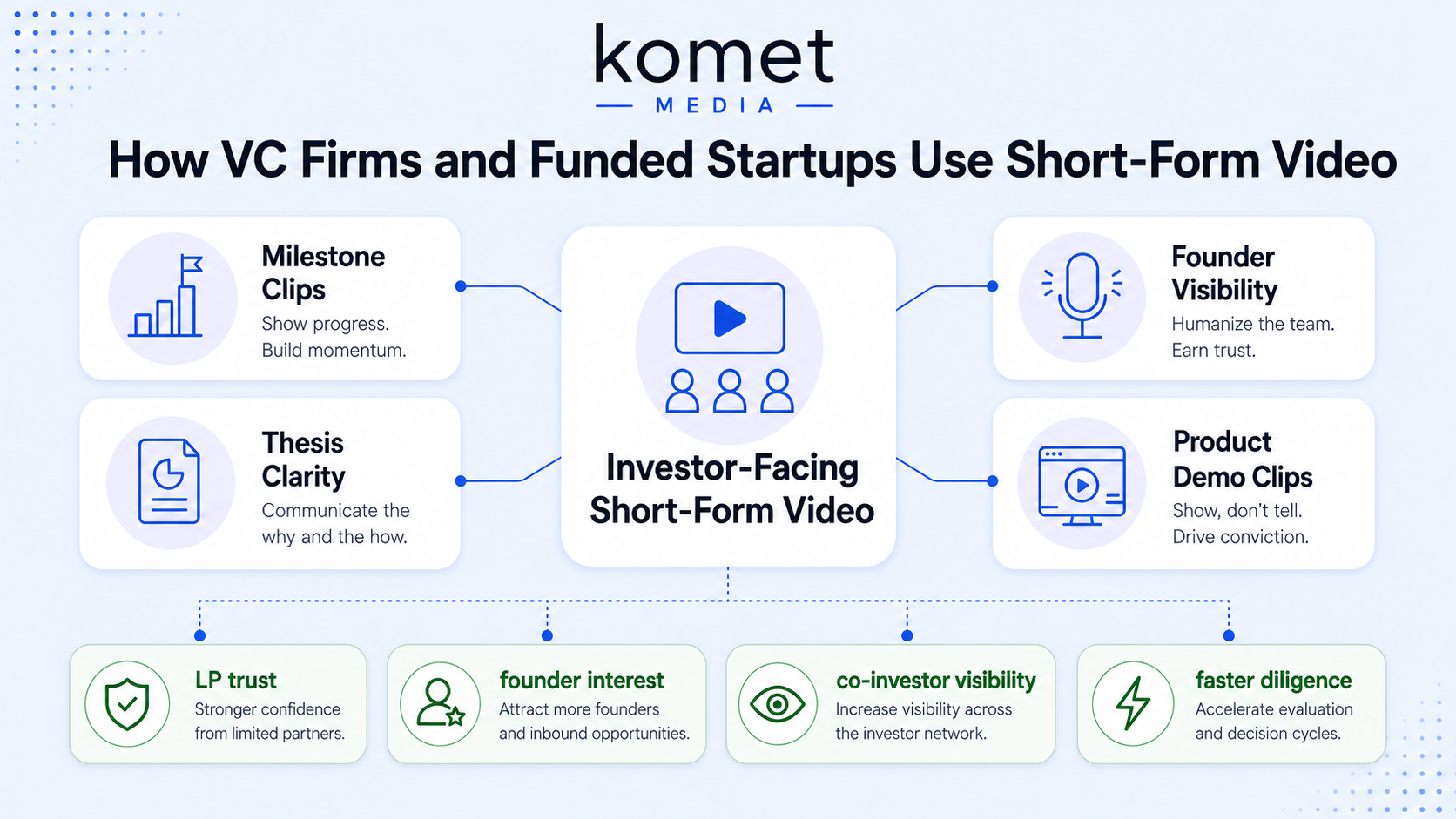
For funded startups, short-form video supports investor relations in specific ways:
- Milestone clips: Short updates on growth metrics, product launches, or partnership announcements shared on LinkedIn reach existing LPs and prospective co-investors
- Founder visibility: Founders who are publicly visible through consistent video content attract secondary interest from follow-on investors
- Thesis articulation: Clear, short videos explaining market positioning help investors understand the bet faster than a pitch deck alone
- Demo environment clips: Showing the product in action through short clips reduces friction for investors conducting preliminary diligence
The production standard for these clips does not need to be high. Authenticity outperforms polish in investor-facing content. What matters is clarity of thought, consistency of output, and direct communication of progress.
For startups already running webinars, board update recordings, or external-facing demos, the raw material for an investor-relations video library already exists. Repurposing that into short LinkedIn-ready clips is a low-cost, high-signal strategy. Teams interested in building that system can get in touch with Komet Media here.
Conclusion
Short-form video is not a nice-to-have for B2B SaaS teams in 2026. It is an active channel in the buyer journey, and the teams who treat it strategically are seeing it show up in pipeline, inbound, and sales velocity.
Key takeaways:
- LinkedIn video is the highest-ROI platform for B2B short-form content, full stop
- Keep videos under 90 seconds for awareness; under 60 seconds for social proof
- Your existing long-form content (webinars, podcasts, demos) is already the raw material
- Measure engagement quality over volume: one view from a target CFO beats a thousand passive scrolls
Frequently Asked Questions
Q1: What is the best length for a B2B short-form video in 2026?
For awareness content on LinkedIn, 30 to 90 seconds performs best. Product explainers can extend to 120 seconds if walking through a specific use case. The rule: stop when the point is made, not when the time runs out.
Q2: Which platform generates the most B2B leads from short-form video?
LinkedIn is the strongest platform for direct B2B lead generation through video. YouTube Shorts adds compounding discoverability. Instagram Reels and TikTok support brand surface area, hiring, and retargeting, but are secondary to LinkedIn for lead gen.
Q3: How does short-form video ROI get measured in B2B?
Track profile visits from target personas, inbound DMs referencing your content, demo request quality, and branded search volume over 60 to 90 days. View counts alone are a weak indicator. The impact is often felt in pipeline 2 to 3 months after consistent posting begins.
Q4: Can a B2B SaaS team repurpose existing webinar content into short-form video?
Yes, and this is one of the highest-ROI production paths available. A single 60-minute webinar can yield 8 to 12 standalone short clips covering individual insights, data points, or product moments. The source material already exists. It just needs to be cut correctly.
Q5: Are VC firms using short-form video to attract deal flow?
Increasingly, yes. Partners who publish consistent short-form video on LinkedIn around thesis, portfolio lessons, and market views generate inbound founder interest without cold outreach. It functions as a trust-building channel in the same way it does for SaaS sales cycles.
Q6: How often should a B2B team post short-form video to see results?
Two to four posts per week on LinkedIn is a productive cadence for most funded SaaS teams. Consistency matters more than frequency. A team posting three quality clips per week for 90 days outperforms one that posts 20 clips in a month and then goes silent.