
🪄 AI Summary
Heading 1
Heading 2
Heading 3
Heading 4
Heading 5
Heading 6
Lorem ipsum dolor sit amet, consectetur adipiscing elit, sed do eiusmod tempor incididunt ut labore et dolore magna aliqua. Ut enim ad minim veniam, quis nostrud exercitation ullamco laboris nisi ut aliquip ex ea commodo consequat. Duis aute irure dolor in reprehenderit in voluptate velit esse cillum dolore eu fugiat nulla pariatur.
Block quote
Ordered list
- Item 1
- Item 2
- Item 3
Unordered list
- Item A
- Item B
- Item C
Bold text
Emphasis
Superscript
Subscript
I'm Rajan Soni, founder of Komet Media. Most B2B SaaS and AI teams I talk to are sitting on a library of demos, webinar recordings, and founder talks, and doing nothing short-form with any of it. That's a pipeline problem. A solid YouTube Shorts strategy for B2B SaaS & AI/Tech startups turns existing product knowledge into buyer education at scale. This guide covers everything: the algorithm, content types, cadence, conversion, and how to stack Shorts against LinkedIn, so your team can act on this immediately.
TL;DR
- 74% of Shorts views come from non-subscribers, making it YouTube's primary discovery format, a major advantage for SaaS teams building brand-new audiences.
- Shorts work for B2B when the content educates, not entertains. Product demos, founder POVs, and feature explainers all convert.
- Post 3–5 quality Shorts per week, optimise for 65%+ retention, and link each video to a long-form asset or demo CTA.
- The real ROI is downstream: Shorts fill the top of the funnel; long-form and demos close it.
Does YouTube Shorts Actually Work for B2B, or Is It Just B2C?
The honest answer: it depends on what you put in it. The platform is not the problem, the content strategy is. Buyers are no longer reading 20-page whitepapers; they're watching short videos on YouTube. According to Amra & Elma's B2B Video Marketing Statistics 2026, 96% of B2B marketers now see positive ROI from short-form videos. The fear most SaaS teams have is that YouTube Shorts is too consumer-facing. It is not.
YouTube Shorts has 2 billion monthly users, ahead of TikTok (1.59B) and Instagram Reels (1.8B), and leads all short-form platforms in engagement with a 5.91% rate. That audience includes your buyers, specifically the 25–44 cohort that dominates most B2B purchasing committees. The format also offers something LinkedIn cannot replicate: search-indexed discoverability.
Educational clips on YouTube Shorts compound in search for 12 to 18 months after posting , meaning a well-titled product explainer keeps surfacing long after publication. LinkedIn posts disappear from feeds in 24–48 hours. B2B video achieves a 4.8% conversion rate versus 2.9% for sites without video, a 65% improvement, and message retention reaches 95% for video versus 10% for text. Those numbers make a compelling case for any SaaS growth team trying to shorten the sales cycle.
The caveat is this: Shorts fail for B2B when teams treat them like entertainment content. The winning approach is to treat every Short as a compressed buyer education asset. One problem, one insight, one CTA. That's the product. Short-form video is not a brand awareness toy. For SaaS and AI/tech startups, it is a pipeline asset, if you build it with buyer intent.
What Types of YouTube Shorts Content Work Best for Software Companies?
The highest-performing B2B Shorts formats are built around product proximity and founder thinking, not trend audio or aesthetic cuts. Here's what actually moves the needle for SaaS and AI/tech teams:
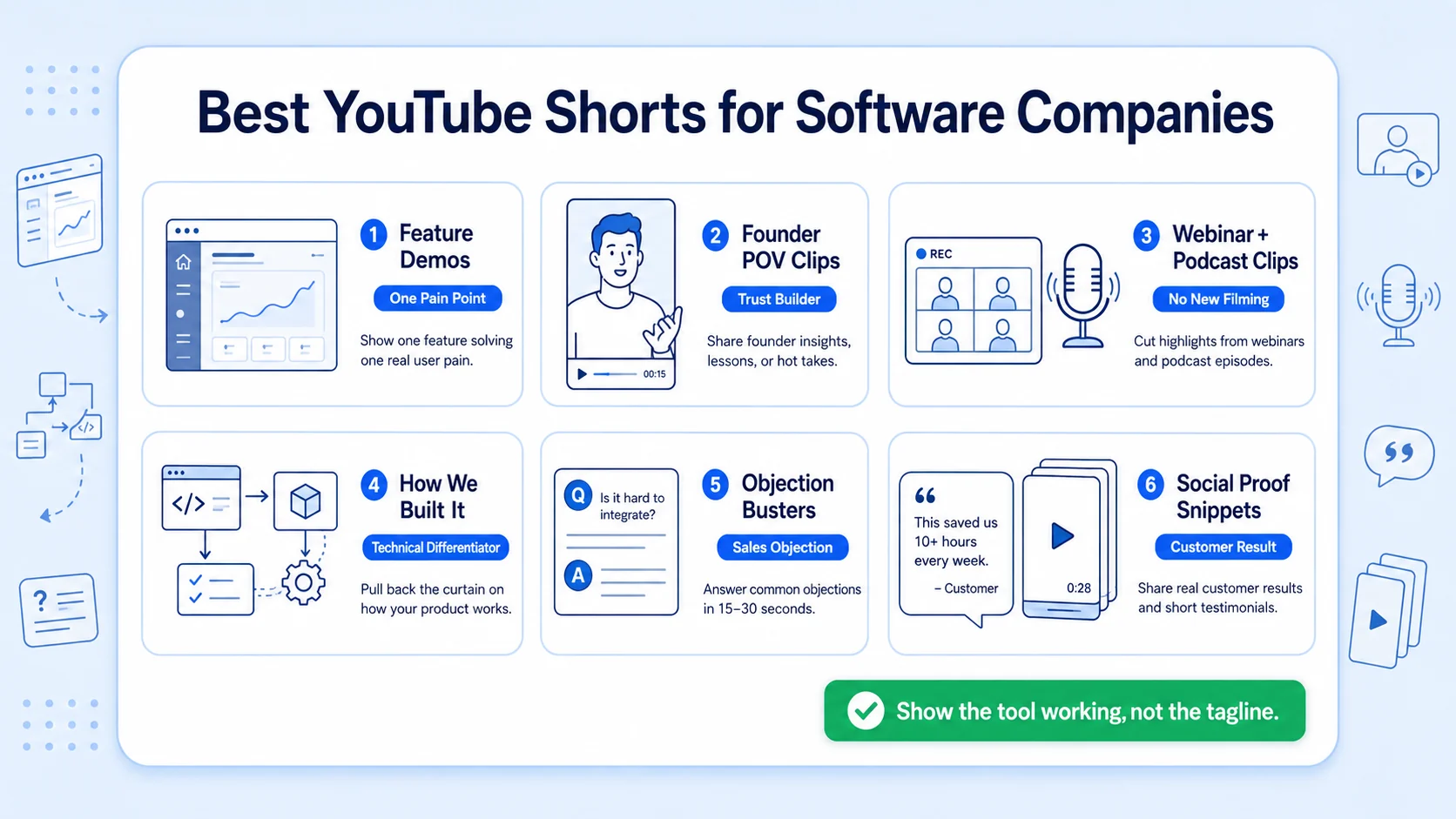
Content types that convert, ranked by buyer-education value:
Feature demos: 30–45 second screen captures showing one product capability solving one specific pain point. No fluff, no intro music, just the outcome.
Founder POV clips: 30–60 second talking-head moments where the founder shares a contrarian take, a product philosophy, or a lesson from building. This drives trust at the top of the funnel.
Repurposed webinar and podcast clips: The highest-leverage format for resource-constrained teams. One 45-minute webinar can produce 8–12 Shorts with no new filming. Our content repurposing workflow at Komet Media is built specifically around this extraction model.
"How we built it" product stories: Especially powerful for AI/tech startups where the technical approach is a differentiator.
Buyer objection busters: Address the #1 sales objection in 45 seconds. These perform well because they map directly to consideration-stage buyers.
Social proof snippets: Short outcome quotes or results from customers, delivered as a montage or single-person clip.
Since October 2024, creators can upload Shorts up to 3 minutes long if the video is square or taller, giving brands more room for story, product education, and stronger hooks without leaving the Shorts format.
For AI and tech startups specifically, content that demonstrates the product working in real time consistently outperforms polished brand films. Buyers want to see the tool, not the tagline. Keep the vertical video format tight, put the hook in the first two seconds, and end with a single next step, subscribe, visit the link in bio, or book a demo.
How the YouTube Shorts Algorithm Works for B2B Teams in 2026
Understanding the algorithm is not optional if you want organic reach. The good news: the smallest accounts are growing the fastest. Channels with a few thousand subscribers more than tripled their views and saw interactions climb too, which means a SaaS startup with no existing audience can compete.
Here's how the algorithm evaluated Shorts as of mid-2026:
- Hook quality: The algorithm tests every Short with a small batch of viewers first, and strong early retention determines whether it gets pushed further. Your first two seconds are your distribution lever.
- Retention thresholds: Shorts ranking moved from swipe rate to watch time per impression. The new thresholds to get pushed wider are roughly 65% retention for sub-30-second Shorts and 50% retention for 30–60 second Shorts.
- Freshness: In December 2025, the Shorts algorithm began favoring uploads less than 30 days old over older evergreen Shorts. Consistent, recent posting now matters more than a viral back catalog.
- Satisfaction signals: Viewer satisfaction replaced raw watch time as the primary signal. YouTube now feeds 1–5 star pop-up surveys directly into ranking.
- Format separation: Shorts and long-form algorithms were formally separated. Bad Shorts no longer hurt long-form reach, and viral Shorts no longer pull viewers to long-form automatically. Each format is judged on its own merits.
For SaaS teams, this means you can run an aggressive Shorts cadence without risking your long-form demo or educational video performance. The two engines run in parallel. Build the Shorts library for discovery and audience retention metrics; build long-form for depth and conversion.
How Often Should a B2B SaaS Company Post YouTube Shorts?
Frequency is the question every SaaS marketing head asks me. The answer is not "as many as possible." Posting 3–5 high-quality Shorts per week on a consistent schedule outperforms daily low-effort uploads. For most B2B teams with limited production bandwidth, that is the sustainable floor. Here's the posting framework I recommend for SaaS and AI/tech startups:
Mix of new + repurposed content
Consistency matters more than any single video, especially since the algorithm began favoring fresh uploads in late 2025. For teams that can't sustain daily production, the answer is content repurposing. One recorded webinar or podcast episode can generate a full week of Shorts without a single new recording session.
Brands publishing 12 or more Shorts per month have seen a 35% reduction in Cost Per Lead compared to those relying solely on static ads. That is roughly three per week, a target most SaaS teams can hit when they have a repurposing system in place.
The trap to avoid: posting daily for two weeks, burning out, and going dark for a month. The algorithm penalises inconsistency harder than low volume. Build a 4-week content buffer before you go public with your Shorts channel.
YouTube Shorts vs LinkedIn Video for B2B SaaS: Which Platform Wins?
This is not a "pick one" decision, but understanding the role each platform plays prevents wasted spend. Here is the honest comparison:
Wistia's 2026 State of Video Report finds LinkedIn surpassed YouTube as the top B2B video channel, with 81% of businesses citing it as their primary platform. That is a meaningful data point, but it reflects where teams are posting, not necessarily where buyers are discovering new solutions. YouTube remains valuable for SEO-driven search content, product demonstrations, and long-form educational material.
For SaaS teams with a defined ICP, I recommend running both in parallel: LinkedIn for direct-to-decision-maker content targeting existing network and paid reach, YouTube Shorts for compounding organic discovery and video SEO. Both feed the same pipeline; they just enter at different stages.
YouTube accounts for 40% of B2B video distribution and ranks as the top-performing video marketing channel. Meanwhile, 17.13% of marketers chose short-form video as their top investment for 2026, the highest choice among all content formats.
How to Convert YouTube Shorts Viewers into SaaS Trial Signups and Pipeline
Discovery without conversion is just a content marketing charity. Here's the conversion framework I run with SaaS clients through Komet Media's short-form video service:
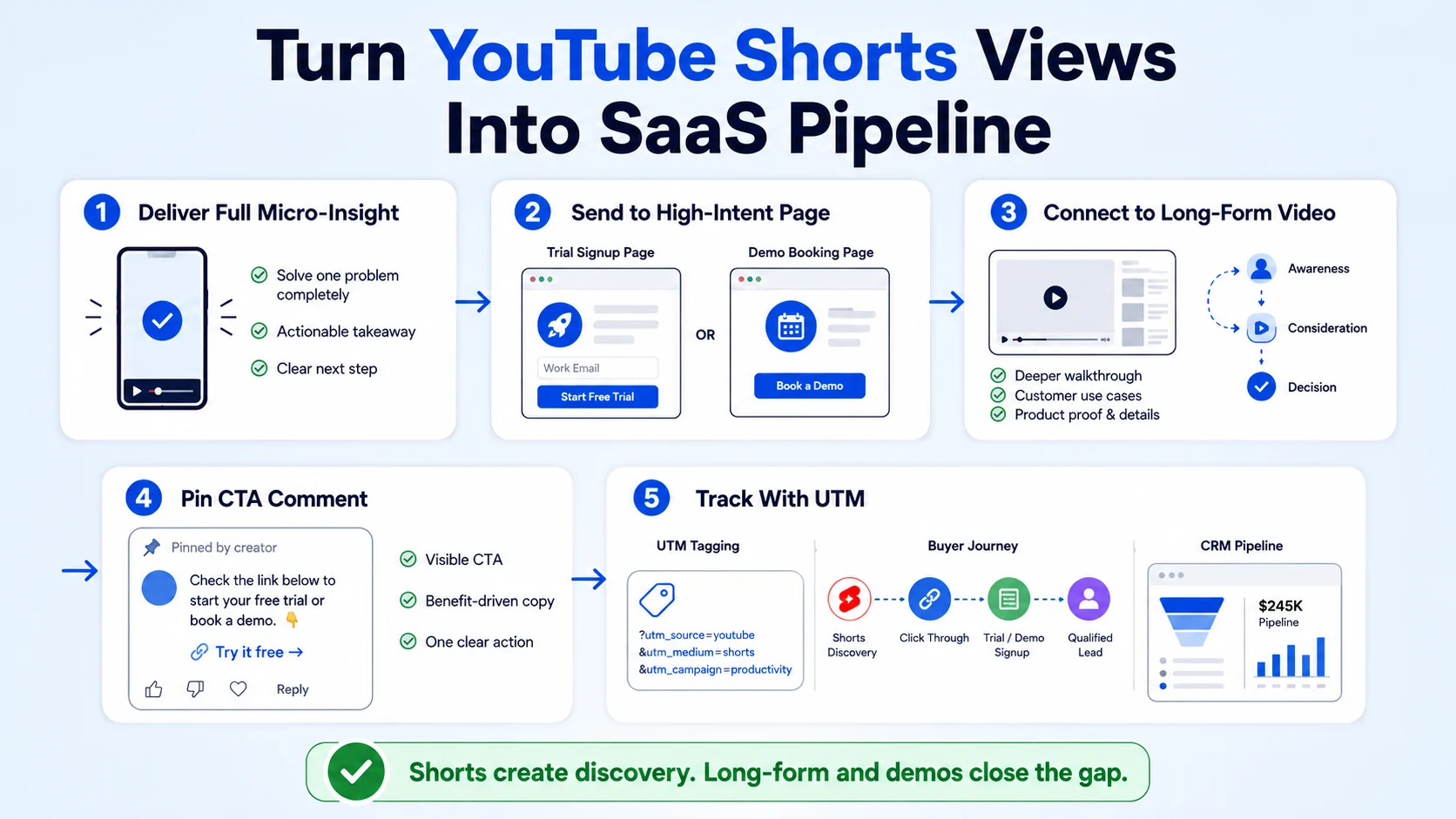
- Engineer the watch-through: Every Short must deliver a complete micro-insight. Don't tease, resolve. Viewers who get full value are far more likely to click to the channel.
- Link bio to a high-intent page: Not the homepage. A free trial URL, a demo booking page, or a services overview page that matches the content topic. Update the link based on which Shorts are currently performing.
- Use end screens on connected long-form: Shorts handles discovery. Long-form handles conversion. Growth happens when both are used together. Every high-performing Short should connect to a 5–10 minute long-form video that goes deeper on the same topic.
- Pin a comment with a CTA: Ask a question or direct viewers to the demo link in the first pinned comment. This boosts engagement signals and gives buyers a clear next step.
- Track the downstream path: Use UTM parameters on every link in bio. The attribution window from Shorts is longer than most teams expect, a buyer may watch a Short in week one and book a demo in week four.
73% of SaaS marketers report faster deal cycles because videos compress buyer education into asynchronous, bite-sized touchpoints. Deals where buyers consumed three or more vendor videos during the consideration phase showed a 28% higher close rate.
That last stat is the strategic anchor for any YouTube Shorts strategy for B2B SaaS & AI/Tech startups: the goal is not one viral clip. It is a library of 20–30 Shorts that a buyer can fall into during the research phase, and come out the other side ready for a demo.
Conclusion
A YouTube Shorts strategy for B2B SaaS & AI/Tech startups is not a creative exercise. It is a demand generation system built from existing product knowledge.
- Repurpose first: every webinar, demo, and podcast is a Shorts library waiting to be unlocked.
- Target 65%+ retention on sub-30-second clips to unlock algorithmic distribution.
- Post 3–5 Shorts per week consistently; use LinkedIn in parallel for direct decision-maker reach.
- Connect every Short to a long-form asset or demo CTA, discovery without conversion is wasted reach.
If you want to build this system without pulling your team off core product work, Komet Media handles the extraction, editing, and publishing for serious B2B teams. Let's talk.
Frequently Asked Questions
Q1: Can YouTube Shorts drive pipeline for enterprise SaaS sales?
Yes, but not directly. Shorts drive awareness and research-stage education. Deals where buyers consumed three or more vendor videos during consideration showed a 28% higher close rate. The Short gets them into your content ecosystem; the long-form and demo close the gap.
Q2: What is the ideal length for a B2B YouTube Short?
The sweet spot for YouTube Shorts in a B2B context is 15–35 seconds. This length maximises completion rates while leaving room for a genuine insight. For product walkthroughs requiring more context, up to 90 seconds is acceptable if the hook lands within the first three seconds.
Q3: How do AI startups use YouTube Shorts to build brand awareness?
AI startups use Shorts to demonstrate the product in action, one workflow, one result, per clip. Showing the AI tool solving a recognisable pain point in 30 seconds converts cold viewers faster than any whitepaper. Pair this with founder commentary Shorts to build personal brand trust alongside product trust.
Q4: Does posting frequency or content quality matter more for Shorts growth?
Both matter, but quality is the multiplier. YouTube's algorithm prioritises engagement and watch time over sheer quantity. A consistent cadence of 3–5 high-quality Shorts per week outperforms daily low-effort uploads. Build quality first; then build volume through repurposing.
Q5: Should B2B SaaS teams build a separate YouTube channel for Shorts?
No. Keep Shorts and long-form on one channel. This builds subscriber compounding across both formats and lets long-form content benefit from the discovery reach that Shorts generate. A unified channel also strengthens video SEO authority under a single brand domain.
Q6: How does content repurposing factor into a B2B Shorts strategy?
It is the production engine. One 45-minute webinar, properly cut, yields 8–12 Shorts covering unique topics, no new filming required. This dramatically reduces per-video cost and makes a 3–5 Shorts per week cadence sustainable for lean SaaS marketing teams. This is the core of how Komet Media builds YouTube Shorts strategy for B2B SaaS & AI/Tech startups for clients with existing content libraries.