
YouTube Posting Cadence and Scheduling: Step-by-Step Guide
Most B2B SaaS, AI native companies, and tech startups & teams treat YouTube as an afterthought, posting when someone has bandwidth, not when it actually serves the pipeline. That's the mistake. YouTube Posting Cadence and Scheduling is infrastructure, not inspiration. Get it wrong and you stall demand generation before it starts. Get it right and your channel becomes a compounding asset that educates buyers, supports sales, and builds founder-led trust at scale. Here's exactly how serious SaaS and tech teams should approach it in 2026.
TL;DR
- For B2B SaaS, AI, and tech startups & teams, 1–2 long-form videos per week plus 2–4 Shorts is the sustainable sweet spot for YouTube Posting Cadence and Scheduling.
- Consistency beats frequency: a predictable schedule outperforms erratic volume every time.
- Repurpose webinars, podcasts, and demos first, you already have the content.
- Use YouTube Analytics weekly to refine timing, topics, and format mix.
How Often Should B2B SaaS Companies Post on YouTube?
The honest answer: less than you fear, more than you're probably doing right now. vidIQ analyzed over 10.2 million YouTube channels with at least 1,000 subscribers and found a clear correlation, channels in higher upload-frequency tiers had faster median monthly view and subscriber growth. But raw volume is not the goal for a B2B SaaS team. Your buyers are not binge-watching content the way consumers are. They're researching a problem, evaluating options, and deciding whether your product is worth a demo.
The practical target for most SaaS, AI, and tech teams: one to two long-form videos per week. A posting cadence of 1–2 long-form videos weekly plus 2–5 Shorts maintains consistency without compromising quality. If your team is leaner, start with one per week and protect that commitment. Consistency beats frequency. Channels with a regular, predictable upload schedule see faster growth than channels that post erratically, even when the erratic channels post more total videos.
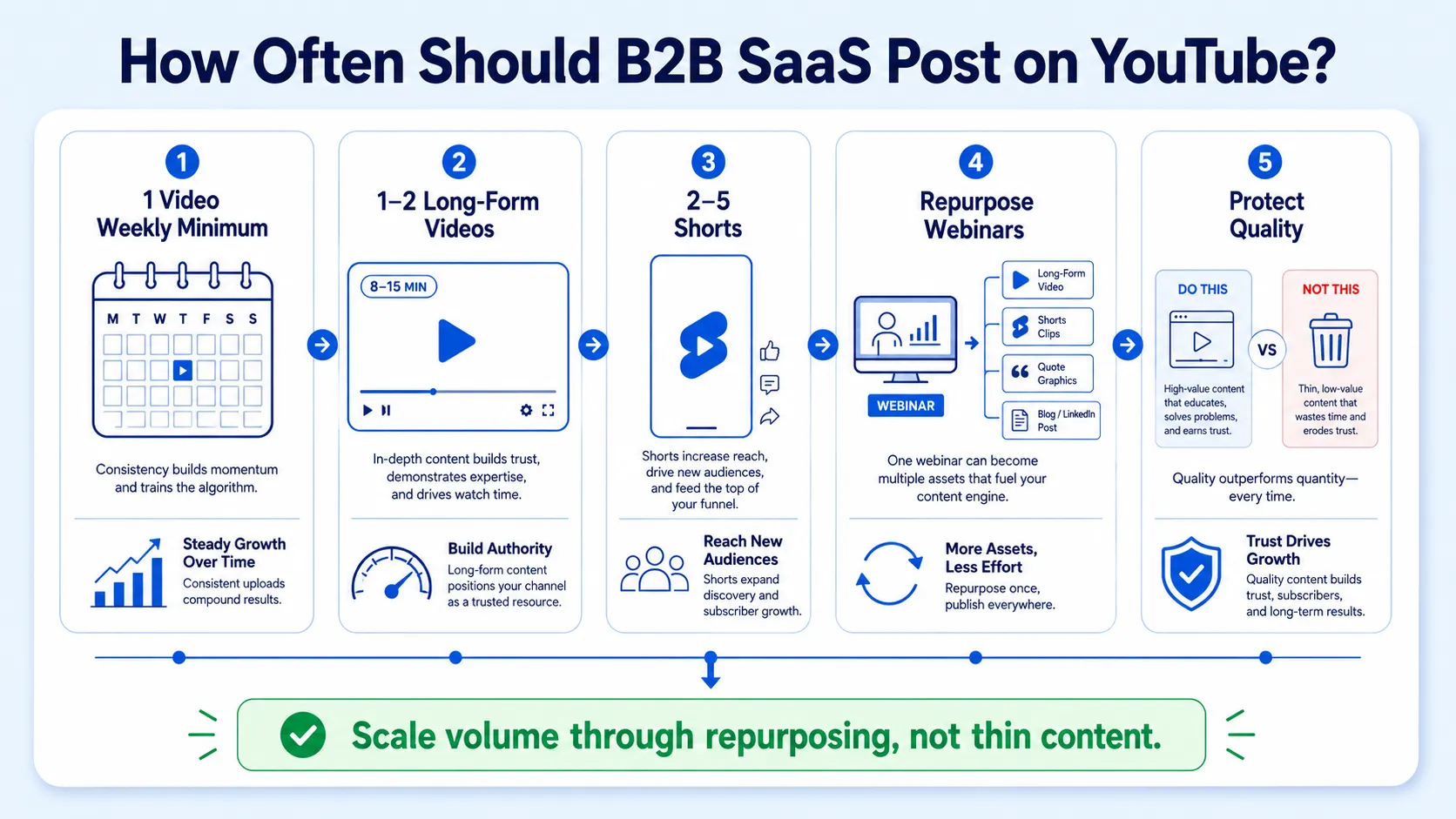
This is especially true for B2B, where buyers return to channels they trust. Showing up every Tuesday at 10 AM builds that trust systematically. The floor for most B2B SaaS channels with any growth ambition: one video per week is the bare minimum to maintain steady momentum. If you're publishing fewer than four times a month, you're largely invisible to the YouTube algorithm and to your buyers.
What about more volume? Channels averaging 12 or more uploads a month had 4.1 times the median monthly view-growth rate compared to low-frequency channels, but for a B2B SaaS, AI, or tech startup team, chasing that number by producing thin content is counterproductive. Every weak video dilutes your channel authority and confuses the algorithm's understanding of your audience.
The better path: use content repurposing to hit volume without proportionally increasing production effort. One 45-minute webinar can feed 4–6 weeks of short-form clips, a long-form recap, and a series of educational Shorts. That's how you scale YouTube Posting Cadence and Scheduling without burning out your team.
What Is the Best YouTube Posting Schedule for Software Companies?
Schedule specificity matters more than most SaaS and tech teams realise. The YouTube algorithm tracks engagement velocity in the first 48 hours after upload, which means when you publish determines whether the algorithm amplifies or ignores your video. YouTube's algorithm weighs engagement velocity in the first 48 hours as a top-5 ranking factor. Publishing when your audience is online means faster early engagement, which triggers broader algorithmic distribution.
For B2B SaaS, AI, and tech audiences, the highest-engagement windows are Tuesday through Thursday, between 9 AM and 12 PM in your primary buyer's time zone. Avoid Friday afternoons and weekends, your ICP is not watching product education videos on Saturday. Here's a recommended weekly posting schedule for a two-person SaaS or tech marketing team:
Whether it's once a week, twice a month, or daily Shorts, find a schedule you can realistically maintain without burning out. A consistent upload schedule of mediocre content will yield far worse results than less frequent, high-quality content. Use tools like Hootsuite or Sprout Social to pre-schedule uploads. Batch your editing on one day per week, schedule all content, and stop making publishing decisions in real time. That's the system that actually holds.
Does Posting Frequency Affect YouTube Channel Growth for B2B?
Yes, directly, but not the way most people think. Frequency is a lever. Consistency is the machine. The algorithm responds better to stable schedules (every Wednesday) than sporadic activity bursts. What the algorithm is doing is building a model of your audience. The more regularly you upload relevant content, the more precisely it can identify who to show your videos to, and the more it rewards you with distribution.
The algorithm favors channels that regularly upload fresh content. Consistency signals to the algorithm that a channel is active and engaging. Three things happen when a B2B SaaS channel posts with irregular YouTube Posting Cadence and Scheduling:
- Algorithm signal degradation: The system loses confidence in your audience model, reducing suggested video appearances.
- Subscriber habit breaks: Buyers who intended to return lose the habit loop. Audience retention drops.
- Click-through rate decline: Thumbnails and titles that were testing well get fewer impressions, starving the data you need to iterate.
Algorithm recoveries typically take 2–4 weeks of consistent, strong-performing uploads. That's the cost of a posting gap. For a demand generation function already operating with limited bandwidth, losing a month of algorithmic momentum is expensive.
The practical implication: never let your schedule drop to zero. If the team is heads-down in a product launch, record and batch-schedule two weeks of content in advance. If a key person is out, publish a repurposed clip rather than going dark. The channel should always be moving.
The algorithm marks channels as high-priority when publications are consistent and generate rapid views, frequently monitoring audience reactions, if new videos receive likes and comments within hours, the algorithm amplifies promotion. That amplification is exactly what B2B demand generation needs.
How to Build a YouTube Content Calendar for SaaS
A content calendar is the operational core of your YouTube Posting Cadence and Scheduling system. Without one, you're making scheduling decisions reactively, which is where consistency goes to die. A content calendar is essential for planning and execution. A well-structured content calendar ensures that efforts are consistent, timely, and aligned with broader marketing strategy.
Build your calendar in five steps:
- Audit existing long-form assets: List every webinar recording, podcast episode, product demo, and founder interview you have. These are your raw materials. One 60-minute webinar can produce 4–8 short clips, a long-form recap, and 2–3 Shorts.
- Map content to buyer journey stages: Map content topics to buyer journey stages, awareness, consideration, and decision. Awareness content educates. Consideration content compares and positions. Decision content converts.
- Set publish slots before topics: Lock in your Tuesday long-form and Wednesday/Thursday Shorts slots for the next eight weeks before you assign a single topic. Commitment to the slot comes first.
- Assign SEO-led titles at planning time: The content calendar should always start with the keyword, not the topic. Before any piece goes into the calendar, it needs a target keyword. For video SEO, that keyword anchors the title, description, and Shorts text.
- Build in a repurposing column: For every asset, you need a column that asks: "Where else does this go?" Every long-form video should generate at least two Shorts and one LinkedIn clip. Document this in the calendar row, not as an afterthought.
Review your calendar monthly using YouTube Analytics. By filtering to show content published in a certain month or quarter, teams can compare planned activity against results like SEO performance or customer conversions. This review process turns the calendar into a feedback tool that helps teams decide what to repeat, what to refine, and what to stop creating.
How to Balance YouTube Quality vs. Quantity for SaaS Content
This is the tension every B2B SaaS, AI, and tech startup & team hits. The answer is structural, not philosophical. The shift from watch time to satisfaction means you should focus on delivering value efficiently. A viewer who watches 100% of an 8-minute video and clicks "like" sends a stronger signal than a viewer who watches 40% of a 25-minute video and leaves.
For SaaS and tech content, this reframes the question entirely. An 8-minute product walkthrough that holds attention is worth more than a 25-minute "deep dive" that loses the viewer at minute seven. The quality threshold for B2B SaaS, AI, and tech YouTube content is clear audio, a coherent structure, and a specific payoff for the viewer. Production polish matters less than those three. An "80%-there" version published within 72 hours of a webinar or interview will outperform the flawless cut that ships a month late.
Here's how to protect quality without throttling volume:
- Templatize your formats: Use the same intro structure, chapter format, and CTA across all long-form videos. This reduces per-video decision-making and speeds editing.
- Repurpose before creating net-new: The most efficient strategy involves repurposing one piece of long-form content, like a webinar, into multiple short video assets for different channels. This keeps quality consistent because the source material was already validated.
- Set a minimum retention target: Aim for 40–55% average view duration on long-form content. Average view duration of 40–55% for long-form is healthy; push above 60% on tutorials. If a video drops below 35%, audit where viewers exit and reformat that section type.
- Separate creation from editing: Founders and product leads should record, not edit. Komet Media's video editing service exists precisely so that SaaS, AI, and tech teams can maintain cadence without making video production a full internal function.
The sustainable formula: one polished long-form video per week, sourced from existing knowledge, plus 2–3 repurposed Shorts. That produces roughly 12–16 uploads per month including Shorts, which aligns with the frequency tier associated with strong growth.
YouTube Posting Strategy for Small B2B Marketing Teams
Most B2B SaaS, AI, and tech startups & teams running YouTube are small, one to three people covering content, demand gen, and sometimes design simultaneously. A strategy that requires a full video team does not work here. The right framework for a lean team is the pillar-and-clip model:
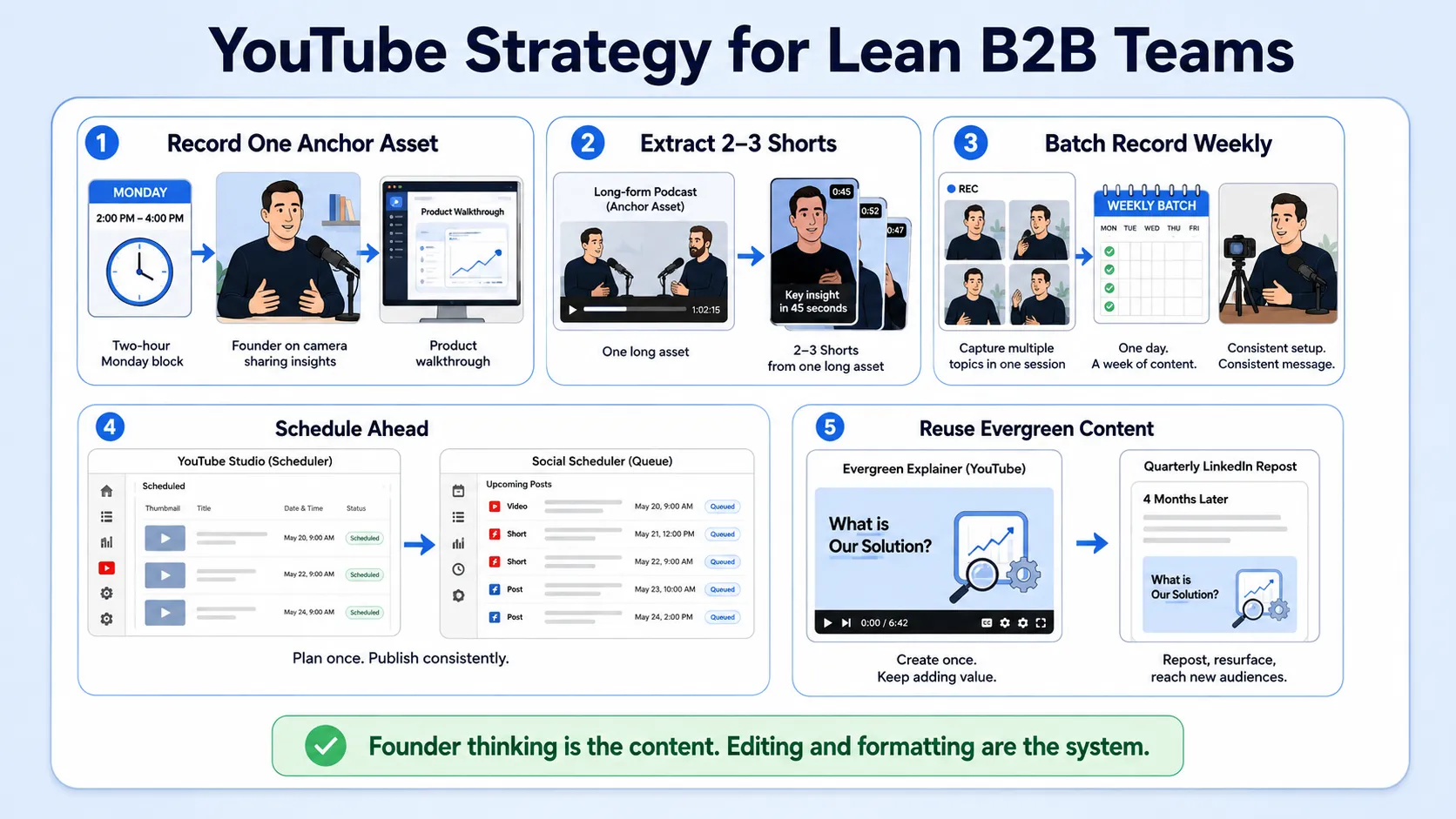
- Record one long-form anchor asset per week. This can be a founder's take on a buyer pain point, a product walkthrough, a repurposed webinar, or a podcast episode turned into a structured video. Keep it 8–12 minutes.
- Extract 2–3 Shorts from that anchor. From one anchor asset, aim to create 10–15 video clips, a handful of static visuals, one short newsletter embed, and a quick sales-enablement reel. Even at a fraction of that, three clips per anchor, you maintain a strong weekly presence.
- Batch record on one day. Pick a two-hour recording block every Monday. Record the long-form video, then record two to three 30–60 second Shorts based on key points from that session. Edit and schedule Tuesday through Thursday.
- Use scheduling tools to remove daily decisions. Pre-scheduling in YouTube Studio (or via Hootsuite, Sprout Social, or HubSpot's content tools) means your team is not touching video on publish days.
- Reuse evergreen content. Create a content calendar with video ideas planned at least a month ahead. Evergreen explainer videos, how your integration works, what problem your product solves, common objections answered, don't expire. Schedule them to re-promote on LinkedIn every quarter.
For short-form video editing specifically, outsourcing the edit layer lets your team focus on what they can't delegate: founder thinking, product knowledge, and buyer insight. That's the content. The clip editing, captioning, and formatting? That's the system.
What Happens If You Post Inconsistently on YouTube?
Inconsistency is not just an aesthetic problem, it has measurable consequences on algorithm performance, audience retention, and subscriber growth. Publishing too infrequently creates the impression that your channel is abandoned, slowing growth and reducing engagement. However, uploading content too frequently risks audience fatigue and compromised video quality. Both extremes hurt. The damage from inconsistency runs deeper:
Algorithm decay: Regular uploads train your audience to expect content from you, and give the algorithm more data to work with. When that data stream stops, the algorithm deprioritizes your channel in suggested videos and Home feeds. Visibility drops quickly.
Subscriber trust loss: B2B buyers who subscribed expecting weekly product education will unsubscribe or disengage if content stops. Re-engagement after a gap is harder than building the relationship in the first place.
Video SEO momentum loss: YouTube's search ranking factors include recency and channel-level engagement velocity. A channel that has not posted in three weeks signals lower authority, and competing evergreen content from active channels will outrank yours over time.
Pipeline gaps: For a SaaS or tech startup team using YouTube as part of demand generation, an inconsistent channel means inconsistent top-of-funnel. Buyers who find your channel mid-research and see the last upload was two months ago will question whether your company is still active.
The YouTube algorithm in 2026 rewards a certain kind of creator, one that prioritizes viewer satisfaction over vanity metrics. A three-week gap followed by five videos in one week satisfies neither the algorithm nor the viewer. Steady cadence does.
The recovery plan after a posting gap: return with a strong, high-value video (not an apology video), resume your normal schedule immediately, and use YouTube Analytics to monitor the recovery in impressions. Algorithm recoveries typically take 2–4 weeks of consistent, strong-performing uploads.
Best Practices for YouTube Scheduling in B2B Companies
Putting it all together: here's the operating model that works for B2B SaaS, AI, and tech startups & teams with real pipeline goals. This is the YouTube Posting Cadence and Scheduling playbook, compressed into execution rules.
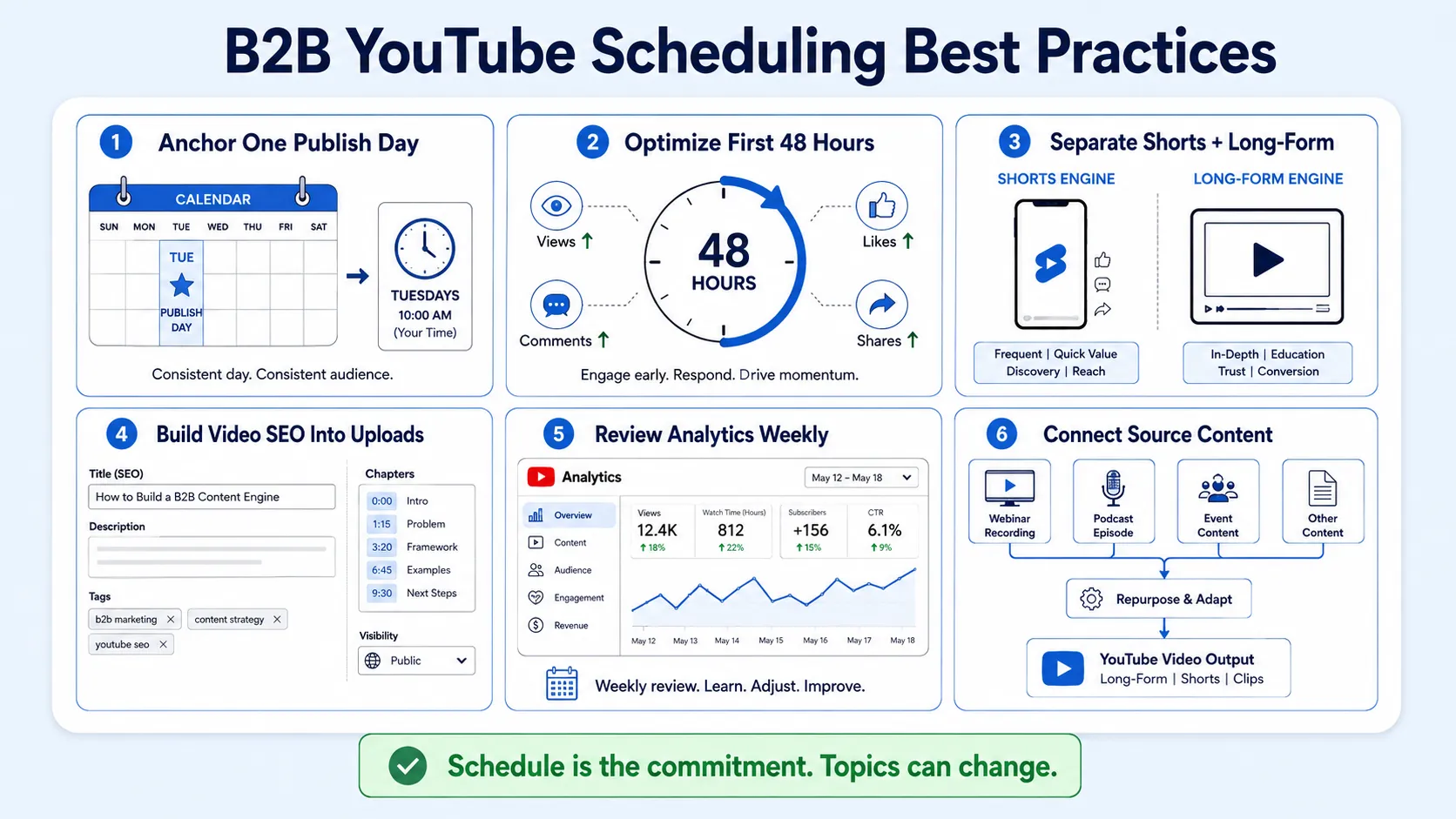
Anchor to one publishing day, not one publishing idea. The schedule is the commitment. Topics change. The Tuesday long-form slot does not.
Optimize for the first 48 hours. YouTube's algorithm weighs engagement velocity in the first 48 hours as a top-5 ranking factor. Publishing when your audience is online means faster early engagement, which triggers broader algorithmic distribution. Check YouTube Analytics for when your subscribers are most active and schedule uploads 15–30 minutes before that window.
Treat Shorts and long-form as separate engines. YouTube fully decoupled the Shorts recommendation engine from long-form in late 2025. Shorts are ranked based on swipe-through rate, loop rate, shares, and engagement within the first few seconds. Optimize each format independently.
Build video SEO into every upload. Titles should lead with the buyer's question, not your product name. Descriptions need the first 150 characters to contain the primary keyword. Chapters signal content structure to the algorithm and improve audience retention by helping viewers navigate.
Use YouTube Analytics as a weekly operating tool. CTR, average view duration, and subscriber source breakdown are the three metrics that matter most for a growing B2B channel. A CTR of 5–10% is the baseline; above 10% often indicates strong topic-audience fit. Average view duration of 40–55% for long-form is healthy.
Connect YouTube to the rest of your content system. Your webinar recordings, podcast episodes, and event content are not separate channels, they're source material for YouTube. One podcast episode can generate 10–30+ content assets. Build that repurposing workflow into your content calendar and your YouTube cadence becomes self-sustaining.
Never sacrifice quality for schedule. The algorithm in 2025 and 2026 is about quality, engagement, and retention, not just how many videos you upload. If a video is not ready, delay by three days rather than publishing something that will damage your retention metrics.
Conclusion
- 1–2 long-form videos per week plus 2–4 Shorts is the right YouTube Posting Cadence and Scheduling target for most B2B SaaS, AI, and tech startups & teams in 2026.
- Consistency is non-negotiable. A predictable schedule outperforms burst publishing every time, for both the algorithm and your buyers.
- Repurpose first. Webinars, podcasts, and demos are already done, turning them into clips before creating net-new content.
- Treat YouTube as pipeline infrastructure, not a content experiment. When the cadence holds, the compounding effect on inbound demand and buyer trust is real.
If you want the system without the overhead, Komet Media builds it for you.
Frequently Asked Questions
Q1: How many YouTube videos per month is right for a B2B SaaS brand?
Four to eight long-form videos per month (one to two per week) plus eight to sixteen Shorts is the sustainable range. Start with four long-forms and scale once the production system is stable. Volume without consistency delivers less growth than a lower, reliable cadence.
Q2: Does it matter what time of day I post on YouTube?
Yes. The YouTube algorithm prioritises engagement velocity in the first 48 hours, so publishing when your subscribers are active accelerates distribution. For B2B SaaS audiences, Tuesday through Thursday between 9 AM and 12 PM in your primary buyer's time zone is the reliable window. Confirm with your own YouTube Analytics data.
Q3: Can I repurpose old webinars and podcasts to maintain my YouTube schedule?
Absolutely, this is the most efficient approach for SaaS teams. One 60-minute webinar can produce one long-form recap video, four to six short clips, and two to three Shorts. That's several weeks of content from a single recording session your team already completed.
Q4: What happens to my channel if I stop posting for a few weeks?
Algorithm distribution drops, suggested video appearances decrease, and subscriber engagement weakens. Recovery typically takes two to four weeks of consistent, strong-performing uploads after you resume. Never go fully dark, schedule a repurposed clip rather than posting nothing.
Q5: Should B2B SaaS companies use YouTube Shorts?
Yes, but as a separate growth engine from long-form. Shorts drive discovery and subscriber growth through a different recommendation system. Use them to tease long-form content, share founder takes, and surface product insights for your AI or tech startup. Post two to four Shorts per week, clipped from your existing long-form recordings.
Q6: How do I measure whether my YouTube posting schedule is working?
Track three metrics weekly in YouTube Analytics: click-through rate (target 5–10%), average view duration (target 40–55% for long-form), and subscriber source breakdown. If CTR is below 5%, fix your titles and thumbnails. If retention drops below 35%, audit where viewers exit and restructure that section type.

