
A Pre-Production Checklist for Founder Videos: Step-by-Step Guide
Most founder videos fail before a camera ever turns on. The planning, or lack of it, decides whether your video builds real buyer trust or disappears into the feed. This pre-production checklist for founder videos covers every step: from locking your brand message to confirming your aspect ratio specs on shoot day. Follow it in order and you will walk into every recording session prepared, consistent, and in control of how you show up to the buyers, investors, and future hires watching you.
TL;DR
- Pre-production determines video quality more than gear or editing ever will.
- Lock message, script, and shot list before you touch any equipment.
- Treat audio setup, lighting, and location as non-negotiable, not afterthoughts.
- Build for repurposing from the start: one shoot should yield multiple assets.
Why Founders Need a Pre-Production Checklist Before Filming Anything
Most executives think they can wing it. They sit down, hit records, and figure it out as they go. That approach costs more time in reshoots and editing than any amount of upfront planning ever would. Pre-production is the foundation of your entire video project. Without proper planning, you risk budget overruns, missed deadlines, and unclear messaging.
For founders specifically, unclear messaging is the most expensive failure. You are the product. If buyers can not read your authority and conviction in the first five seconds, they scroll. 62% of B2B marketers say LinkedIn is their most effective platform for video distribution , and the 2025 Edelman x LinkedIn Thought Leadership Impact Report revealed that 55% of decision-makers use thought leadership as part of their vetting process. Your founder video is a vetting instrument. It either clears the bar or it doesn't.
Here is what the pre-production checklist for founder videos protects you from:
- Recording content your audience does not actually care about
- Showing up on camera without a clear brand messaging framework
- Wasting an entire shoot day because of one missing piece of audio equipment
- Creating a single video with no content repurposing pipeline built in
The five major categories of pre-production are: Creative (goal, audience, script, storyboard, visual style), Logistics (locations, permits, schedules, travel, lodging), and Talent and Interviews (on-camera voices, wardrobe). A great shoot starts long before the first camera rolls.
At Komet Media, I've seen founders with $50,000 camera setups produce content that converts at a lower rate than founders using a phone and a proper pre-production process. The equipment is not the variable. The plan is. "Great videos don't start on set. They start months earlier in pre-production.", Spirit Juice Studios Use the sections below as your complete pre-production checklist for founder videos. Work through them in sequence. Do not skip steps because you are short on time, compress each step instead.
What Founders Should Do Before Filming: Goal-Setting and Audience Persona Mapping
Every section of this checklist flows from one input: a clear goal tied to a defined audience. Without that, you are producing content that performs for no one.
Step 1: Define the single outcome for the video. A video trying to accomplish three things accomplishes none of them. Pick one: generate inbound leads, build investor interest, attract senior hires, or establish category authority on LinkedIn video marketing.
Step 2: Build your audience persona. Founder storytelling that converts is specific. Document:
- Who they are (title, company size, industry)
- What they are evaluating right now (vendor, partner, investor target, employer)
- What objection keeps them from saying yes
- What proof point would dissolve that objection
Step 3: Map your brand messaging framework. Your video needs three layers locked before scripting:
Step 4: Set aspect ratio specifications upfront. Knowing the kind of video you are shooting will determine the budget, its duration, and how long it will take to finish production. LinkedIn feed video runs 16:9 or 1:1. LinkedIn short-form and Reels use 9:16. Decide at this stage, not in the edit, so your framing on shoot day captures usable content for every format.
Start with your launch day, pad a few days, and work back. Fill in a creative brief template with the video's purpose, audience, tone, budget, and materials. That brief is your contract with yourself. Every decision downstream refers to it. In 2025, over 70% of consumers say they prefer seeing "real people" or employees in brand videos rather than traditional actors. For founders, this is a structural advantage. Your authenticity is your differentiator, but only if you show up prepared enough to be relaxed on camera.
Founder Video Scripting, Storyboard Development, and Shot List Creation
Script development is where most founders stall. They overthink it, try to sound perfect, and produce something that reads like a press release. Here is the framework that works.
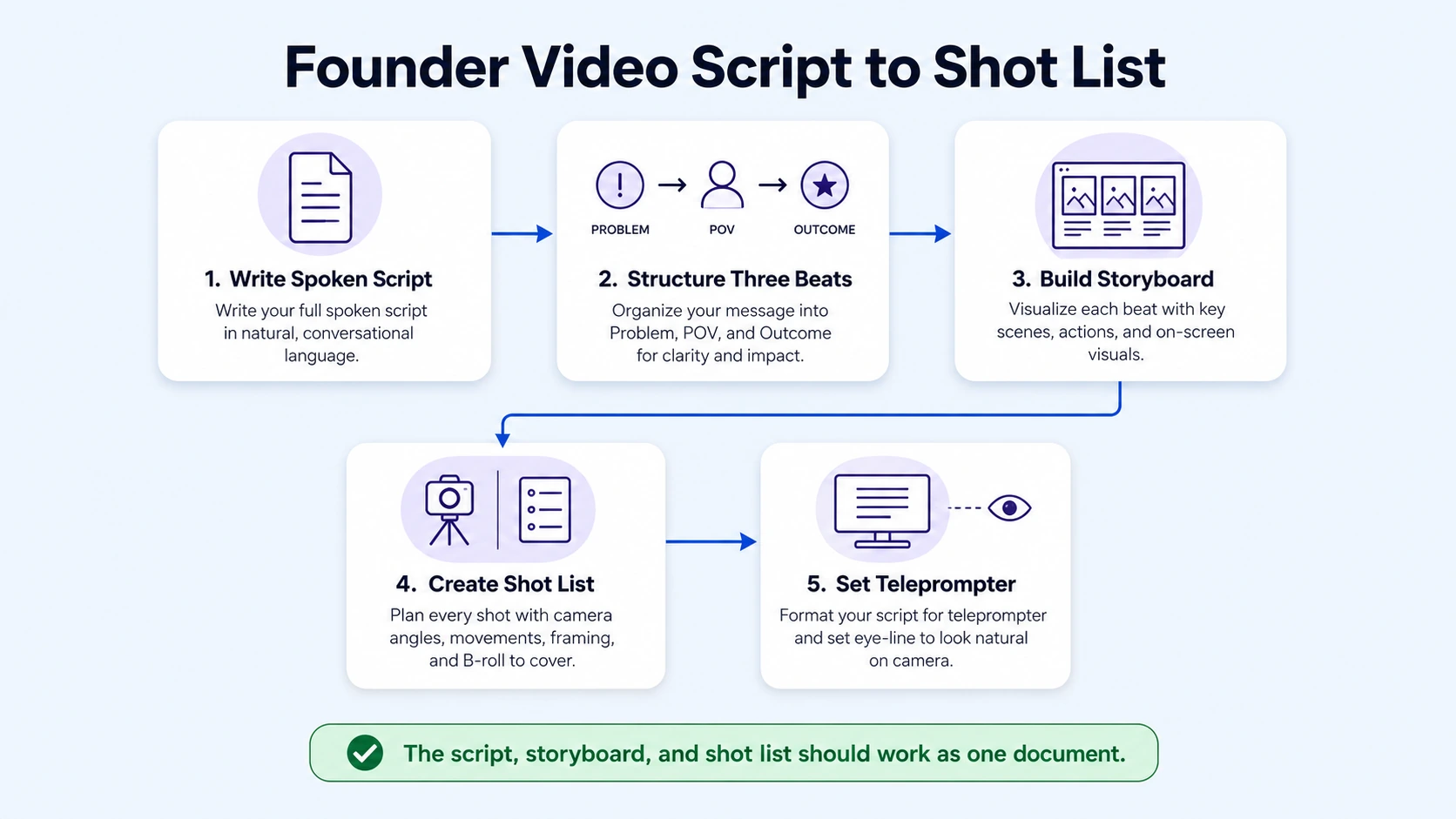
Step 1: Write the script in spoken language. Read every sentence aloud. If it sounds like something you would not say in a meeting, rewrite it. Your script should match your natural speech patterns, sharper, not more formal.
Step 2: Structure the script around three beats:
- Problem or tension your audience lives with right now
- Your specific point of view on why that problem exists
- The outcome you help them reach, with a direct call-to-action scripting prompt at the end
Step 3: Build your storyboard. Create a rough storyboard that details the main scenes of your video. Sketch out the sequence of events with relevant notes regarding the length of each scene, the location, and the characters involved. For a simple talking-head founder video, your storyboard is as straightforward as: intro on camera / key proof point / B-roll footage planning notes / close with CTA.
Step 4: Create your shot list. Your shot list creation document should cover:
- Primary on-camera angles (wide, medium, close)
- B-roll footage planning (product in use, team environment, workspace)
- Any motion graphics or text overlays planned for post
- Sequence order to minimize camera movement between setups
Step 5: Set up your teleprompter setup. If you are reading from a script, the teleprompter must be positioned at lens level, not below or above, or your eye line will betray you. Use a font size and scroll speed you rehearsed with at least twice before the shoot. Cold teleprompter reads are detectable in seconds. Develop a script that outlines the key elements of your video, including the introduction, main content, and conclusion. A well-crafted script enhances the overall flow and coherence of your video. The script, storyboard, and shot list form a single document. Everyone involved in the shoot works from it.
How to Prepare Your Audio Equipment Setup and Lighting Equipment Checklist
Buyers do not forgive bad audio. They will watch slightly blurry videos. They will not tolerate muffled or echo-heavy sound for more than three seconds.
Audio equipment setup checklist:
- Lavalier microphone (clip to lapel, test levels before rolling)
- Backup USB condenser microphone if lav fails
- Dedicated audio recorder separate from camera (for redundancy)
- Headphones on set to monitor live audio while recording
- Acoustic treatment: remove echo with a rug, curtains, or portable panels
Test every audio source before the shoot, not during it. Record a 60-second test clip, put headphones on, and listen for hiss, room tone, echo, and electrical interference. Fix it before the talent sits down.
Lighting equipment checklist:
Natural light works, but only if you can control it. A window as your key light is valid if you have a diffuser (sheer curtain or scrim) and blackout on all other windows. Inconsistent cloud cover will ruin a long recording session. Spend more time on audio than on lighting. Viewers tolerate imperfect visuals. Bad audio ends the video.
Our short-form video editing team at Komet Media works with raw footage every day. The single most common problem that forces reshoots is audio, not lighting, not framing.
Location Scouting, Wardrobe and Styling Guidelines, and Release Form Documentation
Location is an extension of your personal brand. Where you film communicates status, stability, and professionalism before you say a single word.
Location scouting checklist:
- [ ] Scout the space at the same time of day you plan to shoot (lighting changes dramatically)
- [ ] Listen for ambient noise: HVAC systems, street traffic, co-working chatter, building vibrations
- [ ] Check internet connectivity if streaming or uploading from location
- [ ] Measure the depth of field available, you need at least 6 to 8 feet of separation between subject and background for a clean shallow focus look
- [ ] Confirm power access for all lighting and recording equipment
Wardrobe and styling guidelines for founders:
- [ ] Avoid fine patterns (herringbone, fine checks), they create moiré distortion on camera
- [ ] Solid colors read best: navy, charcoal, forest green, burgundy
- [ ] Match wardrobe to brand colors when possible, this creates subliminal consistency across your video library
- [ ] No logos on clothing except your own brand
- [ ] Matte powder for foreheads and any reflective skin (this is not optional under key lighting)
Release form documentation: Any non-founder participant on camera, team members, clients, interviewees, needs a signed video release form before filming begins. This includes:
- [ ] Consent to appear on camera
- [ ] Rights for commercial use and distribution
- [ ] Platform-specific licensing permissions (LinkedIn, YouTube, paid ads)
Do not skip release form documentation because it feels bureaucratic. One unsigned participant can block an entire content repurposing pipeline of videos downstream. Doing a location tech check helps you identify issues with equipment or layout. You get time and scope to fix them before filming.
On-Camera Coaching and Video Production Workflow for Founders
Being prepared technically and being prepared on camera are two different things. Most founders are exceptional in conversation, and stiff on camera. The gap between those two states closes with specific practice, not more takes.
On-camera coaching fundamentals before shoot day:
- Record yourself speaking for 3 minutes: Watch it back without sound first. Check posture, eye contact with lens, and hand positioning.
- Eliminate filler words: Record the same 60-second segment five times. Count the "ums", "uhs", and "you knows" each round. They decrease with reps.
- Practice the open: The first 10 seconds of your video must be memorized, not read. Openings read from a teleprompter collapse energy.
- Calibrate your energy level: On camera, your natural energy reads as low. Speak at 20% higher energy than feels comfortable. Watch it back, it will look correct.
- Lock your eye line: Talk to the lens. Not the monitor. Not the interviewer sitting to the side. The lens.
Video production workflow (pre-production to handoff):
Before you start working through the steps of pre-production, you need someone to take charge of it all. Nominate a video producer, whether that's you or someone else. Make sure this person is responsible because a good video producer is essential to a good video.
The Content Repurposing Pipeline: Plan It Before You Shoot
This is where serious B2B teams separate from everyone else. If you are planning one video, you are already thinking too small. Every founder video shoot should produce a suite of assets, and the only way that happens is if you design for it in pre-production. LinkedIn reports that short-form video creation is growing twice as fast as other post formats on the platform. That growth rewards teams who produce volume without multiplying shoot time. The answer is a structured content repurposing pipeline.
Plan these deliverables from every single shoot:
- Full-length video (6 to 12 minutes) for YouTube and your website
- 3 to 5 short-form clips (60 to 90 seconds) for LinkedIn video marketing
- 1 to 2 vertical cuts (9:16, under 60 seconds) for LinkedIn short-form and Instagram
- Audio strip for podcast or audio content distribution
- Transcript for blog post, newsletter, and SEO content
- Pull quotes for LinkedIn text posts and carousel assets
To make this work, your shot list creation must account for B-roll footage planning at the start, not as an afterthought in post. Plan specific B-roll sequences (product demos, whiteboard moments, walking shots) that cover gaps in any short-form edit.
Aspect ratio specifications reference:
Komet Media's video marketing services are built entirely around this model: one shoot, multiple assets, consistent output. That is how founders stay visible without being in constant production mode.
Pre-Production Mistakes Founders Make Before Filming (and How to Fix Them
Every mistake on this list is something I have seen in real founder shoots. None of them are about equipment. All of them are about preparation.
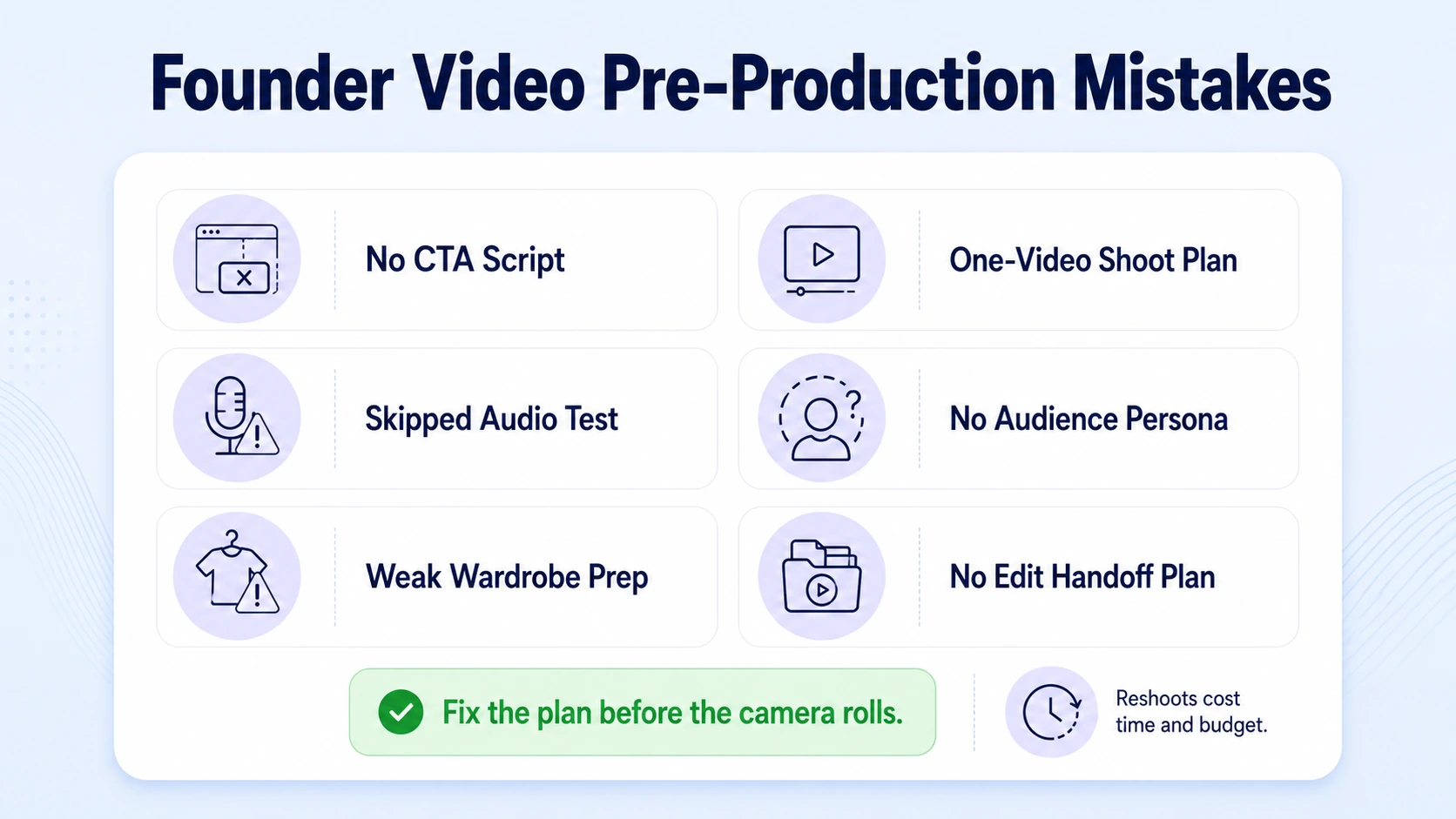
Mistake 1: No defined call-to-action scripting. The video ends and the viewer has no idea what to do next. Fix: write your CTA before your opening line. The ending determines what the video is for.
Mistake 2: Treating the shoot as a one-video event. No B-roll footage planning, no repurposing structure, no multiple camera angles captured. Fix: build your content repurposing pipeline into the shot list before shoot day.
Mistake 3: Skipping the audio equipment setup test. Founders assume the lavalier mic will work because it worked last time. Fix: full audio check minimum 30 minutes before recording, using the exact room you will shoot in.
Mistake 4: No audience persona mapping before scripting. The script is about the founder's achievements instead of the buyer's problem. Fix: write the audience persona card first. Every sentence in the script must serve that person.
Mistake 5: Ignoring wardrobe and styling guidelines. Fine-pattern shirts, reflective skin, and competing logos distract from the message. Fix: wardrobe is confirmed two days before shoot, not the morning of.
Mistake 6: No video editing software handoff plan. Raw files are delivered to an editor with no context, no script, no timecodes. Fix: include a post-production brief in every pre-production package, it travels with the footage.
82% of B2B buyers say they watch more business-related videos now than they did two years ago. The volume of founder video content is going up. The cost of poor pre-production, in credibility, in reshoots, in missed repurposing opportunities, is going up with it. The founders winning on video in 2026 are not the ones with the best cameras. They are the ones who planned better than their competitors did.
Our podcast production and video services at Komet Media are designed to help founders build exactly this kind of systematic pre-production process, whether you are starting from a content library or building one from scratch.
Conclusion
The pre-production checklist for founder videos is not bureaucracy. It is a competitive infrastructure. Here is what to take into your next shoot:
- Lock your brand messaging framework and audience persona before scripting a single line.
- Test audio, confirm lighting, and scout locations at shoot time, not the morning of.
- Build your content repurposing pipeline into the shot list before anyone picks up a camera.
- Assign one production owner who is accountable for every checklist item from brief to handoff.
Founders who do this consistently create more trust, more authority, and more pipeline from the same effort. That is the return on pre-production. Start with Komet Media's production services if you want a team that runs this process for you.
Frequently Asked Questions
Q1: How long should the pre-production phase take for a founder video?
For a simple talking-head founder video, allow 3 to 5 business days: 1 day for goal-setting and brief, 1 to 2 days for scripting and storyboard development, and 1 to 2 days for technical setup confirmation, wardrobe, and location scouting. Rush it and you will pay in reshoots.
Q2: Do I need a professional crew to follow this pre-production checklist for founder videos?
No. The checklist works for solo setups, small in-house teams, and full production crews. The steps scale. What does not change is the sequence: message first, then logistics, then equipment. Skipping message work because you have a good camera is the most common mistake.
Q3: What audio equipment do I actually need as a minimum?
One quality lavalier microphone (wired or wireless), a quiet room with basic acoustic treatment, and headphones to monitor your recording live. A $60 lav mic in a treated room will outperform a $500 USB mic in a hard-walled boardroom every time.
Q4: How do I plan B-roll footage for a founder video if I don't have a team?
Shoot B-roll as a separate session before or after the main interview setup. List the five key points from your script and capture one visual for each product in use, team interaction, a whiteboard, or a relevant workspace moment. That covers most short-form edits.
Q5: What is the biggest pre-production mistake that kills founder video performance?
Scripting for achievements instead of audience problems. Buyers do not watch founder videos to hear what you have built. They watch to find out if you understand their situation. Audience persona mapping done before scripting fixes this completely.
Q6: How does pre-production connect to a content repurposing pipeline?
Every repurposed asset (short clips, vertical cuts, audio strips, blog transcripts) depends on raw footage captured with intent. If your shot list did not account for multiple angles, close-ups, and B-roll, the editor has nothing to work with. Plan repurposing at the pre-production stage or you will not be able to execute it in post.

