
Repurposing Long-Form Content Into YouTube Shorts for B2B SaaS & AI/Tech Startups: Step-by-Step Guide
Most B2B SaaS and AI startups record more long-form video than they ever use. A single demo, webinar, or founder interview usually holds ten or more moments that could stand on their own. Repurposing long-form content into YouTube Shorts is how that footage becomes a channel that earns watch time instead of sitting in a shared drive. I have watched founders sit on strong webinars for months because nobody owned the system for pulling clips out of them. YouTube's Shorts feed now runs at a scale most B2B teams underestimate, and it rewards teams that show up on a schedule.
Quick answer
Quick answer: repurposing long-form content into YouTube Shorts means selecting the clearest, most specific moments from a recording, cutting them as vertical clips with captions and a strong opening line, then publishing on a consistent cadence.
Why B2B SaaS and AI startups should treat Shorts as a real channel
YouTube Shorts is no longer a side experiment for a video platform. The numbers below give a quick sense of scale and buyer behavior before we get into the workflow.
That scale matters because the buyers researching vendors are on that feed too, and B2B budgets are already shifting toward video to reach them.
Shorts also behaves differently from a pure entertainment feed once it carries YouTube's search and recommendation layer underneath it. A clip that answers a specific technical question can keep surfacing in search and suggested videos for months, unlike a clip on a feed built mainly around recency. For teams that already sit on hours of webinar, demo, or podcast footage, repurposing long-form content into YouTube Shorts benefits from that longer shelf life in a way original, one-off short video does not.
None of that means every AI startup needs to become a Shorts channel overnight. It means the format has moved past novelty. For a founder who already records demos, webinars, or podcast conversations, repurposing long-form content into YouTube Shorts is one of the more efficient ways to test whether short video builds any pipeline before committing to original short-form production.
How YouTube Shorts differs from Instagram Reels and TikTok for a B2B audience
Teams often assume one export works everywhere, and it rarely does. Each platform rewards a slightly different kind of clip.
A clip built around how a particular integration works, or why a certain architecture choice matters, tends to perform better on YouTube than a clip built purely around a trend or a sound. A team publishing the exact same cut with the exact same caption across all three platforms is usually leaving performance on the table on at least one of them. None of this means a B2B team needs a completely separate production line for every platform, only that the selection and packaging step should account for where a clip is going before it gets exported.
Where most repurposing efforts go wrong
I see the same handful of mistakes across B2B SaaS and AI teams that try repurposing long-form content into YouTube Shorts on their own.
How to choose the right moments to repurpose
Not every strong quote makes a strong Short. In our work, we score moments against three questions before they get cut:
- Does the moment stand alone? If a viewer with zero context can follow the point in the first five seconds, it is a candidate. If it depends on something said two minutes earlier, it needs a setup line or it gets skipped.
- Does it answer a specific buyer question? A generic statement about "the importance of good data" repurposes poorly. A founder explaining exactly why their AI model handles a specific edge case better than a competitor's approach repurposes well.
- Does it have a natural hook? A moment where the speaker states a clear opinion, a surprising number, or a direct contradiction of common wisdom tends to outperform a moment that opens with throat-clearing or a slow build.
Some source material repurposes more reliably than others. The clip types below are the ones we pull from B2B recordings most often.
A common pattern in our work: a forty-minute webinar on model accuracy will usually contain one long, meandering answer about "why data quality matters in general" and, a few minutes later, a much sharper thirty-second answer about the specific failure mode the speaker's team solved. The second moment repurposes into a strong Short. The first one, on its own, does not, even though it sounds reasonable in the room.
I would rather pull six sharp, specific clips from a forty-minute webinar than fifteen loosely related ones. Strong selection matters more than volume.
A practical workflow for repurposing long-form content into YouTube Shorts
Once you have a master recording, whether that is a webinar, a podcast episode, a founder interview, or a product demo, the workflow generally follows this order:
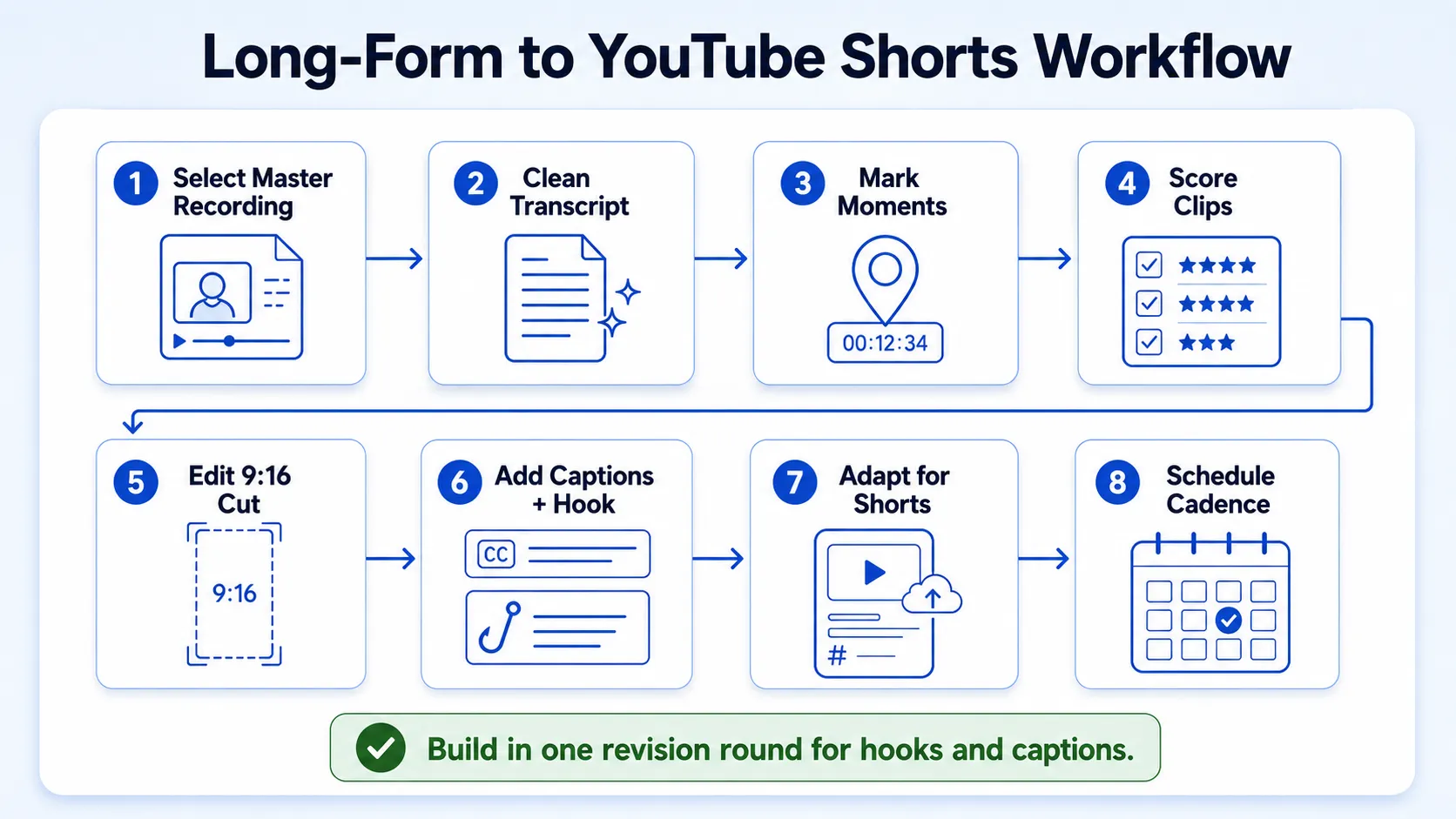
- Select the master recording. Pick the source with the clearest audio and the most specific claims, not necessarily the most recent one.
- Create or clean the transcript. A working transcript makes it far faster to scan for strong moments than scrubbing through raw footage.
- Mark candidate moments. Flag every point where a viewer could reasonably stop and think "wait, say that again."
- Score each moment against the clarity and buyer-value questions above, and keep the strongest set.
- Edit the vertical cut. Reframe for a 9:16 aspect ratio, tighten pauses, and keep the pacing appropriate to the platform.
- Add captions and a hook line. YouTube now allows Shorts up to three minutes long, a limit it extended from 60 seconds starting October 15, 2024, so you have more room than the old one-minute ceiling, but the hook still needs to land in the first few seconds regardless of total length.
- Adapt for the platform. A clip built for LinkedIn's feed does not always work unchanged on YouTube Shorts; test whether on-screen branding, captions, and pacing need adjustment.
- Schedule on a consistent cadence rather than publishing in one burst and going quiet for a month.
For a small in-house team, steps three through five are usually where the process breaks down, since scoring moments takes production judgment that a general marketing hire may not yet have. That is the piece we most often get asked to take over first.
In our experience, a single sixty-minute recording typically yields somewhere between eight and fifteen usable Shorts. The exact number depends far more on how many standalone, specific moments the speaker gives than on the length of the recording itself. Build in at least one revision round for hooks and captions before a batch goes out, since the on-screen text is often what needs the most adjustment after a first look.
Measuring whether your Shorts are producing business value
Not every Short should be judged the same way. Match the metric to what the clip was made to do.
Attribution on short videos is rarely clean, so treat platform analytics as one input alongside sales conversations, inbound demo requests, and direct mentions from prospects, rather than the single source of truth. A founder-led clip that never goes viral but consistently shows up in sales conversations as "I saw your video on X" is doing its job. We usually recommend reviewing performance monthly rather than clip by clip, since a single Short succeeding or failing tells you less than a pattern across a dozen.
What changes when the audience is technical
Writing a hook for a general business audience is not the same as writing one for a technical buyer evaluating an AI or SaaS product. A technical viewer tends to scroll past generic energy and stop for specificity, such as:
- A real number or benchmark
- A named limitation, not just a strength
- A direct comparison to another approach
- A founder disagreeing with a common assumption in their category
One mistake I see repeatedly is polishing a clip until it sounds like a product ad, which is exactly what erodes trust with an engineering or data-buyer audience. A slightly rougher clip where a founder explains a genuine trade-off usually earns more credibility than a highly produced clip that oversells.
We also see AI-native and SaaS teams treat every demo the same way. A feature walkthrough, a founder explaining the "why" behind a product decision, and a customer describing a specific outcome all repurpose into very different kinds of Shorts, and mixing all three into a single publishing cadence tends to build a stronger channel than relying on one format alone.
AI companies specifically tend to sit on an unusually deep well of source material without realizing it: internal engineering walkthroughs, model evaluation discussions, founder AMAs, and customer onboarding calls all contain moments that a general audience never sees. Most of that footage was never recorded with distribution in mind, which is exactly why it tends to sound more credible once it is repurposed.
Where Komet Media fits into this workflow
Most B2B SaaS and AI teams do not need to build an entire production department to make this work. The table below maps the workflow above to the specific services we run for clients.
If your team fits the B2B SaaS or funded startup profile, these services are usually combined into one retainer rather than booked separately.
Where to go from here
Repurposing long-form content into YouTube Shorts will not replace a full content strategy, and it should not be the only thing a B2B SaaS or AI startup publishes. But for a team that already records webinars, demos, podcasts, or founder interviews, it is one of the more efficient ways to find out whether short video builds a real pipeline before investing in original short-form production from scratch. The decision that matters most is not whether to try Shorts. It is whether someone on the team owns the selection process, since that judgment call decides more about performance than the editing itself.
A few practical next steps:
- Pull one existing recording and run it through the scoring questions above before cutting anything.
- Publish a first batch of six to ten clips and review performance after thirty days, not after the first clip.
- If the selection and editing steps are the bottleneck, book a call with our team to talk through what you already have to work with.
We built Komet Media around this gap, helping B2B SaaS, AI, and venture-backed teams turn existing recordings and new footage alike into a working short-form system.
Further reading
- Video editing for B2B SaaS: what to know
- YouTube Shorts video best practices for B2B
- Adding captions and subtitles that lift retention
- YouTube Shorts algorithm and reach explained
- How many clips can you get from one podcast
- Short-form video for AI and ML startups
- What is content repurposing
- Short-form vs long-form video for B2B
FAQ
1) What does it mean to repurpose long-form content into YouTube Shorts?
It means taking an existing long recording, such as a webinar, podcast episode, or demo, and editing specific moments from it into standalone vertical clips built for YouTube's Shorts feed, complete with captions and a clear hook.
2) How much does it cost to repurpose long-form video into YouTube Shorts?
Pricing depends on volume, turnaround time, and whether the project includes strategy and distribution support alongside editing. Our typical working range for a retainer or recurring project runs from about $2,500 to $5,000, though scope and production difficulty change the final number. Our B2B video editing pricing models breakdown covers what usually moves that number up or down.
3) What is the process for turning a long recording into YouTube Shorts?
The process for repurposing long-form content into YouTube Shorts generally covers transcription, marking strong moments, scoring them for clarity and buyer value, editing vertical cuts with captions, and publishing on a consistent schedule. See our full YouTube Shorts repurposing workflow for the step-by-step breakdown.
4) How long does it take to produce YouTube Shorts from a long-form video?
Turnaround varies by team and volume, but most production partners can deliver an initial batch of clips from one recording within a week, with ongoing batches following a set weekly or biweekly cadence, similar to the pacing in our posting cadence guide.
5) What deliverables come with a YouTube Shorts repurposing project?
Typical deliverables include the edited vertical clips themselves, captions, thumbnail or cover frame options, and often a short list of recommended titles and hooks for each clip. See our YouTube Shorts format and spec guide for the technical specifics.
6) Should a B2B SaaS company use a freelancer or an agency for this work?
A freelancer can work well for a single, well-defined batch of clips. An agency tends to fit better once a company wants a repeatable system across multiple recordings, platforms, and a consistent publishing cadence. Our breakdown of outsourcing video editing, pros and cons covers the trade-offs in more detail.
7) Can an internal marketing team handle this without outside help?
Yes, if someone on the team has the production judgment to score moments and edit for retention, and the time to do it consistently. Most lean marketing teams find the selection and editing steps are what slow them down first, which is often where outside support gets added.
8) Does Komet Media work with early-stage AI startups that do not have much existing long-form content yet?
Yes. Komet Media works with teams that have existing recordings to repurpose and with teams that need new short-form and long-form content created from scratch, so an early-stage AI startup does not need a large back catalogue to get started. Book a call to talk through what your team already has to work with.

