
YouTube Shorts Video Best Practices for B2B: Step-by-Step Guide
Most B2B Shorts are clips cut from something longer, with no thought for the person scrolling past. The idea may be good, but the opening is slow, the captions are missing, and the link back to the full video is unclear. These YouTube Shorts video best practices for B2B follow the same ten steps we use when we produce short video—both created from scratch and repurposed from long-form content—for B2B SaaS companies, AI companies, tech startups and teams, venture and private equity firms, and executives. Each step ends with something you can apply to your next Short.
Quick Answer
Pick one viewer and one idea, open with the answer or the problem, add captions, keep the edit tight, export vertical, and connect each Short to a longer video or a next step.
Snapshot
What YouTube Says About Shorts
Two platform facts matter before you plan anything.
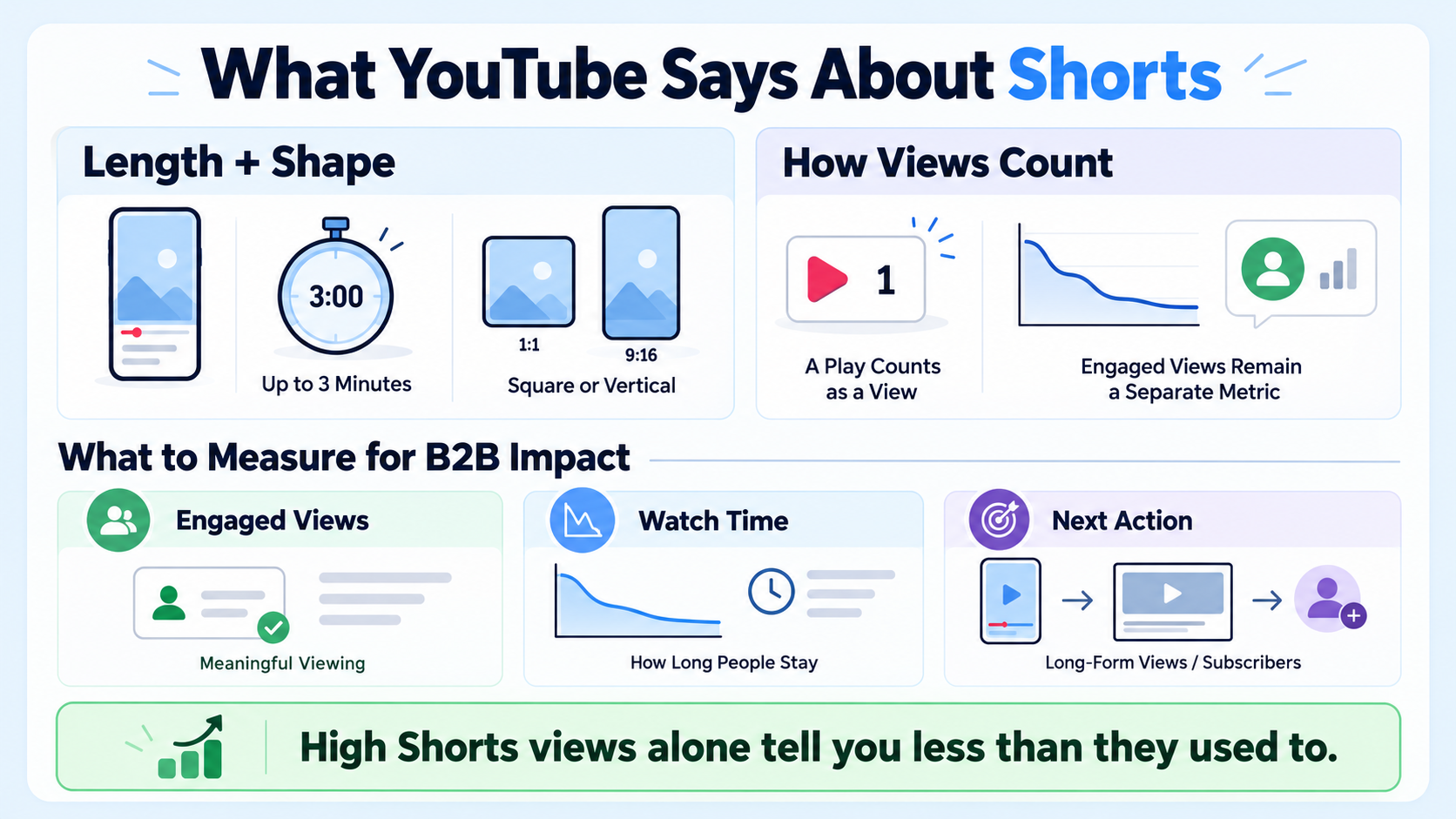
- Length and shape. YouTube's Help Center says Shorts can run up to three minutes, and that videos with a square or vertical aspect ratio can be categorized as Shorts. The page says qualifying videos uploaded on or after October 15, 2024 are categorized this way. See YouTube's page on three-minute Shorts.
- How views count. Tubefilter reported that from March 31, 2025, YouTube counts a Shorts view whenever the Short plays for any length of time, with no minimum watch time. It also reported that the earlier measure continues as "engaged views," which still determines Partner Program eligibility.
The second point changes how you read your numbers. A high view count alone tells you less than it used to. For B2B, I look at engaged views, how long people stay, and whether viewers go on to watch longer videos or subscribe.
Our explainer on the YouTube Shorts algorithm and reach goes into the mechanics, and our overview of YouTube Shorts strategy for B2B brands covers planning.
Step 1: Set a Goal and Name the Viewer
A Short is not a mini ad. It is a short answer to a question someone in your market already has. Before you record, write down:
- Viewer: a role, such as "head of product at a growth-stage software company."
- Question: what are they trying to figure out?
- Outcome: do you want a subscriber, a view of a longer video, a profile visit, or a click?
Different goals need different Shorts, as the table shows.
Step 2: Choose a Shorts Format Your Team Can Sustain
If you already record podcasts or product demos, a fast way to build a Shorts pipeline is to repurpose a podcast episode into YouTube Shorts, turn a demo into YouTube Shorts, and turn long-form content into Shorts posts. Alternatively, you can record net-new vertical content from scratch. To decide how Shorts and long videos fit together, read long-form YouTube vs short-form clips.
Step 3: Write the Hook First
The hook is the first sentence or visual. A Short plays in a fast feed, so the opening decides whether anyone stays. Write it before you plan visuals.
Avoid greetings, logo animations, and long intros. For more structure, see our hook writing framework and the guide to writing hooks that stop the scroll.
Step 4: Script a Simple Structure
A short video needs a short structure. I use this four-part pattern:
- Hook: the problem or the answer.
- Reason: why it matters to this viewer.
- Proof or example: one specific illustration.
- Next step: subscribe, watch the full video, or visit a link.
Keep the script conversational. Most people read their scripts too fast, so leave gaps for emphasis. Our short-form video scripting template can be reused for each batch.
Step 5: Frame for Vertical
Because YouTube categorizes square or vertical uploads as Shorts, vertical 9:16 is the safest choice. YouTube's page gives no pixel dimensions, so I use the same 1080 by 1920 master I use elsewhere and check the current guidance in YouTube Studio before publishing.
Our YouTube Shorts format and spec guide lists the full set of recommended settings.
Framing guidance:
- Keep the speaker's face in the upper-middle of the frame.
- Leave margins at the top and bottom, because interface elements cover parts of the picture.
- Place captions in the middle-lower area, away from buttons.
- Preview on a phone before publishing.
Step 6: Add Captions
Many people watch without sound. Captions also make the message easier to follow, and they help with accessibility.
- Use large, high-contrast text.
- Keep two lines or fewer on screen at a time.
- Highlight key words sparingly.
- Check names, product terms, and numbers for accuracy.
See our guide on captions and subtitles that lift retention and the discussion of captions vs subtitles for B2B video.
Step 7: Edit for Pace and Sound
Retention is an editing problem as much as a content problem. Remove pauses, tighten sentences, and change the visual every few seconds where it helps. Do not add effects that do not support the point.
Learn more in our guides on pacing and cuts for high-retention short video and using B-roll in talking-head video.
Step 8: Match the Length to the Idea
Shorts can run up to three minutes, but longer is not automatically better. I would use these as starting points, then adjust with your own data.
These are my working ranges, not YouTube rules. Our discussion of how long a B2B short-form video should be explains how to test length.
Step 9: Write the Title and Description
Shorts feed on a swipe, but titles and descriptions still help people and search understand the video.
For channel-level search habits, see our YouTube SEO basics for B2B channels.
Step 10: Publish, Link, and Review
Publishing is where YouTube Shorts video best practices for B2B meet real life, so keep it simple. Post on a schedule you can keep. Our guide on YouTube Shorts posting cadence can help you choose a rhythm. Then reuse the same core video on LinkedIn, Instagram Reels, and TikTok, but check captions and safe areas for each platform. Our notes on cross-posting video without killing reach cover the details.
Review after each batch:
Attribution will be imperfect. Use several signals, and ask new contacts where they found you. Do not treat correlation as proof of causation.
A 30-Day Batch Plan You Can Copy
Knowing the steps is easier than applying them every week. This is the plan I suggest to teams starting from zero. It is a working template, not a YouTube requirement, and you should adjust it to your own capacity.
Three habits keep the plan alive:
- Mix original concepts with repurposed content. Record dedicated Shorts from scratch or extract several clips from a strong long-form episode.
- Use a checklist. Teams that apply YouTube Shorts video best practices for B2B as a checklist, not a memory exercise, ship more consistently.
- Review on a fixed day. Look at engaged views and retention once a week, not every hour.
If you find the plan heavy, that is normal. Most teams struggle with selecting and editing clips, not with finding ideas.
Common Mistakes
Most of the problems I see when teams apply YouTube Shorts video best practices for B2B come down to the following:
- Opening with a logo, a greeting, or a slow lead-in.
- Packing several ideas into one Short.
- Cutting a clip with no context, so it makes no sense alone.
- Forgetting captions or placing them too low.
- Posting in bursts and then disappearing.
- Measuring only raw views.
Read our notes on what good YouTube Shorts content looks like for B2B for more.
Who Should Produce Your Shorts
Komet Media provides short-form video editing and YouTube video editing for B2B teams—creating original video from scratch as well as repurposing existing material—plus video marketing support when you want distribution handled with the edit. For planning the channel as a whole, see our YouTube strategy for B2B brands. Typical retainers run around $2,500 to $5,000, depending on scope, volume, production difficulty, turnaround, and distribution needs. That is a working range, not a fixed package.
Conclusion
The best Shorts are narrow, clear, and consistent. Start with one viewer and one idea, write the hook before you film, caption everything, and review the numbers that matter. YouTube Shorts video best practices for B2B are simple to state and hard to sustain, which is why a production routine matters more than inspiration. Editing creates the asset. Distribution and consistency give it a chance to produce business value. If you want to talk through a Shorts plan, you can book a call.
FAQ
What are YouTube Shorts video best practices for B2B?
They are production and publishing habits that fit a business audience: a clear viewer, a strong opening, captions, tight editing, vertical framing, one call to action, and review of engaged views and retention.
How much does Shorts production cost for a B2B team?
Cost depends on volume, production difficulty, and whether you want strategy and posting included. Komet Media's typical working range is around $2,500 to $5,000 for retainers. Freelancers and in-house hires price differently, so compare what each includes.
How long should a B2B Short be?
Start with 15 to 60 seconds for most ideas, then test longer cuts when the topic needs them. YouTube allows Shorts up to three minutes, but length should follow the idea. Among YouTube Shorts video best practices for B2B, matching length to the idea matters more than hitting a number.
How often should we post Shorts?
Choose a pace the team can sustain. Many managed programs aim for several Shorts a week. Consistency matters more than volume.
How long does it take to see results?
Plan for at least a few months. The first weeks are for production and testing, and later weeks show which hooks and topics work. Starting with a clear viewer and a hook list shortens that testing phase, but it does not remove it.
Should we use a freelancer or an agency?
A freelancer suits edits when your team handles strategy, scripting, and posting. An agency suits teams that want end-to-end production (from scratch concepting to clip selection), editing, and posting handled together. See our comparison of a freelance video editor vs an agency for B2B.
Do B2B companies really need Shorts?
Not every company does. Shorts fit teams that want a lighter way to reach new viewers, whether by producing original vertical shorts from scratch or repurposing existing long-form YouTube video or podcasts. See our comparison of Reels vs Shorts vs TikTok for B2B.
Does Komet Media produce Shorts for B2B brands?
Yes. We produce original content from scratch as well as repurpose existing assets into short video for B2B SaaS companies, AI companies, tech startups and teams, venture and private equity firms, and executives, either as editing support or as a full growth service.

