
🪄 AI Summary
Heading 1
Heading 2
Heading 3
Heading 4
Heading 5
Heading 6
Lorem ipsum dolor sit amet, consectetur adipiscing elit, sed do eiusmod tempor incididunt ut labore et dolore magna aliqua. Ut enim ad minim veniam, quis nostrud exercitation ullamco laboris nisi ut aliquip ex ea commodo consequat. Duis aute irure dolor in reprehenderit in voluptate velit esse cillum dolore eu fugiat nulla pariatur.
Block quote
Ordered list
- Item 1
- Item 2
- Item 3
Unordered list
- Item A
- Item B
- Item C
Bold text
Emphasis
Superscript
Subscript
Most SaaS teams are sitting on hours of recorded webinars, demos, founder interviews, and podcasts with zero distribution plan. Outsourcing video editing is the lever that converts that backlog into pipeline-driving short-form content without pulling engineers or PMs into post-production. But it is not a zero-risk decision. This guide breaks down the real advantages and trade-offs so you can make the right call for your team's content calendar, growth goals, and budget.
TL;DR
- Outsourcing video editing frees internal teams to focus on strategy and product while specialists handle post-production.
- The biggest risks are brand inconsistency, slow turnaround time, and unclear intellectual property rights.
- Agencies beat freelance marketplaces for B2B SaaS teams that need scalable content operations and brand consistency.
- Vet any partner on their B2B portfolio, revision process, and tooling (Adobe Premiere Pro, DaVinci Resolve) before signing.
What Are the Core Pros of Outsourcing Video Editing?
For founders and growth teams already stretched across pipeline, product, and hiring, building an in-house video production workflow rarely pencils out in the short term. Here is what outsourcing video editing gets you immediately.
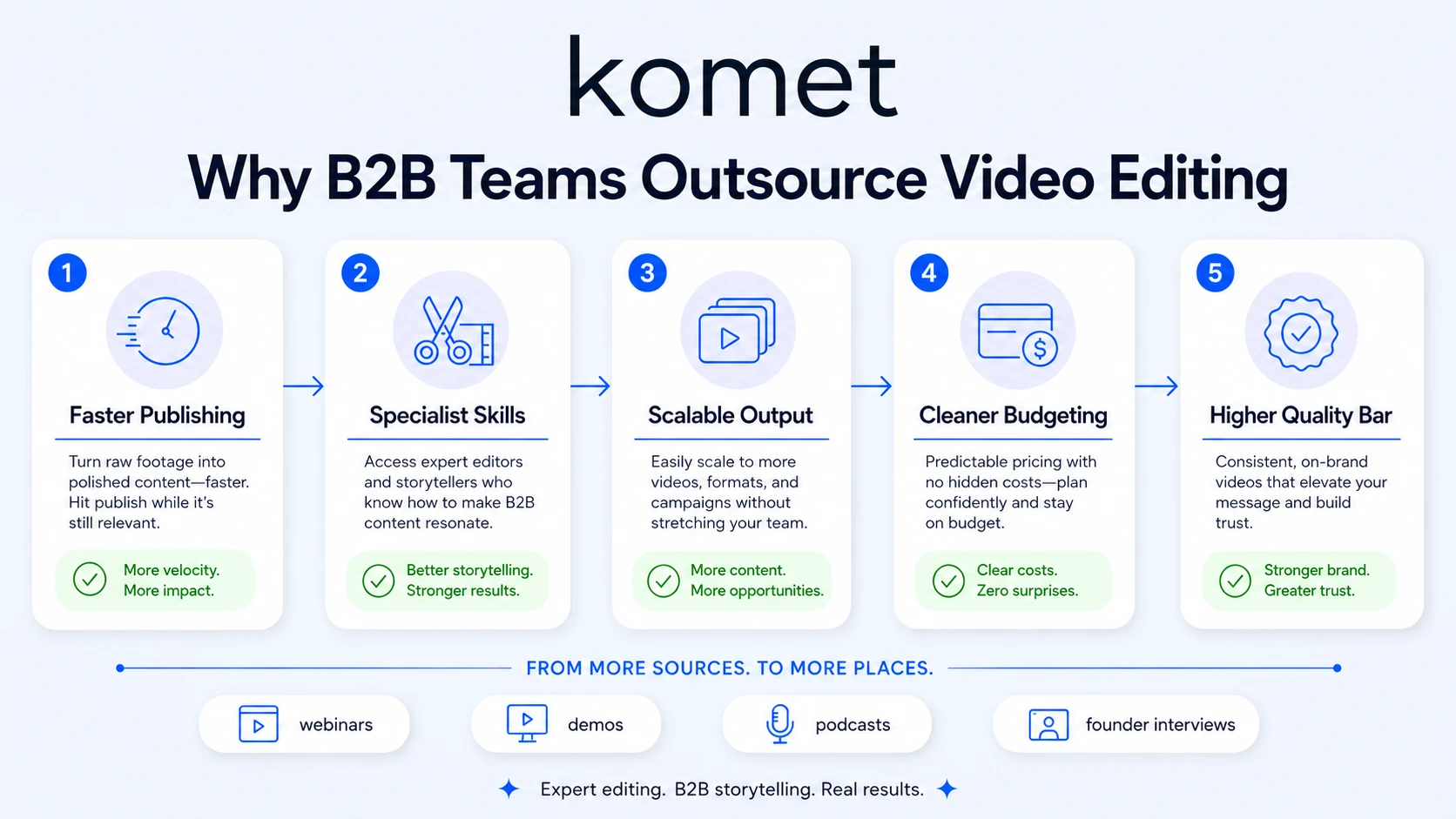
- Speed to publish: A dedicated editor or agency running a structured post-production pipeline can turn raw recordings into polished clips in 24 to 72 hours. That matters when your content calendar has weekly publishing targets and your sales team needs enablement assets this month, not next quarter.
- Access to specialist skills: Color grading, audio mixing, motion graphics, and YouTube optimization are distinct disciplines. A generalist hire rarely commands all of them. An agency built for B2B video brings a full skill stack without you managing multiple contractors.
- Scalable content operations: When a product launch, event series, or conference season spikes your raw footage volume, an outsourced team scales with you. You are not capped by one editor's bandwidth or constrained by a single software license.
- Cost structure clarity: Agencies and subscription models convert unpredictable production costs into fixed monthly line items. That makes budget forecasting cleaner for a funded startup operating on a quarterly spend plan.
- Creative quality benchmark: A team that edits B2B video daily builds pattern recognition for what performs on LinkedIn, YouTube, and sales sequences. You inherit that benchmark immediately rather than building it through trial and error.
The compounding benefit is distribution velocity. More polished clips published faster means more touchpoints with buyers across more channels, which directly supports demo demand and founder-led growth through short-form video. That distribution compound effect is the real ROI argument for outsourcing.
What Are the Real Risks and Cons of Outsourcing Video Editing?
Outsourcing video editing solves a capacity problem. It introduces a different set of operational risks that teams underestimate until they are managing a revision spiral two weeks before a campaign launch.
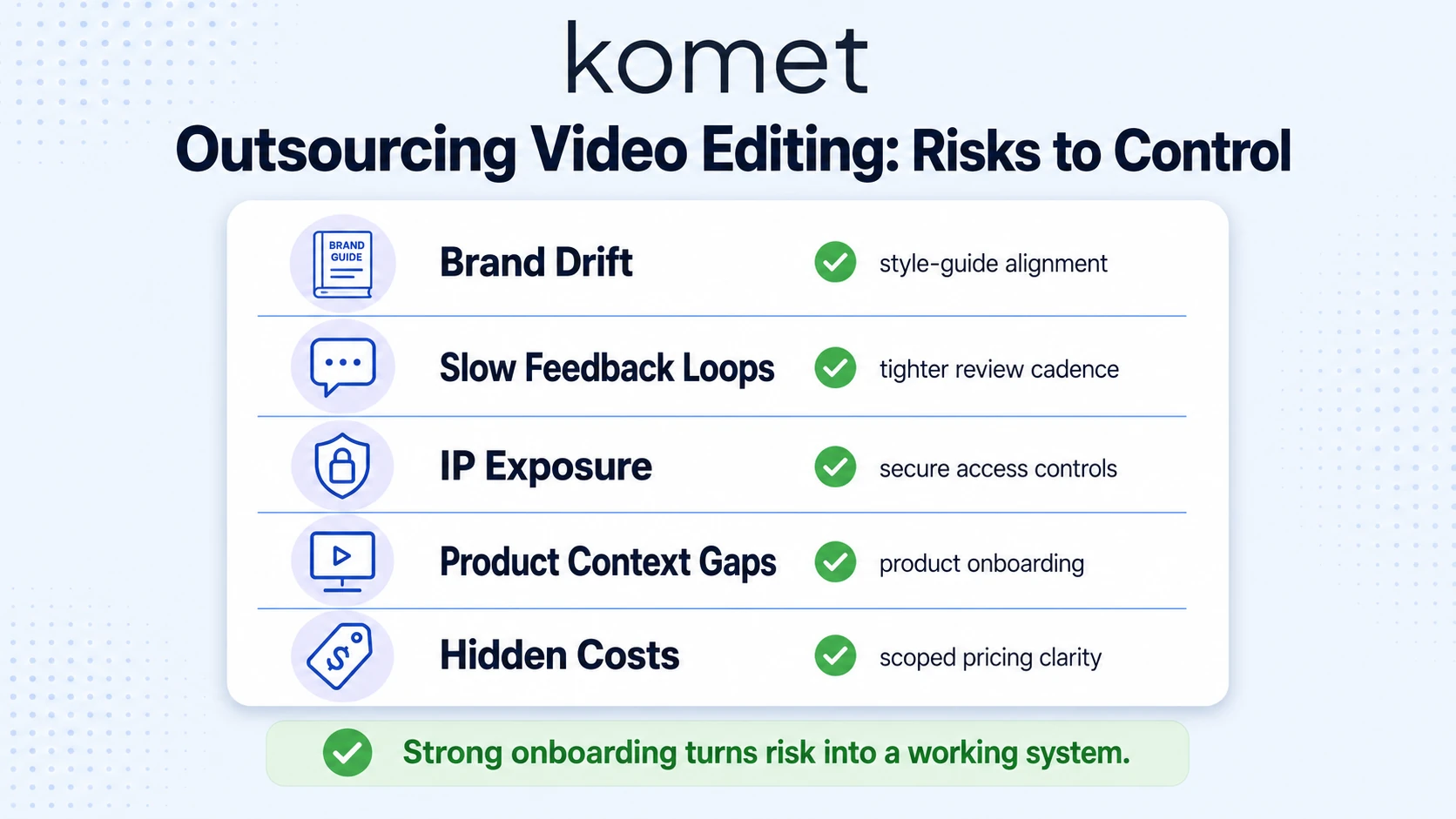
- Brand consistency drift: External editors default to their own aesthetic preferences unless you give them a detailed brand kit covering fonts, colors, tone, pacing, caption style, and audio levels. Without it, every video looks slightly different, which erodes the visual trust you are trying to build with buyers.
- Communication lag and revision cycles: Async feedback across time zones adds friction. A revision that takes 30 minutes to explain verbally turns into three rounds of back-and-forth comments that stretch turnaround time from two days to six.
- Intellectual property exposure: Raw footage containing unreleased product features, investor conversations, or customer data needs a clear IP and confidentiality agreement before it leaves your server. Most freelance marketplace contracts default to platform terms that may not be sufficient.
- Context deficit on your product: A video editor who does not understand your ICP, your product's value proposition, or the specific pain points you are addressing will cut clips that look polished but miss the buyer psychology that makes a clip convert. This is especially common when editors work across industries without a B2B focus.
- Hidden cost overruns: Per-video pricing on platforms like Upwork compounds fast when volume scales. Revision fees, rush delivery premiums, and file transfer overhead eat into the cost savings that motivated the outsource decision in the first place.
The agencies that consistently underdeliver are the ones that treat B2B video as a production commodity rather than a strategic content asset tied to pipeline.
Mitigating these risks requires a structured onboarding process, a detailed brand style guide, and a partner who asks the right questions about your buyers before touching the footage.
Outsourcing vs. In-House Video Editing: Which Model Fits B2B SaaS Teams?
The honest answer is that neither model is universally right. The decision depends on your publishing volume, the complexity of your content repurposing strategy, and your stage of growth.
For most funded SaaS teams at the Seed to Series B stage, full-time in-house video production is premature. The volume does not justify the salary, and the skill set required spans editing, motion graphics, audio mixing, and platform-specific optimization. An outsourced partner with a repeatable post-production pipeline covers that gap until the volume and budget warrant bringing production in-house.
Where in-house wins is speed of iteration. When your editor sits in Slack with your marketing team, feedback loops are shorter and context transfer is near-zero. That advantage shrinks when you build a tight brief template and async workflow with an outsourced partner. The video editing services model works best when the agency is embedded enough in your brand to operate without constant hand-holding.
What Should You Look for When Hiring a Video Editing Agency?
Choosing a video editing partner is a positioning decision, not just a procurement one. The wrong partner can produce technically competent work that does nothing for buyer trust or pipeline. Here is the evaluation framework I use.
- B2B portfolio specificity: Ask for examples of SaaS product demos, founder interviews, or webinar clips they have edited. Lifestyle brand reels do not demonstrate the judgment needed for buyer education content.
- Tooling transparency: Confirm they work in Adobe Premiere Pro or DaVinci Resolve. Proprietary tools create lock-in and make it harder to hand off project files if you part ways.
- Brief and onboarding process: A quality agency will ask about your ICP, brand voice, publishing cadence, and platform targets before starting. If they skip straight to deliverables, that is a warning sign.
- Revision policy in writing: Understand the number of included revision rounds, what constitutes a revision versus a scope change, and the turnaround commitment for each round.
- IP and confidentiality terms: Ensure the contract explicitly assigns all output rights to your company and includes an NDA covering raw footage and unreleased product content.
- Quality control process: Ask who reviews work before it reaches you. A solo freelancer's QC is their own judgment. A structured agency has a review layer that catches technical and brand errors before delivery.
- Communication cadence: Confirm how feedback is collected (frame-accurate comment tools, Loom, written notes), the response time SLA, and the primary point of contact.
The differentiator between a commodity editing service and a real growth partner is whether they understand that a short-form video clip is a sales asset, not just a content deliverable.
How Should B2B Teams Manage Outsourced Video Production at Scale?
Outsourcing works at scale when you treat the agency relationship as a system, not a task queue. Here is the operational structure that prevents the common failures.
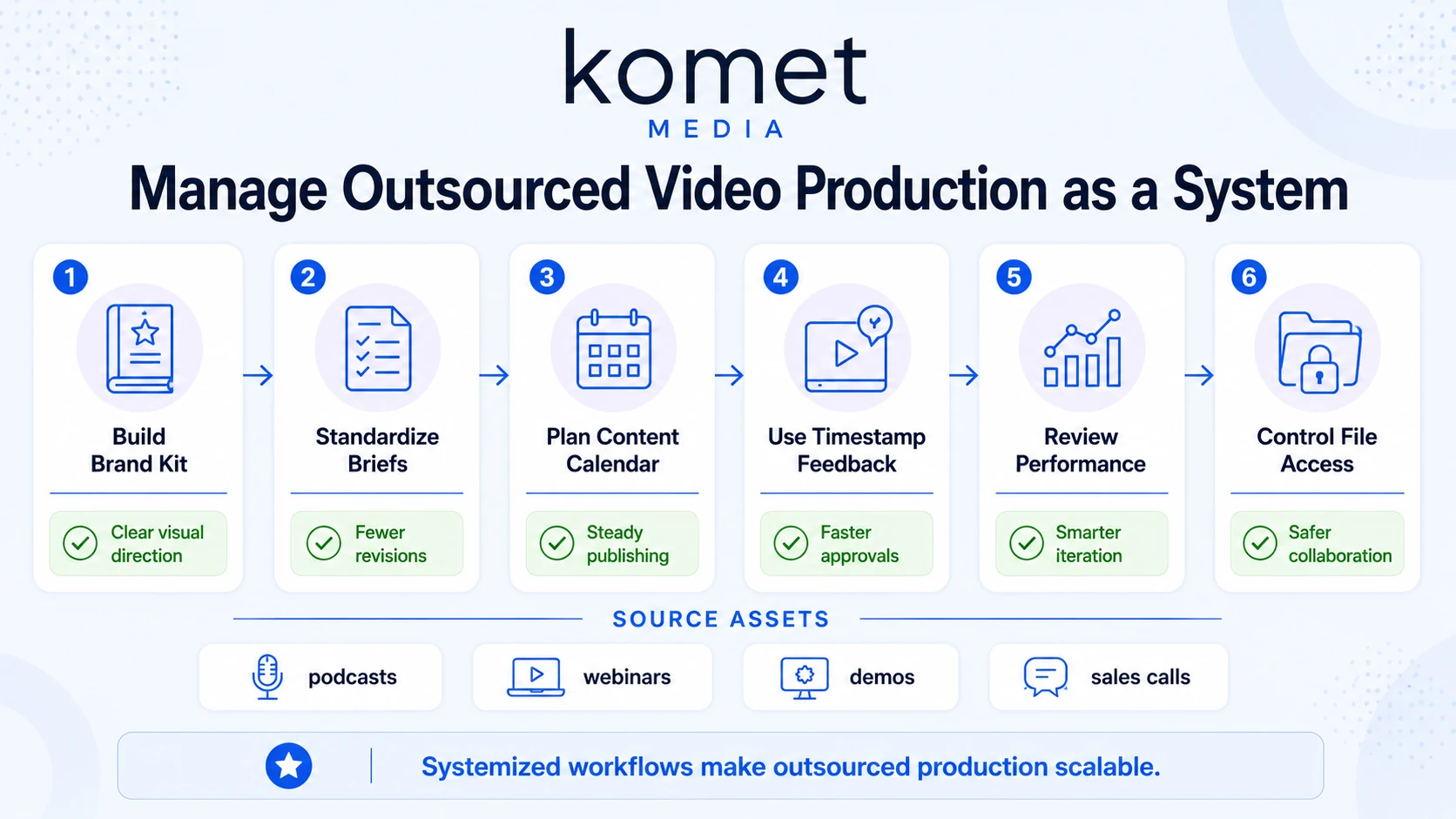
- Build a master brand kit: Cover logo usage, color codes, font stacks, caption formatting, lower-third style, music tone, and pacing preferences. This document is your quality control proxy when you are not in the edit suite.
- Standardize your brief template: Every piece of raw footage submitted should include: the target platform, the intended audience segment, the core message or hook, the call to action, and the desired length. Ambiguity at the brief stage multiplies into revision cycles at delivery stage.
- Set a content calendar with a buffer: Publish dates should account for editing turnaround time plus one revision round. Rushing the post-production pipeline is the fastest way to get mediocre output approved under deadline pressure.
- Use frame-accurate feedback tools: Tools that let you leave timestamped comments on video drafts cut revision cycles significantly compared to written descriptions or phone calls.
- Run a monthly performance review: Look at which clips generated demo requests, LinkedIn engagement, or sales sequence click-throughs. Feed that data back to your editing partner so their decisions reflect what actually performs, not just what looks polished.
- Protect raw footage with access controls: Use a shared drive with permission tiers. Editors should access only the footage relevant to active projects. Sensitive material (investor updates, pre-launch demos) should require explicit authorization before transfer.
Podcast and webinar content is the highest-leverage raw material for this system because one 45-minute recording can generate eight to twelve short clips with proper repurposing. That multiplier is what makes a structured outsource relationship a scalable content operations model rather than a one-off production expense.
How Much Does It Cost to Outsource Video Editing in 2026?
Pricing varies significantly by model, volume, and the expertise tier you need. Here is a practical breakdown.
Subscription services like those offered by competitors in the space compete primarily on price and speed. They are built for volume editing without deep strategic input. For a SaaS team where every video touch is a buyer education moment, that model produces content that looks finished but does not work as hard as it should in a sales motion.
The real cost calculus is not editing fees against salary. It is editing fees against the pipeline value of consistent, high-quality video content published at a cadence your buyers actually see. A founder who records a 10-minute product walkthrough every two weeks and has it repurposed into four short clips per recording is publishing 8 to 10 assets monthly from a single commitment. That output level is structurally impossible without outsourcing video editing to a capable partner.
Motion graphics, color grading, and audio mixing add cost but also add perceived production value that directly affects how buyers perceive your brand's credibility and authority.
What Are the Best Practices for Outsourcing Creative Work as a B2B Team?
The teams that get the most from outsourcing treat it as a strategic capability, not a cost-cutting measure. These are the practices that separate high-output content teams from ones stuck in constant revision cycles.
- Start with a paid test project: Before committing to a retainer, assign a single high-priority clip. Evaluate the output against your brand standards, the revision responsiveness, and the communication quality. Contracts should follow demonstrated fit, not promises.
- Protect your intellectual property: Have legal review of the IP assignment clauses in any editing or agency contract. Ensure your company owns all deliverables, including intermediate files and project files, not just the final export.
- Document your content repurposing strategy: Editors perform better when they understand the downstream use of every asset. A clip destined for a LinkedIn cold audience needs a different hook structure than a clip sent in a sales sequence to a warm prospect.
- Separate strategy from production: Your in-house team owns the positioning, messaging, and content strategy. The outsourced partner executes production. When that line blurs, brief quality drops and output suffers.
- Review intellectual property rights annually: Agency contracts and platform terms evolve. An annual contract review ensures your IP protections remain current, especially as your content library grows in value.
Komet Media's approach to video marketing is built on this principle: the strategy stays inside the client's team, and we provide the production system that turns that strategy into published assets consistently.
Conclusion
- Outsourcing video editing accelerates publishing velocity, reduces internal production burden, and gives B2B teams access to specialist skills without full-time headcount.
- The primary risks are brand inconsistency, IP exposure, and context-deficit editing. All three are solvable with strong onboarding, a detailed brand kit, and a proper contract.
- Agencies with a B2B focus outperform generic subscription services for SaaS teams where video is a buyer education and pipeline tool, not just a content checkbox.
- Start with a paid test project, document your brief process, and treat your editing partner as an embedded production system rather than a task vendor.
Frequently Asked Questions
Q1: What is the biggest risk of outsourcing video editing for a SaaS team?
Brand inconsistency is the most common failure point. Editors without deep context on your product, ICP, and messaging produce technically clean videos that miss the buyer psychology. A detailed brand kit and structured brief template solve most of this before the first edit starts.
Q2: Is a freelance marketplace like Upwork better than an agency for video editing?
Upwork works for simple, low-volume projects where price is the primary variable. For B2B teams running consistent content operations across LinkedIn, YouTube, and sales sequences, an agency with a structured post-production pipeline and brand onboarding process delivers better output and fewer revision cycles.
Q3: How many revision rounds should I expect when outsourcing video editing?
Two rounds is standard. Round one addresses structural issues (pacing, clip selection, hook). Round two handles brand polish (captions, color grading, audio levels). More than two rounds typically signals a brief quality problem, not an editing quality problem.
Q4: Who owns the raw footage and final videos when I outsource editing?
You do, if your contract says so explicitly. Always ensure the agreement includes a full IP assignment clause covering all deliverables and intermediate files, plus an NDA for any raw footage containing unreleased product or customer data.
Q5: How do I calculate the ROI of outsourcing video editing?
Measure demo requests, LinkedIn engagement rates, and sales sequence click-throughs attributed to video assets. Set a baseline before outsourcing, run for 90 days, then compare. Distribution volume multiplied by conversion rate against editing cost is the clearest unit economics frame.
Q6: How is Komet Media different from subscription editing services?
Subscription services provide production capacity. Komet Media provides video editing and content repurposing systems built around buyer education and pipeline. The difference is strategic input: we work from your product positioning and ICP to determine which clips to make and how to structure them, not just how to make them look polished.