
YouTube Shorts Posting Cadence and Scheduling for B2B SaaS & AI-Native Companies: Step-by-Step Guide
Most B2B SaaS teams I talk to know they should be on YouTube Shorts. What they don't know is how often to post, when to post, or how to build a system that doesn't collapse after week three. YouTube Shorts posting cadence and scheduling is one of those topics where generic creator advice sends enterprise software teams in the wrong direction entirely. This guide gives you the B2B-specific answer, backed by current data, and a repeatable workflow you can actually run.
TL;DR
- Post 3–5 Shorts per week as your baseline; daily posting accelerates growth only when production quality stays consistent.
- Optimal posting windows for B2B SaaS: Tuesday–Thursday, 8–11 AM and 12–3 PM in your audience's time zone.
- Repurpose webinars, demos, and podcasts first; net-new production is secondary.
- Track engaged views and audience retention in YouTube Studio, not raw view counts.
How Often Should You Post YouTube Shorts for Your SaaS Company?
This is the question I get most from founders and marketing heads. The honest answer: there is no single number YouTube has officially endorsed. There is no universal YouTube-approved number of Shorts to publish per day or per week. The best cadence depends on your idea supply, quality control, and ability to stay original. That said, the research converges on a clear starting point.
- For most creators, posting 3–5 YouTube Shorts per week is the minimum frequency for consistent algorithmic growth, with daily posting driving significantly faster results when quality stays stable.
- For B2B SaaS teams specifically, I lean toward the lower end of that range at launch, because the cost of producing generic content is higher than the benefit of raw volume.
Here's why: Hootsuite's 2025 Social Trends report notes that accounts posting high-quality Shorts three to four times per week outperform accounts posting daily mediocre Shorts. If your team is choosing between five rushed clips and three tightly edited ones, the three win every time. A vidIQ analysis of 5.08 million YouTube channels covering June 2024 to June 2025 found a direct correlation between posting frequency and channel growth. Every increase in upload frequency led to faster view and subscriber growth.
The pattern is clear: channels posting 12 or more times per month (roughly 3+ per week) grow substantially faster than those posting sporadically.
The practical starting cadence for a B2B SaaS team:
- Weeks 1–4: 3 Shorts per week. Build the workflow, test hooks, measure retention.
- Weeks 5–8: Scale to 4–5 per week once editing is systematized and top-performing formats are identified.
- Week 9+: Consider daily if a content repurposing system is running reliably.
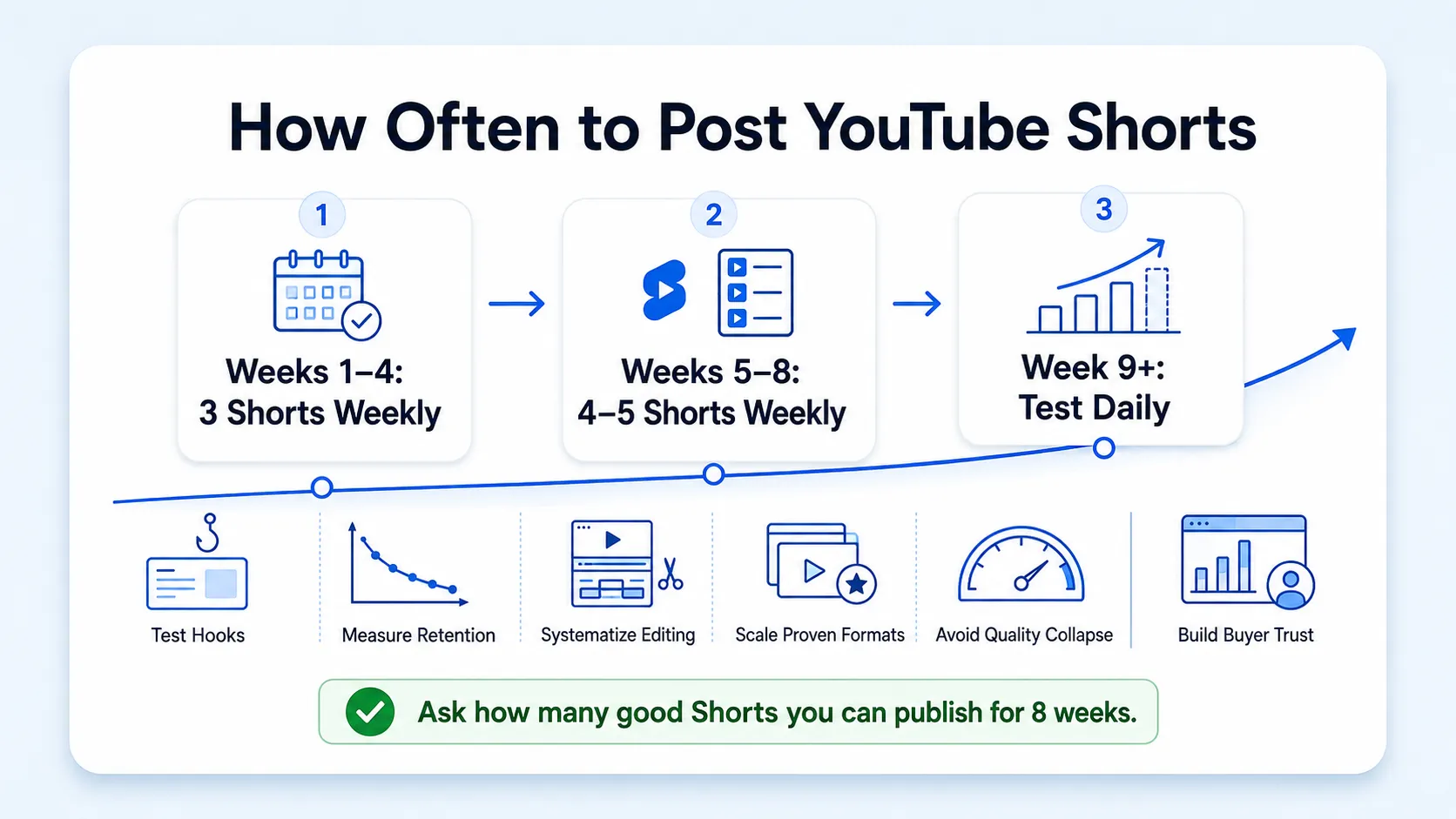
The right question is not "How many Shorts can I post?" but "How many good Shorts can I publish for the next 8 weeks without quality collapse?" For SaaS teams, that mental reframe matters. Pipeline and buyer trust are the goals, not subscriber counts.
YouTube Shorts Posting Schedule: Timing Windows That Work for B2B
Timing is secondary to quality, but it's not irrelevant. The algorithm tests your Short with early viewers. YouTube Shorts uses an "explore-exploit" system. The faster the initial engagement signal, the wider the distribution. Posting when your buyers are actually on the platform compresses that feedback loop. For B2B SaaS, your ICP is not scrolling YouTube at midnight. If you're running B2B SaaS Shorts, Tuesday 8 AM ET, before standups end, is the recommended window.
More broadly, business and finance content performs best in the 9 AM–2 PM window, during professional research sessions. Here's a practical scheduling table for B2B SaaS teams targeting a US audience:
According to Sprout Social's 2025 engagement data, Tuesday through Thursday show the highest YouTube engagement on average.
One critical point: consistency beats optimization. Posting at the same time every day trains both the algorithm and your audience to expect new content at a specific time. A consistent 10 AM daily post outperforms random posting at theoretically optimal times. Use YouTube Studio to validate these windows against your actual audience.
YouTube Studio shows when your subscribers are most active. Navigate to Analytics, then Audience, then look at the "When your viewers are on YouTube" chart. This heat map shows your specific audience's peak activity hours by day of the week.
Does Posting More YouTube Shorts Increase Channel Growth Faster?
More volume does correlate with faster growth, but the relationship is not linear. Three or more per day yields diminishing returns. Your Shorts compete with each other for algorithmic attention, and quality typically drops at high volume. Only channels with dedicated production teams should consider this cadence. The more important variable is retention, not frequency.
Shorts with 70%+ average watch time get pushed to larger audiences. A Short with 80% watch time posted at 3 PM beats one with 60% watch time posted at the perfect time. Focus 80% on hook/retention, 20% on timing. The algorithm won't promote low-retention videos just because you upload daily. For B2B SaaS, this matters because your buyers will click away from a vague hook in under two seconds. Every Short needs a specific, outcome-tied hook: "Here's why your onboarding flow is killing trial conversions" lands. "Tips for SaaS success" does not.
The framework I use with clients: treat each Short as a signal test. Post, measure engaged views at 48 hours, then decide whether to scale that format. YouTube's 2025 Shorts view-count update makes cadence analysis trickier. A Short can register views when it starts to play or replay, while engaged views remain the better signal for whether viewers chose to continue watching. YouTube says engaged views remain in Analytics and still matter for YPP eligibility and Shorts ad revenue sharing.
Rule of thumb: If publishing more Shorts increases raw views but lowers average engagement rate, your cadence is too aggressive. Pull back and tighten the content before scaling again.
How to Build a YouTube Shorts Content Calendar for B2B SaaS Teams
A social media calendar built on net-new production dies within six weeks for most B2B teams. The sustainable model is a content repurposing workflow. A sustainable YouTube Shorts content strategy for SaaS companies relies entirely on repurposing. By feeding a 60-minute webinar into an AI platform, you instantly generate a month of content. Here is the five-step calendar system I recommend:
- Audit existing long-form assets: Identify webinars, product demos, founder interviews, and podcast episodes recorded in the last 90 days. These are your primary content feedstock.
- Timestamp key moments: When atomizing a podcast or webinar, use timestamps to identify the most impactful 30–60 second clips. These can be turned into short video reels for channels like YouTube Shorts and TikTok.
- Batch-produce clips: Instead of creating one Short from start to finish each day, dedicate a block of time to film and edit multiple Shorts at once. For repurposed content, one editing session per week can produce five to seven clips.
- Map clips to content pillars: Assign each clip to a buyer education category (product trust, objection handling, use case proof, founder POV, customer outcome). Rotate pillars across the week to avoid repetition.
- Schedule in YouTube Studio: When uploading, set the video to Private or Scheduled, open the Schedule card, and pick the date, time, and timezone. Queue the full week in one session.
One 45-minute B2B podcast episode produces: 1 YouTube upload + 4–7 LinkedIn/YouTube Shorts clips + 1 SEO blog post + 2–3 derivative blog posts + 1 email newsletter + 3–5 social quote posts. Total output per episode: 30+ pieces of content from one 45-minute recording. That output-to-input ratio is why repurposing is the core of what we build at Komet Media for SaaS clients.
YouTube Shorts vs. Long-Form Video: What's the Right Mix for B2B?
The short answer: use Shorts for discovery and long-form for conversion. Most successful YouTube strategies in 2026 combine both. For B2B SaaS specifically, the split matters because the buyer journey is longer and more complex than a DTC purchase. YouTube video marketing for B2B in 2026 requires a Shorts-first discovery strategy combined with long-form content for consideration-stage buyers.
Here's how the formats serve different pipeline stages:
SocialPilot's 2026 analysis suggests 1–2 long-form videos plus 3–5 Shorts per week as a sustainable mix, with the median active channel publishing around 12 videos a month.
For enterprise SaaS (higher ACV, longer sales cycles), keep Shorts experimental and focused on driving toward your long-form content. Long-form is where conversions happen. Use Shorts for brand awareness, generating buzz, and driving signups for webinars and other longer-form content.
Per the 2026 Content Strategy Report, 48% of users want to hear from company leadership. That data point tells you exactly what your Shorts should feature: founders explaining a real problem, not polished marketing copy read by an actor. If you're building a founder-led video presence, Shorts are the fastest path to visibility before your long-form library is built.
YouTube Shorts Scheduling Tips for B2B Tech and AI Startups
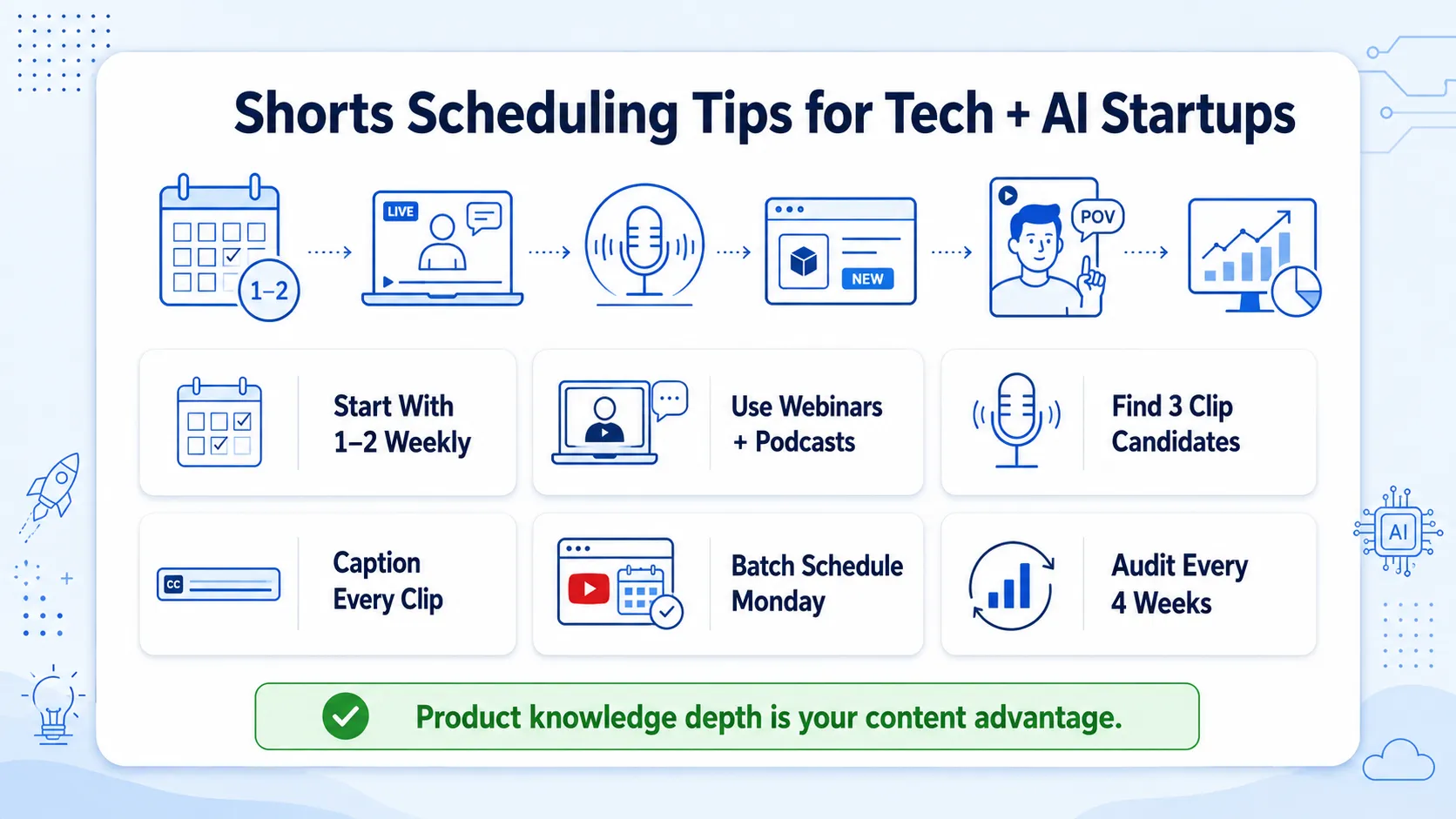
AI-native and tech startups have a specific advantage in Shorts: product knowledge depth. Your team understands the problem space better than any generalist content creator. The scheduling and production challenge is converting that expertise into 30–60 second clips consistently. Here is how to operationalize it:
For AI startup teams running lean:
- Create 1–2 Shorts weekly from existing long-form content, extract clips from existing content, test different content types, and monitor engagement metrics to build your subscriber base.
- Map your webinar and podcast recordings as your primary input. Every recording session should produce at least three Short candidates before anything is published live.
- Add captions to every clip. Add captions to every clip. 85% of viewers watch videos without sound on social platforms, making captions non-optional for B2B audiences.
Scheduling mechanics that reduce friction:
- Batch schedule Monday morning for the full week. This removes daily decision fatigue and keeps the calendar filled even during product sprint cycles.
- Use YouTube Studio's native scheduler, not third-party tools. Consistent daily posting at the same time beats sporadic posting at the "perfect" time.
- Set a recurring audit: every four weeks, review your YouTube Studio analytics for top-performing Shorts, identify the hook style, format, and topic category that drove the most engaged views, and weight the next month's content calendar accordingly.
For AI startup content specifically: product feature updates, founder takes on industry shifts, and customer outcome clips tend to outperform generic "tips" content because they carry verifiable authority. Buyers researching AI tools want to see proof of thinking, not polished brand language.
YouTube Studio Analytics: Measuring Whether Your Cadence Is Working
Posting consistently is the input. YouTube Studio analytics are the feedback mechanism that tells you whether to maintain, accelerate, or restructure your YouTube Shorts posting cadence and scheduling.
The metrics that matter for B2B SaaS, in priority order:
- Engaged views: Viewers who actively chose to watch your Short. Do not judge cadence only by total views. Look at how many viewers stayed past the initial seconds, how the Short performed against comparable uploads, and whether the topic produced follow-up interest.
- Audience retention rate: Aim for 70%+ average completion. Drops in the first two seconds indicate weak hooks; drops at the end indicate weak CTAs.
- Subscriber growth rate: Are Shorts converting discovery into subscribers who stay for long-form content? If not, your Short-to-long pipeline is broken.
- Traffic source breakdown: Shorts Feed vs. YouTube Search vs. External traffic. B2B teams should monitor whether any Shorts are appearing in Google Search results, which signals video SEO value.
Shorts reporting can show views, likes, subscribers, how viewers found the Short, how viewers engaged, top Shorts, and remix data. Review this data weekly during the first 90 days, then move to a bi-weekly cadence once patterns stabilize. If publishing more increases starts but weakens engagement, the schedule is probably too aggressive or the ideas are too similar. That's your signal to compress the cadence, not to push harder.
For teams connecting Shorts to pipeline, supplement YouTube Studio with Google Search Console to track branded search lift. An increase in branded queries over 60–90 days is a reliable leading indicator that Shorts-driven awareness is converting to bottom-of-funnel intent.
Conclusion
Consistency, quality, and a repurposing workflow beat raw posting volume every time for B2B SaaS teams. Here's what to execute:
- Start at 3–5 Shorts per week, with Tuesday–Thursday morning slots targeting your buyer's work hours.
- Build your content calendar from webinars, demos, and podcast recordings before shooting anything net-new.
- Measure engaged views and retention, not total views, to determine whether to scale your cadence.
- Combine Shorts (awareness/discovery) with long-form content (conversion/trust) for a complete YouTube Shorts posting cadence and scheduling system that actually moves the pipeline.
If your team needs a reliable production system behind this strategy, explore Komet Media's short-form video services or get in touch directly.
Frequently Asked Questions
Q1: How many YouTube Shorts per week should a B2B SaaS brand post?
3–5 Shorts per week is the evidence-backed starting range. This gives the algorithm enough signals to understand your niche without overwhelming your production capacity. Scale to daily only once you have a repurposing system that maintains quality consistently across weeks.
Q2: Is YouTube Shorts posting cadence and scheduling different for AI startups versus established SaaS companies?
The core cadence recommendation (3–5 per week) applies to both. AI startups without an existing content library should prioritize product demo clips and founder POV content. Established SaaS teams can draw from a deeper archive of webinars, customer stories, and case studies to maintain cadence without net-new production.
Q3: What time should B2B SaaS brands post YouTube Shorts?
Tuesday through Thursday, 8–11 AM and 12–2 PM in your audience's primary time zone. For US-focused B2B audiences, that means ET. Validate against your own YouTube Studio "When your viewers are on YouTube" heatmap quarterly, since buyer habits shift.
Q4: Does posting YouTube Shorts affect long-form video performance on the same channel?
Shorts and long-form videos run on separate algorithmic feeds. Posting Shorts does not hurt long-form performance, and Shorts-driven subscribers can become long-form viewers if you consistently link between formats. The risk is Shorts subscribers who never migrate to long-form, which is why every Short should include a clear CTA pointing to a deeper asset.
Q5: How do you build a YouTube Shorts content calendar without a full video team?
Start with a repurposing workflow. One 45-minute webinar or podcast episode can produce 4–7 Short clips when properly timestamped and edited. Batch the editing into one weekly session, schedule all clips in YouTube Studio, and review analytics at the end of each month to inform the next batch.
Q6: How long should YouTube Shorts be for B2B SaaS content?
30–60 seconds is the optimal range for B2B educational Shorts. Clips under 60 seconds tend to get higher completion rates, which is the primary engagement signal the algorithm uses to scale reach. Longer Shorts (up to 3 minutes) work for detailed feature walkthroughs or mini-demos where buyer intent is already established.

