
🪄 AI Summary
Heading 1
Heading 2
Heading 3
Heading 4
Heading 5
Heading 6
Lorem ipsum dolor sit amet, consectetur adipiscing elit, sed do eiusmod tempor incididunt ut labore et dolore magna aliqua. Ut enim ad minim veniam, quis nostrud exercitation ullamco laboris nisi ut aliquip ex ea commodo consequat. Duis aute irure dolor in reprehenderit in voluptate velit esse cillum dolore eu fugiat nulla pariatur.
Block quote
Ordered list
- Item 1
- Item 2
- Item 3
Unordered list
- Item A
- Item B
- Item C
Bold text
Emphasis
Superscript
Subscript
If your AI or ML startup has a killer product but buyers still don't fully understand it, that's a distribution problem, not a product problem. Short-form video for AI and ML startups companies is the fastest way to close that gap in 2026, educate buyers before the first sales call, and build the kind of trust that accelerates pipeline. I'm Rajan Soni, Founder and Video Director at Komet Media, and this guide breaks down exactly how to do it.
TL;DR
- Short-form video ranks as the highest-ROI content format for the third year running in 2026.
- AI and ML startups should use founder-led clips, neural network explainers, and product demo videos to educate buyers and compress sales cycles.
- LinkedIn and Reels are your highest-leverage distribution channels for B2B pipeline.
- Content repurposing workflows turn one webinar or demo into 10 to 15 buyer-ready clips.
Why Short-Form Video Strategy for AI Startups Can't Wait Until Series B
Most AI founders treat video as a post-fundraise priority. That's backwards. The time to build buyer trust through content is before the demo request, not after it. 91% of businesses use video as a marketing tool in 2026, and short-form video holds the top ROI position across all content formats. For AI and ML startups specifically, the stakes are even higher: your product is complex, your sales cycle is long, and your buyers are skeptical. Video closes that trust gap faster than any other format.
The median Series A for SaaS startups reached $12 million in 2025, with AI-powered SaaS companies commanding $15 to $20 million rounds, which means your content is competing in an exceptionally noisy funding environment. Every competitor that just closed a round is fighting for the same buyer attention you are.
Short-form video for AI and ML startups companies solves three problems at once:
- Buyer education: Prospects arrive at demos already understanding your core value proposition.
- Pipeline velocity: Informed buyers convert faster and require fewer objection-handling touchpoints.
- Founder credibility: Consistent video presence builds the thought leadership signals that Andreessen Horowitz-backed competitors use to dominate category conversations.
According to LinkedIn's B2B Content Marketing research, B2B decision-makers spend 3x more time on thought leadership content from company executives than on traditional brand content, and founder-led content consistently outperforms corporate content on reach, engagement, and qualified pipeline attribution. The window for organic reach on LinkedIn's video feed is still wide open in 2026.
LinkedIn short-form video is still early enough that organic reach is unusually high for B2B content. AI and ML startups that build their video system now will compound their authority while competitors are still debating whether it's worth doing. Waiting until you have a dedicated content team to start video is the same mistake as waiting until you have revenue to find product-market fit. You build both by doing.
The Komet Media short-form video editing service was built specifically for this scenario: serious B2B teams with deep product knowledge and no time to turn it into consistent content.
How AI Companies Use TikTok, LinkedIn, and Reels for B2B Marketing
The question isn't whether to use short-form video platforms. It's which signals each platform rewards and how to use them intentionally for a B2B AI audience.
TikTok's engagement rate is projected to reach 3.15% in 2026, delivering interaction rates that dwarf most other platforms. For AI startups targeting technical buyers who are active on TikTok (and more are than most B2B marketers assume), the TikTok algorithm's interest-graph distribution means your neural network explainer can reach thousands of relevant engineers and decision-makers with zero follower base.
On LinkedIn alone, video content gets 5x more engagement than text posts, which is critical for B2B brands and service companies. For AI and ML companies, LinkedIn video also builds the kind of credibility that accelerates investor and enterprise conversations, not just SMB pipeline. TikTok's social ad revenue hit $8.25 billion in Q2 2025, up 40% year over year , confirming that paid short-form distribution is now a real, scalable channel even for technical B2B products. Organic-first, paid-to-amplify is the go-to-market strategy that compounds.
Best Short-Form Video Content Ideas for Machine Learning Startups
The most common mistake AI founders make here is trying to explain everything. The best short-form content for ML startups explains one thing, to one buyer, in one situation.
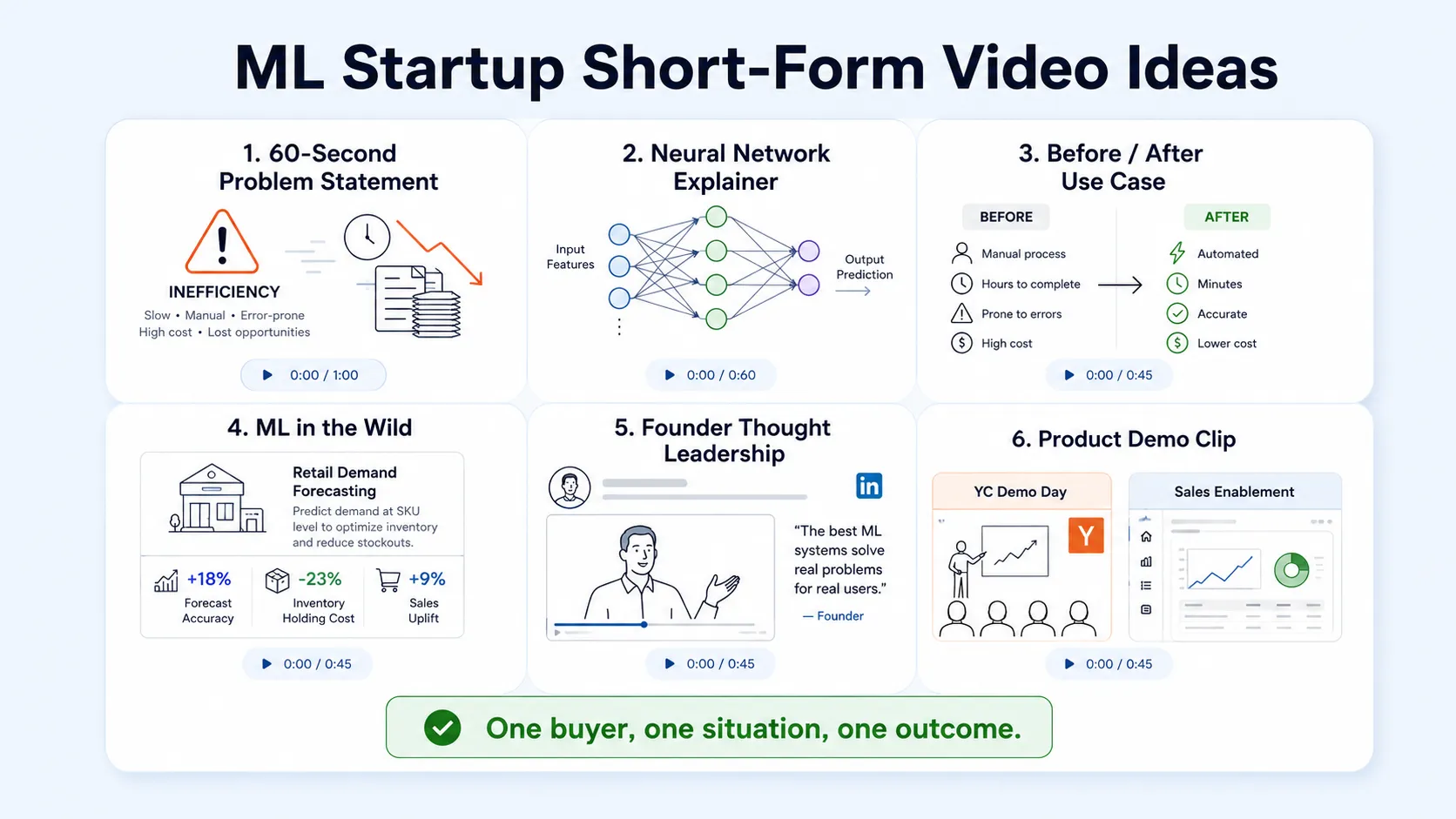
Here are the content types that consistently generate pipeline for AI and ML teams:
1) The 60-second problem statement: Open with the exact inefficiency your ML product eliminates. No feature walk, no roadmap. Just the pain and the outcome. This is your highest-performing top-of-funnel asset.
Example:
2) Neural network explainer: Animate or visualize what your model actually does in plain language. Use a developer advocate on camera with a simple whiteboard or screen share. This is the clip that gets saved and shared.
Example:
3) Before/after use case: Show a manual workflow your product replaces. Thirty seconds maximum. This is your best sales enablement asset because reps can share it in outbound sequences.
Example:
4) Machine learning use cases in the wild: Real customer examples (even unnamed, industry-specific) remove the "but does this work in my context" objection faster than a case study PDF ever will.
Example:
5) Founder-led thought leadership: Hot takes on AI trends, Y Combinator demo day patterns, or Andreessen Horowitz portfolio moves. This builds the personal brand that makes cold outbound warm.
Example:
6) Product demo clips: Not a full walkthrough. One feature, one outcome, one buyer persona. Under 60 seconds, every time. Example:
A single hour-long interview or webinar can yield 15 to 20 standalone clips, each targeting different audience segments or search intents. If you've run a product webinar, a demo, or a podcast recently, you already have the raw material for a month's worth of content.
The Komet Media video marketing service is designed to handle the entire content lifecycle, whether you require original creation from scratch or the expert transformation of your existing recordings into a distribution-ready clip library.
How to Explain Complex AI Products in 60 Seconds or Less
This is the highest-leverage skill a founder or marketing head at an AI startup can develop, and most teams get it wrong by defaulting to product features instead of buyer outcomes. Here's the framework I use at Komet Media with every AI and ML client:
- Open with the inefficiency (0 to 8 seconds): Name the exact problem your buyer faces today. Not "data teams struggle with pipelines." Something specific: "Your data scientists spend 40% of their week on data cleaning, not modeling."
- Name the category clearly (8 to 15 seconds): What type of product solves this? "An ML-powered data preparation layer that auto-classifies and cleans incoming data in real time." One sentence.
- Show one outcome (15 to 35 seconds): Demonstrate or describe one specific result. Screen record, customer quote, or animated visualization. No more than one outcome per clip.
- Add social proof signal (35 to 50 seconds): Mention a recognizable customer logo, a funded round from a credible VC, or a Y Combinator batch. This shorthand builds trust in seconds.
- Close with a micro-CTA (50 to 60 seconds): "Link in bio to see the full demo" or "Comment 'use case' and I'll send you a breakdown." Platform-native CTAs outperform generic ones.
Short-form video under 60 seconds drives 2.5x more engagement per impression than other formats, with completion rate as the primary algorithmic signal, meaning the hook in the first 1.5 seconds determines distribution more than anything else.
91% of consumers watch explainer videos to learn about products or services , making the short explainer format the default first-touch asset for any ML startup with a complex technical narrative. If your product requires a 30-minute call to explain, a well-made 60-second explainer cuts that call in half.
For teams that record webinars or podcast episodes, Komet Media's repurposing expertise turns those assets into short explainers, complementing our primary production of custom-built videos from the ground up.
The Biggest Mistakes AI Companies Make with Short-Form Video
I've worked with enough AI and ML teams to see the same patterns repeat. Here's where they lose:
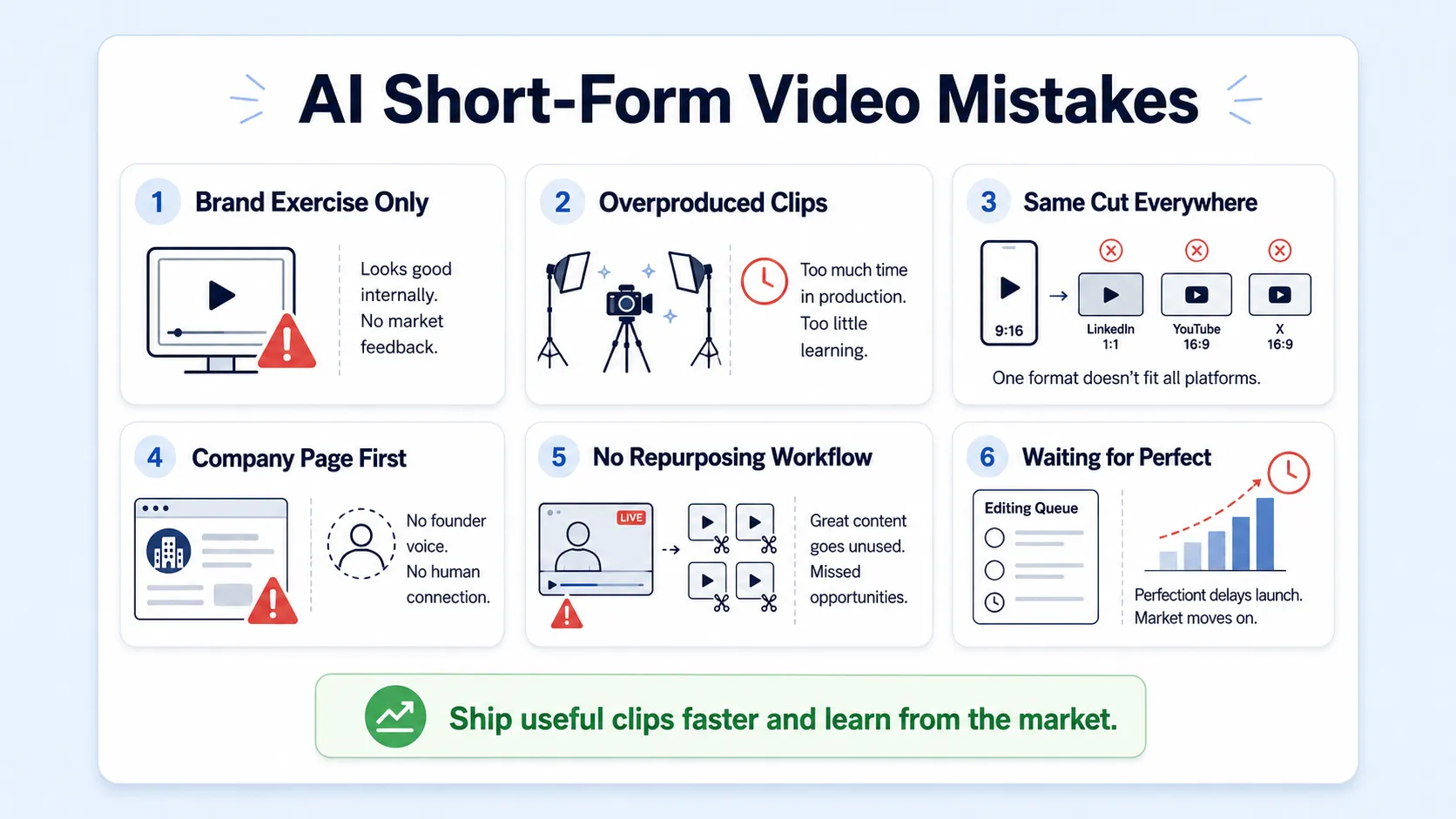
Mistake 1: Treating video as a brand exercise, not a pipeline tool. Every clip should have a buyer intention behind it. Who is this for? What should they do after watching? If you can't answer those two questions in one sentence, the video isn't ready to publish.
Mistake 2: Over-engineering production quality at the expense of cadence. Audiences increasingly prefer creator-style content that looks native in feeds over overproduced material. A founder on camera with good lighting and tight scripting will outperform a studio-produced animation with no distribution strategy behind it.
Mistake 3: Creating platform-agnostic content. Success on TikTok, Instagram Reels, and YouTube Shorts isn't about simply repurposing the same content across all three platforms. Each ecosystem operates with distinct algorithms, audience behaviors, and content expectations. A clip optimized for LinkedIn will not perform on TikTok without intentional re-edits.
Mistake 4: Posting from the company page instead of the founder's profile. LinkedIn's algorithm rewards personal accounts over company pages by roughly 7x in impressions for equivalent content. For Series A startups building go-to-market strategy, founder-led content is not optional, it's the primary growth lever.
Mistake 5: No content repurposing workflow. The most successful content teams in 2026 are leveraging AI tools to transform long-form content into short-form gold. If your team is creating net-new content for every platform with no systematic repurposing, you're burning resources that could go into paid distribution or sales enablement.
Mistake 6: Waiting for perfection. Startups report that AI video reduced their go-to-market timeline for product launches by an average of 5.3 weeks. Speed matters. A published imperfect video beats an unpublished perfect one every single time.
The Komet Media content repurposing and video editing services exist to eliminate mistakes 5 and 6 specifically.
Best Platforms and Distribution Strategy for AI and ML Startups in 2026
Platform selection should follow your ICP, not your personal content preferences. Here's how I recommend AI and ML startups approach their video-first distribution strategy:
LinkedIn is the primary platform for any AI or ML startup selling B2B. LinkedIn has claimed the top position for video marketing usage at 70%, according to Wyzowl, representing a pivotal transformation for the platform evolving from a text-centric professional network to a multimedia engagement powerhouse, particularly for B2B marketers. Post from the founder's profile. Use native video, not YouTube links.
Instagram Reels works particularly well for AI companies with visual products, workflow demonstrations, or strong brand narratives. Reels live in the Explore tab and the dedicated Reels feed, giving them reach beyond existing followers. Instagram's algorithm favors original content over reposts, so TikTok watermarks hurt distribution.
TikTok is underused by B2B AI companies and represents a genuine organic reach opportunity in 2026. Technical storytelling, ML trend commentary, and developer advocate content performs well. Rather than primarily showing content from accounts you follow, TikTok's "For You" page uses sophisticated machine learning to predict what you'll find engaging, even from creators you've never encountered. This interest-graph model is a major advantage for niche technical content.
YouTube Shorts serves a different purpose: feeding subscribers into longer product demos, webinars, or technical deep-dives. Shorts are YouTube's answer to TikTok, and they serve a specific strategic purpose: they feed subscribers into your long-form content. A Short that hooks a viewer can drive them to your full channel.
The most effective AI startups use a hub-and-spoke content repurposing workflow:
- Record one high-value long-form asset (demo, webinar, podcast, or founder interview).
- Extract 10 to 15 clips targeting different buyer personas and funnel stages.
- Re-edit for each platform's native format and algorithmic signal.
- Distribute across LinkedIn (founder profile), Reels, TikTok, and Shorts simultaneously.
- Amplify top-performing clips with paid spend to confirmed ICP audiences.
71% of marketers confirm that short-form videos in the roughly 30-second to 2-minute range perform the best , validating this clip-length discipline across every platform in the stack.
Explore Komet Media's full short-form video services to see how we manage both original production and high-volume repurposing workflows for AI and ML teams.
Conclusion
Short-form video for AI and ML startups companies is the clearest path from product knowledge to pipeline in 2026. The data is settled, the platforms are ready, and the organic window is still open.
Key takeaways:
- Lead with buyer outcomes, not model architecture. One problem, one outcome, 60 seconds.
- Post from the founder's profile on LinkedIn. Company pages don't compound the same way.
- Build a content repurposing workflow around your existing demos, webinars, and podcasts.
- Treat each platform's algorithm as a separate distribution channel, not a copy-paste destination.
- Start now. Pipeline from founder-led content compounds over 12 to 18 weeks. The clock starts when you post.
Talk to the Komet Media team if you're ready to build a short-form video system for your AI or ML startup.
Frequently Asked Questions
Q1: How many short-form videos should an AI startup post per week?
The cadence that works for most founders is 3 to 5 posts per week, with a mix of formats including short opinion, longer narrative, behind-the-scenes, and data observation. For AI and ML startups, consistency beats volume. Three focused, buyer-relevant clips per week outperform seven generic ones.
Q2: Should AI startup founders appear on camera, or is animation better?
Both have roles, but founder-on-camera content builds trust faster for B2B buyers. Talking-head videos with genuine expertise outperform polished corporate video consistently. Use animation for neural network explainers where visualization adds genuine clarity, not as a substitute for founder presence.
Q3: How long does it take for short-form video to generate pipeline for a B2B AI company?
Expect three time horizons: first signals like inbound DMs and impressions in 3 to 6 weeks, measurable pipeline sourced demos in 9 to 12 weeks, and compounding effects that materially affect CAC in 12 to 18 weeks. Plan the content system around a 90-day horizon, not a campaign sprint.
Q4: What's the single most important element of a short AI product video?
The hook. Completion rate is the primary algorithmic signal across short-form platforms, meaning the hook in the first 1.5 seconds determines distribution more than anything else. Open with the buyer's pain, not your product name.
Q5: Can we repurpose our existing webinars and demos into short-form content?
Yes, and this should be your first move. One 10-minute video can become 15 or more clips across platforms. A recorded product webinar or podcast episode is already a content library. You just need a repurposing workflow to unlock it.
Q6: Is TikTok actually relevant for B2B AI and ML companies?
More than most teams assume. The TikTok algorithm's interest-graph distributes technical content to technical audiences regardless of follower count. ML engineers, CTO personas, and startup operators are active on TikTok in 2026. TikTok's social ad revenue hit $8.25 billion in Q2 2025, up 40% year over year , confirming it's a platform with real B2B distribution at scale. Start organic, amplify what works.