
🪄 AI Summary
Heading 1
Heading 2
Heading 3
Heading 4
Heading 5
Heading 6
Lorem ipsum dolor sit amet, consectetur adipiscing elit, sed do eiusmod tempor incididunt ut labore et dolore magna aliqua. Ut enim ad minim veniam, quis nostrud exercitation ullamco laboris nisi ut aliquip ex ea commodo consequat. Duis aute irure dolor in reprehenderit in voluptate velit esse cillum dolore eu fugiat nulla pariatur.
Block quote
Ordered list
- Item 1
- Item 2
- Item 3
Unordered list
- Item A
- Item B
- Item C
Bold text
Emphasis
Superscript
Subscript
Most B2B teams create strong content once, publish it once, and move on. That's the problem. What is content repurposing? It's the practice of taking one high-value asset and distributing it across multiple formats and channels, a podcast becomes clips, a whitepaper becomes a LinkedIn carousel, a panel discussion becomes a short-form video series. For founders, executives, and VC firms, this is how you build sustained visibility without starting from zero every week.
TL;DR
- What is content repurposing: transforming one existing asset into multiple formats for different channels and audiences.
- It multiplies reach without multiplying production effort.
- B2B firms and VC funds use it to build thought leadership, trust, and pipeline from conversations they're already having.
- The biggest mistake is treating each piece of content as a one-time event.
What Is Content Repurposing for B2B Companies?
Content repurposing is the strategic process of taking a single piece of long-form or high-effort content and rebuilding it into multiple formats suited to different audiences, platforms, and stages of the B2B marketing funnel. A 45-minute webinar doesn't die after the live session. It becomes a blog post, a LinkedIn carousel, three short-form video clips, a quote graphic, and a newsletter section.
This is what the Gary Vee Content Model codified: one "pillar" piece of content, broken down into dozens of micro-assets. The Content Marketing Institute calls this content atomisation, the practice of exploding a single asset into its smallest useful components so each one can travel independently.
For B2B companies, the logic is practical. Your buyers are busy. They're not reading every article you publish. But they might catch a 45-second clip on LinkedIn, then later find the full webinar, then subscribe to your newsletter. Repurposing creates multiple entry points into your thinking without requiring multiple rounds of original research.
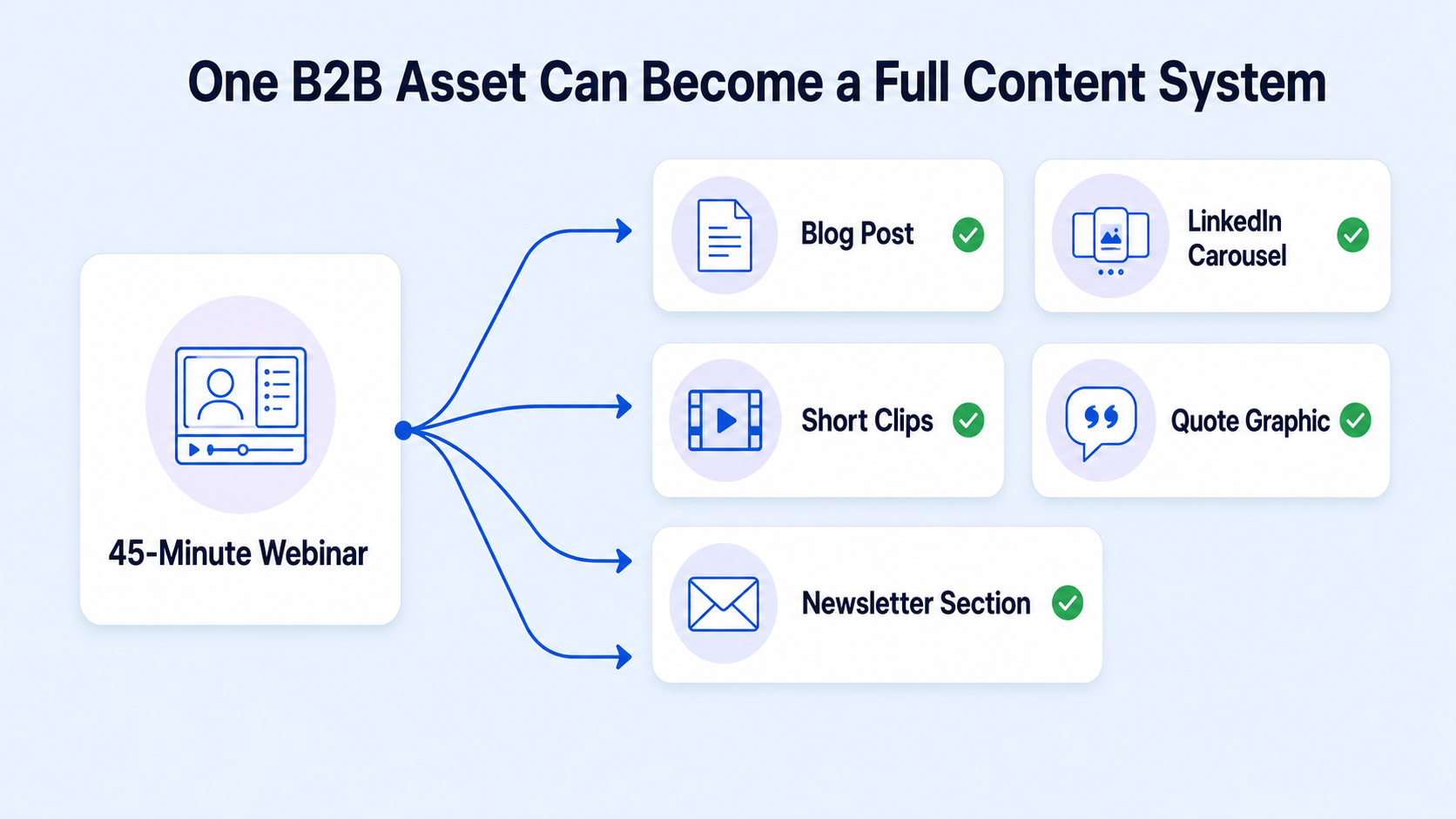
Where B2B repurposing delivers the most value:
- Evergreen content: frameworks, investment theses, hiring philosophies, and market perspectives that stay relevant for 12 to 24 months.
- Executive thought leadership: conversations your managing partners are already having in LP meetings, portfolio reviews, or keynotes.
- Podcast and video recordings: high-quality audio and visual content that contains dozens of usable moments.
- Research and whitepapers: data-dense documents that most people won't read end-to-end, but will engage with in smaller doses.
The mistake most B2B teams make is treating content as a publishing problem rather than a distribution problem. Creating a great whitepaper and posting it once on your website is not a content strategy. What is content repurposing if not the solution to that exact gap?
At Komet Media, the first question I ask a new client is: "What conversations are you already having?" Because the answer is almost always the starting point for a six-month content engine. You already have the substance. The system is what's missing. If you want to see what that system looks like in practice, our services page outlines how we build it.
What Is the Difference Between Content Repurposing and Content Recycling?
These terms get used interchangeably, but they describe different behaviors. Getting this distinction right determines whether your content strategy compounds over time or goes stale.
Content recycling is occasionally useful for genuinely evergreen posts at the right moment. But as a default strategy, it erodes authority. Buyers, especially sophisticated ones like LP investors, procurement leads, or enterprise buyers, notice when a firm keeps resharing the same content with no new angle.
Repurposing, by contrast, takes the underlying insight and rebuilds it to fit how a specific audience consumes content on a specific platform. A LinkedIn Marketing audience expects different packaging than a podcast listener or a YouTube viewer.
Repurposing respects the platform. Recycling ignores it.
The practical difference: repurposing requires a workflow. You need a production process that moves from source asset to derivative formats consistently. That's where most B2B teams stall, not from lack of ideas, but lack of infrastructure to execute on them at scale.
Content Repurposing Definition and Examples for Investors and VC Firms
Venture capital and private equity firms have a specific content challenge. Their audience, LPs, founders, co-investors, and future hires, is high-trust and low-patience. These audiences won't read a 2,000-word essay. But they will watch a 60-second clip of a managing partner sharing a sharp take on market conditions.
This is where content repurposing becomes a direct business tool, not just a marketing one.
Concrete repurposing examples for VC and PE firms:
- A GP-LP call contains market perspective, portfolio updates, and thesis evolution. Strip those segments, edit them into standalone clips, and publish on LinkedIn. LPs feel acknowledged; prospective LPs get a window into your thinking.
- An investment thesis document can be broken into a five-part LinkedIn article series, each post covering one pillar of your thesis. Pair each with a short talking-head video from the partner who wrote it.
- A portfolio company founder interview becomes a podcast episode (which we can produce and distribute), a short-form video clip, and a quote pull for newsletter use.
- A panel appearance or keynote generates 8 to 12 usable clips, each targeting a different insight or question from the discussion.
How do VC firms repurpose content across channels?
The answer is channel-specific packaging, not channel-specific creation. You're not writing different things for each platform. You're taking the same ideas and presenting them in the format that performs best where your audience lives.
For managing partners at growth-stage or multi-stage funds, this approach supports three goals simultaneously: LP trust (consistent, substantive communication), founder sourcing (visibility with the right operators), and talent acquisition (executives evaluating fund culture before joining a portfolio company).
Best Content Repurposing Strategies for Fund Managers and B2B Executives
The goal isn't to produce more content. The goal is to extract more signal from the content you're already creating. Here are the strategies that actually move the needle for fund managers, founders, and executive teams.
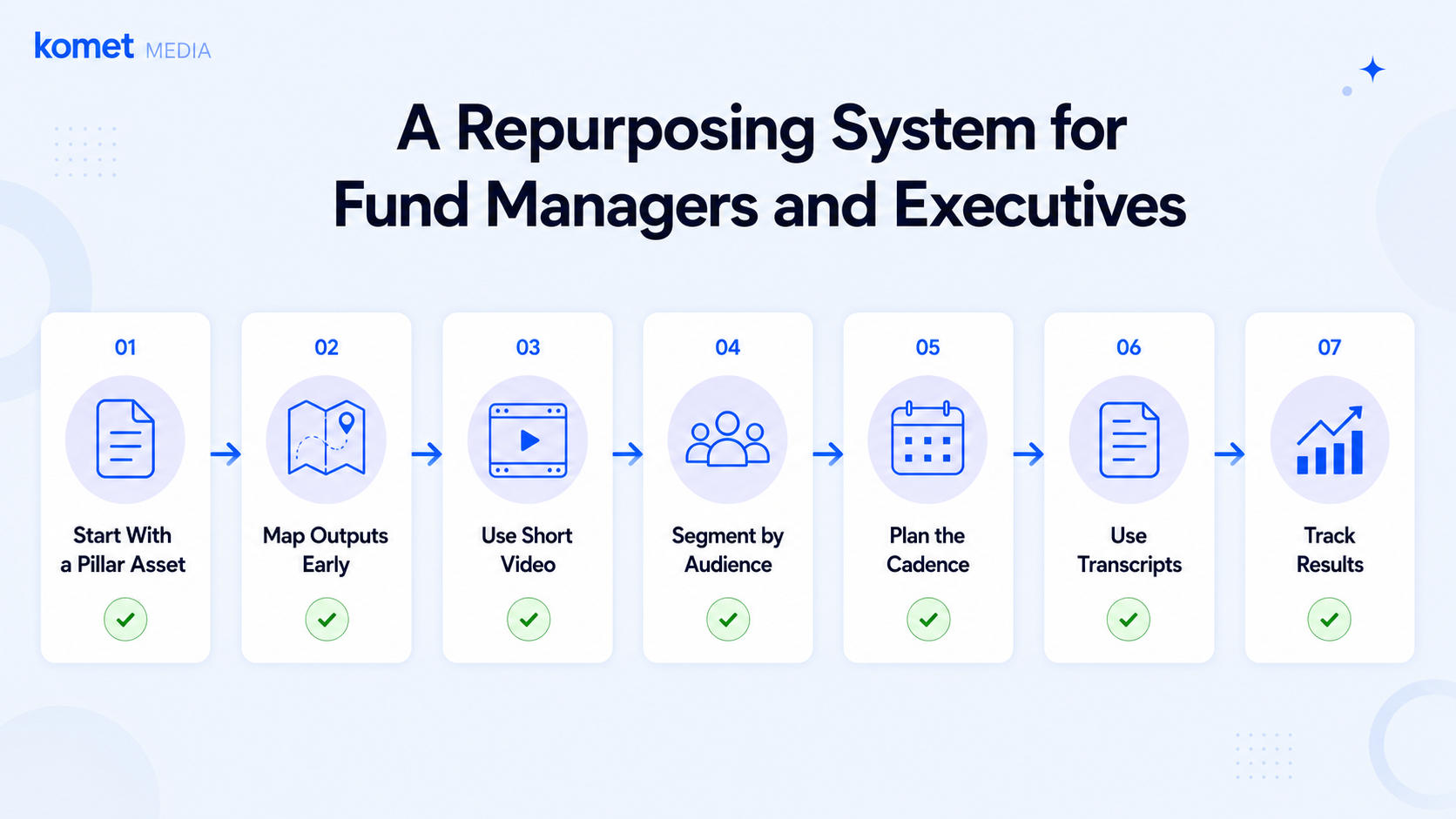
1. Start with a pillar content strategy. Every month, create one high-quality anchor asset: a long-form interview, a recorded panel, a detailed market memo, or a webinar. Everything else flows from it.
2. Build a derivative map before you hit publish. Before the anchor asset goes live, list every format it can become: clips, carousels, blog post, newsletter section, pull quotes, infographic. Assign ownership to each.
3. Prioritise short-form video for executive visibility. LinkedIn's algorithm favors native video. Founders and executives who publish consistent short-form video build faster trust than those who only post text. Our short-form video editing service is built specifically for this workflow.
4. Repurpose by audience segment, not just by format. A clip for LP investors needs different framing than a clip for a founder evaluating your firm as a lead investor. Same source material, different angle, different caption, different CTA.
5. Use a content calendar to maintain cadence. Repurposing fails when it's reactive. Tools like Ahrefs or SEMrush help you identify which topics are generating search demand so your repurposed content targets queries with real intent, not just recency.
6. Let transcripts do the heavy lifting. A podcast transcription turns a one-hour conversation into a searchable text document that feeds blog posts, LinkedIn content, email newsletters, and FAQ pages, all from a single recording session.
7. Measure and iterate. Track which derivative formats drive the most inbound, whether that's investor inquiries, founder DMs, or demo requests. Double down on what works. Cut what doesn't.
The firms and founders building real pipelines from content aren't creating more. They're systematising the extraction process.
How to Turn a Whitepaper Into Multiple Content Formats for B2B Audiences
A whitepaper is one of the most under-leveraged assets in B2B marketing. Most teams spend weeks producing it, then publish it behind a form and wonder why nobody reads it. What is content repurposing if not the answer to that exact waste?
Here's a repeatable process for atomising a whitepaper into a full quarter of content:
- Extract the key claims. Identify the five to seven most quotable, provocative, or data-supported statements in the document. These become standalone LinkedIn posts or short-form video scripts.
- Build a summary carousel. Condense the whitepaper into a 10-slide LinkedIn carousel. Each slide covers one core point. First slide: the bold claim. Last slide: the full report CTA.
- Record a walkthrough video. The author or a senior executive records a 5-10 minute explainer. This becomes the anchor video asset. Pull three to five clips from it for short-form distribution.
- Write a blog post. Use the whitepaper's argument structure as the outline. This is not copying, it's translating a dense document into a readable narrative. This post targets search terms relevant to your thesis or investment focus.
- Build an email series. Each section of the whitepaper becomes one email in a five-part nurture sequence. This works especially well for VC firms communicating with LP prospects who opted in but haven't committed.
- Host a live session. Run a webinar or event where a partner walks through the findings and takes questions. Record it. That recording becomes next quarter's pillar asset.
- Publish show notes. If the walkthrough becomes a podcast episode, show notes with timestamps, quotes, and key takeaways extend its SEO reach and improve listener experience.
One whitepaper. One quarter of content. No new research required.
Content Repurposing Examples for B2B Financial Services and SaaS Firms
The same system that works for VC funds applies directly to B2B SaaS companies and financial services firms. The formats shift slightly; the logic stays identical.
B2B SaaS examples:
- A customer success call contains objection-handling gold. Pull the moments where your team explains product value clearly. Edit into a short clip for sales enablement or LinkedIn visibility.
- A product demo recording becomes a short-form video series, each clip focusing on one feature or use case. This targets buyers who are in evaluation mode.
- A founder interview on a podcast (we handle podcast editing and production) generates clips, a blog post, and a newsletter feature that warms cold leads without a sales touch.
Financial services examples:
- A market update memo becomes a talking-head video, a LinkedIn post series, and a quoted section in your investor newsletter.
- A conference presentation is transcribed, turned into a blog post, clipped for social, and pitched as a contributed article to industry publications.
- A client Q&A session becomes an FAQ page, a short-form video, and a LinkedIn carousel, all of which serve organic search and buyer education simultaneously.
Omnichannel marketing doesn't require an omnichannel content creation budget. It requires a repurposing workflow. The Content Marketing Institute consistently emphasises that documented strategy separates high-performing content teams from those who create in reactive cycles. Repurposing is that strategy made operational.
How Do Managing Partners at VC Firms Build Content Engines From Existing Assets?
The most consistent content producers in the VC and PE space aren't the firms with the largest marketing teams. They're the ones with the tightest workflows.
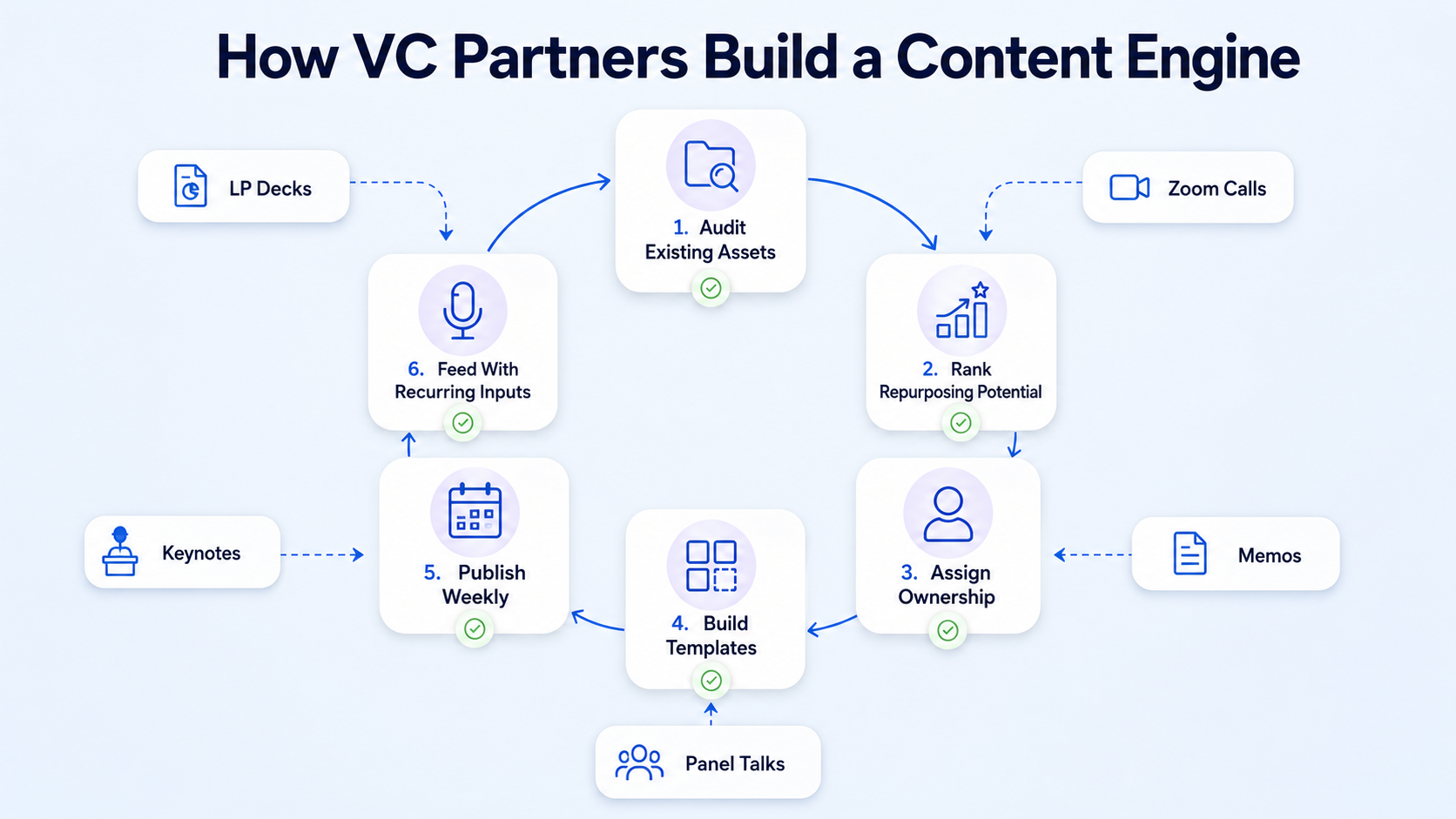
Building a content engine from existing assets follows a clear structure:
- Audit what already exists. Keynote slides, LP decks, recorded Zoom calls, panel appearances, internal memos, due diligence frameworks. These are your raw materials.
- Rank by repurposing potential. Long-form recordings and research-heavy documents rank highest. One-off announcements rank lowest.
- Assign a content owner per asset. Without ownership, repurposing stalls. Someone must be responsible for seeing each asset through to its derivative formats.
- Build templates for each output format. A LinkedIn carousel template, a short-form video brief, a blog outline. Templates cut production time and maintain brand consistency.
- Establish a weekly publishing rhythm. Demand generation from content is a function of consistency, not volume. Publishing three well-repurposed pieces per week outperforms publishing fifteen rushed ones.
- Feed the engine with recurring inputs. A monthly podcast, a quarterly webinar, and a weekly conversation with a portfolio founder can generate enough raw material for a full content calendar.
The managing partners who have built recognisable personal brands in venture, recognisable to LPs, founders, and operators alike, didn't get there by writing new essays every week. They got there by systematically extracting value from conversations they were already having. That's what is content repurposing at its most strategic: turning existing authority into compounding visibility.
Conclusion
- What is content repurposing: one asset, multiple formats, compounding reach across the B2B marketing funnel.
- VC firms, PE funds, SaaS companies, and B2B financial services teams all have more usable raw material than they're using.
- The competitive advantage isn't better content, it's a better extraction and distribution system.
- If you're already creating conversations worth having, the next step is making sure those conversations work harder. Start here.
Frequently Asked Questions
Q1: What is content repurposing in simple terms?
It means taking one piece of content, a podcast, webinar, whitepaper, or video, and rebuilding it into multiple formats for different platforms. You create once and distribute many times. It's the most efficient way to build consistent visibility without a large content team.
Q2: How is content repurposing different from just reposting?
Reposting shares the same asset in the same format. Repurposing transforms the asset to fit a new platform, audience, or format. A clip edited for LinkedIn performs differently than the same moment embedded in a blog post, different packaging for different consumption habits.
Q3: Is content repurposing good for SEO?
Yes. Each repurposed piece, a blog post, FAQ page, or video with a transcript, creates new indexed pages and new keyword signals. It extends the organic footprint of a single idea across multiple search queries, which is a core principle of pillar content strategy.
Q4: How many pieces can you get from one long-form asset?
A 45-minute recording can reasonably produce 8 to 15 derivative assets: 4 to 6 short-form video clips, 1 blog post, 1 LinkedIn carousel, 2 newsletter sections, pull quotes, and a podcast episode with show notes. The ceiling depends on the richness of the source material.
Q5: Which content formats work best for VC and PE firms?
Short-form video clips from partner commentary, LinkedIn carousels from investment theses, and podcast episodes from founder or LP conversations perform consistently well. These formats match how senior decision-makers consume content, quickly, on mobile, during gaps in their schedule.
Q6: How often should B2B firms repurpose content?
Weekly output from a single monthly pillar asset is the baseline. One long-form recording per month, processed into daily or near-daily derivative posts, creates a sustainable cadence without requiring new ideation every week. Consistency matters more than volume.