
🪄 AI Summary
Heading 1
Heading 2
Heading 3
Heading 4
Heading 5
Heading 6
Lorem ipsum dolor sit amet, consectetur adipiscing elit, sed do eiusmod tempor incididunt ut labore et dolore magna aliqua. Ut enim ad minim veniam, quis nostrud exercitation ullamco laboris nisi ut aliquip ex ea commodo consequat. Duis aute irure dolor in reprehenderit in voluptate velit esse cillum dolore eu fugiat nulla pariatur.
Block quote
Ordered list
- Item 1
- Item 2
- Item 3
Unordered list
- Item A
- Item B
- Item C
Bold text
Emphasis
Superscript
Subscript
Founders choose investors partly on reputation, and reputation is now built in public. A YouTube strategy for VC firms gives partners a place to show how they think, which founders they back, and what they believe about the market, in a format that stays searchable long after a post disappears. This guide covers audiences, formats, a 90-day plan, guardrails, and measurement for firms with limited partner time.
Quick answer
Define the audience first: founders, co-investors, or LPs. Publish partner viewpoints, founder conversations, and market thesis videos on a steady rhythm. Cut clips for LinkedIn and Instagram. Add guardrails, and judge results by founder inbound and relationships, not views alone.
Why VC firms should think about YouTube
Most firms already publish memos, posts, and podcasts, so a YouTube strategy for VC firms should add to that work rather than duplicate it. YouTube adds three things: search, depth, and a permanent home for long conversations.

Some context from current research:
- YouTube says its podcast content reaches one billion monthly active users. Firms that already host a podcast or fireside series have a ready-made format.
- Edison Research's 2026 Infinite Dial, as reported by Tubefilter, found that 57% of Americans surveyed had both listened to and watched a podcast, the first time more than half did both. The survey covers Americans aged 12 and older, so it is a general-population figure.
- In Wistia's 2026 State of Video Report, 81% of teams said they share videos on LinkedIn and 76% on YouTube. The report combines a survey of more than 900 professionals with platform data and comes from a video vendor, so read it as directional. It shows that firms usually pair the two channels.
I do not claim that YouTube wins deals. My view is narrower. Founders research investors before they take a meeting, and a firm with a clear body of video work is easier to understand and trust than a firm with only a logo and a bio.
Who the channel is for
VC audiences differ, and the content should match.
For most firms, founders should be the primary audience, since they are the people deciding whether to take a call. Our overview of how VC firms use video content covers the wider picture.
Firm channel or partner channels
This is a common debate. Each option has trade-offs.
I usually suggest the third option. A firm channel with series led by named partners keeps the brand coherent and lets individual partners build recognition.
Content pillars for a VC channel
Three pillars cover most firms.
- Thesis and market view. Explain where you see opportunity, what you are watching, and where you are cautious.
- Founder conversations. Interview founders, whether portfolio or not, about decisions, mistakes, and lessons.
- How we work. Show how you evaluate companies, support portfolio teams, and make decisions.
Test each pillar with one question: would a founder who is not yet in your portfolio learn something specific? If not, the pillar is too vague.
Formats that respect partner time
Partners have limited time, so formats should be efficient.
On clips, YouTube Help says Shorts can be up to three minutes long. It also explains that since March 31, 2025, a Short counts a view whenever it starts or replays, with no minimum watch time, and that the older metric now appears as "engaged views." For a VC audience, I would look at engaged views and comments from the right people, not raw view counts.
If your firm already runs a podcast, the cheapest path is often to publish the video version on YouTube and cut clips. See our podcast repurposing playbook for VC firms and the resource on podcast repurposing for VCs.
A 90-day YouTube strategy for VC firms
Here is the plan I would run for a firm starting from a small base.
Rules to follow while running it:
- Appoint one internal owner who schedules and chases approvals.
- Batch partner recording into one or two blocks a month.
- Cut clips from every long video so each recording becomes several assets.
- Review results monthly with the partners involved.
How partners should prepare for a recording
Most partner conversations go better with short preparation, not a script. A rambling recording is the most common reason a VC video never ships.
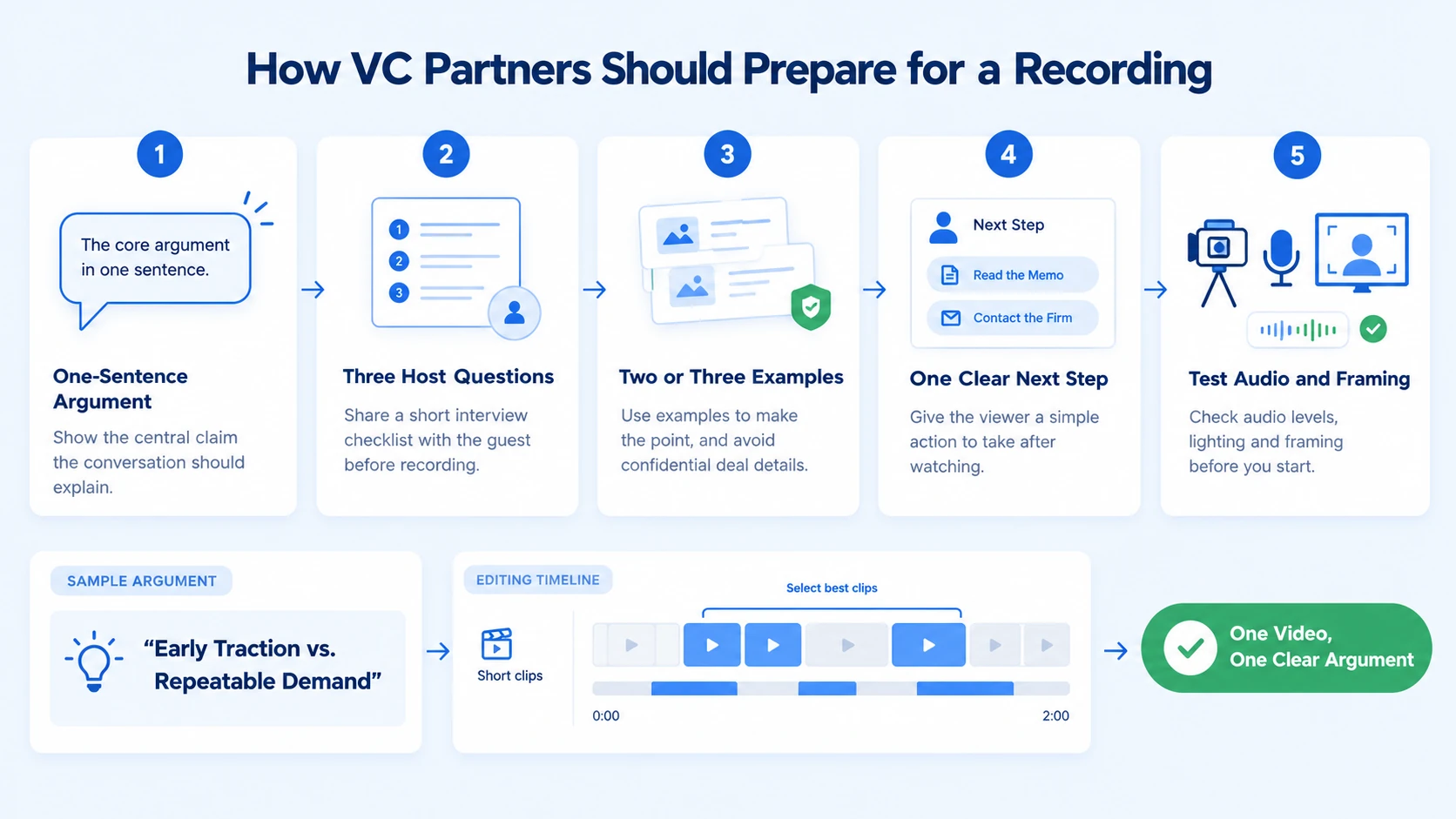
- Write the one-sentence argument the conversation should prove.
- List three questions the host will ask, and share them with the guest.
- Pick two or three examples the partner can explain without naming confidential deals.
- Decide the single action a viewer should take afterward, such as reading a memo or reaching out.
- Record a short test clip to check audio and framing.
Here is a hypothetical example of the argument step, not a client case. A partner at a seed-stage fund wants to explain why the firm is cautious about a certain category. The one-sentence argument might be: "Founders in this category confuse early traction with repeatable demand, and here is how we test the difference." That sentence tells the host where to steer and tells the editor which moments to cut for Shorts.
A good rule for a YouTube strategy for VC firms is that every video should be explainable in one sentence. If the partner cannot say it in one sentence, the video will not hold a founder's attention for ten minutes.
A sample first quarter series plan
This table is an illustration for a hypothetical early-stage firm. Use it as a shape, not a prescription.
The plan keeps the output small and predictable. A firm that publishes four strong videos a month and cuts clips from each will usually learn more than one that publishes ten rushed ones.
Guardrails for a firm channel
A firm has more to protect than a typical startup, so set rules before the first recording.
- Agree on topics that are off limits, such as confidential deal information and unannounced investments.
- Get written consent from every founder and guest before publishing, and give them a review window.
- Do not discuss fund performance, fundraising, or investment returns on camera without checking with your counsel and compliance advisers first.
- Keep a fact-check step for numbers, names, and dates.
- Define who can approve publication.
I am not a lawyer, and rules for communications about funds vary, so treat this as a prompt to involve counsel early. These steps add a few minutes to each video. They protect the firm and make partners more comfortable speaking plainly, which is what makes a YouTube strategy for VC firms credible.
Packaging and discovery
A strong conversation needs clear packaging.
- Titles: name the topic or the question, not only the guest.
- Thumbnails: one clear image and a few words. See designing thumbnails that earn clicks.
- Descriptions: include a summary, the guest's role, and relevant links.
- Playlists: group videos by pillar, such as market view and founder conversations.
- Search: use the terms founders use when they research investors in your sector. Our guide to YouTube SEO basics for B2B channels covers the details.
Distribution beyond YouTube
Each video can support the rest of the firm's channels.
- Cut clips for LinkedIn. See the LinkedIn video strategy for VC firms.
- Share videos with founders in your pipeline as context before a first call.
- Add videos to your website's team and portfolio pages.
- Include relevant videos in newsletters to the portfolio and network.
- Send conference or event talks to attendees afterward. Our article on conference and event video repurposing shows how.
What to measure
Views are a weak signal for a VC firm. A small audience of the right founders is worth more than a large audience of the wrong ones.
Attribution is imperfect, and Wistia's report notes that fewer than half of marketers connect their video platform to a CRM or email tool. Use a simple "how did you hear about us" field and review it monthly. For a fuller framework, read video KPIs B2B teams should track and our overview of how VC firms use video to build inbound pipeline.
Mistakes I see repeatedly
- Publishing fund-style announcements instead of useful views
- Leaving partners without a clear brief, so conversations ramble
- Over-polishing the first videos and publishing too rarely
- Using the channel only for portfolio promotion
- Ignoring clips, so long videos get little discovery
- Skipping consent and review steps with founders
- Measuring success only by views
How the work gets done
A VC firm's marketing team is usually small. Strategy, partner relationships, and approvals stay in-house, while a production partner can handle full end-to-end production, scriptwriting, editing, packaging, clips, and distribution. Komet Media supports firms with video editing for VC firms, YouTube video editing, and short-form video editing, as well as full from-scratch video production. Firms in the New York market can also see our video editing services in New York. We can repurpose partner interviews, podcasts, and event talks you already have, or script, produce, and edit original thesis and market-view videos from scratch. Many firms use both, and the approach to a YouTube strategy for VC firms works best when the production plan and the approval plan are set together.
Conclusion
The goal is not to turn a firm into a media company. It is to make the firm's judgment visible to the founders it wants to back. A YouTube strategy for VC firms succeeds when it is narrow, consistent, and respectful of partner time, and when it is measured by relationships rather than views.
FAQ
1. What is the best YouTube strategy for VC firms?
Choose founders as the primary audience, build a firm channel with series led by named partners, publish a steady mix of conversations and clips, and measure inbound quality rather than views.
2. How much partner time does a firm YouTube channel need?
A realistic plan uses one or two recording blocks a month, plus short review windows. Partnering with a full-service production partner like Komet Media to handle scriptwriting, from-scratch video production, editing, packaging, clips, and publishing keeps partner time focused strictly on high-level strategy and conversations.
3. How much does it cost to run a VC firm YouTube channel?
Costs depend on volume, motion graphics, recording support, and distribution. At Komet Media, our typical retainers run from roughly $2,500 to $5,000, depending on scope, volume, production difficulty, and turnaround. An internal approach costs staff time instead.
4. How long until a firm channel shows results?
I would plan on 90 days before judging format and topic choices, and longer for relationship effects. I do not have a verified benchmark for VC channel growth, so be careful with promises of fixed outcomes.
5. Should a firm feature portfolio founders on its channel?
Often yes, with consent and review. Founder conversations help new founders see how you work. Agree on topics in advance and avoid confidential information.
6. Is it worth uploading our podcast to YouTube?
If you already record video, yes. YouTube says its podcast content reaches one billion monthly active users, and you can cut clips for LinkedIn and Instagram from the same recording.
7. Should the firm hire an agency or use an internal team?
Keep strategy, partner relationships, and compliance review in-house. Use an agency or dedicated production partner like Komet Media for end-to-end from-scratch production, editing, packaging, clips, and distribution, especially when partner time is limited.
8. Does Komet Media work with VC firms?
Yes. We work with venture firms on video editing, podcast repurposing, YouTube, and short-form distribution, using existing recordings or original video built from scratch. If you want to talk it through, you can book a call.