
🪄 AI Summary
Heading 1
Heading 2
Heading 3
Heading 4
Heading 5
Heading 6
Lorem ipsum dolor sit amet, consectetur adipiscing elit, sed do eiusmod tempor incididunt ut labore et dolore magna aliqua. Ut enim ad minim veniam, quis nostrud exercitation ullamco laboris nisi ut aliquip ex ea commodo consequat. Duis aute irure dolor in reprehenderit in voluptate velit esse cillum dolore eu fugiat nulla pariatur.
Block quote
Ordered list
- Item 1
- Item 2
- Item 3
Unordered list
- Item A
- Item B
- Item C
Bold text
Emphasis
Superscript
Subscript
Martech companies sell to the hardest audience in B2B: marketers. Your buyers know every hook formula, every gated asset trick, and every recycled LinkedIn template. Podcast repurposing and show creation work for martech brands because they give that audience something they rarely get: real practitioners explaining what actually worked. The catch is that marketers spot weak clips instantly. This guide covers how I select moments, avoid the clichés your buyers are tired of, and distribute clips—or launch a show from scratch—so they support the pipeline rather than just filling a calendar.
Quick Answer
Podcast repurposing and original show production for martech brands mean turning full episodes or newly launched shows into clips and assets that teach marketers something specific. It works when content shows real practitioner insight, avoids recycled social formulas, and is distributed with a clear buyer and goal.
Why Martech Podcasts Carry So Much Hidden Value
Most martech podcasts feature marketing leaders, operators, and practitioners. These guests often share specific campaigns, failed experiments, and team structures that rarely appear in polished case studies. That is exactly the kind of content marketers want and cannot find elsewhere.
The problem is that marketers are busy, and few of them listen to every episode. The insight stays locked in a 45-minute file. Meanwhile, the buying committee for a martech platform often includes marketing ops, demand generation, sales leadership, IT, and finance. Each group needs a different part of the conversation.
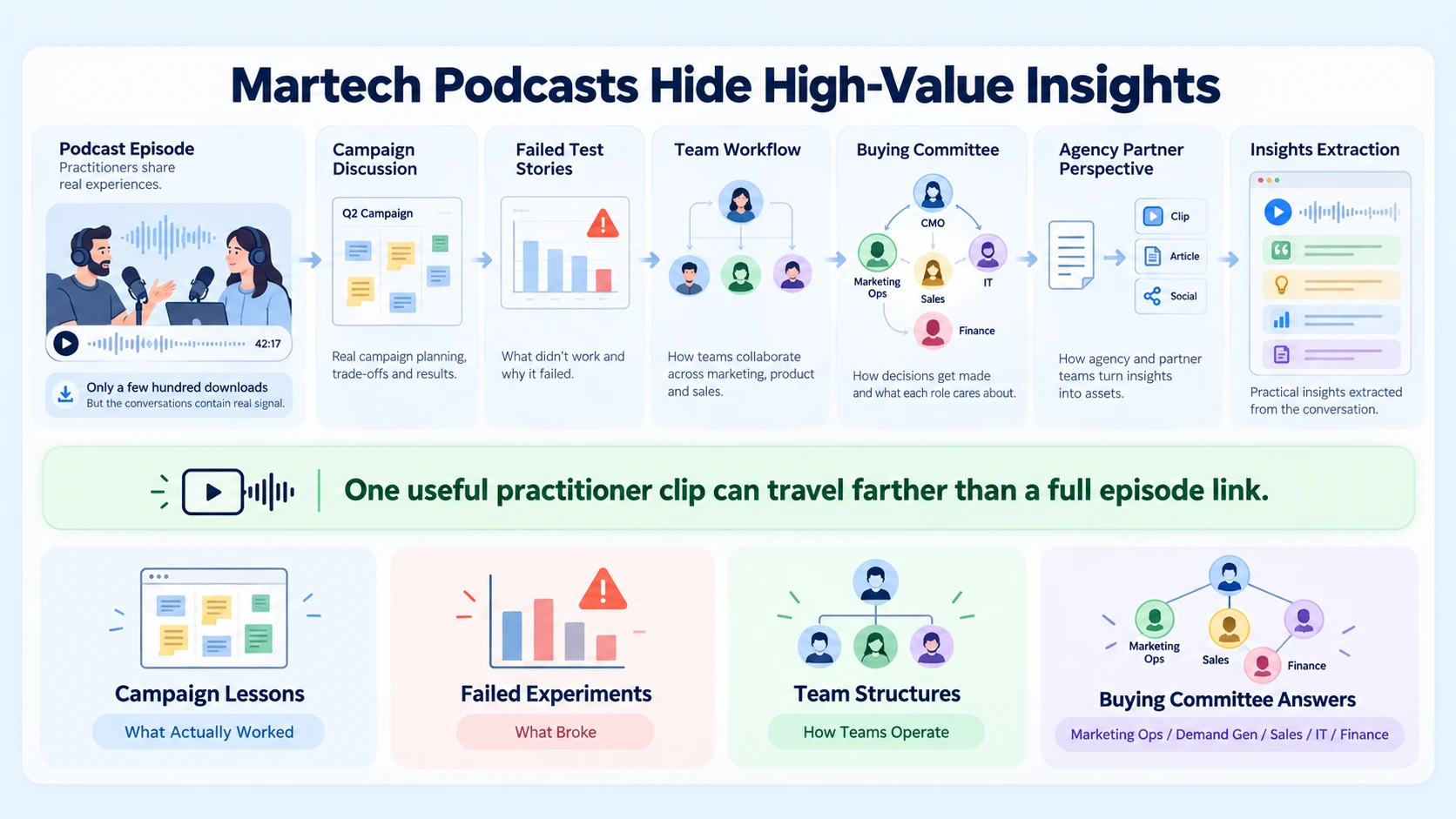
The 2025 Edelman and LinkedIn B2B Thought Leadership Impact Report, based on a survey of nearly 2,000 management-level professionals, found that more than 40% of B2B deals stall because of internal misalignment within buying groups. In martech, that misalignment often sits between marketing, which wants the tool, and the teams that must integrate, approve, or pay for it. Short clips can speak to each of those concerns directly.
The format has broad reach. The Infinite Dial 2026 from Edison Research at SSRS found that 58% of Americans age 12 and older consumed a podcast in the last month. Among 35 to 54 year olds, a core age range for marketing leaders, the figure was 68%. These are general population numbers, not marketer-specific data, but they show that long conversations are a mainstream habit.
Martech also has an ecosystem advantage. Agencies, consultants, and integration partners influence many purchases. A clip that helps an agency explain a tactic to its own clients can travel further than anything on your brand page. Podcast repurposing lets you give those partners useful material without asking them to sit through a full episode.
The Content Fatigue Problem Martech Brands Face
Martech brands face a problem most B2B companies do not: their audience produces content for a living. Marketers recognize templates, formulas, and filler on sight.
AI has made this worse. In its B2B Content and Marketing Trends: Insights for 2026 research, based on a survey of more than 1,000 B2B marketers, the Content Marketing Institute reported that 9 in 10 marketers use AI to produce content, but fewer than 4 in 10 say it has improved performance. The same research found that 96% say their organization creates thought leadership, while in many companies fewer than 5% of employees contribute.
That combination creates an opening. When feeds fill with generic, AI-assisted posts from content teams, a real guest describing a real experiment stands out. A podcast gives you dozens of those moments every month.
The mistakes I see most often in martech clips:
The last row matters. Marketers are trained to question numbers. A clip that states a result without context invites doubt rather than interest. If a guest shares a figure, keep the surrounding detail, and confirm the guest is comfortable with it being published.
Choosing Moments That Marketers Will Actually Watch
The best moment in a martech episode is rarely the guest's big-picture opinion on the future of marketing. It is usually the moment they describe exactly what they did and why.
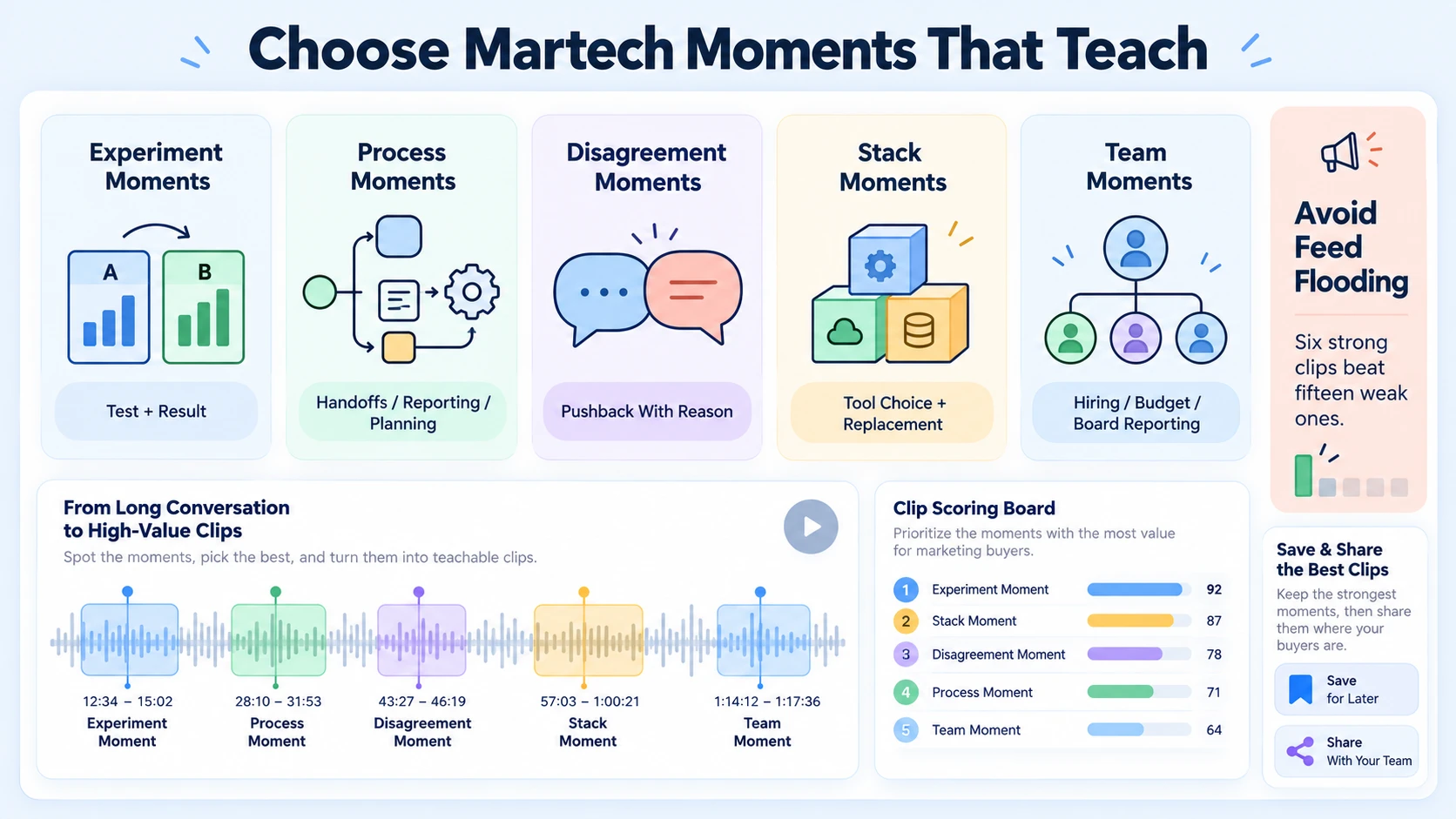
I sort moments into five buckets:
- Experiment moments. A guest describing a test, what they expected, and what happened. These are the most shareable clips in martech.
- Process moments. How a team structures handoffs, reporting, or campaign planning. These help operators and managers.
- Disagreement moments. A guest pushing back on common advice, with a reason. These start conversations.
- Stack moments. How a team chose, combined, or replaced tools. These speak directly to evaluators.
- Career and team moments. How a leader hires, budgets, or reports to the board. These reach senior buyers.
When we edit martech interviews, we look for clear arguments, proof points, short stories, and buyer objections. I would rather produce six strong clips than fifteen weak ones. More clips do not always produce more reach, and marketers are especially quick to unfollow brands that flood their feed.
Guest selection shapes all of this. Practitioners who run campaigns produce better clips than executives who speak only in strategy terms. If your guest list leans heavily toward vendors, analysts, or your own team, clip quality usually drops.
Formats beyond video also work well with marketers. Many save and share carousels and quote cards that summarize a tactic. Our tutorial on turning a podcast into quote cards and carousels walks through that process.
Captions matter too. Marketers often watch with the sound off during the workday, so the caption carries the message. Keep caption lines short, check every tool name and acronym, and use on-screen text to highlight the single idea a viewer should remember.
A Podcast Repurposing Workflow for Martech Teams
Most podcast repurposing fails before editing starts. The team has not decided who each episode is for or what a good outcome looks like. Martech teams often have the skills to do this well, but not the time.
This is the cycle I recommend:
- Define the audience and goal. Demand gen leaders, marketing ops, CMOs, or agency partners?
- Brief the guest. Ask for specific examples and confirm which numbers and company details they can share publicly.
- Record clean audio and video. Good source files make every later step faster.
- Create a transcript. It becomes the working document for selection and review.
- Mark and score moments. I score on specificity, audience value, whether the clip stands alone, and approval risk.
- Confirm sensitive moments with the guest. Especially results, budgets, and named tools or vendors.
- Edit the master episode.
- Cut clips, add captions, and build carousels.
- Adapt for each platform.
- Final check and archive.
- Schedule distribution across several weeks.
- Review performance and feed lessons into the next recording.
A few recording habits make every later step easier. Ask one question at a time, since compound questions produce answers that wander. Follow any abstract answer with "walk me through the last time you did that." Close each episode by asking the guest to summarize their main advice in two sentences, which often becomes a strong opening clip.
Small teams can combine steps 4 and 5 and use one export template for short platforms. I would not skip the guest brief or the confirmation step. Pulling a published clip because a guest objects to a number damages the relationship and wastes the work.
What one strong episode can usually become:
These are planning ranges, not promises. A specific, candid guest produces far more usable material than a polite overview.
Distribution: Meeting Marketers Where They Work
A polished clip with no distribution plan is still an underused asset. Marketers are spread across several channels, and they notice when a brand posts the same thing everywhere without adapting it.
LinkedIn is the main channel for most martech brands. Marketing leaders and practitioners are active there, and video consumption has grown. Digiday reported that total video viewership on LinkedIn increased 36% year over year for the period from October 30, 2024, to January 29, 2025, based on figures shared by the company. Native video, carousels, and text posts that pull one insight from an episode all work there.
YouTube is where many marketers go to learn tactics. Full episodes with clear, search-friendly titles can attract viewers long after release. YouTube reported more than 1 billion monthly active viewers of podcast content as of January 2025. That is a platform-wide figure, not martech-specific, but it supports treating YouTube as a home for full episodes.
Instagram Reels can work for martech brands with a strong founder voice or a creative angle, such as brand, social, or creator-economy tools. For pure marketing ops or data products, I usually treat it as secondary.
Email newsletters remain one of the most trusted channels for marketers. A short weekly or monthly email with two clips and one written takeaway gives subscribers an easy way to keep up with the show. It is also a channel you control, which matters when social reach shifts without warning.
Employee advocacy matters more in martech than most categories. Your own marketers have networks full of potential buyers. Give them clips and suggested captions they would actually want to post, not mandatory reposts.
Guests are your strongest amplifiers. Marketing practitioners often have engaged followings. Send every guest their clips with suggested copy and a deadline-free invitation to share.
Sales enablement is the channel martech teams most often forget, despite selling to fellow marketers. Organize clips by objection: integration effort, reporting, team adoption, and cost. Our guide to short-form video for martech companies covers formats in more depth.
Takeaway: adapt each clip to the channel and give guests and employees easy ways to share.
How to Measure What the Podcast Does for Pipeline
Martech buyers will ask you how you measure your own content. Your podcast should be able to answer that question honestly.
Do not judge clips only by views. A clip watched by a few hundred marketing ops leaders at target accounts can matter more than one with broad reach among students and job seekers.
Attribution will be imperfect. Someone may watch three clips, forget, and arrive months later through search. Combine platform data with a "how did you hear about us" field, sales notes, and CRM touchpoints. Our article on attribution for video and podcast content goes deeper on building a practical model.
Review results monthly. Look at which guests, topics, and opening lines performed best, then use them to plan future episodes. Over time, podcast repurposing should shape your guest list as much as your clip list.
Conclusion
Martech brands have a natural advantage. Their podcasts can feature practitioners sharing the exact tactics and experiments their buyers want to hear. The weakness is that this insight usually stays inside long episodes while the brand publishes generic posts that marketers ignore.
The decision that matters is to run podcast repurposing as a specificity-first system. Choose moments that teach something concrete, avoid the formulas your audience recognizes, confirm sensitive details with guests, and give every clip a clear destination. That is how one conversation can earn attention from the most skeptical buyers in B2B.
FAQ
What is podcast repurposing for a martech company?
It is the process of building original video or podcast shows from scratch or turning existing podcast episodes into shorter assets such as clips, carousels, newsletter summaries, and sales follow-up videos. For martech brands, the focus is on specific, practitioner-level insight that marketers can actually use.
How much does it cost?
Freelancers often charge per clip or per hour, subscriptions charge a flat monthly fee for editing volume, and agencies price by scope. At Komet Media, engagements typically fall in the range of about $2,500 to $5,000, depending on whether you need show launch from scratch, episode production volume, clip count, carousel design, turnaround, and distribution support.
How long does it take to turn one episode into clips?
It depends on episode length, clip count, and how quickly guests confirm sensitive details. Teams that review a list of selected moments before editing usually publish faster than teams that review finished clips one by one.
What deliverables should we expect from one episode?
A typical plan includes the full edited episode, several short clips, two or three carousels or quote cards, one or two sales-ready clips, and a newsletter summary. The mix should follow your buyers and channels.
Should we hire a freelancer or an agency?
A skilled freelancer can handle editing well at low volume. An agency is usually a better fit when you need end-to-end production—from original video creation and podcast launches to moment selection, design, platform adaptation, and distribution support. Ask any partner how they decide which moments to cut or structure, not just how their edits look.
Can our internal marketing team do this?
Often yes, since martech teams usually have strong marketing skills. The common issue is time. Podcast clips tend to slip when product launches, events, or campaigns take priority.
How do we avoid clips that feel like generic marketing content?
Pick moments with specific examples, numbers in context, or clear disagreements. Avoid template hooks, keep editing restrained, and let practitioners speak in their own words rather than rewriting their points into marketing language.
How does Komet Media work with martech brands?
We handle moment selection, editing, captions, carousels, platform adaptation, and distribution support. We can also create original video from scratch or help you launch a podcast if you do not have one yet. If you want to talk through your show, you can book a call with our team.