
🪄 AI Summary
Heading 1
Heading 2
Heading 3
Heading 4
Heading 5
Heading 6
Lorem ipsum dolor sit amet, consectetur adipiscing elit, sed do eiusmod tempor incididunt ut labore et dolore magna aliqua. Ut enim ad minim veniam, quis nostrud exercitation ullamco laboris nisi ut aliquip ex ea commodo consequat. Duis aute irure dolor in reprehenderit in voluptate velit esse cillum dolore eu fugiat nulla pariatur.
Block quote
Ordered list
- Item 1
- Item 2
- Item 3
Unordered list
- Item A
- Item B
- Item C
Bold text
Emphasis
Superscript
Subscript
Most VC firms have a credibility problem that no pitch deck solves. Founders research investors before reaching out. LPs want to trust the people behind the fund, not just the numbers. Video content closes that gap faster than any other format. I've seen this shift accelerate sharply, and the firms treating video as a core firm-building tool are pulling away from everyone else.
TL;DR
- The best VC firms are building media operations because deal flow follows attention, founders research investors online before reaching out, so firms with a larger content footprint attract better inbound deals.
- Short-form video on LinkedIn and YouTube is now the highest-leverage format for building partner authority and LP trust simultaneously.
- Content repurposing turns one recording into 10+ assets, lowering cost while multiplying reach.
- Posting consistency matters more than production quality.
Why VC Firms That Ignore Video Content Are Losing Deal Flow
If a VC has no public presence, founders assume they have nothing to say. In a world where every founder is a Google search away from comparing every investor on their cap table, silence is a signal, it says "we're just capital." And capital, in 2026, is a commodity. With over 630 active micro-VC firms competing for attention, simply having capital to deploy is no longer enough to win the best deals.
The firms winning on deal flow aren't just the ones with the deepest pockets. They're the ones with the clearest point of view, and a consistent video presence that communicates it. Today's best founders don't wait for warm intros. They research VCs the same way they research SaaS tools, they Google, they read, they subscribe, they follow. By the time a founder reaches out to a VC, they've already consumed hours of that VC's content.
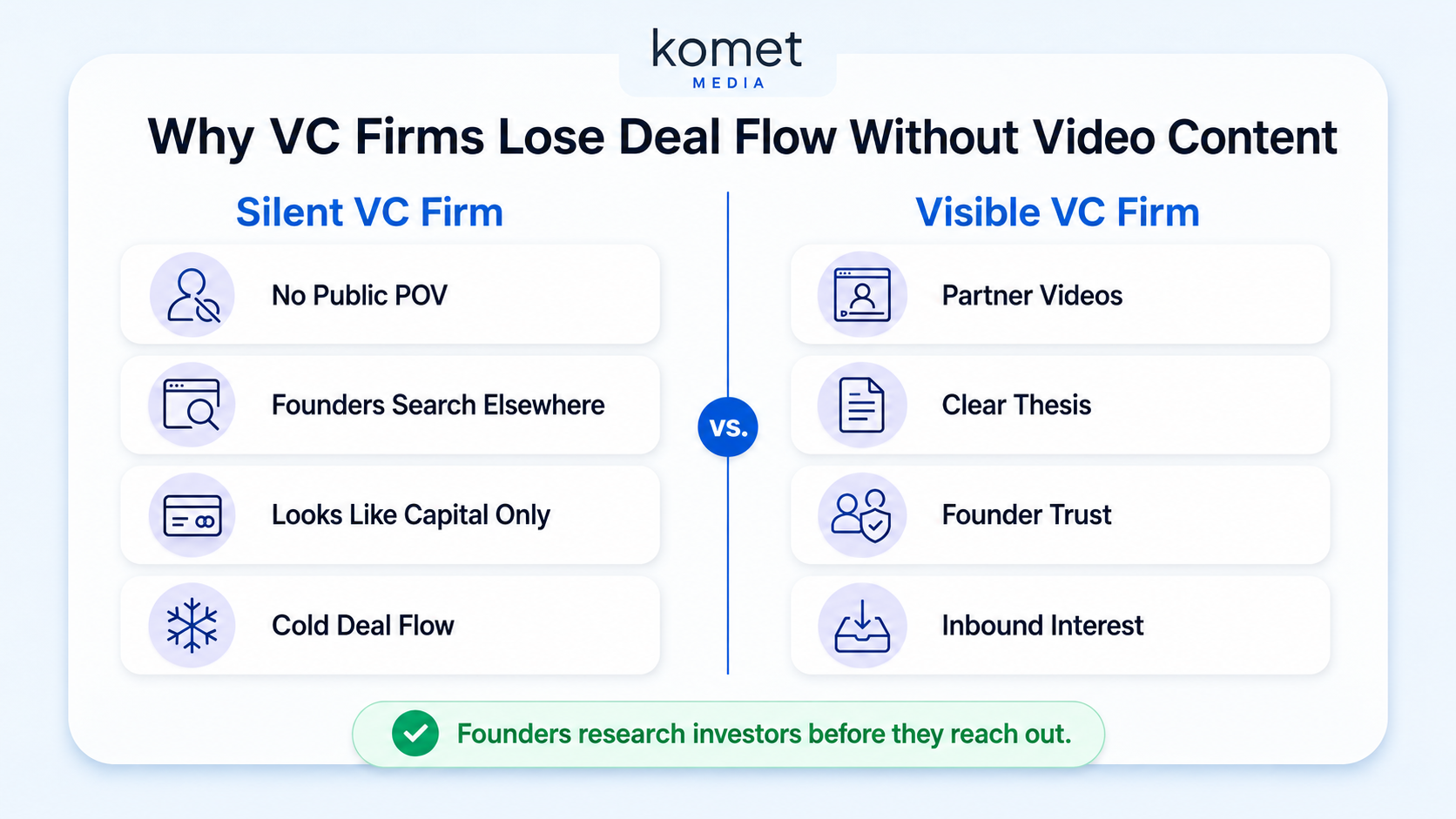
Video accelerates that trust loop. A written post tells founders what you think. A video shows them how you think. It signals confidence, clarity, and a founder-friendly communication style, before you ever take a meeting. When founders research potential investors at 2 AM (and they all do), your content serves as your always-on pitch deck, showcasing your expertise and approach before you ever meet. The same logic applies to LPs. Content builds genuine trust with LPs through stories, not just spreadsheets.
The firms still waiting for referrals to drive deal flow are operating on an old playbook. The inbound funnel has flipped, and video content is the primary engine powering it.
What Types of Video Content Work Best for Venture Capital Firms
Not all video is created equal for VC audiences. The formats below are ranked by their impact on the three priorities that matter most: brand authority, founder trust, and LP confidence.
VC content marketing strategies increasingly incorporate video formats that demonstrate partner expertise while creating more personal connections with founders. Y Combinator's "How to Start a Startup" video lectures exemplify this approach, they provide genuine educational value while subtly positioning YC as the premier destination for early-stage founders.
The insight clip is the format I recommend most to VC teams starting out. It is low-production, high-signal, and perfectly sized for LinkedIn's algorithm. A managing partner sharing a 90-second take on why a particular sector is mispriced right now does more for deal flow than any firm newsletter.
When producing video content, keep production values professional but not overly polished. Founders respond to authenticity, not perfection.
How to Build Authority as a VC Using LinkedIn Video
Unlike other social platforms, the LinkedIn algorithm prioritizes sending content to people in your immediate network first (1st-degree connections or followers), and posts that get more activity are pushed into more people's top updates across 2nd or 3rd-degree connections.
For VC partners, that means your video is likely to reach the exact founders and operators you want to be in front of, without paid amplification. Short-form video is the best-performing format in 2025 due to LinkedIn's push toward mobile-first experiences.
The practical playbook for building authority on LinkedIn video comes down to five steps:
- Choose a sharp point of view: Pick one thesis, a sector, a stage, a founder profile, and own it consistently. Generic market commentary doesn't build authority.
- Record 60–90 second takes: Tight, specific, no wind-up. State the insight in the first five seconds.
- Post natively: Upload directly to LinkedIn rather than linking from YouTube. Native video gets materially higher reach.
- Add captions: Most professional feeds are scrolled silently.
- End with a signal, not a pitch: Invite founders to reply with a question, not to book a call.
Jenny Fielding, managing partner at Everywhere Ventures, has successfully leveraged LinkedIn for authority and deal flow. As the leader of a small, early-stage venture fund lacking the marketing resources of larger firms, she and her team focus on building personal brands, understanding that authentic, engaging content is their most effective asset. By consistently posting about issues relevant to founders such as scaling challenges, hiring strategies, and funding insights, Everywhere Ventures has positioned itself as an approachable, founder-friendly firm.
The short-form video editing services that actually move the needle for VC teams are the ones built around consistent, repurposed partner insights, not one-off produced pieces.
Why VC Firms Are Investing in YouTube and Podcast Video Content
YouTube has officially become the world's largest video podcast platform. For VC firms, that changes the calculus entirely. A podcast recorded with a founder or portfolio operator isn't just an audio asset, it's a YouTube video, a LinkedIn clip series, a newsletter hook, and a searchable reference piece for future LPs. The stronger model is to treat each episode as source material. One conversation can become a YouTube upload, short-form clips, sales enablement snippets, an email newsletter angle, and a companion article.
20VC founder Harry Stebbings started his venture capital podcast from his mum's kitchen table at age 19 with no contacts in the VC industry. He used the podcast to build relationships with prominent VCs and startup founders, and the eventual popularity of the show led to his raising US$140M to start his own fund at the age of just 24.
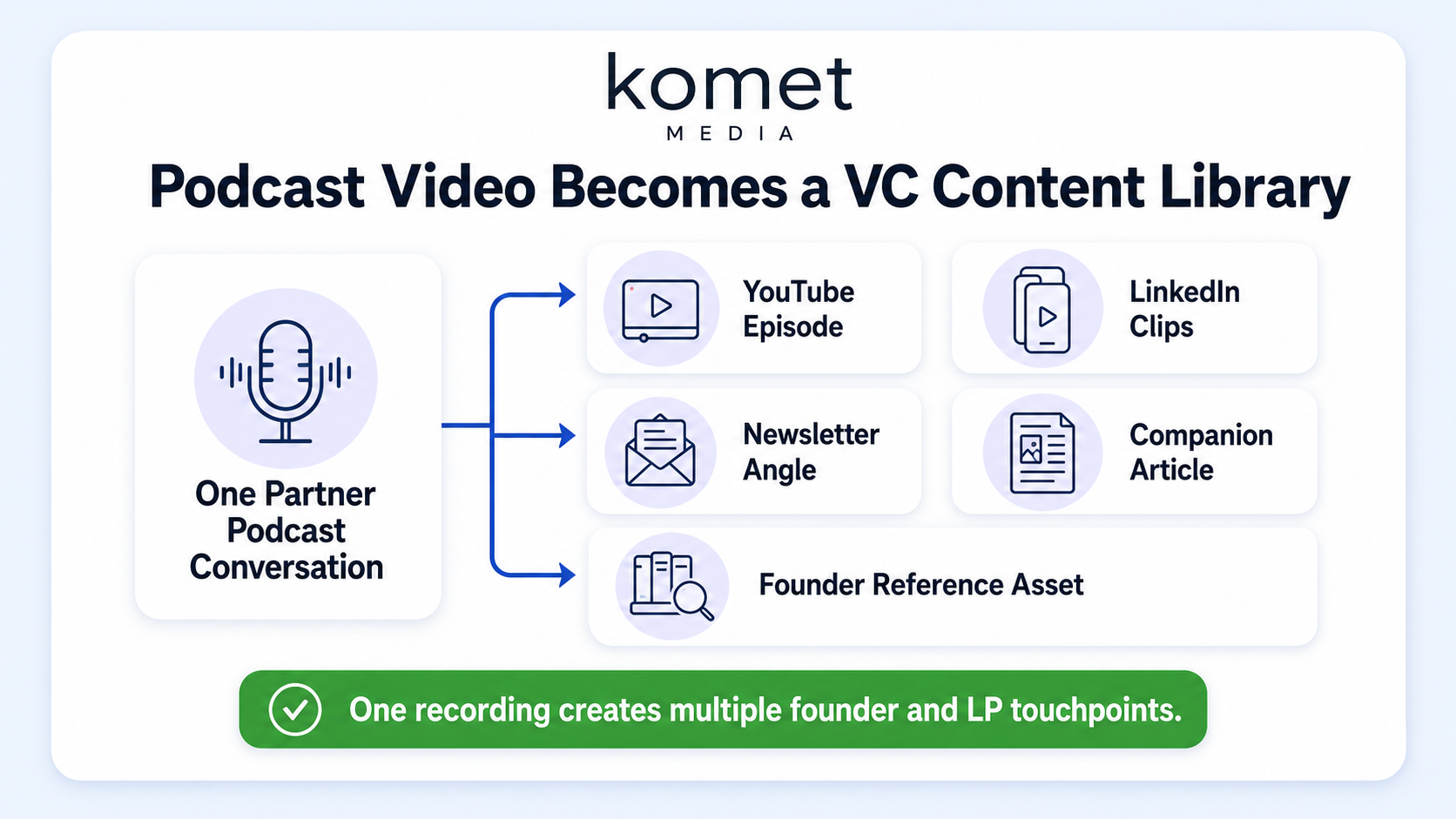
Andreessen Horowitz went further than anyone. Their New Media initiative offers startups "go-direct as a service" through creative production, owned channels, and expert support. The "one hour podcast, one minute clip" format has proven effective at bringing out what's interesting about people with something to say, even if they aren't polished or on-message.
The podcast production and YouTube video editing workflow is exactly where I help VC teams at Komet Media, not by creating content from scratch every time, but by turning the conversations your partners are already having into a library of short-form assets that work across every channel.
Examples of VC Firms with Strong Video Content Presence
The firms below have made video content a structural part of how they build brand authority and attract deal flow.
Australia's Blackbird VC has published hundreds of articles, videos, and podcast episodes, which it uses to further its brand and visibility amongst Australian founders. Its content features a mix of guides on leadership, product and culture, marketing and sales, capital raising, as well as founder stories that serve to highlight its portfolio companies.
Attention compounds. The firms investing in media-grade content today are building advantages that will only widen over time: founders will seek them out before they even need to fundraise, LP fundraising becomes faster and more efficient, and they shape how entire markets are understood, not just which startups get funded.
What VC Firms Should Post on Video to Attract LPs and Founders
The mistake most VC teams make is treating their video as a branding exercise rather than a trust-building system. LPs and founders need different signals from the same firm.
For founders, post video content that signals:
- How you think about sectors and market timing (market point-of-view takes)
- What you look for in a founder (values, traits, stage)
- How you've supported portfolio companies through hard moments
- Honest takes on the fundraising environment right now
For LPs, post video content that signals:
- Investment thesis clarity and conviction
- Portfolio company progress and founder wins
- Your track record framed through storytelling, not just IRR tables
- How your partners think about risk and capital allocation
Founders and LPs increasingly look to social proof and credibility markers when deciding which firms to engage with. By showcasing unique insights on emerging technologies, market trends, or sector-focused analyses, a VC firm cements its place as a trusted authority. This sense of authority deepens brand loyalty and nurtures a strong reputation that persists even in volatile economic cycles.
One recording of a partner conversation at a portfolio event can yield five short clips, each targeting a different signal for a different segment of your audience. That's the repurposing model that makes video marketing sustainable for a VC team without a full content staff.
How Often Should VC Firms Post Video Content, and How to Build the System
Consistency is the variable that most VC content programs get wrong. Numerous venture firms have started publishing podcast episodes, but stopped doing so after seven or so episodes, a phenomenon known as podfading. The same pattern plays out with video series. The answer isn't to post more, it's to build a system that makes posting the path of least resistance.
The sustainable cadence for a VC firm's video content is:
- Partner insight clips: 2–3 per week on LinkedIn (under 90 seconds each)
- Long-form podcast/video: 1 per month on YouTube, repurposed into 4–6 clips
- Event or panel recording: As available, repurposed immediately after the event
- Portfolio founder spotlight: 1 per quarter minimum
The firms that rise to the top commit to the long game, consistently producing valuable content that compounds in value over months and years. Like the best investments in your portfolio, content requires patience before delivering its biggest returns.
The repurposing engine is what makes this volume achievable. Consistent repurposing multiplies visibility and keeps the brand's voice active across multiple feeds. One partner conversation recorded at your next firm event can become a month of LinkedIn content and a full YouTube episode, with the right editing workflow behind it. Content marketing venture capital success increasingly depends on the combined reach of individual team members rather than just the firm's logo.
That means every partner needs their own video presence, not just a firm-level channel. The podcast editing and short-form repurposing infrastructure we build at Komet Media is designed for exactly this: VC teams where partners have insights worth sharing but no production capacity to turn those insights into consistent output.
Conclusion
Video content is no longer optional for VC firms competing for the best founders and LPs in 2026. The takeaways:
- Deal flow follows attention: Founders research you before they pitch you. Your video presence is your first meeting.
- LinkedIn short-form + YouTube long-form is the most efficient two-platform stack for VC authority building.
- Repurposing is the multiplier: One partner conversation becomes a month of content when you have the right system.
- Consistency beats production quality: A managing partner on a phone camera, twice a week, beats a polished quarterly video every time.
If your firm has insights worth sharing, and it does, the only remaining question is whether those insights are visible to the founders and LPs who need to see them. Komet Media builds the video content systems that make that visibility consistent and repeatable.
Frequently Asked Questions
Q1: How do VC firms use video content to build credibility with founders?
VC firms build credibility by sharing partner point-of-view videos on market trends, investment thesis, and founder support stories. Founders research investors online before reaching out, so VCs with the largest content footprint attract the best inbound deals and differentiate beyond capital alone. Video accelerates trust because it shows how partners think, not just what they think.
Q2: What is the best video platform for a VC firm, LinkedIn or YouTube?
Both serve distinct roles. LinkedIn video reaches founders and operators in your existing network and drives near-term deal flow conversations. YouTube has officially become the world's largest video podcast platform, making it the right home for long-form partner podcasts and founder interviews that build durable, searchable authority over time. Use both.
Q3: How does content repurposing work for VC video content?
The strongest model is to treat each recording as source material. One conversation can become a YouTube upload, short-form clips, sales enablement snippets, an email newsletter angle, and a companion article. For VC firms, a single 45-minute partner podcast episode typically yields 4–6 LinkedIn clips, a blog post, and a newsletter section.
Q4: What video content should VC firms create to attract limited partners?
LPs want to see investment thesis clarity, portfolio company progress framed as storytelling, and evidence of how partners navigate hard decisions. Video updates replacing or supplementing traditional LP letters are gaining traction because they communicate conviction and transparency in a way written documents cannot.
Q5: How often should a VC firm post a video on LinkedIn?
Two to three partner insight clips per week is the sustainable baseline. Video posts naturally capture attention, which means your audience is more likely to interact by liking, commenting, or sharing, and those actions push your content to their connections, expanding your visibility. Consistency over 90 days compounds reach far more than sporadic, high-production posts.
Q6: Do VC firms need a professional video production team?
Not necessarily at the start, but a production system becomes essential once you commit to consistency. Keep production values professional but not overly polished, founders respond to authenticity, not perfection. Where most firms break down is in editing and repurposing speed. That's the gap a focused agency partner fills, turning weekly recordings into a full content calendar without pulling partners off their core work.