
🪄 AI Summary
Heading 1
Heading 2
Heading 3
Heading 4
Heading 5
Heading 6
Lorem ipsum dolor sit amet, consectetur adipiscing elit, sed do eiusmod tempor incididunt ut labore et dolore magna aliqua. Ut enim ad minim veniam, quis nostrud exercitation ullamco laboris nisi ut aliquip ex ea commodo consequat. Duis aute irure dolor in reprehenderit in voluptate velit esse cillum dolore eu fugiat nulla pariatur.
Block quote
Ordered list
- Item 1
- Item 2
- Item 3
Unordered list
- Item A
- Item B
- Item C
Bold text
Emphasis
Superscript
Subscript
Most PE firms still treat video as a nice-to-have. The firms closing proprietary deals and winning LP commitments in 2026 treat it as infrastructure. This YouTube playbook for private equity lays out exactly how partners, operating teams, and firm marketers can use YouTube to build institutional credibility, surface the right deals, and show up where LPs and founders are already doing research, before they ever reach out.
TL;DR
- YouTube is now the research platform of choice for B2B decision-makers, and PE firms that ignore it are invisible during the most critical moments.
- The strongest PE video content leads with third-party validation: portfolio stories, founder perspectives, and partner insight, not firm promotion.
- Short-form clips repurposed from long-form content (panels, podcasts, webinars) are the fastest path to consistent output.
- LinkedIn distributes. YouTube compounds. You need both, working together.
Should Private Equity Firms Be on YouTube?
The short answer: yes, and the case is no longer debatable. YouTube commands 2.70 billion monthly active users , and its role in B2B decision-making has matured far beyond consumer entertainment. 88% of B2B buyers watched video in the last quarter to evaluate products and services, and brands without a YouTube presence are invisible during those critical research moments.
For PE firms specifically, the buyer psychology matters. An owner-operator considering a recapitalization, a family office allocating to a new fund, or a strategic LP doing digital due diligence will run a YouTube search on your firm's partners before they respond to an email. YouTube has become the platform of choice for B2B research, with over 50.9% of decision-makers preferring it as their primary research outlet. The authority gap is also real.
High Growth financial firms prioritize thought leadership significantly more than their No Growth counterparts, 31.4% vs. 16.7%. YouTube is the highest-leverage place to close that gap at scale. Video in private equity still sits in a weird place, everyone knows it's powerful, everyone knows it's increasingly expected, but most firms still don't know exactly how to use it.
That uncertainty is your competitive window. PE firms that build a systematic YouTube presence now face a largely uncrowded field compared to consumer categories. The argument against YouTube, "our LPs aren't on YouTube", doesn't hold up. Over 75% of Fortune 500 executives regularly watch online video.
The institutional investors you want to reach are watching. The founders you want to source from are watching. The question is whether they find you or a competitor. A PE firm's YouTube channel is a 24/7 pitch deck that builds trust before the first call. Most firms still don't have one.
How Private Equity Firms Use YouTube for Marketing
PE firms use YouTube across three distinct business goals: LP relations, deal sourcing, and brand authority. Each requires a different content approach.
LP investor relations: GPs can use YouTube to deliver consistent macro perspective and market views to prospective and current LPs. A partner recording a quarterly outlook, walking through capital allocation thesis, or explaining how the firm evaluates add-on acquisitions gives LPs a visible and ongoing reason to trust the team, without requiring an in-person event. Webinars and recorded panels hosted at Komet Media's webinar hub or events pages can be repurposed directly into YouTube content.
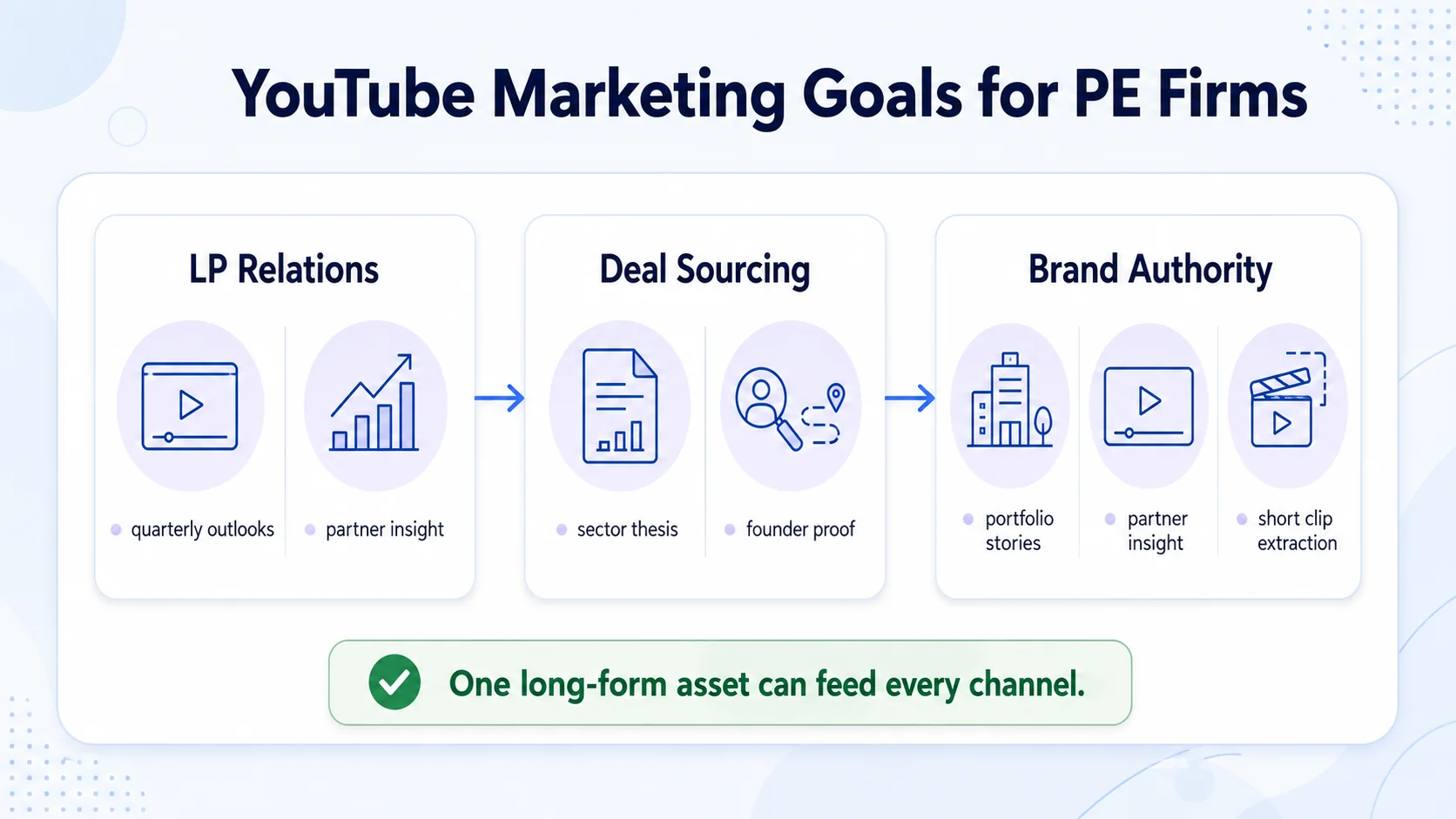
Deal sourcing: Business owners researching PE options actively search for firm-specific content. A PE partner discussing the firm's thesis for a specific sector, healthcare services, B2B software, industrial distribution, shows up in search exactly when a founder is evaluating fit. Content marketing is a strategy where a company creates content to educate prospects and build trust for a future relationship, and there's no more complicated transaction than partnering with a PE firm. YouTube makes that trust-building searchable and scalable.
Brand authority: The most effective video content in private equity is built around third-party validation, founders, sellers, management teams, portfolio executives. The message isn't "we're great." It's "look at what we did together." The mechanics are straightforward. Each long-form video (20–40 minutes) gets sliced into:
- 60–90 second clips for YouTube Shorts and LinkedIn
- 3–5 minute topical cuts for YouTube search
- Audiograms for podcast repurposing via Komet Media's podcast services
- Written clips for email nurture
AI-powered content repurposing offers an opportunity to drive results from existing efforts, taking one high-value long-form asset like a webinar or research panel and transforming it into blog posts, social media updates, video clips, and newsletter articles from a single source.
How to Create a YouTube Channel for a PE Firm
Setup done right takes one focused afternoon. Done wrong, it signals that the firm doesn't understand digital.
- Create the channel under a brand Google account: Never use a personal Gmail. The channel should belong to the firm entity.
- Name it clearly: Use the exact firm name. Avoid creative wordplay, LPs and founders will search your brand.
- Write a channel description that serves search: Include the firm's focus verticals, deal size, and geographic thesis. Google indexes this.
- Design channel art at correct specs: Banner at 2560×1440px, channel icon at 800×800px. Use firm brand colors and a clean professional logo.
- Build three playlists before publishing content: One for market views and thought leadership, one for portfolio company stories, and one for firm overview and culture. Playlists extend session watch time and signal topical authority to the YouTube algorithm.
- Optimize your first video for a high-intent search query: "How to sell a business to PE" or "what to expect from PE partnership" pulls in exactly the founder audience you want.
- Link your YouTube channel from the firm website, LinkedIn profile, and email signature from day one. Cross-platform signals accelerate indexing.
- Publish a channel trailer (90 seconds max): It should answer: who we are, who we invest in, and what working with us looks like. No stock footage. Real people on camera.
Creating engaging video content that simplifies complex ideas, showcases portfolio success stories, and builds trust through thought leadership starts with infrastructure. Get the channel architecture right once, and every video you publish compounds on top of it.
YouTube Content Ideas for Private Equity Investors
Content strategy for PE firms doesn't require a media team. It requires a clear answer to one question: what does your target audience need to believe before they'll take a meeting?
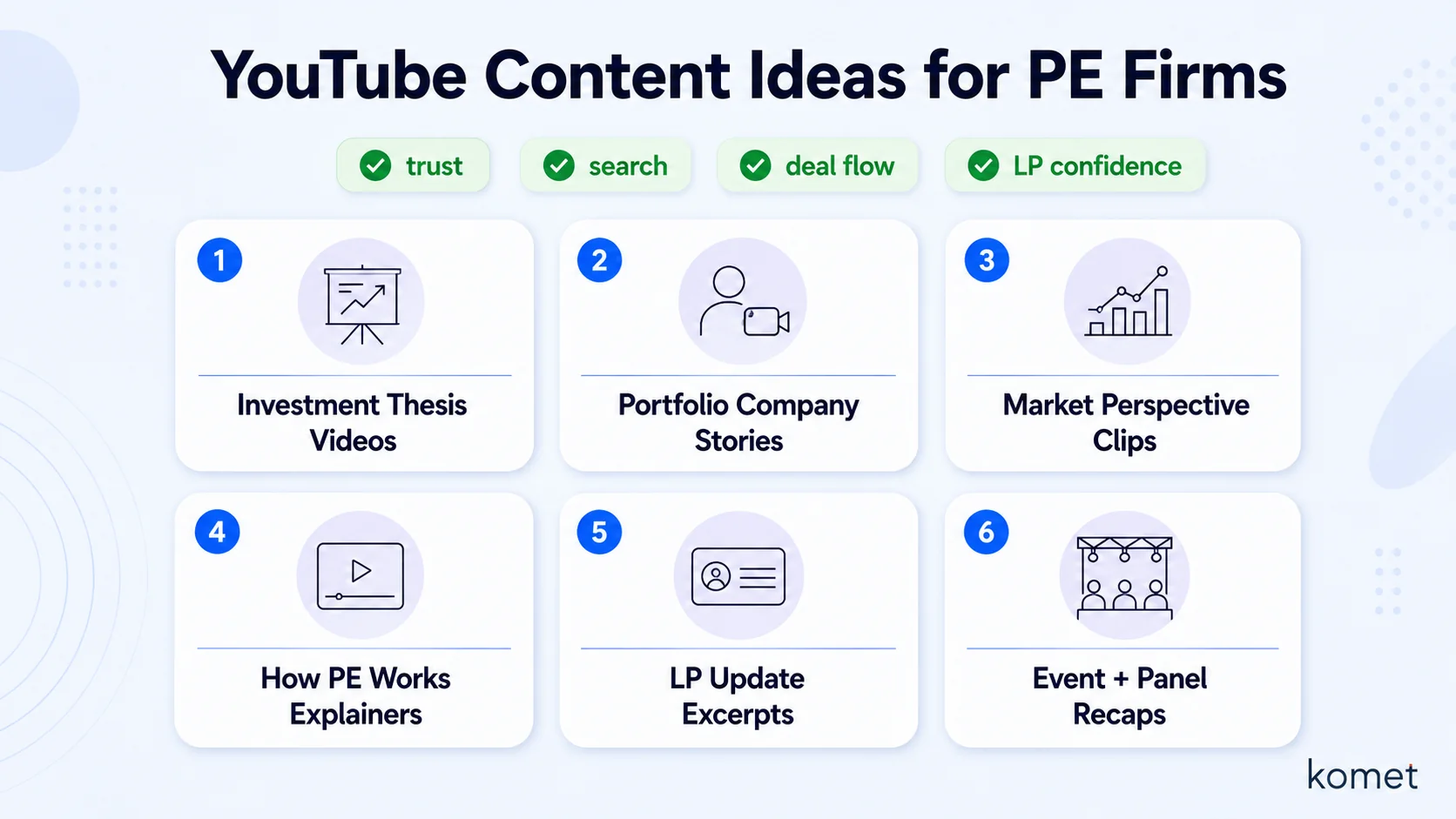
Build around these content pillars:
- Investment thesis videos: A 10–15 minute walkthrough of your sector focus, check size range, deal structure preferences, and what "ideal founder" looks like for your firm. This filters inbound deal flow automatically.
- Portfolio company stories: A 5–7 minute interview with a founder or CEO of a portfolio company, what problem they were solving, why they chose your firm, and what changed post-investment. The most effective video content in private equity is built around third-party validation.
- Market perspective clips: A partner records a 3–4 minute take on a macro trend affecting their investment vertical. This feeds both YouTube search and LinkedIn distribution.
- "How PE works" explainers: Founders evaluating their options search for this content constantly. Videos like "What happens after you sell to PE" or "How value creation works in a PE-backed company" position the firm as a transparent partner, not an adversary.
- LP update excerpts: Snippets of GP-to-LP communication (non-confidential) that show investment discipline, portfolio performance framing, and market outlook. These resonate with prospective LPs during GP fundraising cycles.
- Event and panel recaps: If a partner spoke at a conference or hosted an industry event, the clip belongs on YouTube within 48 hours.
Short-form video delivers the highest ROI by a wide margin, in 2025, 104% more marketers named it their most valuable channel compared to 2024, and it's where investment is growing fastest for 2026. Every long-form piece you record should generate at least three to five short-form clips for Shorts and LinkedIn.
YouTube vs. LinkedIn for Private Equity Marketing: Which Is Better?
This is the wrong question. The right question is: how do they work together?
LinkedIn remains the top choice for private equity firms due to its professional user base and networking potential, however, platforms like YouTube offer significant opportunities, especially for video content and thought leadership. The compounding logic favors YouTube for the YouTube playbook for private equity: a LinkedIn post decays in 48 hours. A well-optimized YouTube video still drives views 18 months later. Companies leveraging video achieve 49% faster growth compared to non-video competitors, and that growth differential widens over time as content accumulates.
The operational model that works: record once, publish long-form on YouTube, cut three to five clips for LinkedIn video posts, repurpose audio to the firm podcast, and link everything back to the channel. LinkedIn distributes to your existing network. YouTube distributes to people who don't know you yet, which is where deal flow and new LP relationships come from. Use LinkedIn to feed warm audiences. Use YouTube to build cold ones into warm ones.
How Private Equity Firms Can Use Video Content to Attract Deal Flow
Most PE deal sourcing relies on banker relationships, cold outreach, and proprietary networks. Video adds a fourth channel that works while you sleep. The mechanism: a founder in your target sector searches YouTube for guidance on evaluating PE offers. They find your partner walking through exactly the considerations they're wrestling with. They watch 12 minutes. They visit your website. They read your portfolio page. Then when your BD team sends a cold email six weeks later, it's not cold anymore.
Content marketing is highly valuable for complex business transactions, and the objectives of a content marketing program include differentiating your firm so a prospect is more likely to agree to a call, and educating prospects about the process so they know what to expect. This is the YouTube playbook for private equity applied to deal sourcing, building conviction before the first conversation.
Specific tactics that move deal flow:
- Optimize video titles and descriptions with keywords founders actually search: "PE recapitalization explained," "selling majority stake to private equity," "growth equity vs PE differences"
- Create sector-specific playlists (healthcare services, tech-enabled services, industrials) so a founder in your vertical immediately sees relevance
- End every video with a clear, low-friction call to action: "If you're evaluating PE options for your business, reach out through the link below" or direct to a contact page
- Use YouTube analytics to identify which videos drive the most traffic to your website, then build more content on those topics
With global private equity assets under management reaching nearly $9 trillion, intensifying competition means exclusive deal networks and financial acumen are no longer enough, top firms are increasingly turning to digital performance marketing as a lever for growth, brand building, and visibility.
Video content repurposing is the unlock for PE teams with limited bandwidth. Our short-form video editing service and video marketing service are built specifically for this: take what a partner already said in a panel or podcast, turn it into five assets that work across platforms, and build a content pipeline without adding recording sessions to anyone's calendar.
YouTube Channel Optimization for PE Firms
Publishing is the start, not the finish. Optimization is what separates a channel that compounds from one that stagnates.
Titles: Write for search intent first. "Q3 Market Outlook from [Firm Name]" is firm-centric and gets no search traffic. "Where Private Equity Is Deploying Capital in 2026" is query-matched and pulls in LPs, intermediaries, and founders doing research.
Thumbnails: Use a partner's face. Human faces consistently outperform text-only or abstract graphics. Add a short, punchy text overlay (under six words). Content strategies favor algorithm-optimized approaches with hyperoptimized thumbnails and formats proven to maximize viewer retention.
Descriptions: First 150 characters are the preview. Use them for the core value proposition of the video, not the firm name. Include relevant terms, "private equity deal sourcing," "LP investor relations," "alternative assets", naturally in the full description.
End screens and cards: Every video should link to a related video and a playlist. This extends watch session length, which is the single strongest signal for YouTube's recommendation algorithm.
Upload cadence: 61% of B2B marketing teams say their budget for video will increase in 2025, and consistent cadence is why. Two to four videos per month is sustainable for most PE teams using a repurposing model. One podcast episode per month generates enough raw material for four to six YouTube assets via Komet Media's podcast repurposing workflow.
Chapters: Add timestamp chapters to every video over five minutes. This improves YouTube search snippet visibility and lets repeat viewers navigate to the section they need. The YouTube playbook for private equity also means treating the channel as a content system, not a content dump. Every video should link to another. Every playlist should have a logical arc. Every description should include a clear next step, subscribe, visit the firm site, reach out.
About 53% of B2B content marketers use YouTube, with the platform ranking among the top four most valued social media channels for B2B decision-makers. The firms that build a systematic channel, not just a library of random uploads, are the ones that generate compounding returns from the investment.
Conclusion
The YouTube playbook for private equity is not a theory, it's an operational system that the best-positioned firms are already running while most of their competitors debate whether it's worth it.
Key takeaways:
- YouTube builds evergreen trust that no cold email can replicate, optimize every asset for search, not just distribution.
- Lead with portfolio stories and partner insight, not firm promotion; third-party credibility converts.
- Repurpose ruthlessly: one panel, podcast, or webinar becomes five to eight YouTube-ready assets.
- LinkedIn and YouTube are complementary, short-form on LinkedIn feeds warm audiences, YouTube converts cold ones.
- Start with the channel architecture, then build cadence; consistency compounds.
Komet Media builds video systems for PE firms that don't have the bandwidth to execute this alone, from repurposing existing content to producing new video from scratch.
Frequently Asked Questions
Q1: How often should a PE firm publish on YouTube?
Two to four videos per month is the sustainable baseline for most PE firms using a repurposing model. One recorded panel, podcast episode, or webinar generates enough material for multiple YouTube assets. Consistency matters more than frequency, a firm publishing twice a month for 12 months builds far more authority than one that publishes 10 videos in January and goes dark.
Q2: Do PE firms need to worry about SEC compliance when posting video content?
Yes. Your compliance team should review any video discussing fund performance, returns, or investment opportunities before publishing. General thought leadership (market views, sector analysis, how PE processes work) typically carries lower regulatory risk. Work with legal counsel to establish a pre-publish review workflow before launching a video program.
Q3: What's the fastest way for a PE firm to start a YouTube channel with no existing content library?
Start with a partner interview, no slides, no studio, just a camera and a 15-minute conversation about the firm's investment thesis and what "ideal partnership" looks like for founders in your target sector. That single video, edited into a long-form piece plus three short clips, is a full first month of content.
Q4: Can YouTube actually drive deal flow for a PE firm?
Yes, through search intent. Founders evaluating exit and recapitalization options search YouTube for information. A PE partner who has answered those questions on camera earns trust before the first cold outreach. The channel acts as a pre-qualifying filter that makes every subsequent BD conversation warmer and shorter.
Q5: Should PE firm partners be on camera themselves?
Yes, whenever possible. Institutional trust is built through people, not logos. A partner explaining an investment thesis on camera builds more credibility than a professionally animated firm overview. Start with whoever is most comfortable on camera and build from there, authenticity outperforms production value in B2B financial services video.
Q6: How does the YouTube playbook for private equity differ from what a consumer brand would do?
PE firms don't optimize for subscribers or views, they optimize for the right 200 people seeing the right content at the right time. That means tighter topic focus (sector-specific, deal-type-specific), longer acceptable video lengths (10–20 minutes is fine for a sophisticated LP audience), and calls to action tied to relationship initiation rather than product purchase. Quality of attention beats volume of attention, every time.