
🪄 AI Summary
Heading 1
Heading 2
Heading 3
Heading 4
Heading 5
Heading 6
Lorem ipsum dolor sit amet, consectetur adipiscing elit, sed do eiusmod tempor incididunt ut labore et dolore magna aliqua. Ut enim ad minim veniam, quis nostrud exercitation ullamco laboris nisi ut aliquip ex ea commodo consequat. Duis aute irure dolor in reprehenderit in voluptate velit esse cillum dolore eu fugiat nulla pariatur.
Block quote
Ordered list
- Item 1
- Item 2
- Item 3
Unordered list
- Item A
- Item B
- Item C
Bold text
Emphasis
Superscript
Subscript
Most B2B SaaS teams close a great deal, write a one-paragraph case study, and leave it there. That is a wasted asset. Turning customer wins into a video flywheel for B2B SaaS & AI/Tech Startups means systematically converting every customer success story into short-form video proof that educates buyers, shortens sales cycles, and generates pipeline on repeat. This guide covers the full strategy: from capturing the right stories to building a distribution engine that compounds.
TL;DR
- A video flywheel turns each customer win into multiple short-form assets that keep working across the buyer journey.
- Testimonial videos and case study clips consistently outperform static formats for trust and pipeline impact.
- LinkedIn is the primary distribution channel for B2B SaaS and AI/tech buyers in 2026.
- The flywheel only works when the capture, production, and distribution process is repeatable, not one-off.
What Is a Video Flywheel Strategy for B2B SaaS and AI/Tech Startups?
Most teams think about customer proof as a deliverable: produce one case study video per quarter and call it done. A flywheel is structurally different. It is a system where each new customer wins feeds a repeatable production loop that generates multiple assets, those assets build trust and demand, demand drives more pipeline, and closed deals create the next customer win to feed back into the loop. The flywheel model, popularized in growth contexts by HubSpot, applies directly to video content strategy: momentum compounds when each part of the system reinforces the next. For B2B SaaS and AI/tech startups, the mechanism looks like this:
- Close a customer deal: A real outcome exists (time saved, revenue gained, churn reduced, adoption increased).
- Capture the story: Interview the customer on camera, on a call, or via async video. Extract quotes, metrics, and use-case context.
- Produce a core asset: A 2 to 3 minute case study video or testimonial video becomes the source of truth.
- Repurpose into short-form clips: Slice the core asset into 30 to 90 second clips targeting specific buyer pain points, objections, and use cases.
- Distribute across the buyer journey: Deploy clips on LinkedIn, in email sequences, on sales pages, inside demo follow-ups, and in outbound prospecting.
- Measure and feed back: Track which clips drive demo requests or engaged pipeline. Those insights inform which customer stories to capture next.
HubSpot's annual State of Marketing report notes that short-form leads in ROI, engagement, and lead generation compared to other video formats , making it the right format to anchor the entire flywheel around. The difference between a video flywheel and a one-off testimonial campaign is repeatability. Turning customer wins into a video flywheel for B2B SaaS & AI/Tech Startups means the system produces assets on a scheduled cadence, not whenever someone on the team has bandwidth. That cadence is what creates compounding visibility and buyer trust over time.
At Komet Media, I have built this exact system for SaaS teams that had strong product outcomes but no structured way to turn those outcomes into video content. The output is a library of short-form proof that covers every stage of the buyer journey without requiring a production team in-house.
How to Turn Customer Success Stories into Video Content for B2B SaaS
Every customer success story contains multiple videos waiting to be pulled out. The challenge is knowing which story elements map to which buyer stage and which video format.
Step 1: Identify the right customer for video. Not every customer makes a strong video subject. Look for customers who achieved a specific, quantifiable outcome, who represent your ideal customer profile, and who are willing to speak on camera or on a recorded call. One strong video customer is worth more than five reluctant ones.
Step 2: Run a structured story interview. Use a framework of five questions: What was the problem before? What did you try first? Why did you choose us? What changed after? What would you say to someone considering this now? These questions produce quotable, emotionally honest material that edited clips can be built from.
Step 3: Map story elements to buyer stages:
Step 4: Produce the core asset first. The full case study video or testimonial video is the master file. Every short-form clip comes from it. This one-to-many production model keeps costs down and consistency high.
Step 5: Write copy variations for each clip. The same video clip needs different captions for LinkedIn organic, email nurture, and sales outreach. Write these before you publish. A clip with a weak caption underperforms a clip with a strong one, regardless of video quality.
Videos featuring customer testimonials see 31% higher engagement compared to standard product videos, which makes the investment in structured story capture disproportionately valuable compared to any other video type. Our short-form video editing service is built around exactly this production workflow.
Best Practices for Customer Testimonial Videos in B2B SaaS
Testimonial videos are the highest-trust format in B2B video marketing. They are also the most commonly executed poorly. Here is what separates clips that convert from clips that collect dust.
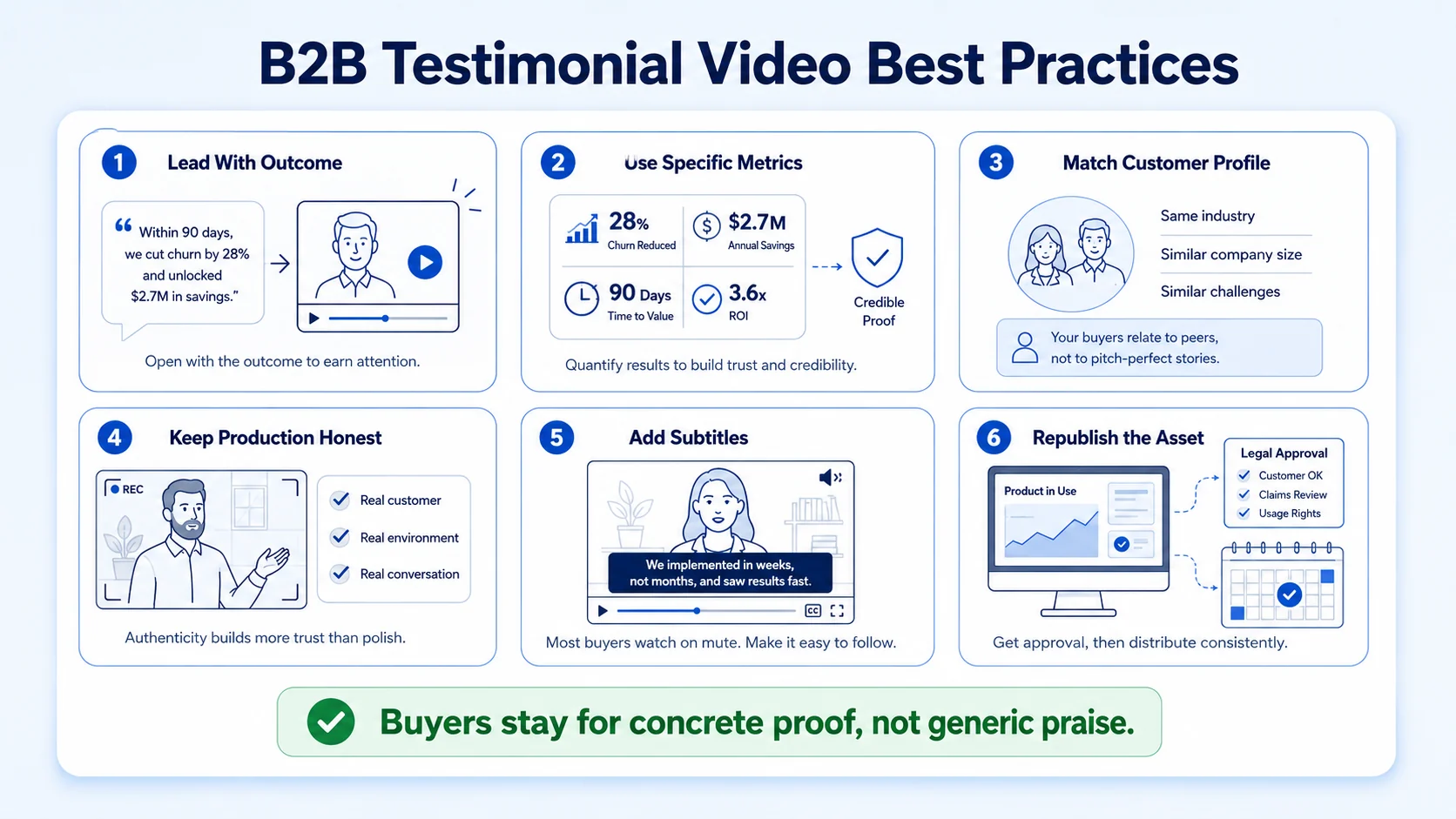
Lead with the outcome, not the introduction. The first five seconds of a testimonial clip should state what changed: "We cut onboarding time by 60%." Not: "Hi, I'm Sarah, VP of Customer Success at Acme." Buyers skip intros. They stay for results.
Keep it specific. Vague praise loses credibility instantly. "It's been a game-changer" tells the buyer nothing. "We went from 14 days to 3 days to activate a new account" tells them exactly what they want to know.
Match the customer profile to the viewer. A sales leader should hear from another sales leader. A Series B SaaS founder should see proof from a peer-stage founder. Profile alignment is what makes a testimonial feel relevant rather than generic.
Keep the production level honest. TikTok, Reels, and YouTube Shorts have changed what buyers expect from video. Even on LinkedIn, "lo-fi" now equals high trust. A phone-recorded customer reaction with good audio often outperforms a studio-produced clip because it reads as authentic.
Use subtitles, always. Most LinkedIn videos are consumed without sound. Captions are not optional.
Avoid common mistakes B2B companies make with testimonial video content:
- Producing one testimonial video per year and calling it a strategy
- Letting legal and approval cycles kill momentum (build a fast-track approval template)
- Featuring only enterprise logos when your ICP is mid-market
- Using talking heads without any visual context showing the product in use
- Publishing once on the company page and never touching the asset again
72% of B2B buyers report that video content from vendors influences their vendor shortlist decisions , which means a buyer who watches your customer proof is already narrowing the field. Get in front of them before a competitor does.
How AI/Tech Startups Use Customer Wins for Video Marketing
For AI and tech startups, customer wins carry special weight. The category is crowded, claims are often abstract ("faster," "smarter," "autonomous"), and buyers are skeptical. A real customer explaining what your product actually did in their workflow is more persuasive than any positioning statement.
Here is how high-growth AI startups are using customer win videos effectively in 2026:
Founder-led distribution: The founder or CEO shares customer clips on their personal LinkedIn, adding a brief commentary about what the win taught the team. LinkedIn video consumption is up 36% year-over-year, with a growing emphasis on original creator content. A founder sharing a 45-second customer clip with a one-paragraph insight reaches a far larger and warmer audience than the company page alone.
Pipeline-specific proof: AI startups are building clip libraries by use case rather than by customer name. A prospect in legal tech sees legal tech customer clips. A prospect in fintech sees fintech wins. This is not personalization at scale; it is segmentation with existing assets, done correctly.
Demo support videos: Short testimonial clips are embedded directly into demo follow-up emails. After a live demo, a sales rep sends a 30-second clip from a customer in the same vertical saying exactly what changed after they signed. This format compresses the trust gap between demo and decision.
Webinar and podcast content as raw material: The most efficient strategy involves repurposing one piece of long-form content, like a webinar, into multiple short video assets for different channels. AI startups running product webinars are mining those sessions for micro-testimonials when customers speak live about their experience. Explore how Komet Media's webinar and podcast repurposing services turn long-form content into short-form pipeline assets.
Product trust as a sales enablement layer: Customer win videos are shared by AEs in active deals, posted by CSMs in renewal conversations, and embedded on pricing pages. Turning customer wins into a video flywheel for B2B SaaS & AI/Tech Startups means the same asset works at every stage of the funnel, not just at the top.
How to Build a Repeatable Video Content Engine from Case Studies
A repeatable engine requires three components: a reliable intake process, a production workflow that scales, and a distribution system that does not depend on any single person remembering to post.
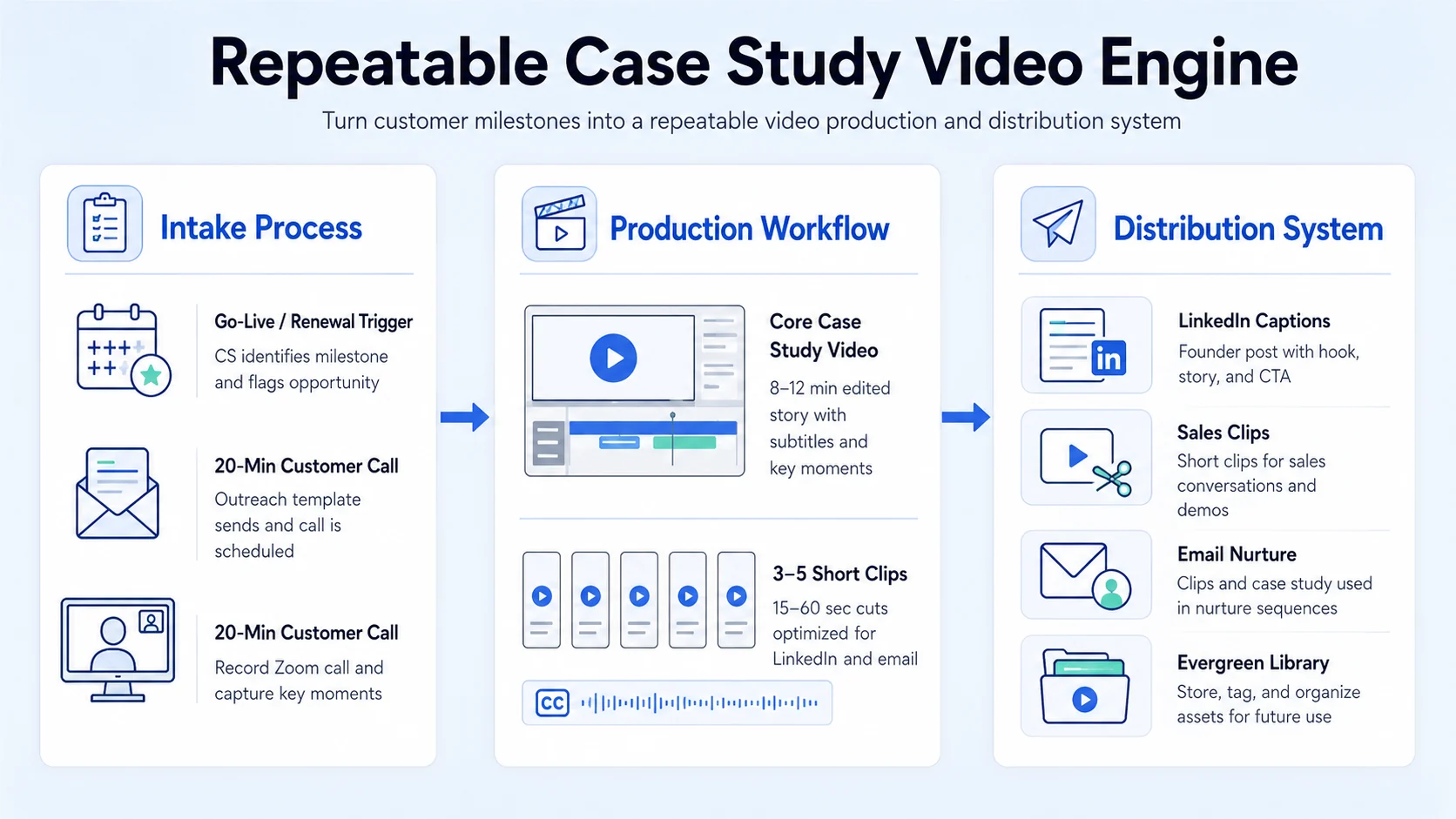
The intake process: Set a trigger. Every time a customer hits a defined success milestone (go-live, renewal, expansion, NPS above a threshold), the customer success team flags them for video outreach. The outreach is a short, templated ask that makes the process feel lightweight for the customer: a 20-minute recorded call, async video via Loom, or an add-on to an existing QBR.
The production workflow:
- Record the customer interview (20 to 30 minutes of raw footage is enough)
- Edit the core 2 to 3 minute case study video
- Pull 3 to 5 short-form clips (15 to 90 seconds each) targeting specific pain points or objections
- Write caption variations for LinkedIn, email, and sales use
- Add subtitles and branding
The distribution system:
- Week 1: Founder posts the first short clip on personal LinkedIn with commentary
- Week 2: Company page posts the core case study video
- Week 3: Sales team adds clips to active deal sequences
- Week 4: Second short clip posted on LinkedIn, targeting a different pain angle
- Ongoing: Clips are added to the evergreen library used in demo follow-ups, email nurture, and ads
61% of B2B content marketers plan to increase video investment in 2026 , which means the bar for standing out with customer proof is rising. The teams that win are the ones with a structured system, not the ones with the biggest production budget.
This is precisely what the Komet Media video marketing service is built around: a repeatable production and distribution engine that turns customer wins into consistent pipeline assets.
What Types of Videos Work Best for B2B Customer Proof and How to Repurpose Them
Turning customer wins into a video flywheel for B2B SaaS & AI/Tech Startups produces the most value when each asset is designed for a specific job, not repurposed randomly.
The core formats and their jobs:
Testimonial videos, product demos, and explainer videos consistently rank as the highest-converting B2B video types. Combining all three within a single customer story gives you assets that cover the full buyer journey from one production session.
How to repurpose one customer story session across formats: A 25-minute recorded customer interview typically yields: one full case study video, three to five LinkedIn short clips, one sales enablement clip for the relevant vertical, one email-embedded proof clip, and source material for a written case study. That is six to eight distinct assets from a single 20-minute conversation.
The repurposing discipline is what makes turning customer wins into a video flywheel for B2B SaaS & AI/Tech Startups economically viable at scale. 72% of customers trust a brand more with positive video testimonials , and that trust compounds the more a buyer sees consistent proof from peers across different formats and channels. Visit Komet Media's video editing services to see how we structure this repurposing workflow for SaaS teams.
How Top SaaS Companies Turn Wins into Ongoing Video Campaigns: The Step-by-Step Process
The gap between companies that treat customer proof as a one-time deliverable and companies that run it as an ongoing campaign is a system. Here is the step-by-step process that top-performing SaaS teams use.
- Define the video ICP: Establish which customer profiles, verticals, and use cases you need video proof for. Map gaps in your current proof library against your target accounts.
- Build a customer advocacy list: Work with CS and sales to identify eight to twelve customers per quarter who are strong candidates for video. Prioritize customers with specific metrics, willingness to be public, and ICP alignment.
- Create a standing interview schedule: Block one day per month for customer interviews. Treat it as a production day, not a marketing favor.
- Produce in batches: Edit all interviews from the month into a structured queue: core videos first, short clips second, caption copy third.
- Launch a campaign, not a post: Each customer story becomes a four to six week micro-campaign with a planned distribution sequence across LinkedIn (founder and company), email nurture, sales outreach, and paid amplification.
- Track what closes pipeline: Use UTM parameters and CRM tagging to see which clips appear in deals that close. This data tells you which proof types matter most to buyers at which stage.
- Feed insights back into story selection: If clips about onboarding speed perform best, prioritize customers who can speak to onboarding. The flywheel learns and improves with every cycle.
62% of B2B marketers say LinkedIn is their most effective platform for video distribution , which makes it the primary amplification channel for every step of this campaign sequence. Learn more about how Komet Media structures these campaigns at our services page.
Conclusion
The flywheel works because it is systematic, not because any individual video is exceptional. Here are the core takeaways:
- Every customer win contains multiple short-form video assets. One 25-minute interview session yields six to eight distinct pieces of content.
- Testimonial and case study videos are the highest-trust and highest-converting formats for B2B SaaS buyers.
- LinkedIn is the primary distribution channel; founder-led posting consistently outperforms company page posting.
- The system only compounds when capture, production, and distribution are on a fixed cadence, not driven by ad hoc effort.
Turning customer wins into a video flywheel for B2B SaaS & AI/Tech Startups is not a campaign. It is an infrastructure decision. Build the system once, and it generates pipeline assets indefinitely.
Frequently Asked Questions
Q1: How many videos should I produce from a single customer interview?
A 20 to 30 minute customer interview should yield one full case study video (2 to 4 minutes), three to five short-form LinkedIn clips (15 to 90 seconds), one sales enablement clip for the relevant vertical, and source material for email sequences. That is six to eight assets minimum from a single session.
Q2: What is the ideal length for a B2B testimonial video clip on LinkedIn?
Average video length has trended significantly shorter, projected to reach approximately 39 seconds by 2026. For LinkedIn, 30 to 60 seconds performs best for short clips. The full case study video can run 2 to 4 minutes and lives best on your website or YouTube.
Q3: How do I get customers to agree to be on camera?
Make the ask feel lightweight: a 20-minute recorded Zoom call, no prep required, with a clear agenda. Offer to share the final video with them for their own LinkedIn. Most customers who are genuinely successful with your product are willing to talk when the process is simple.
Q4: Should the founder or the company page post customer videos on LinkedIn?
Both, but the founder post comes first. LinkedIn video consumption is up 36% year-over-year, and the number of CEO videos on the platform has increased by over 50% in just two years. Founder personal pages reach warm audiences faster and build more trust than branded company pages.
Q5: How often should we be adding new customer videos to the flywheel?
Target one new customer story per month at minimum. That yields six to eight assets per cycle, and over 12 months you build a library of 70 to 90 short-form proof assets covering multiple verticals, use cases, and buyer objections.
Q6: What is the biggest mistake B2B SaaS teams make with customer proof video?
Treating it as a one-time deliverable rather than a system. A single testimonial video posted once and forgotten has minimal impact. The same clip distributed across LinkedIn, email nurture, sales follow-up, and paid retargeting over a six-week campaign generates significantly more pipeline exposure from the same production investment.