
🪄 AI Summary
Heading 1
Heading 2
Heading 3
Heading 4
Heading 5
Heading 6
Lorem ipsum dolor sit amet, consectetur adipiscing elit, sed do eiusmod tempor incididunt ut labore et dolore magna aliqua. Ut enim ad minim veniam, quis nostrud exercitation ullamco laboris nisi ut aliquip ex ea commodo consequat. Duis aute irure dolor in reprehenderit in voluptate velit esse cillum dolore eu fugiat nulla pariatur.
Block quote
Ordered list
- Item 1
- Item 2
- Item 3
Unordered list
- Item A
- Item B
- Item C
Bold text
Emphasis
Superscript
Subscript
I'm Rajan Soni, Founder and Video Director at Komet Media, and I hear this question almost every week from SaaS founders and marketing heads: "Should we be doubling down on video or is the blog still our best pipeline lever?" The honest answer is that the question itself is the problem. The debate over video vs blog content for SaaS pipeline isn't really about format, it's about funnel stage, buyer intent, and what your team is willing to execute consistently. Here's what the 2026 data actually says.
TL;DR
- Video drives higher mid-funnel engagement and faster MQL-to-SQL conversion; blogs build the SEO authority and search presence that surfaces buyers in the first place.
- Website conversion rates increase from 2.9% to 4.8% with video, a 65% improvement that directly impacts lead generation and pipeline creation.
- AI Overviews are effectively ending the ROI on informational queries, pushing high-performing teams toward middle and bottom-of-funnel content where product nuances actually count.
- The winning SaaS content strategy in 2026 uses blogs as the SEO anchor and video to convert the buyers blogs bring in.
What Type of Content Drives More Pipeline for B2B SaaS in 2026?
Pipeline is not a traffic metric. It's a conversion metric. And that distinction determines which format wins at which stage. 72% of B2B buyers say that blog posts are the most valuable format at early stages of the buyer's journey, while webinars (78%), case studies (58%), and user reviews (57%) work best for the middle funnel. Video occupies a critical space in that middle zone where buyers are comparing options and building internal consensus to make a purchase.
Video is a pipeline powerhouse, dominating middle-funnel engagement at 24% and driving a 213% ROI from webinars alone. In 2025, this strategy helped marketing-sourced pipelines hit 30-60% of revenue targets, especially when videos boost website conversions from the typical 2-5% to over 10% on optimized landing pages.
Blogs, by contrast, produce pipeline through compounding SEO authority. According to First Page Sage's 2026 benchmarks, B2B SaaS SEO averages 702% ROI with a break-even time of 7 months, measured over a three-year window. That's hard to ignore when your CAC is climbing.
The practical split looks like this:
The MQL-to-SQL conversion sits at just 13%, representing the biggest bottleneck in most SaaS funnels. Video is the format purpose-built to close that gap, because it builds product trust faster than any written asset at scale.
Is Video Content Better Than Blogging for SaaS Growth?
Neither is unconditionally better. They serve different parts of the buyer's brain. Blogs earn trust through depth and searchability. B2B companies that published 9+ blog posts per month increased Google monthly website traffic year-over-year by 35.8%, versus 16.5% for those blogging 1-4 times monthly. That traffic compounds. A blog published today can drive qualified demo requests two years from now if it ranks. Video earns trust through credibility and clarity.
There has been a definitive shift away from static, text-based content: a clear majority of 73% of B2B decision-makers now prefer to watch product demo videos over reading whitepapers. When your product is complex, a 90-second walkthrough does what a 2,000-word post cannot: it shows the product working. The data cuts clearly in the video's favor for conversion velocity.
On average, B2B video content shortens the sales cycle by 23%. For funded SaaS teams with aggressive pipeline targets, that speed matters. Blog content builds pipeline over months; video accelerates it within the quarter. But there is a trap. A SaaS company may publish one authoritative benchmark report that generates a significant sourced pipeline, while another company publishes 30 keyword-optimized blog posts that rack up views but never lead to a single demo. The difference is efficiency.
Video without a distribution system is also a waste. The highest-converting video placements for B2B SaaS are embedded on landing pages and in personalized sales emails, not just on a YouTube channel. A team that spends $15,000 and six weeks on a polished 90-second explainer and simply uploads it to YouTube often sees 400 views over three months with no measurable pipeline impact. The answer to "is video better?" is: video converts better mid-funnel; blog scale reaches better long-term. You need both.
Does Video or Blog Content Rank Better for SaaS SEO in 2026?
This is where the answer has genuinely shifted in the last 12 months. Historically, long-form blog content owned search rankings for SaaS. That advantage is eroding for informational queries specifically. AI Overviews are effectively ending the ROI on informational queries. Static blog posts are losing ground to interactive tools, templates, and integration hubs, because these assets provide immediate value and are much harder for an AI to summarize away into a single paragraph.
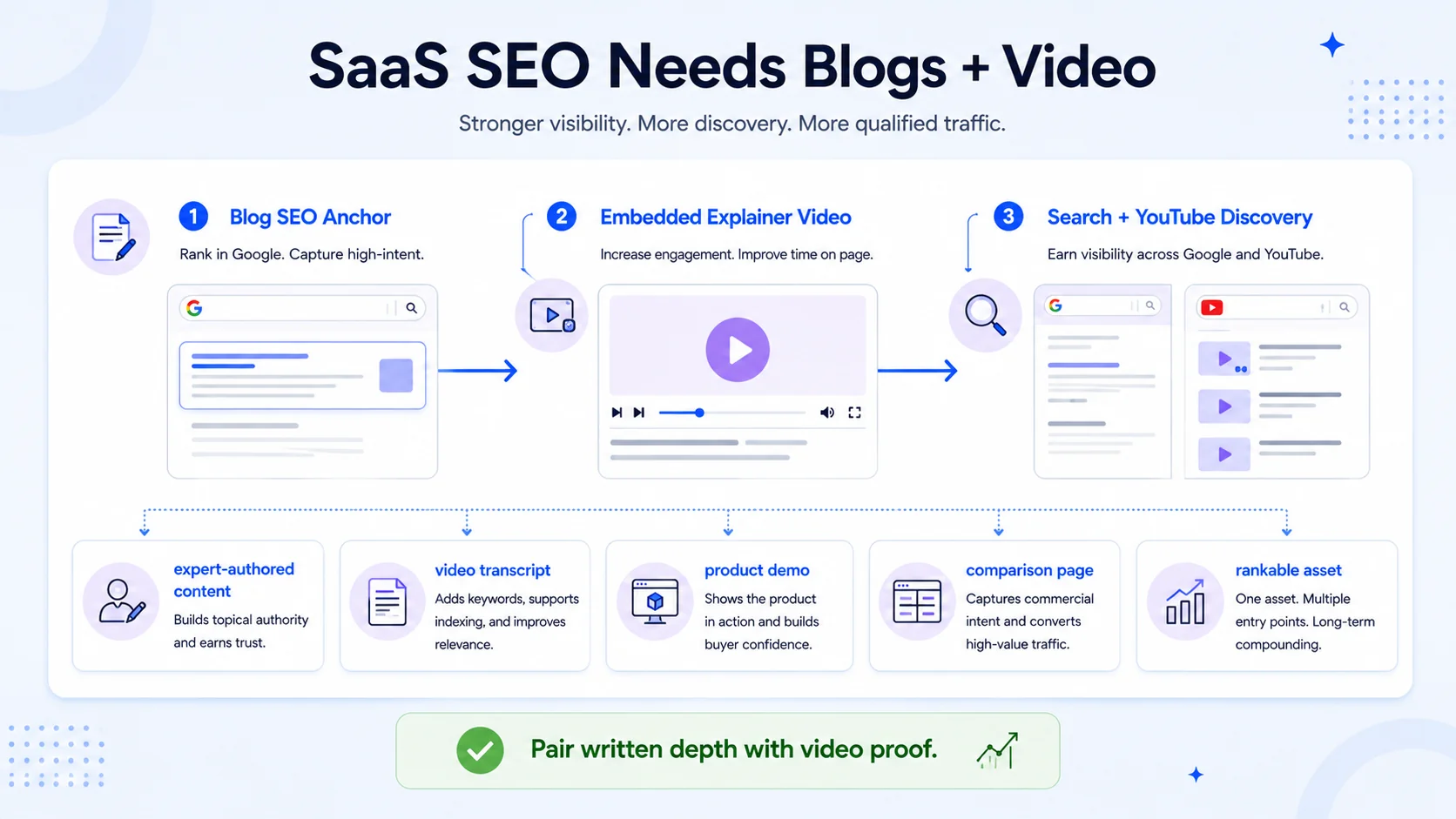
For video's SEO position, video content now outperforms traditional blog posts for engagement and visibility across many verticals, according to Search Engine Land. AI has yet to convincingly replicate the authenticity of a real person speaking on camera, and with AI systems now indexing video transcripts for search, video has become an even more valuable tool for building authority and reaching new audiences.
The smartest move in 2026 is a combined approach. The best-performing content programs use blog content as the SEO anchor and video to extend reach and deepen engagement. A long-form blog post paired with an embedded explainer video on the same topic consistently outperforms either format alone.
For SaaS teams specifically, product demos, onboarding walkthroughs, and webinar recordings are all rankable assets when optimized correctly. Hosting on YouTube and embedding on your marketing site doubles the impact, because YouTube is the second-largest search engine, and an optimized video ranks in both Google and YouTube search simultaneously.
Google is rewarding smaller blogs written by people with real lived experience over faceless corporate blogs, and this is especially true in competitive spaces like SaaS SEO. Founder-led video content and expert-authored blog posts both satisfy Google E-E-A-T signals better than generic AI-generated content.
How SaaS Companies Are Using Video to Replace Top-of-Funnel Blog Content
This is the real shift happening in SaaS content strategy right now, and I see it directly in the work we do at Komet Media. The playbook is changing. AI can now summarize the world's information in seconds. People can find the answers they need without reading your articles. Because of that, the value of "educational" blog posts is shrinking.
Top-of-funnel traffic is no longer a reliable growth lever. For years, SaaS marketing teams used "What is [Category]" blog posts as a low-cost way to build a massive retargeting audience. That playbook is officially obsolete. What's replacing it? Founder-led short-form video on LinkedIn. Product walkthroughs. Punchy 60-90 second clips that surface the specific pain your product solves.
For pre-Series A SaaS, the highest-ROI awareness channel is founder-led short-form video. Founders built massive audiences through raw, authentic LinkedIn videos long before paid channels scaled. At the awareness stage, authenticity and specificity outperform production value. A $200 Loom recording from a founder that nails a specific customer pain point can easily outperform a $10,000 animated explainer that speaks to no one.
The teams winning at short-form video are not abandoning blogging. They're using short-form video to generate demand, then driving buyers to blog-based comparison pages and product-led content at the consideration stage where purchase intent is high and conversion is measurable. There's been a 12% year-over-year increase in B2B advertisers using video on LinkedIn, with a 34% rise in video completions. The audience is there. The algorithm rewards it. The question is whether your team has a repeatable system to produce it.
Video Content vs Blog Posts for SaaS Conversion Rates
Here's where the numbers are most decisive. This is the direct comparison most SaaS founders actually want. A staggering 73% of SaaS homepages still do not feature a product video, despite the proven ROI.
That's a gap your team can exploit immediately.
Companies using video in their marketing see an average increase of 38% in lead generation. 88% of marketers say video marketing helps generate more leads, whether through webinars, YouTube, or social clips, according to Wyzowl. Blogs still earn in bottom-funnel conversion for high-intent SEO queries. SEO leads have an average 14.6% close rate, compared to just 1.7% for outbound leads, per the HubSpot 2026 State of Marketing Report.
Blog-sourced organic leads arrive with built-in intent. They've already read your content, trust your perspective, and are closer to making a decision. The real play for SaaS pipeline is layering both: use podcast production and webinar content to generate video assets, repurpose those into short clips for LinkedIn and email, and let your blog capture the buyers who come in through search with high commercial intent.
How to Choose the Best Content Strategy for SaaS Pipeline in 2026
The decision isn't binary. It's sequenced. Here's how to think about it based on where your SaaS business actually is:
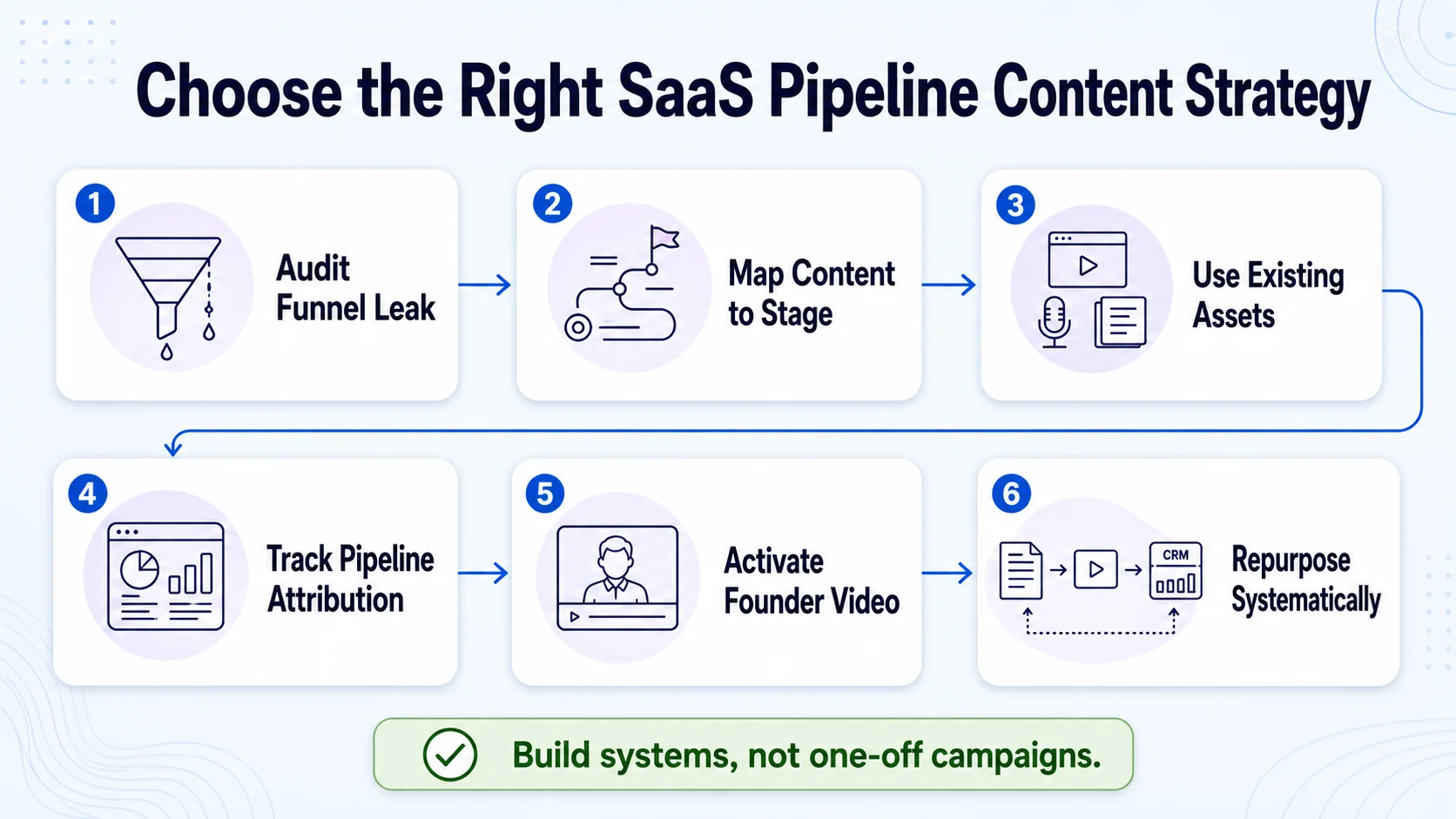
- Audit your current funnel leak: Identify where prospects stall. If demos convert but traffic is low, prioritize blog SEO. If traffic is healthy but demo rates are low, video is your constraint.
- Map content to funnel stage: Blog for top-of-funnel search intent. Short-form video for middle-funnel trust and LinkedIn distribution. Demo or testimonial video for bottom-funnel conversion.
- Start with content you already have: If you run webinars, podcasts, or product demos, those are video assets waiting to be repurposed. Content repurposing means taking one existing asset and reshaping it for different formats, channels, and audiences. A single webinar, blog post, or case study can fuel LinkedIn posts, email sequences, podcast episodes, sales one-pagers, and more.
- Measure pipeline attribution, not vanity metrics: Track pipeline value by content type: which specific content assets, including blogs, reports, webinars, and case studies, are directly tied to opportunities created.
- Activate founder-led video early: Marketing leaders should start with short-form video for demand generation rather than brand awareness, featuring actual users, specific results, and authentic reactions that drive higher completion rates.
- Repurpose systematically: Measure how spin-offs perform: if a blog becomes a LinkedIn carousel, a webinar, a YouTube short, and a slide for sales enablement, measure the ROI of each version.
The customer acquisition cost for the average SaaS business has risen 40-60% since 2023. Growth-at-all-costs is dead, and the SaaS marketing trends shaping 2026 reflect that. The companies winning now are building systems, not running campaigns. For teams that want to explore what a full video content system looks like, our video editing services and video marketing programs are built specifically for B2B SaaS teams who already have content and need to turn it into pipeline assets.
Conclusion
The video vs blog content for SaaS pipeline debate in 2026 resolves the same way every time: neither format wins alone, but video converts faster and blog scales reach further.
- Video drives MQL-to-SQL conversion, shortens sales cycles, and builds product trust that text simply cannot replicate at mid-funnel.
- Blog content builds SEO authority and surfaces high-intent buyers who arrive ready to convert, producing a 14.6% average close rate.
- The highest-ROI SaaS teams use both, pairing blog-led SEO with a short-form video strategy that repurposes existing webinars, demos, and founder thinking into buyer-facing assets.
- In 2026, the content advantage doesn't go to the team that produces more. It goes to the team that distributes more intelligently across the full funnel.
Frequently Asked Questions
Q1: Should a SaaS startup prioritize video or blogging if it can only do one?
Start with a short-form founder-led video. It costs less, builds trust faster, and generates pipeline demand without waiting 7 months for SEO to compound. Once you have traction and a content library, layer in blog content to capture organic search intent. Most early-stage SaaS teams underestimate how much a consistent LinkedIn video presence moves pipeline compared to a blog no one ranks yet.
Q2: What video types generate the most pipeline for B2B SaaS specifically?
Vidyard's benchmark data shows that product demo videos have a 65% average completion rate, compared to 40% for generic brand videos. For pipeline specifically, prioritize product demos, founder-led explainers targeting specific pain points, customer testimonials with outcome metrics, and short clips repurposed from webinars or podcast episodes. Each format maps to a different funnel stage and a different buyer need.
Q3: Does blog content still rank well for SaaS in 2026 given AI search?
Many SEO studies between 2024 and 2025 showed double-digit CTR declines on informational queries when AI summaries appear. At the same time, branded, comparison, and solution-aware searches hold steadier CTR because users still need context and proof before buying. Informational "what is" posts are shrinking in value. Comparison pages, use-case content, and product-led blog assets retain strong conversion value.
Q4: How should SaaS teams measure whether video or blog content is driving the pipeline?
Track pipeline value per asset in your CRM. Connect each blog post, video, or webinar to the opportunities it sourced or influenced using first-touch and multi-touch attribution. Measure video pipeline influence, not just views. Integrate tools like Wistia or Vidyard with your CRM to track which videos prospects watch before they buy. For blogs, track demo requests and trial signups attributed to organic sessions, not just page views.
Q5: What is the content repurposing approach that maximizes both video and blog ROI?
A single webinar insight can become a LinkedIn post, a podcast clip, a sales one-pager, and a blog post without creating anything new. Start with a high-value long-form asset such as a webinar, demo, or podcast episode. Extract short-form video clips for LinkedIn. Write a blog post covering the same topic for SEO. Use clips in sales outreach emails. This system produces compounding returns from a single content investment.
Q6: How does the video vs blog decision change for enterprise SaaS versus product-led growth (PLG) SaaS?
Enterprise SaaS relies heavily on sales enablement video: testimonials, case study walkthroughs, and personalized demo recordings that reps send to multistakeholder buying committees. PLG SaaS benefits more from in-product video and YouTube content that helps users self-educate and activate. Both benefit from blog-led SEO for top-of-funnel discovery, but the video formats diverge significantly based on your sales motion.