
🪄 AI Summary
Heading 1
Heading 2
Heading 3
Heading 4
Heading 5
Heading 6
Lorem ipsum dolor sit amet, consectetur adipiscing elit, sed do eiusmod tempor incididunt ut labore et dolore magna aliqua. Ut enim ad minim veniam, quis nostrud exercitation ullamco laboris nisi ut aliquip ex ea commodo consequat. Duis aute irure dolor in reprehenderit in voluptate velit esse cillum dolore eu fugiat nulla pariatur.
Block quote
Ordered list
- Item 1
- Item 2
- Item 3
Unordered list
- Item A
- Item B
- Item C
Bold text
Emphasis
Superscript
Subscript
I have sat across the table from enough technical founders to know the instinct. Ship the product, write the docs, maybe record a podcast when there is time. Podcast editing for funded AI and tech startups is usually the last thing a lean team budgets for, right up until a founder needs to explain a complex idea to investors, engineers, and buyers who are all skeptical of anything that sounds like marketing. A well-edited podcast is one of the few formats that earns that skepticism instead of fighting it.
Quick Answer
Podcast editing for funded AI and tech startups means turning founder and technical conversations into a clean episode, short clips, and written assets that hold up with skeptical, technical audiences, not just a polished audio file.
Why Podcast Editing Matters More for Funded AI and Tech Startups
Technical buyers are unusually resistant to generic marketing, and that resistance is getting sharper as AI-generated content floods every channel. TrustRadius's 2026 B2B Buying Disconnect Report found that 63% of B2B technology buyers used AI to research software purchases in 2026, yet 94% of them still fact-check what AI tells them, and product demos, trials, and prior experience remain the resources that most influence a final decision. A founder speaking candidly on a podcast, with real reasoning instead of a polished pitch, is exactly the kind of verifiable, human signal that report describes buyers reaching for.
The format itself has also shifted toward video. Edison Research's Podcast Consumer 2026 study found that weekly video-podcast viewing overtook audio-only listening for the first time in the third quarter of 2025. An AI or tech startup recording audio only is producing for a shrinking share of a technical audience that increasingly expects to watch, not just listen.
A few patterns show up often in our work with funded AI and tech founders:
- The strongest material is usually the least scripted. A founder explaining a hard technical tradeoff, unprompted, tends to land better with an engineering audience than a rehearsed product pitch ever will.
- General video marketing still earns its spend. In Wyzowl's 2026 State of Video Marketing report, 82% of marketers said video marketing had given them good ROI, and 85% said it helped generate leads. Podcast editing inherits that baseline, then adds the credibility a founder's own voice carries with a technical buyer.
- Investors and candidates watch these clips too. A funded startup's podcast rarely has one audience. The same episode can carry weight with a prospective customer, a Series B investor doing diligence, and an engineer deciding where to interview next.
Podcast editing for funded AI and tech startups is not about making a recording sound polished. It is about preserving the reasoning that made the conversation credible in the first place, then packaging it so more of the right people actually see it.
Where AI and Tech Startup Podcasts Usually Break Down
I would rather name the common failure points than repeat generic advice. Four show up constantly with technical teams.
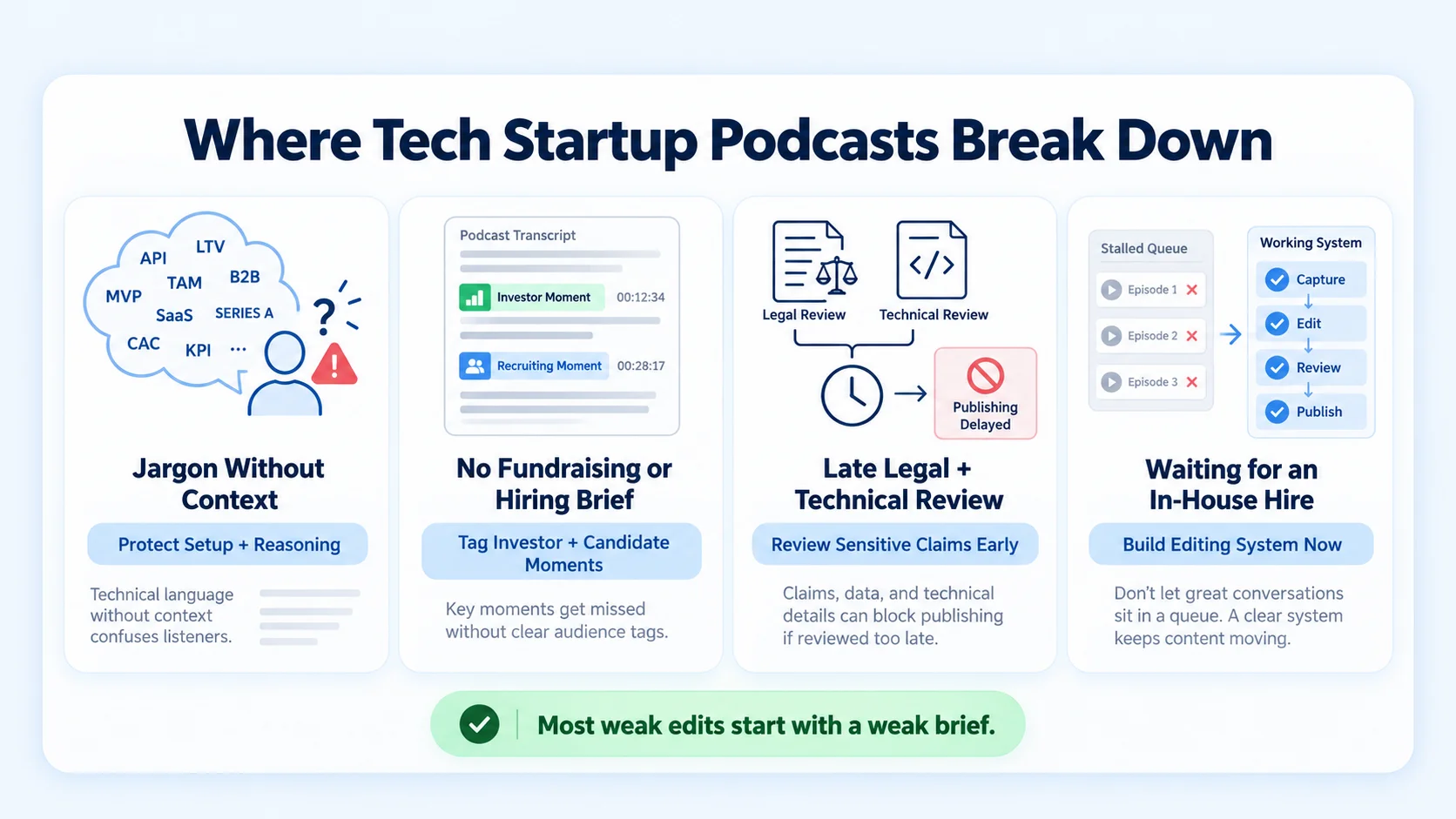
The episode gets buried under jargon no editor was briefed to protect. A clip that cuts out the two sentences of context around a technical term leaves a buyer confused rather than convinced. Editors who do not understand the product tend to cut for pace and lose the meaning.
The team treats the podcast as separate from the fundraising and hiring narrative. A funded startup's podcast often carries messages that also matter to investors and candidates, but the editing brief rarely accounts for that, so the strongest recruiting or investor-relevant moments never get pulled as their own asset.
Legal and technical review happens too late. Startups discussing product roadmaps, benchmarks, or competitive positioning often need a technical or legal check before a clip goes out, and without a defined review step, that check either gets skipped or delays publishing past its relevance window.
Editing waits for a dedicated hire that never arrives. Small teams often plan to bring on an in-house editor once the podcast proves itself, but the podcast never gets consistent enough to prove itself because nobody is editing it in the meantime.
None of these are editing problems in the technical sense. They are workflow and briefing problems that show up as inconsistent, hard-to-follow episodes, and each one is fixable with a better briefing document and a clearer review step rather than a more expensive editor.
What Podcast Editing for Funded AI and Tech Startups Should Actually Include
A capable podcast editing partner working with technical founders is not just cutting silence and leveling audio. The work usually spans several distinct pieces.
Not every team needs the full list from the first episode. A pre-seed team testing the format might start with a clean full-episode edit and two or three buyer-facing clips, then add investor and recruiting cuts once the show has a few episodes behind it. A Series B company already fielding investor and press interest usually needs the fuller set from the start, since the same episode is doing more jobs at once.
The deliverable list matters less than the decision behind it. A clip meant for a technical buyer needs different context than one meant for a candidate evaluating the engineering culture, even if both come from the same twenty-minute conversation. Reviewing how other AI and ML startup brands approach podcast repurposing is a useful way to see this audience-first cutting in practice before briefing a new editor.
A Practical Workflow, From Recording to Publish
Founders do not need to run production themselves, but knowing the shape of the workflow sets realistic expectations for turnaround and approvals.
- Decide which audiences this episode needs to serve before recording. A conversation aimed mainly at buyers gets structured differently than one meant to double as investor material, so naming the audience before the mics turn on shapes which questions get asked.
- Brief the editor on the product, not just the episode. A short glossary of terms and a one-page product overview saves an editor from cutting out the exact sentence that made a technical claim make sense.
- Review the transcript and mark moments by audience. Tagging a moment as buyer-facing, investor-facing, or recruiting-facing before editing starts speeds up clip selection later and keeps each cut focused.
- Cut the full episode first. This becomes the anchor asset for YouTube and the podcast feed, and every short clip gets pulled from this version.
- Pull clips that keep their technical context. A clip can still be short and still include the two sentences of setup that make the claim inside it hold up.
- Route sensitive claims through technical or legal review. Anything touching unreleased features, benchmarks, or competitive comparisons should clear review before publishing, not after.
- Adapt exports by platform. A vertical cut for LinkedIn needs different pacing than a horizontal cut for YouTube, and captioning technical terms correctly matters more on platforms where sound defaults to off.
- Schedule distribution around fundraising and hiring moments, not just a content calendar. A strong investor-relevant clip can matter more the week before a round opens than it does on a generic Tuesday.
Small teams can compress this. A founder recording solo interviews might skip a separate investor-facing cutting pass early on, but skipping the technical review step on anything involving unreleased product details usually costs more than the time it saves.
How to Judge Whether the Editing Is Working
Views are not the right first metric for a funded startup's podcast, and treating them as one tends to hide what actually matters. I would weigh these signals instead:
- Completion rate on the full episode, which tells you whether a technical audience is staying through the reasoning, not just the hook.
- Clip performance by audience segment, since a buyer-facing clip and a recruiting-facing clip should be judged against different benchmarks, not lumped into one number.
- Investor and press mentions of specific episodes, which is a stronger signal during a fundraising window than any view count.
- Candidate references to the podcast during interviews, since a candidate who mentions a specific episode is showing exactly the kind of pre-interview research a strong hire usually does.
- Sales team use of clips in technical buyer conversations, since a clip a rep can drop into a deal is worth more than one that only performs well on social.
Attribution here is rarely clean, especially for a startup running a podcast alongside a fundraise or a hiring push. The signals above, tracked together, tell you more than any single dashboard number, and they matter more than raw download counts for a show built to carry weight with a few specific audiences rather than a broad one.
A common pattern in our work is a technical founder who judges every episode by downloads, sees a flat number, and assumes the podcast is not working, without checking whether the one episode that mattered most was the one an investor mentioned unprompted in a follow-up call. A podcast built for a few high-value audiences will rarely post download numbers that look impressive next to a consumer show, and comparing the two is the wrong test.
Freelancer, In-House Hire, or a Production Partner
This decision comes up in nearly every conversation about podcast editing for funded AI and tech startups, and the right answer depends on how technical the content is and how much internal bandwidth exists to brief and review it.
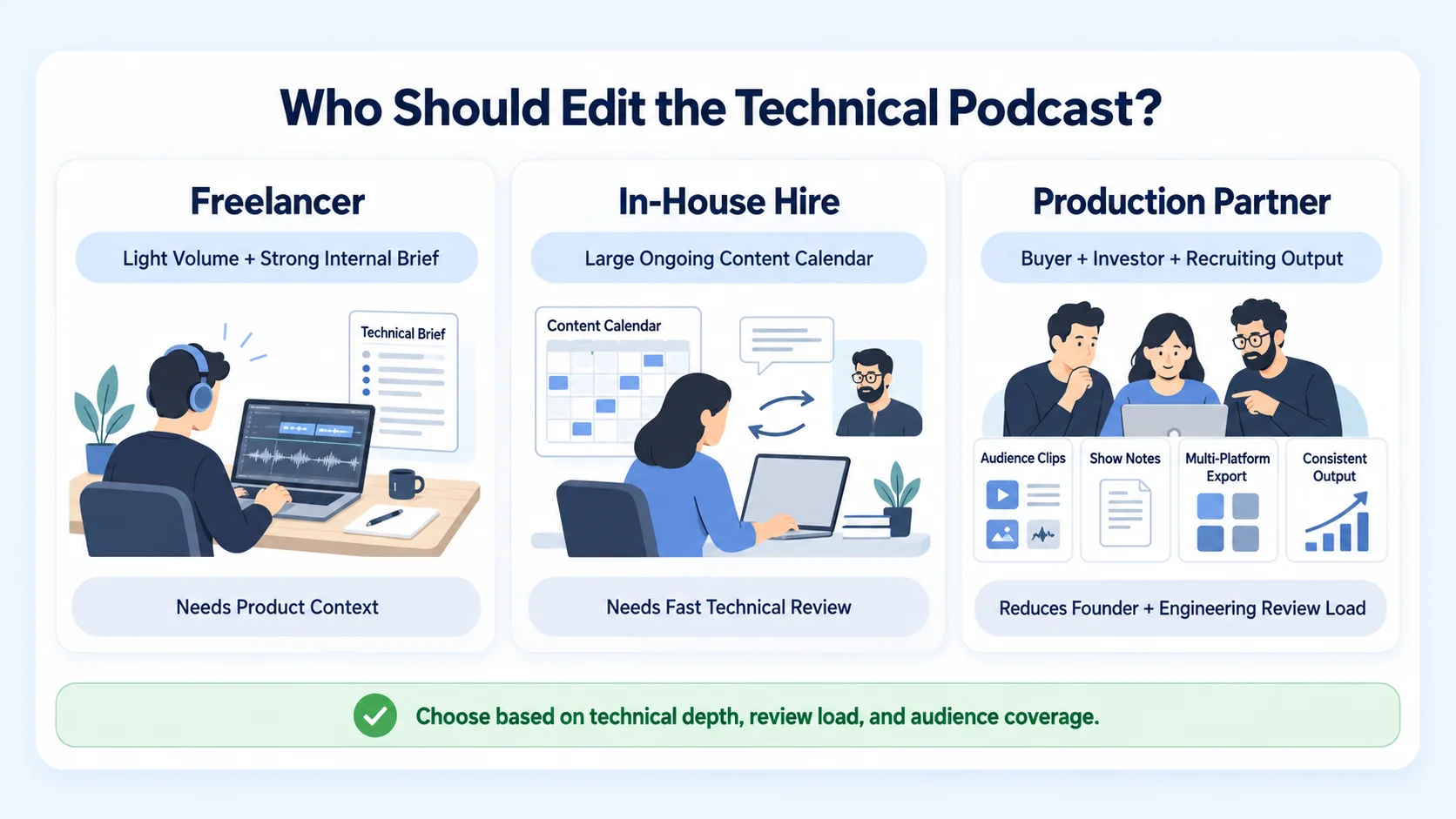
A freelance editor can work well for a single show with light volume, provided the founder or a team member has time to write a proper technical brief and catch anything cut without context. The tradeoff is coverage: a freelancer juggling other clients may not have bandwidth to learn a fast-moving product closely enough to protect nuance consistently.
An in-house hire makes sense once the podcast is a large enough part of the content calendar to justify the role, and once there is someone technical enough to review cuts quickly without becoming a bottleneck.
A production partner tends to fit best once a startup needs consistent output across buyer, investor, and recruiting audiences without pulling engineering or founder time into every review cycle. Working through a checklist for vetting a podcast editing partner before signing a retainer is worth the hour it takes, since it surfaces whether a prospective partner actually asks about the product before touching the raw files, which is usually the clearest signal of whether they will protect technical accuracy under a tight deadline. A guide to choosing a podcast editing service covers similar ground for teams comparing several options at once.
Conclusion
The decision that matters most is not which editing software gets used or how fast a single clip turns around. It is whether podcast editing for funded AI and tech startups is treated as a way to protect and extend technical credibility, or as a generic content task handed to whoever is available. Founders who get this right are not publishing more episodes than everyone else. They are getting more use out of conversations that were already worth having. If you are weighing whether to build this in-house or bring in a partner, our team at Komet Media is glad to talk through what a working system would look like for your show.
FAQ
1) What does podcast editing for funded AI and tech startups involve?
It covers a full episode edit, audience-specific clip selection for buyers, investors, and candidates, captions that handle technical terms correctly, show notes, and a review step for anything touching sensitive product details.
2) How much does podcast editing cost for a funded startup?
Pricing depends on episode length, how many clips and audience cuts are needed, and whether a technical or legal review step is included. At Komet Media, retainers for this kind of work typically fall between $2,500 and $5,000 per month, with the final number set by scope rather than a fixed package.
3) What does the podcast editing process typically look like?
Most workflows move from a product briefing and transcript review, to a full episode cut, to audience-tagged clip selection, captioning, and platform-specific exports, with a review step for anything sensitive before publishing.
4) How long does it take to edit a single episode?
Turnaround varies with episode length and how many audience-specific cuts are needed, but a common range is three to seven business days for a full episode plus its clips, once the product briefing and any review requirements are confirmed upfront.
5) What deliverables should a founder expect from a podcast editing partner?
A finished long-form episode, short clips separated by audience where relevant, captions on every asset, a transcript or show notes, and a clear flag on any clip that still needs technical or legal review before it goes live.
6) Should a funded startup use a freelance editor or a podcast editing agency?
A freelancer can work well for a single show with light volume and a team member available to brief and review cuts closely. An agency tends to fit better once the show needs consistent output across multiple audiences without pulling technical staff into every review.
7) Does this level of podcast editing make sense for a pre-seed or seed-stage startup?
Yes, though the scope should be smaller. A pre-seed team can start with a clean full-episode edit and a handful of buyer-facing clips, then add investor and recruiting-specific cuts once the show has a track record and those audiences start paying attention.
8) How does Komet Media approach podcast editing for funded AI and tech startups?
We start by learning the product well enough to protect the reasoning behind a claim, not just the soundbite, then build clip sets around the specific audiences a funded startup's podcast usually serves: buyers, investors, and candidates, rather than treating every episode as one generic asset.