
🪄 AI Summary
Heading 1
Heading 2
Heading 3
Heading 4
Heading 5
Heading 6
Lorem ipsum dolor sit amet, consectetur adipiscing elit, sed do eiusmod tempor incididunt ut labore et dolore magna aliqua. Ut enim ad minim veniam, quis nostrud exercitation ullamco laboris nisi ut aliquip ex ea commodo consequat. Duis aute irure dolor in reprehenderit in voluptate velit esse cillum dolore eu fugiat nulla pariatur.
Block quote
Ordered list
- Item 1
- Item 2
- Item 3
Unordered list
- Item A
- Item B
- Item C
Bold text
Emphasis
Superscript
Subscript
Healthtech buyers are cautious for good reason. A new tool can affect patient care, clinician workload, data security, and an organization's finances all at once. Video marketing helps healthtech companies because it lets buyers see the product in context and hear from credible people before committing to a long evaluation. In healthcare, though, every video needs more care than usual. Clinical claims must stay accurate, and patient information must stay protected. This guide covers what to produce, how to review it, and how to distribute and measure video for healthtech.
Quick Answer
Video marketing for healthtech companies works when it shows real workflows, features credible clinical and operational voices, and stays accurate. Combine end-to-end original video production—from research and scripting to recording and editing—with repurposed clips, while ensuring privacy and claims reviews are built into production.
Why Video Earns Its Place in Healthtech
Healthtech products are often hard to understand from text alone. A care coordination platform, a remote monitoring tool, or a revenue cycle product changes how people work across shifts, departments, and systems. Video can show those changes in a way a feature list cannot.
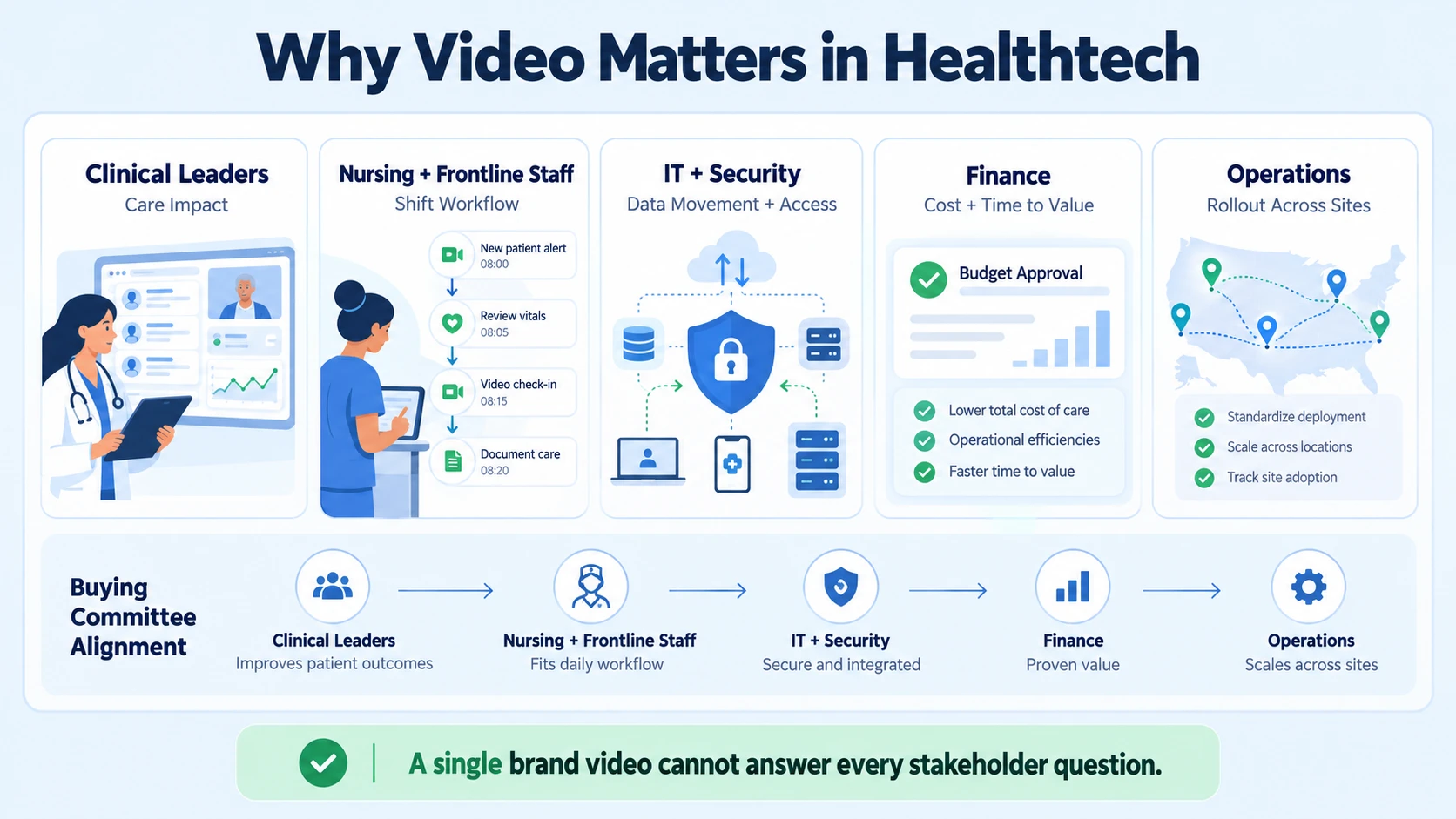
The buying committee is also large. A single health system purchase can involve clinical leaders, nursing, IT security, compliance, finance, procurement, and the frontline staff who will use the tool. The 2025 Edelman and LinkedIn B2B Thought Leadership Impact Report, based on a survey of nearly 2,000 management-level professionals, found that more than 40% of B2B deals stall because of internal misalignment within buying groups. Healthcare buying groups often face exactly that tension between clinical and administrative priorities.
At the same time, video is everywhere. Wyzowl's 2026 survey of 266 marketers found that 91% of businesses use video as a marketing tool. Simply having video does not set a healthtech company apart. Accuracy, credibility, and relevance to each stakeholder do.
Each stakeholder brings a different question to the evaluation:
- Clinical leaders ask whether the tool improves care or at least does not get in the way.
- Nursing and frontline staff ask whether it adds clicks to an already full shift.
- IT and security ask how data moves, where it is stored, and who can access it.
- Finance asks what it costs to implement and how quickly value appears.
- Operations asks how rollout will work across sites and shifts.
A single brand video cannot answer all of these. A small library of focused videos can.
The Healthtech Video Mix: What to Produce
One mistake I see repeatedly is a healthtech team investing in one polished brand film and then going quiet. Buyers need a steady flow of useful video across a long evaluation, whether built from scratch through research, scripting, recording, and editing or created from existing recordings.
There are two primary ways to build this mix. Some teams already record webinars, podcasts, and conference talks that can be repurposed. Others need complete end-to-end original video production built from scratch: researching audience needs, scripting tailored hooks, conducting or supporting recording sessions, and editing high-retention final videos. Most healthtech teams benefit from combining both approaches. If your team runs a podcast, our guide to repurposing healthtech podcast episodes covers that specific workflow.
Customer stories need extra planning in healthcare. Health systems often have communications and legal teams that must approve any vendor content featuring their staff or logo. Start that conversation early, agree on what can be said and shown, and build the approval time into your schedule. A customer story that takes three months to approve is still worth it, but only if you planned for it.
Production style matters. Healthcare audiences respond to calm, clear editing. Clean captions, lower thirds with names and credentials, and simple diagrams of a care pathway usually work better than fast effects. Production quality helps, but it cannot replace a clear point of view.
What makes a strong workflow explainer? In my experience, it starts with a moment clinicians recognize, such as a handoff at shift change or a discharge that stalls waiting on paperwork. Then it shows exactly what changes on screen and in the room. It names the safeguards and ends with one clear outcome, stated with the right context. The best healthtech video marketing feels less like an advertisement and more like a colleague showing you how they solved a problem.
Accuracy and Privacy: The Two Review Points
I am not a lawyer, and your regulatory, clinical, and privacy teams decide what applies to you. From a production view, there are two review points every healthtech video needs.
Clinical and outcome claims
Clinicians speak carefully, and their qualifiers matter. "In our pilot, for this patient group" is often what makes a statement accurate. When an editor trims for pace, those phrases disappear, and a measured observation becomes a product claim. Your clinical and regulatory reviewers should approve outcome, accuracy, and safety statements before they appear in marketing.
Practical rules we follow:
- Keep qualifiers attached to any outcome or accuracy statement.
- Add on-screen context, such as the study setting or sample, when a short video needs it.
- Avoid statements about regulatory status or future approvals unless your regulatory team has approved the wording.
- Separate a clinician's personal view from company claims.
Patient information
Clinician guests and customers naturally tell patient stories. Those stories are powerful, and they can include details that identify a person. In an HHS settlement involving a physical therapy provider that posted patient testimonials with full names and photos without valid authorizations, the HHS Office for Civil Rights stated that, with limited exceptions, the HIPAA Privacy Rule requires an individual's written authorization before protected health information is used or disclosed for marketing.
What that looks like in production:
- Brief clinicians to keep patient stories general.
- Never film or screen-record real patient data. Use demo environments.
- Get written authorization, through the process your privacy team approves, before featuring any patient.
- Check backgrounds in hospital or clinic footage for screens, whiteboards, or charts.
Accessibility deserves attention too. Many healthcare organizations have strict accessibility expectations, and clinicians often watch without sound between tasks. Accurate captions, readable on-screen text, and clean audio are baseline requirements. Medical terms and drug names need a manual caption check, since automatic transcription often gets them wrong.
Building a Video Marketing System for Healthtech
Healthtech sales cycles are long, so video needs to show up consistently over months, not in one burst. A system makes that possible.
A typical monthly rhythm might look like this:
This is an example rhythm, not a fixed package. Organizations with heavier review requirements may need a longer cycle.
What keeps the system working:
- Batch recordings. Clinicians and executives can record several topics in one session.
- Review before editing. Scripts and transcript excerpts get approved first, which avoids rebuilding finished videos.
- A medical term glossary. Drug names, conditions, and acronyms stay correct across captions.
- One owner for distribution. Someone schedules, posts, and reports every week.
- A sales clip library. Organized by stakeholder and objection.
The most common reasons healthtech video programs stall are predictable: no clear owner for distribution, late review that forces rebuilds, clinician availability, and treating every video as a separate project. Each of these is a process problem, not a creative one.
Small teams can combine the recording and scripting weeks. I would not skip clinical review, privacy checks, or the distribution owner.
Strong healthtech video marketing also plans around the healthcare calendar. Budget cycles, major conferences, and regulatory deadlines affect when buyers pay attention. Schedule implementation and planning content before budget season, and conference follow-up clips right after major events.
Distribution: Reaching Clinical and Operational Buyers
A polished video with no distribution plan is still an underused asset. Decide where each video goes before you produce it.

LinkedIn is usually the main channel for healthtech. Health system executives, clinical informatics leaders, and digital health investors are active there. Video use on the platform has grown: Digiday reported that total video viewership on LinkedIn rose 36% year over year for the period from October 30, 2024, to January 29, 2025, based on company figures.
YouTube works for workflow explainers and full webinar or podcast episodes. Searchable titles help clinicians and operators find videos long after release.
Your website should host workflow explainers, security videos, and customer stories on the pages buyers visit during evaluation.
Sales and customer success should have a clip library organized by role and objection: clinician adoption, integration, security, training, and cost. A peer clinician addressing workload concerns can be more persuasive than any case study PDF.
Conferences and associations are major moments in healthcare. Recording short interviews with customers and partners at events can also give you a library of fresh material for the months that follow. Clips featuring respected clinicians fit naturally into event follow-ups and association newsletters.
Instagram Reels can work for clinician-facing brands and founder visibility. For enterprise infrastructure products, I treat it as secondary. Our guide to short-form video for healthtech companies covers short formats in more depth, and our article on customer testimonial videos for B2B covers how to produce proof-led videos with customers.
Paid distribution can extend your best-performing organic videos to specific health systems or job titles. Prove a video organically first, then put budget behind the pieces that already earn engagement from the right roles. Check whether paid placements need separate review.
Email remains dependable. A monthly update with one explainer and two short clips keeps prospects and customers informed on a channel you control.
How to Measure What Video Is Doing for the Business
Do not judge healthtech videos only by views. A video watched by a few hundred hospital operations leaders can matter more than one with broad reach among the general public.
Attribution is hard in healthtech because sales cycles are long and committees are large. Combine platform data with a "how did you hear about us" field, sales notes, and customer success feedback. Review monthly.
Qualitative signals matter too. Notice when a prospect references a specific video in a meeting, when a clinician shares a clip with colleagues, or when sales stops answering the same security question repeatedly. These moments rarely show up in dashboards, but they are strong evidence that video is doing its job.
Over time, your video marketing data should shape what you produce next. If implementation videos are watched heavily during evaluations, make more of them. If brand-level videos collect views but never appear in deals, shift effort toward practical content.
Conclusion
Healthtech companies face a specific challenge: cautious buyers, large committees, and products that change how people work. Video is well suited to that challenge when it shows real workflows, features credible voices, and stays accurate.
The decision that matters is to run video marketing as a reviewed, repeatable system. Combine original from-scratch production (research, scripting, recording, and editing) with repurposed video, build clinical and privacy review into production, give every video a clear destination, and measure what it does for evaluations and pipeline. That is how video becomes a dependable part of how healthtech companies earn trust.
FAQ
1) What does video marketing for healthtech companies include?
It usually includes workflow explainers, clinician point-of-view videos, implementation and security videos, customer stories, short clips from webinars and podcasts, and sales follow-up videos. The mix should follow your buyers and evaluation process.
2) How much does it cost?
It depends on the model and scope. Freelancers often charge per video or per hour, subscriptions charge a flat monthly fee for editing volume, and agencies price by scope. At Komet Media, engagements typically fall in the range of about $2,500 to $5,000, depending on volume, original production needs, motion graphics, review requirements, and distribution support.
3) How long does it take to produce healthtech videos?
Editing time depends on complexity, but clinical, regulatory, and privacy review often set the timeline. Reviewing scripts and moment lists before editing usually saves time.
4) Can we feature patients in our videos?
Only with the authorizations and approvals your privacy and legal teams require. Many healthtech teams focus on clinicians and operators instead, keeping patient stories general and non-identifying.
5) Should we hire a freelancer or an agency?
A skilled freelancer can handle editing well. An agency fits better when you need strategy, scripting, original production, repurposing, review coordination, and distribution handled as one system.
6) Can our internal team handle this?
Yes, if someone has the skills and time to own production and distribution every week. Consistency usually suffers during conference season and product launches.
7) Which video should a healthtech company make first?
Start with a clear workflow explainer that shows how your product fits a real clinical or operational process. It supports sales conversations immediately and gives you a foundation for shorter clips. Once it is working, add clinician point-of-view videos and an implementation video to answer the next questions buyers usually ask.
8) How does Komet Media work with healthtech companies?
We provide end-to-end video production and strategy for healthtech teams, including original content built from scratch—handling research, scripting, recording coordination, and editing—as well as clips repurposed from existing recordings. Review steps for accuracy and privacy are built into the workflow. If you want to talk through your plans, you can book a call with our team.