
🪄 AI Summary
Heading 1
Heading 2
Heading 3
Heading 4
Heading 5
Heading 6
Lorem ipsum dolor sit amet, consectetur adipiscing elit, sed do eiusmod tempor incididunt ut labore et dolore magna aliqua. Ut enim ad minim veniam, quis nostrud exercitation ullamco laboris nisi ut aliquip ex ea commodo consequat. Duis aute irure dolor in reprehenderit in voluptate velit esse cillum dolore eu fugiat nulla pariatur.
Block quote
Ordered list
- Item 1
- Item 2
- Item 3
Unordered list
- Item A
- Item B
- Item C
Bold text
Emphasis
Superscript
Subscript
Most healthtech companies are sitting on a goldmine of product knowledge, clinical data, founder insight, and customer success stories, and converting none of it into buyer trust. That is the exact problem short-form video for healthtech companies solves. The format is fast, searchable, and credible in the hands of the right team. This guide breaks down strategy, compliance, content types, platform execution, common mistakes, and how to build a system that compounds pipeline over time.
TL;DR
- Short-form video delivers 2.5x more engagement per impression than any other content type , making it the highest-leverage format for healthtech buyer education.
- HIPAA compliance is achievable, it requires documented consent workflows and zero incidental PHI in any frame.
- The best healthtech videos explain one thing clearly in under 60 seconds: a feature, a clinical outcome, or a founder perspective.
- Repurposing webinars, demos, and podcasts into clips is the fastest path to a content library that supports pipeline.
Short-Form Video Strategy for Healthtech Startups
Most healthtech founders treat content as a nice-to-have. That is a pipeline problem. Buyers in this space, clinical leads, VP of Operations, CMOs, health system procurement teams, do research long before they take a demo. If your product isn't showing up in their feeds with clear, credible video education, a competitor is. The right strategy starts with one question: what does your buyer need to understand before they will agree to a demo? Every short-form video you produce should answer one piece of that question.
The core strategy framework:
- Map the buyer education gap: List every objection, misconception, or knowledge deficit that slows your sales cycle. These become your video topics.
- Identify your best source content: Founder talks, recorded demos, webinar clips, podcast episodes, and customer interviews are raw material. If you run regular webinars or podcasts, you already have a library.
- Define a cadence: Three to five short videos per week across platforms is the target. Quality matters more than quantity, a single high-engagement Reel can outperform a week of mediocre static posts.
- Choose a primary voice: Founder-led video builds the fastest trust in a B2B healthtech context. A clinical advisor or KOL (Key Opinion Leader) adds regulatory and scientific credibility.
- Repurpose systematically: One 45-minute webinar should yield at least 8 to 12 standalone clips. That is the content repurposing workflow that scales without scaling headcount.
A healthtech startup with no video presence is invisible during the 70% of the buyer journey that happens before your sales team gets involved. Healthcare providers and healthtech brands are using short-form video to break down complex topics and meet buyers where they spend time online, with educational Reels and Shorts explaining conditions, treatments, or product benefits in 30 to 60 seconds. For funded startups, this is the lowest-cost, highest-credibility channel to create inbound demand before your paid budget scales.
How Healthtech Companies Use TikTok and Reels Effectively
The channel question is more nuanced for healthtech than for consumer brands. Your buyer mix may include hospital procurement teams (LinkedIn-dominant), clinicians doing product research (YouTube), and digital health consumers including patients and caregivers (TikTok and Instagram Reels). Getting platform selection right matters.
Platform comparison for healthtech content:
YouTube Shorts leads engagement at 5.91% with 200 billion daily views and 2 billion monthly users, and its integration with long-form YouTube creates a unique discovery-to-depth funnel no other platform can match. For medical device marketing and wearable technology promotion, this matters: a buyer watches your 45-second Short, then clicks through to your 12-minute product walkthrough.
Instagram Reels command the highest reach rate at 30.81%, more than double that of carousels or image posts, which makes it the right channel for top-of-funnel healthtech awareness and telehealth adoption content. With 57% of Instagram users searching for health-related information and one-third of Gen Z turning to TikTok for medical advice , both platforms carry real clinical communication weight. The audience is already there. The question is whether your content is.
For B2B healthtech companies targeting health system buyers, LinkedIn anchors the paid and organic strategy. TikTok and Reels earn attention and build category awareness while LinkedIn converts it.
What Types of Short-Form Video Content Work Best for Healthtech Brands
Not all video formats perform equally for healthtech. The ones that compound trust and pipeline share three traits: they are specific, they are credible, and they answer one question completely. Here are the formats that work, in order of impact:
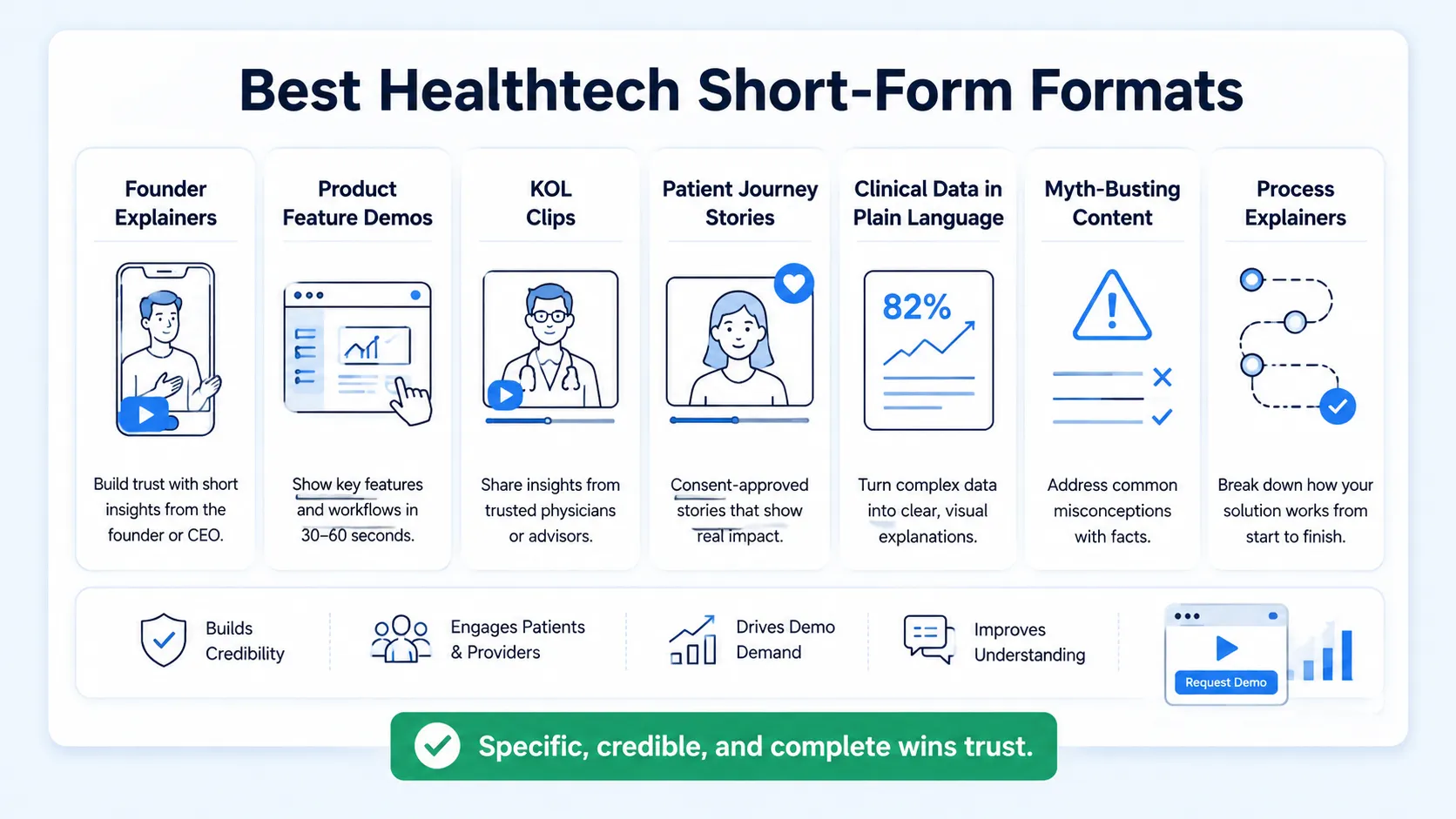
1) Founder explainers: The founder or CEO on camera answering one hard buyer question in 45 to 60 seconds. No B-roll, no production. Clinical credibility by proximity.
Example:
2) Product feature demos: Screen-recorded or live-shot walkthroughs of a single feature. The format that maps directly to demo demand and buyer education goals.
Example:
3) KOL (Key Opinion Leader) clips: A physician, clinical researcher, or recognized healthcare professional explaining the clinical rationale for your product. These anchor medical storytelling credibility.
Example:
4) Patient or user journey narratives: With proper HIPAA-compliant authorization, real user stories in 60 seconds outperform any brand-produced content on trust metrics.
Example:
5) Clinical data in plain language: A sixty-second clip of a physician answering one question on a phone is quietly outperforming expensive brand films, polish is not what wins attention anymore; clarity and a credible human face are.
Example:
6) Myth-busting and health literacy content: Short rebuttals to common misconceptions about your product category, mental health app stigma, wearable accuracy concerns, telehealth limits.
Example:
7) Process explainers: How does onboarding work? What does implementation look like for a health system? These reduce friction in the B2B healthtech sales funnel.
Example:
73% of businesses use explainer videos in their marketing strategy , and for healthtech, the explainer format directly addresses the product trust problem: buyers don't move forward on products they don't understand.
Our short-form video editing work at Komet Media consistently shows that feature-demo clips and founder POV videos generate the most qualified inbound conversations for B2B healthtech teams.
How to Explain Complex Health Technology in 60 Seconds or Less
This is the craft challenge that separates healthtech companies that win with video from those that don't. The impulse is to explain everything. The discipline is to explain one thing clearly.
The 60-second healthtech video framework (numbered for execution):
- Open with the problem, not the product (0 to 5 seconds): State the specific friction your buyer feels. "Most EHR integrations take 6 months and still break." That is your hook.
- Name the mechanism (5 to 20 seconds): How does your product solve it differently? One sentence. No jargon unless your audience uses it themselves.
- Show proof (20 to 45 seconds): A stat, a customer outcome, a live product moment. Landing pages with embedded video convert at 86% higher rates than text-only equivalents, with the effect strongest for complex products where video reduces cognitive load. The same principle applies inside the clip itself.
- Deliver the CTA (45 to 60 seconds): One action. "Book a demo," "Read the case study," "Follow for more." Not three options.
The hook is everything. 65% of viewers who watch the first three seconds will continue watching for at least 30 seconds. Your first frame is your entire ad. For health technology specifically, the language layer matters as much as the structure. Health literacy research consistently shows that consumer-facing health content performs better when written at a 6th to 8th grade reading level, with active verbs and concrete outcomes. "Reduces A1C by 1.2 points" beats "improves glycemic management" every time.
When repurposing a webinar or demo recording, clip the moment where someone explains the core mechanism, not the intro, not the Q&A small talk. That 90-second segment inside a 60-minute session is your content. Our video marketing services are built specifically around finding and shaping those moments, as well as developing original content from scratch.
Is Short-Form Video HIPAA Compliant? How to Build Trust Without Violating Privacy
The compliance question is real and it stops a lot of healthtech teams from shipping video content. Here is the actual framework. HIPAA applies when your video includes or could lead to the disclosure of Protected Health Information (PHI). Generic educational content, founder explainers, product walkthroughs, animated clinical diagrams, carries zero HIPAA risk. Patient stories, testimonials, or any footage where a real patient could be identified requires explicit documented authorization.
The HIPAA-compliant video workflow:
- Identify the content type: Is a patient identifiable in any frame, by face, voice, name, condition, or context? If yes, proceed to step 2. If not, proceed to production.
- Obtain written authorization: HIPAA requires written patient authorization before any PHI is shared for purposes beyond treatment, payment, or healthcare operations, including marketing. Verbal permission is not enough, and general consent forms do not cover public sharing.
- Specify every platform: HIPAA-compliant authorization must specify exactly what information will be shared and identify all platforms where content may appear.
- Audit your backgrounds: Photography and video content for social media marketing must be planned to avoid capturing identifiable patient information in backgrounds or waiting areas.
- Store documentation separately: Store consent documentation separately from your marketing platform, compliance audits require proof that consent existed before content was published.
The cleanest path for most healthtech marketing teams: build a library primarily from product content, founder content, KOL content, and animated explainers. Reserve patient-story formats for cases where you have airtight authorization workflows in place. Over 75% of patients report that social media posts from healthcare providers influenced their decision in choosing specific treatments or hospitals. The compliance work is worth it. The audience is paying attention.
What Mistakes Do Healthtech Companies Make with Short-Form Video?
I see the same pattern repeatedly across healthtech teams that aren't getting results from video. These are the errors to eliminate:
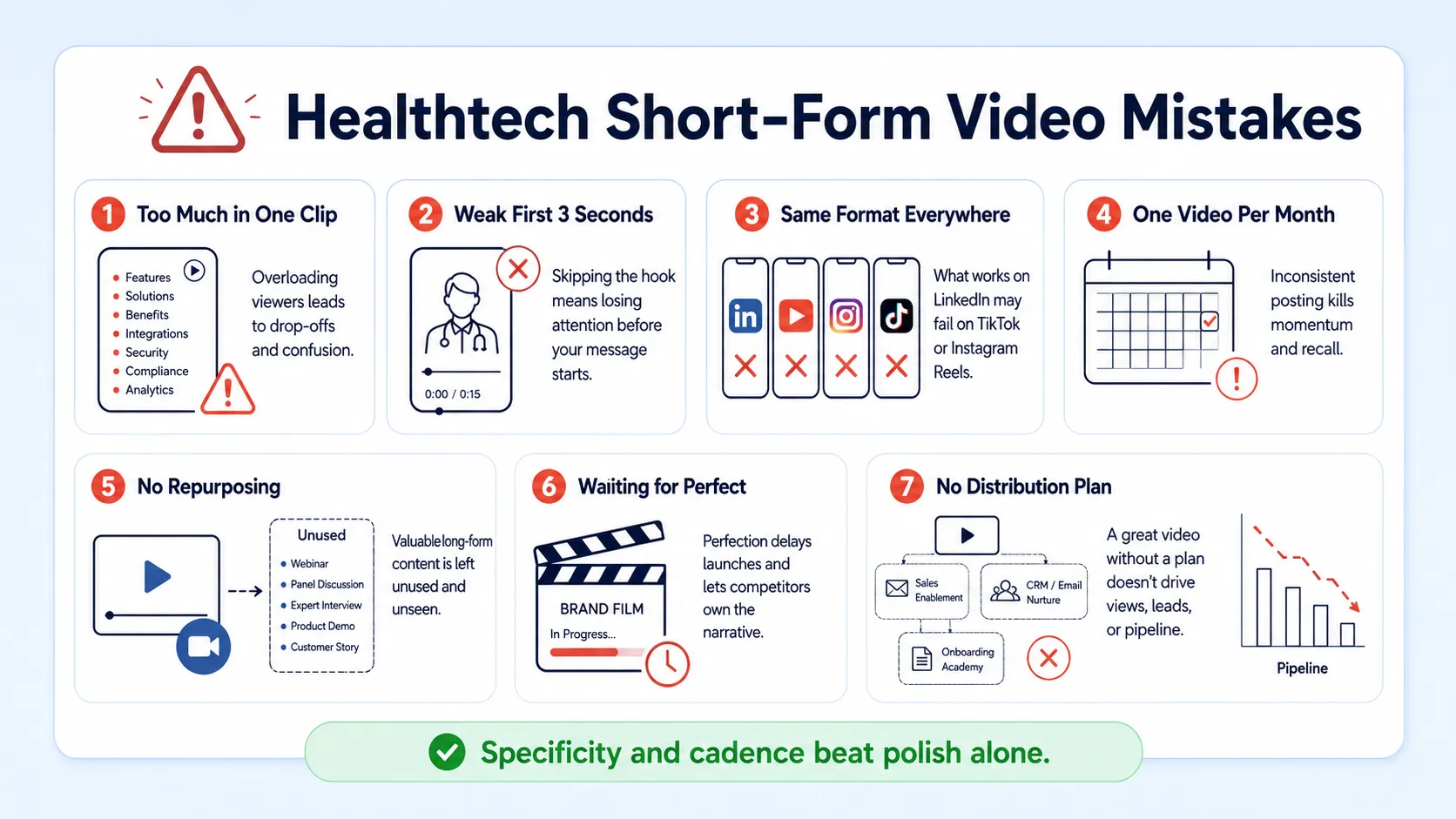
Mistake 1, Trying to explain everything in one clip: The product has 14 features. Each feature deserves its own 45-second video. Compression kills comprehension.
Mistake 2, No clear hook in the first 3 seconds: Leading with a logo animation, a title card, or a "Hi, welcome to our channel" intro is a skip. Start mid-thought, mid-problem, or mid-proof.
Mistake 3, Treating all platforms as identical: It is not the length of a video that counts, but the clarity of the format, every platform prefers specific structures, and those who understand them produce content that won't be overlooked. A LinkedIn video and a TikTok video serve different audiences with different intent.
Mistake 4, Producing one video per month: One video per month is not a content strategy. It is a content event. Algorithms reward consistent publishers. Marketers rank short-form video as the number one ROI format for the third consecutive year, and 57% of marketing budgets now include a dedicated short-form line item. Consistency is what creates that ROI.
Mistake 5, Ignoring repurposing: Most healthtech companies are recording demos, hosting webinars, and publishing long-form content already. Make the most of existing material by repurposing it into various formats, brief snippets from lengthy recordings work natively on Instagram Reels and TikTok.
Mistake 6, Waiting for production perfection: The glossy, expensive brand film is quietly losing to a sixty-second clip of a physician answering one question on a phone. Ship at 80% polish. Speed of learning beats quality of delay.
Mistake 7, No distribution strategy: Publishing and hoping is not a strategy. Omnichannel health campaigns layer organic video with paid amplification, email embed, sales enablement sequences, and LinkedIn reposts. A single short video can work across six touchpoints in your B2B healthtech sales funnel. Connect with the Komet Media team if you want a structured distribution system built around your content.
Conclusion
Short-form video for healthtech companies is not a content trend, it is infrastructure for the modern B2B sales and marketing motion. The brands building consistent, compliant, specific video libraries are building pipeline assets that compound over time.
Key takeaways:
- Build your video library from existing content: demos, webinars, podcasts, and founder conversations.
- HIPAA compliance is a workflow problem, not a creative one, solve it once, then scale confidently.
- One concept per video, one CTA per video, one platform optimized per format.
- Consistency over production value. Specificity over breadth.
Explore Komet Media's video services to build a short-form video system your sales team will actually use.
Frequently Asked Questions
1) How long should short-form videos be for healthtech brands?
The sweet spot for healthtech education is 45 to 90 seconds. Product explainers and founder POV clips perform best under 60 seconds. Clinical walkthroughs and KOL content can extend to 90 seconds without significant drop-off. Prioritize retention rate over arbitrary length targets.
2) Does short-form video work for B2B healthtech, not just direct-to-consumer health brands?
Yes. B2B marketers use short-form videos effectively to communicate product benefits or provide concise testimonials, engaging prospects without being perceived as invasive. For healthtech specifically, clips that educate clinical buyers on outcomes and implementation drive qualified demo requests.
3) Do I need a large production budget to start with short-form video?
No. AI-powered editing, scripting, voiceover, and generation tools have reduced median video production costs significantly , and the highest-performing healthcare clips are often simple, direct, and filmed on a phone. Start with founder-facing explainers, then invest in production as content proves its pipeline value.
4) How do I measure if short-form video is working for our healthtech pipeline?
Track three layers: top-of-funnel (views, saves, follows), mid-funnel (demo requests attributed to video touchpoints, CTA clicks), and bottom-of-funnel (deals where video was consumed during the sales cycle). Most teams underestimate how often short video drives a prospect to book a call via a separate channel.
5) Can we repurpose our existing webinar and podcast content into short-form videos?
Yes, and this is the fastest path to volume. A single 45-minute webinar typically yields 8 to 12 standalone clips. Podcast episodes yield 5 to 8. The key is identifying the moments where one insight is explained crisply, those are your clips.
6) What is the biggest compliance risk in healthtech video marketing?
The most common risk is incidental PHI capture, a patient name visible on a whiteboard, a chart in the background, or a recognizable face in a waiting room. Common scenarios that create compliance risks include responding to patient reviews with specific treatment information, sharing before-and-after photos without written consent, and inadvertently capturing patient information in background images or videos. Build a review checkpoint into every video before it publishes.