
🪄 AI Summary
Heading 1
Heading 2
Heading 3
Heading 4
Heading 5
Heading 6
Lorem ipsum dolor sit amet, consectetur adipiscing elit, sed do eiusmod tempor incididunt ut labore et dolore magna aliqua. Ut enim ad minim veniam, quis nostrud exercitation ullamco laboris nisi ut aliquip ex ea commodo consequat. Duis aute irure dolor in reprehenderit in voluptate velit esse cillum dolore eu fugiat nulla pariatur.
Block quote
Ordered list
- Item 1
- Item 2
- Item 3
Unordered list
- Item A
- Item B
- Item C
Bold text
Emphasis
Superscript
Subscript
Healthtech companies often record excellent podcast conversations with clinicians, operators, and health system leaders. Then the episode goes out, a few hundred people listen, and the insight disappears. Podcast repurposing turns those conversations into clips and assets that reach the full buying committee. In healthcare, though, the stakes are higher. A trimmed sentence about outcomes can overstate evidence, and a casual patient story can create a privacy problem. This guide covers how I approach selection, editing, privacy, and distribution for healthtech shows, as well as how we complement repurposing with original video and content creation from scratch.
Quick Answer
Podcast repurposing for healthtech means turning each episode into clips, posts, and sales assets for clinical and operational buyers. It works when claims stay accurate, patient information is protected, and every clip has a clear audience. Beyond repurposing, brands can also leverage original video and content creation from scratch to fill strategic content gaps.
Why Healthtech Buyers Respond to Podcast Content
Healthtech sales cycles involve many people. A single deal can include a CMIO, a nursing leader, IT security, finance, procurement, and the operational team that will use the product every day. Each of them has a different question, and very few of them have time for a sales deck.
A good podcast episode answers those questions in the voice of someone they trust. A practicing physician explaining how a workflow tool changed shift handoffs carries more weight than a product page. The challenge is that most of the buying committee will never hear the full episode.
The format itself has broad reach. The Infinite Dial 2026 from Edison Research at SSRS, based on a national survey of 2,050 people aged 12 and older, found that 80% of Americans have ever listened to or watched a podcast. It also found that 57% have both listened to and watched one. These are general population figures, not healthcare-specific data, but they show that video clips from podcasts are now a familiar way for people to consume expert conversations.
The B2B case is about trust. The 2025 Edelman and LinkedIn B2B Thought Leadership Impact Report reported that more than 40% of B2B deals stall because of internal misalignment within buying groups. In healthcare, that misalignment often sits between clinical and administrative stakeholders. Short clips that speak to each group's concerns can help close that gap.
This is why I treat podcast repurposing as a trust and sales function, not a social media task. The useful question is not how many clips you can post. It is which buyer questions each episode answers, and who needs to hear each answer.
The Two Risks That Make Healthtech Different
I have seen strong healthtech interviews produce clips the team could not publish. Almost every time, the cause was one of two risks that nobody planned for before recording.
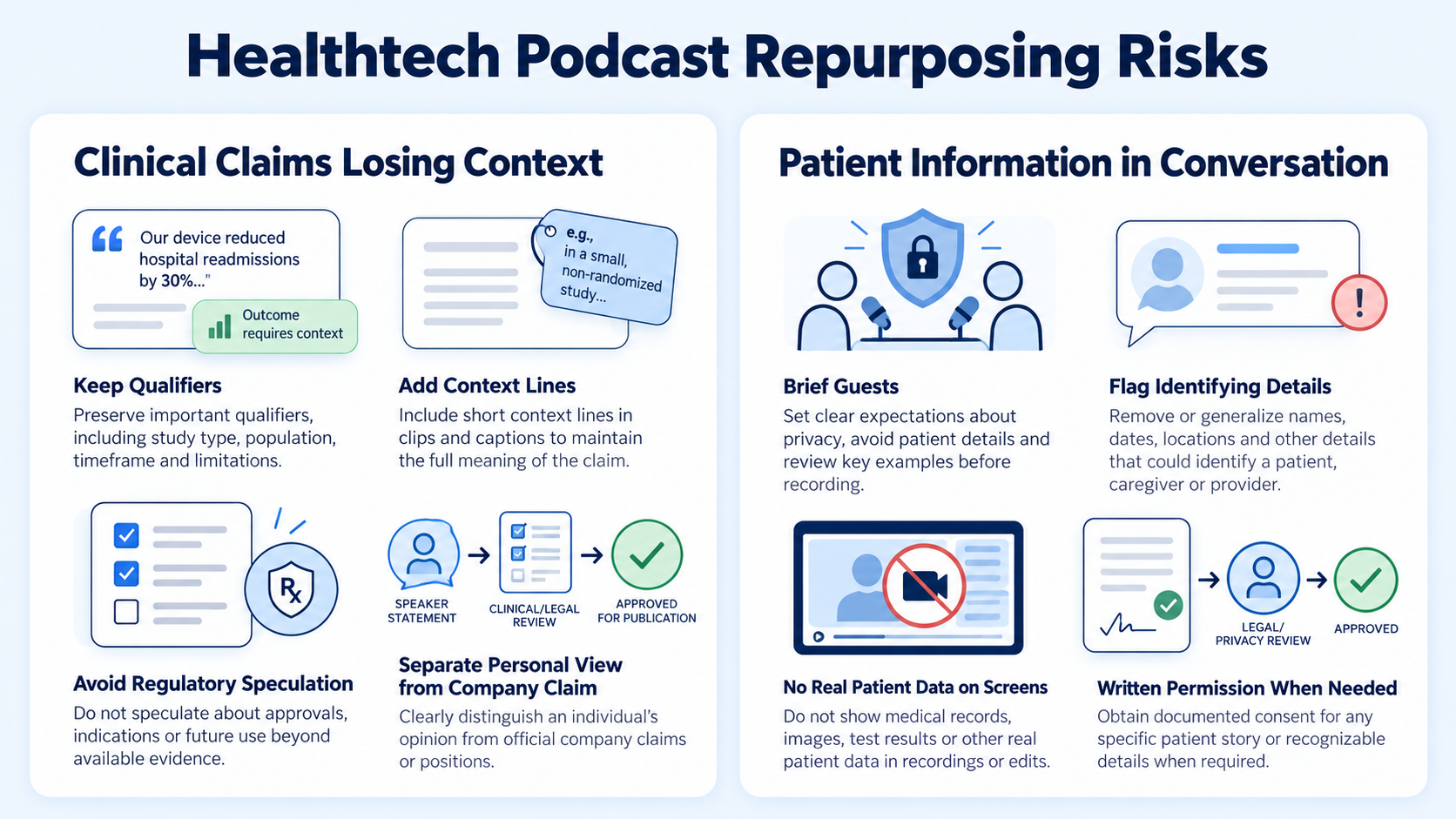
Risk one: clinical claims that lose their context
Clinicians speak carefully, and their qualifiers matter. "In our early pilot" or "for this patient population" is often what makes a statement accurate. When an editor trims for pace, those phrases are the first to go.
A clip that says "this cut readmissions" without the surrounding context can read as a product claim the company cannot support. Your medical, clinical, and regulatory reviewers should decide which outcome statements can appear in marketing. My job as a producer is to make sure they see those statements before the clip is built, not after.
Practical rules we follow:
- Keep qualifiers attached to any outcome, accuracy, or safety statement.
- Add an on-screen context line when a short clip needs it, such as the study setting or sample.
- Avoid clips where a guest speculates about regulatory status or future approvals.
- Separate a clinician's personal view from company claims, and label it clearly if needed.
Risk two: patient information in conversation
Clinician guests naturally tell stories about patients. Those stories are often the most memorable part of an episode. They can also contain details that identify a person, even without a name.
If your company is a HIPAA covered entity or business associate, this matters a great deal. In an HHS settlement involving a physical therapy provider that posted patient testimonials with full names and photos without valid authorizations, the HHS Office for Civil Rights stated that, with limited exceptions, the HIPAA Privacy Rule requires an individual's written authorization before protected health information is used or disclosed for marketing. I am not a lawyer, and your privacy team should decide how this applies to you. From a production view, the lesson is to treat patient details as a review item every time.
What that looks like in practice:
- Brief clinician guests before recording to keep patient stories general.
- Flag any mention of dates, locations, rare conditions, or other details that could identify someone.
- Never use product screen recordings that show real patient data.
- Get written permission from any patient guest, through the process your privacy team approves.
A Podcast Repurposing Workflow for Healthtech Teams
Most podcast repurposing fails before editing starts. The team has not decided who each episode is for or what a clip is allowed to say. A clear workflow solves both problems.
This is the cycle I recommend:
- Set the audience for the episode. Is it for health system executives, frontline clinicians, payers, or digital health buyers?
- Brief the guest. Explain where clips will appear, ask them to keep patient details general, and confirm what they can say about their organization.
- Record clean audio and video. Good source files make every later step faster.
- Create a timestamped transcript. This is the shared working document for producers and reviewers.
- Mark and score moments. I score on clarity, buyer value, whether the clip stands alone, and review risk.
- Send the moment list for clinical and privacy review. Resolve concerns before editing.
- Edit the master episode. Remove identifying details if the review asked for it.
- Cut the clips. Add accurate captions, a clear opening line, and any context lines.
- Adapt for each platform. Change length, aspect ratio, and caption style by channel.
- Final check and archive. Confirm spelling of medical terms, credentials, and approvals.
- Schedule distribution and review performance.
Small teams can merge steps 4 and 5 and use one export template for all short platforms. I would not skip the guest brief, the review of the moment list, or the final check. In healthtech, those steps protect your credibility.
Captions deserve extra care. Medical terms, drug names, and acronyms are easy for automatic transcription to get wrong. A misspelled clinical term in a caption tells a physician that nobody checked the work.
Here is what one strong 40-minute episode can usually become:
These are planning ranges, not guarantees. A sharp, specific guest produces more usable moments than a general conversation. For a deeper look at clip volume, see our breakdown of how many clips you can get from one podcast.
Choosing the Right Moments for Clinical and Operational Buyers
The best moment in a healthtech episode is rarely the most emotional one. It is usually the clearest answer to a question a buyer is already asking.
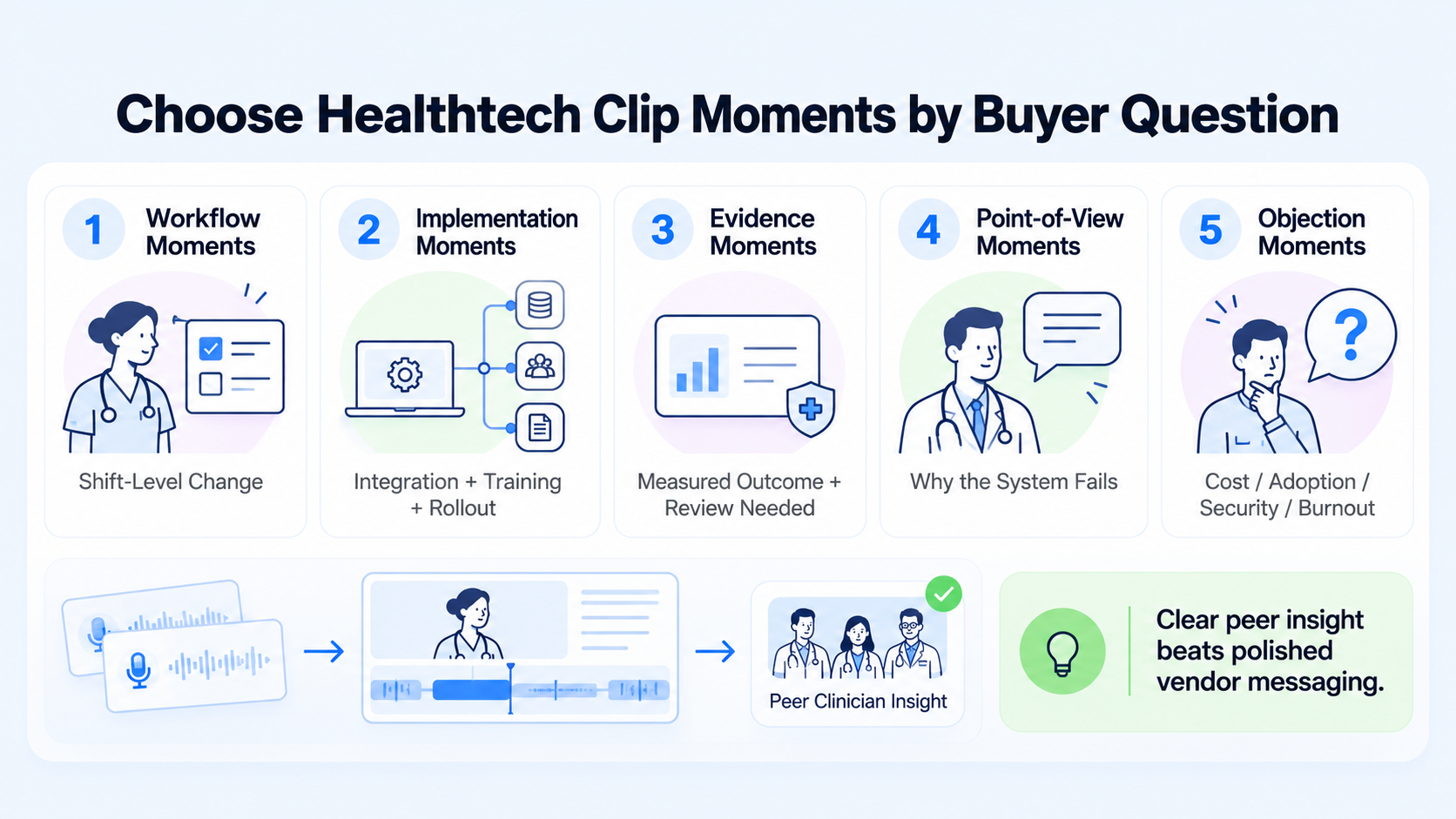
I sort moments into a few buckets:
- Workflow moments. A nurse leader explaining what actually changes during a shift. These work well for frontline and operational audiences.
- Implementation moments. An IT or operations leader describing integration, training, or rollout. These answer the quiet fears that stall deals.
- Evidence moments. A clinician explaining what they measured and how. These need the most careful review.
- Point-of-view moments. A founder or medical director explaining why the current system fails patients or staff. These build authority.
- Objection moments. Any time a guest addresses cost, adoption, security, or clinician burnout directly.
One mistake I see repeatedly is building every clip around the founder. Founder clips matter, but healthcare buyers often trust peers more than vendors. A respected clinician guest saying something specific can carry more weight than a polished company message.
Visual treatment matters too. Healthcare audiences tend to respond to calm, clear editing. Clean cuts, readable captions, and simple lower thirds with name and credential work better than fast effects. Production quality helps, but it cannot replace a clear point of view.
Some healthtech products are hard to picture from a conversation alone. A simple animated diagram of a data flow or care pathway can make a clip easier to follow. Keep it restrained, and ask your clinical team to confirm the diagram reflects how the product actually works.
Distribution: Getting Clips in Front of Healthcare Decision-Makers
A polished clip with no distribution plan is still an underused asset. Decide where each clip goes before you cut it.
LinkedIn is usually the main channel for healthtech. Health system executives, clinical informatics leaders, and digital health investors are active there. LinkedIn has also leaned into video: Digiday reported that total video viewership on LinkedIn grew 36% year over year for the period from October 30, 2024, to January 29, 2025, based on company figures. Our guide to short-form video for healthtech companies goes deeper on formats.
YouTube gives full episodes a long shelf life. YouTube reported more than 1 billion monthly active viewers of podcast content as of January 2025. That is a platform-wide figure, not healthcare data, but it means your full episodes can live where many people already look for long conversations.
Instagram Reels can work for clinician-facing brands, recruiting, and founder visibility. It is less useful for enterprise infrastructure products unless the founder is building a personal audience.
Sales and customer success should have a clip library organized by objection and role. A 60-second clip of a peer clinician addressing adoption concerns can be a stronger follow-up than another case study PDF.
Email is underrated for healthtech. A monthly newsletter with two or three clips and a short written takeaway gives busy executives an easy way to keep up with the show. It is also a channel you control, which matters when social reach changes without warning.
Guests and their institutions are often your best amplifiers. Send guests their clips with suggested captions. Check whether their organization's communications team needs to approve the post first, since many hospitals have their own review rules.
How to Measure Results Without Chasing Vanity Metrics
Do not judge every clip only by views. A clip watched by 600 hospital operations leaders may matter more than one with far larger reach from the wrong audience.
Attribution in healthtech is messy because sales cycles are long. A buyer may see clips for months before a formal evaluation starts. Ask sales to log when prospects mention the podcast, and add a "how did you hear about us" field to your demo form.
Review performance monthly. Look for patterns in topics, guest types, and opening lines, then use them to plan future episodes.
Over time, podcast repurposing should change how you record. If clips about implementation consistently outperform clips about vision, book more guests who can speak to rollout. Prepare questions that draw out specific, short answers. The episode and the clips then improve together.
Conclusion
Healthtech teams already have something many B2B companies lack: credible voices with real clinical and operational experience. The opportunity is to make sure those voices reach every person involved in a buying decision, not just the people who press play on a full episode.
The decision that matters most is to treat podcast repurposing as a reviewed, repeatable system. Plan for accuracy and privacy before recording, select moments by buyer question, and give every clip a destination. That is how one conversation keeps earning trust for weeks.
FAQ
What is podcast repurposing in healthtech?
It is the process of turning podcast episodes into shorter assets such as clips, carousels, show notes, and sales follow-up videos. In healthtech, it also means checking clinical statements for accuracy and protecting patient information throughout the process.
How much does it cost?
Freelancers usually charge per clip or per hour, subscription services charge a flat monthly fee for editing volume, and agencies price by scope. At Komet Media, engagements typically fall in the range of about $2,500 to $5,000, depending on episode volume, clip count, review needs, motion graphics, and distribution support.
How long does it take to turn an episode into clips?
Editing is rarely the slowest part. Clinical and privacy reviews often set the timeline. Teams that review a list of selected moments before editing usually move faster than teams that review finished clips.
What deliverables should we expect from one episode?
A typical plan includes the edited full episode, several short clips, one or two sales-ready clips, quote cards or carousels, and show notes. The right mix depends on your buyers and channels.
Should we hire a freelancer or an agency?
A skilled freelancer can handle editing well at low volume. An agency is usually a better fit when you need moment selection, review coordination, platform adaptation, and distribution handled together. Ask any partner how they handle accuracy checks and patient privacy, not just how their edits look.
Can our internal team do this instead?
Yes, if someone owns the work every week and has editing skills. The common risk is consistency. Internal teams often pause when a conference, launch, or funding round takes priority.
Do clinician guests need to approve their clips?
It is good practice to let guests review clips that feature them, and some health systems require their communications teams to approve external content. Agree on this before recording so approvals do not delay publishing.
How does Komet Media work with healthtech brands?
We handle moment selection, editing, captions, platform adaptation, and distribution support, with review steps for accuracy and privacy built into the workflow. In addition to repurposing existing podcast episodes, we specialize in creating original video and content from scratch, or helping you launch a new podcast if you do not have one yet. If you want to discuss your show or content strategy, you can book a call with our team.