
🪄 AI Summary
Heading 1
Heading 2
Heading 3
Heading 4
Heading 5
Heading 6
Lorem ipsum dolor sit amet, consectetur adipiscing elit, sed do eiusmod tempor incididunt ut labore et dolore magna aliqua. Ut enim ad minim veniam, quis nostrud exercitation ullamco laboris nisi ut aliquip ex ea commodo consequat. Duis aute irure dolor in reprehenderit in voluptate velit esse cillum dolore eu fugiat nulla pariatur.
Block quote
Ordered list
- Item 1
- Item 2
- Item 3
Unordered list
- Item A
- Item B
- Item C
Bold text
Emphasis
Superscript
Subscript
Most founders know LinkedIn video matters. Yet their videos still get buried. The LinkedIn video mistakes founders make in 2026 aren't about production quality, they're about strategy: wrong format, weak hooks, no captions, and posting from the wrong account. LinkedIn hit 154 billion video views in 2024, with video impressions rising 73% year-over-year heading into 2026. The opportunity is real. The waste is avoidable. Here is exactly where founders break it, and what to do instead.
TL;DR
- Most founder videos fail before the first 3 seconds due to weak hooks and no captions.
- Posting a YouTube link instead of a native upload is a silent reach killer.
- Your personal profile outperforms your company page by a wide margin, post there.
- Video length, call to action, and consistency are the three most fixable gaps right now.
What LinkedIn Video Mistakes Are Founders Making Most in 2026?
I work with B2B founders and SaaS teams every day at Komet Media, and the same patterns show up constantly. The LinkedIn video mistakes founders make in 2026 are not random, they cluster around a handful of decisions that compound against you. Here are the seven most common:
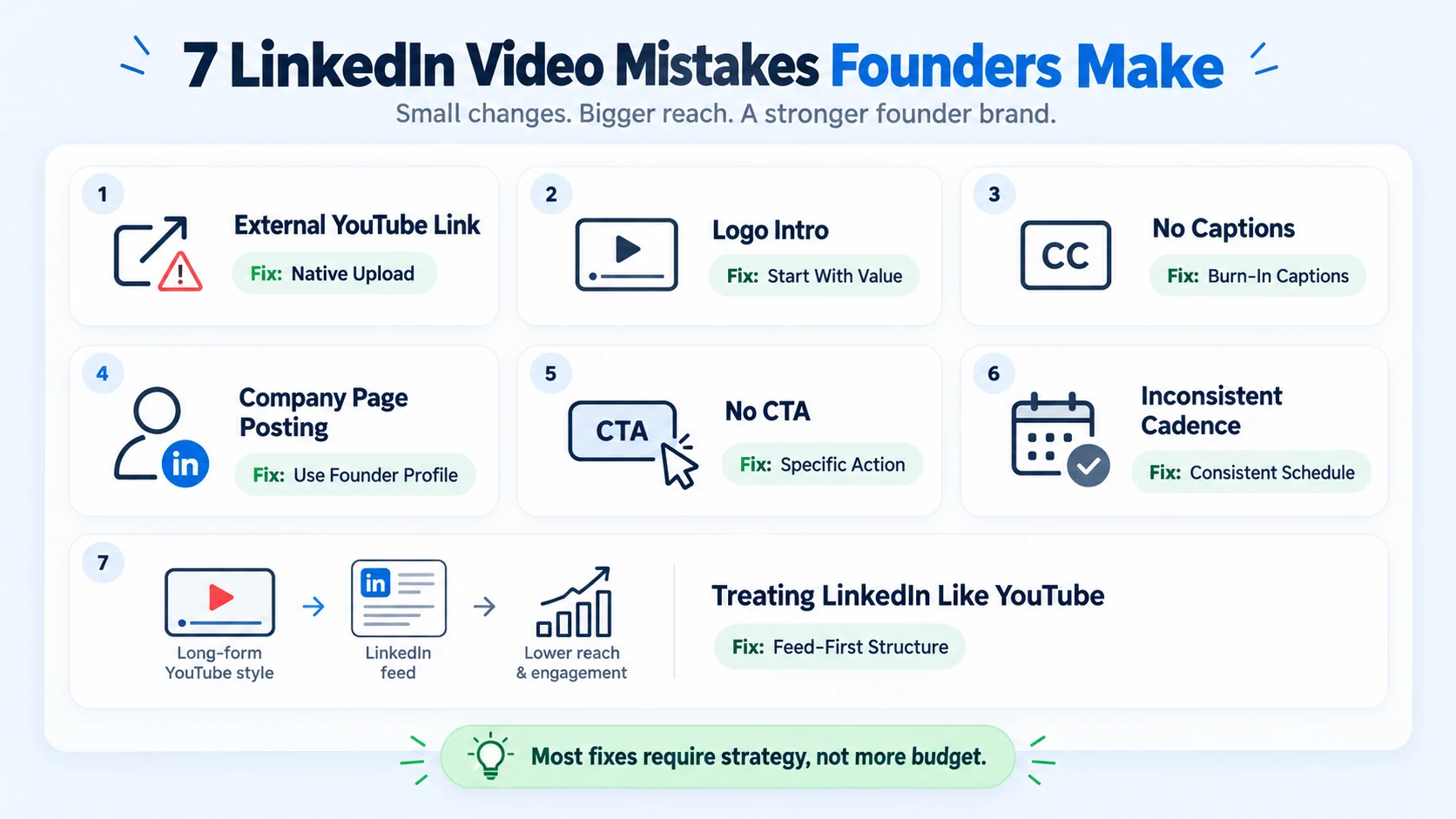
- Posting a YouTube link instead of a native upload: The LinkedIn algorithm actively suppresses external links. Native uploads are viewed roughly 52% longer than the same clip posted as a link, with about 42% more visibility on top.
- Opening with a logo or "Hi, I'm [name]" intro: This kills retention before the algorithm even decides who to show the video to.
- No captions: 80% of LinkedIn viewers watch with sound off, your hook must work visually and textually before it works verbally.
- Posting from the company page instead of your personal profile: Personal profiles generate 8x more engagement than company pages posting identical content.
- No clear call to action: Ending a video with "hope that helps" is not a CTA.
- Inconsistent posting cadence: Sporadic posting builds zero algorithmic authority.
- Treating LinkedIn like YouTube: Long talking-head videos with no structure, no captions, and no scroll-stopping content design fail on every signal the algorithm measures.
Most of these mistakes are free to fix. They require a decision, not a budget.
The good news: every single one of these is correctable in the next video you record. The sections below break each cluster into specific, actionable fixes.
Why Is My LinkedIn Video Getting No Views as a Founder?
The most likely answer: you posted a link, skipped captions, or buried the value. Let's address each directly.
The link penalty is real and immediate. LinkedIn's 2026 algorithm changes now reward vertical video and punish outbound links. When you paste a YouTube URL into a post, LinkedIn treats that as you trying to pull users off-platform. When you prioritize native video, LinkedIn rewards you with better organic reach. Pasting a YouTube link is essentially telling LinkedIn you want to send people away, which almost always leads to the algorithm burying your post.
You have three seconds. Retention drops from 68% at the 3-second mark to 22% at 15 seconds on average, the algorithm assumes viewers abandoned because they saw no value immediately. If your video opens with a logo animation, a soft "Hey everyone," or a slow pan of your office, those three seconds are gone.
Captions are not optional. Native videos with captions can boost reach by 112%. Add them. Every time. Even if you think your audio is clear.
You are posting from the wrong account. Organic reach for company pages has declined sharply, Wave Connect's 2026 analysis puts company page organic reach at approximately 2%, down from 7% in previous years. Founder-led content on a personal profile is not a nice-to-have. It is your primary distribution channel.
Fix these four things, and views will move before you change anything else about your content.
How Should Founders Post Videos on LinkedIn in 2026?
The format and upload method matter as much as the content. Here is the correct posting process:
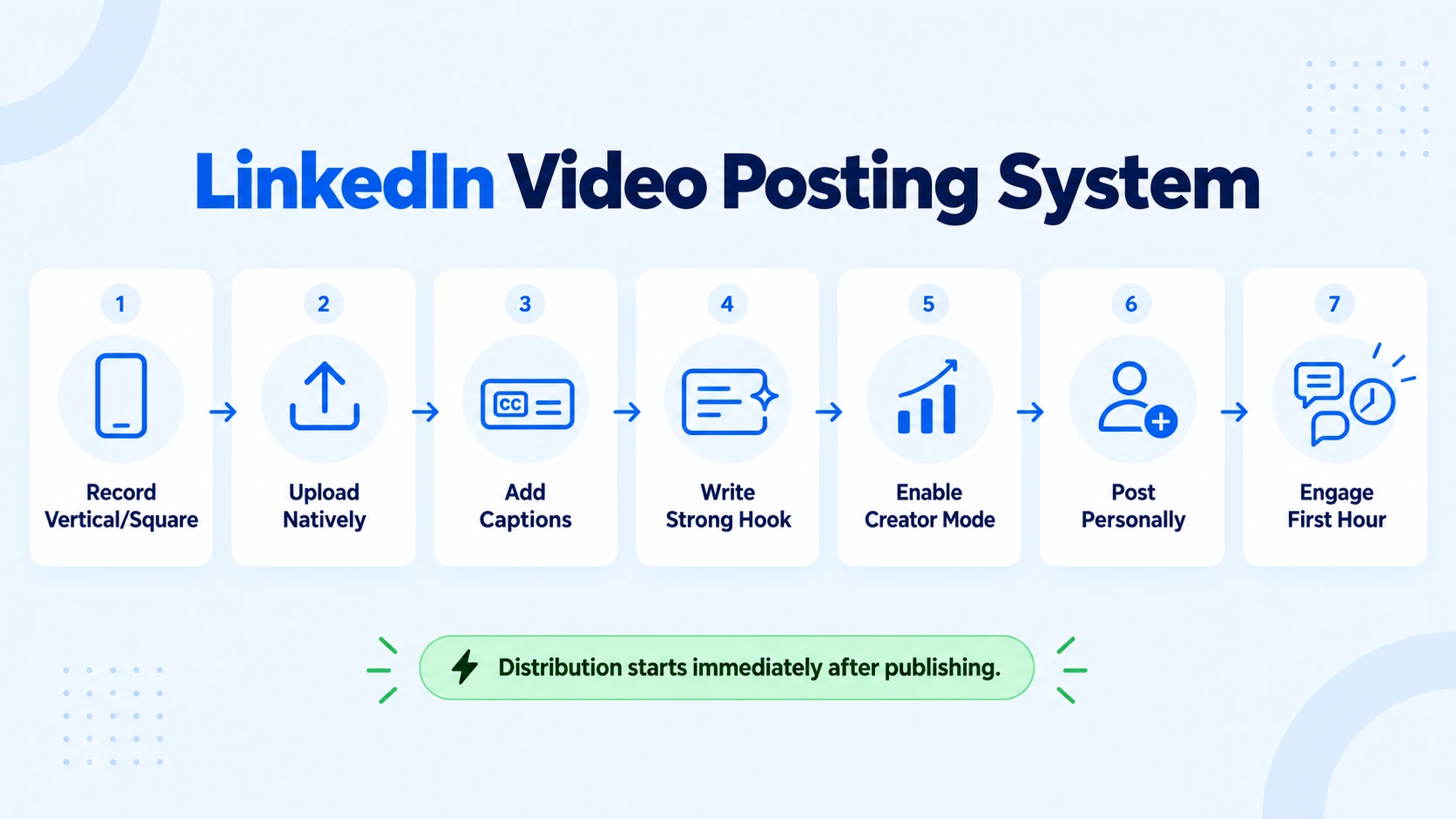
- Record in vertical or square format: The 2026 algorithm prioritizes a dedicated vertical video lane (9:16 aspect ratio) that sits above text posts in the feed. Square (1:1) also performs well for desktop/mobile balance.
- Upload natively: When you upload a video directly onto LinkedIn instead of linking from another platform, the LinkedIn algorithm often rewards native content with higher visibility.
- Add burned-in captions: Do not rely on auto-generated captions alone. Burn them in during editing or upload a synced .SRT file.
- Write a strong caption with a hook in the first line: The first line of your post text is the only line visible before "see more", treat it like a subject line.
- Enable LinkedIn Creator Mode: This activates video distribution features and unlocks LinkedIn Analytics for deeper performance data.
- Post from your personal profile: Personal posts from founders, executives, and individual creators continue to reach significantly larger portions of their networks than company page posts.
- Engage in the first 60 minutes: Reply to every comment in that first hour, your response counts as engagement too. Early velocity tells the algorithm this content is worth distributing further.
This is the exact sequence I walk through with Komet Media's short-form video production clients. Get the structure right first. The content compounds on top of it.
What Makes a LinkedIn Founder Video Fail to Get Engagement?
Engagement failure almost always comes from one of three root causes: a broken hook, a missing caption strategy, or an absent call to action. Here is how to diagnose each.
Broken hook: LinkedIn's internal data shows that 60% of viewers decide to continue watching within the first 3 seconds, that is your critical threshold. If your hook fails here, the video is dead even if the content is gold. Hook formats that work for B2B founders include a counterintuitive claim ("Most SaaS demos lose the deal in the first 90 seconds"), a direct problem statement ("Here is why your pipeline stalled this quarter"), or a specific data point that creates curiosity.
No caption strategy: Captions are not just an accessibility feature. Captions drive a 3.2% engagement rate lift, and videos with captions see 30–50% higher engagement. This is a distribution lever, not a polish item.
Weak or absent CTA: Most founder videos end with no instruction. Specific CTAs significantly outperform generic ones, a specific comment prompt drives 6x more comments than a generic "like and share," and every comment is an engagement signal. Tell your audience exactly what to do: comment a word, tag someone, or save the post.
Authentic storytelling matters more than polish: A 2025 Sprout Social study found that 72% of B2B decision-makers trust professionals with an active thought leadership presence more than company marketing alone. A shaky talking-head video where you deliver a real insight will outperform a slick corporate production with no perspective every time.
LinkedIn Video Best Practices for Startup Founders in 2026
Here is what the data says works, organized by the variables founders can control:
Video length by content type:
The sweet spot for maximum retention on LinkedIn is between 30 seconds and 90 seconds for most content types, videos in this range consistently achieve completion rates above 60%. However, data from MagicPost's 2026 analysis shows the 1–5 minute range earns the highest median likes (45–48 vs. 26 for under 30 seconds), making it the stronger format for thought leadership.
Posting cadence: Three times per week is the optimal cadence for most founders, consistency beats frequency, and three high-quality posts per week for 60 days builds more algorithmic authority than daily posting for two weeks.
Content creation & repurposing: Whether creating videos completely from scratch or leveraging existing media, Komet Media's video editing system handles both. It can turn a single webinar, podcast episode, or demo into five to eight short clips, each with a different hook, format, and angle. 78% of B2B buyers prefer a message delivered via video compared to just 9% via text, which means your existing long-form content is already sitting on an untapped distribution asset.
Custom thumbnail: Video posts with a custom thumbnail drive 24% more engagement than those using auto-generated frames. Set one every time.
How to Use LinkedIn Analytics to Fix Underperforming Videos
Most founders post and forget. LinkedIn Analytics inside Creator Mode gives you the exact data to improve every next video. Here is how to read it:
Metrics that matter for founder-led content:
- Retention rate at 3 seconds: Check your analytics for 3-second retention rates, good hooks maintain 40%+ retention at the 3-second mark. Below that, rewrite the opening.
- Watch time vs. impressions: High impressions with low watch time means your thumbnail or caption is attracting the wrong audience, or your hook is not delivering on the promise of the post text.
- Profile visits from video: If your video doesn't drive profile visits, it won't generate leads, track this metric consistently. Profile visits are the bridge between content and pipeline.
- Engagement rate by impressions: In 2026, LinkedIn's engagement rate stands at an average of 5.20%, registering an 8% year-over-year increase. Video at 5.60% beats that average, if yours is below 3%, the content-audience fit needs work.
Use LinkedIn Analytics data alongside Sales Navigator to close the loop between content performance and buyer behavior. If your top-viewed videos are reaching VPs of Marketing but your ICP is VP of Sales, your topic selection needs to shift. Video analytics is a targeting tool, not just a vanity metric dashboard.
Are Founders Using LinkedIn Video Wrong in 2026?
Broadly, yes. The LinkedIn video mistakes founders make in 2026 are mostly strategic, not technical. The cameras are fine. The distribution system is broken. The deepest strategic error: treating LinkedIn video as brand awareness instead of as a pipeline asset. According to LinkedIn Marketing Solutions, 4 out of 5 LinkedIn members drive business decisions at their organizations. That means every video a founder posts is seen by people who can buy, refer, or partner. Treating that surface casually is a costly miss.
The second strategic error: posting once, seeing modest numbers, and concluding "video doesn't work for us." In Q4 2025, LinkedIn confirmed three consecutive quarters of double-digit video upload growth, with uploads rising 20% year-over-year. The platform is rewarding consistent video creators, not one-time experiments.
The founders who are winning at founder-led content in 2026 do three things differently. They post from their personal profile. They repurpose existing conversations, podcasts, webinars, demos, panels, into short clips with sharp hooks. And they treat the first 60 minutes after posting as a live engagement window, not a passive wait. That combination of system and consistency is what separates visible founders from invisible ones.
Conclusion
The LinkedIn video mistakes founders make in 2026 are fixable. Here is the short list:
- Upload natively every time, no YouTube links in the post body.
- Hook in 3 seconds, caption every video, end with a specific CTA.
- Post from your personal profile, not the company page.
- Produce content from scratch or repurpose existing long-form material into short clips.
- Use LinkedIn Analytics to track 3-second retention and profile visits, not just likes.
If you want to build this as a system rather than a one-off effort, Komet Media's video growth services are built exactly for this.
Frequently Asked Questions
Q1: How long should a founder's LinkedIn video be in 2026?
For thought leadership and organic feed content, 60–90 seconds is the most reliable range. For organic B2B content, 60 to 90 seconds is consistently the most effective duration, long enough to make a substantive point and short enough to hold attention. Longer clips (1–5 minutes) perform well for product demos and deep-dive topics with a warm audience.
Q2: Should founders post videos from a personal profile or company page?
Personal profile, always. Wave Connect's 2026 analysis puts company page organic reach at approximately 2%, down from 7% in previous years, while personal profile posts from founders consistently reach larger portions of their network. The data is not close.
Q3: Does posting a YouTube link instead of uploading natively hurt your reach?
Yes, significantly. Native video uploads outperform links by approximately 52% in watch time and receive about 42% more visibility on LinkedIn. Always upload the video file directly. If you want to share the YouTube link, put it in the first comment.
Q4: What is the single most important fix for a LinkedIn video with no views?
Fix the hook. Retention dropped from 68% at the 3-second mark to 22% at 15 seconds on average, the algorithm assumes viewers abandoned if they didn't see value immediately. Rewrite your opening line so it states a problem, makes a bold claim, or poses a question that your specific buyer cares about.
Q5: How often should founders post videos on LinkedIn?
Three times per week is the optimal cadence for most founders. Consistency beats frequency, three high-quality posts per week for 60 days builds more algorithmic authority than daily posting for two weeks. Batch your recording sessions to protect your calendar.
Q6: Can repurposed content (webinars, podcasts) work as a LinkedIn video?
Yes, and it is a highly efficient content system for busy founders. In addition to creating videos from scratch, a single 45-minute webinar or podcast can yield 6–8 short clips, each with a different hook and topic angle. Video with a real person on camera cuts through buyer skepticism in a way text cannot, 78% of B2B buyers prefer a message delivered via video compared to just 9% via text. Your existing conversations are an untapped asset.