
🪄 AI Summary
Heading 1
Heading 2
Heading 3
Heading 4
Heading 5
Heading 6
Lorem ipsum dolor sit amet, consectetur adipiscing elit, sed do eiusmod tempor incididunt ut labore et dolore magna aliqua. Ut enim ad minim veniam, quis nostrud exercitation ullamco laboris nisi ut aliquip ex ea commodo consequat. Duis aute irure dolor in reprehenderit in voluptate velit esse cillum dolore eu fugiat nulla pariatur.
Block quote
Ordered list
- Item 1
- Item 2
- Item 3
Unordered list
- Item A
- Item B
- Item C
Bold text
Emphasis
Superscript
Subscript
Most SaaS product pages are one video away from a meaningful pipeline lift. The problem is that most teams either skip video entirely or produce content that walks through features no one asked about. This guide breaks down the best SaaS product video examples that convert, what makes each format work, and the structure your team can copy right now. I'm Rajan Soni, founder and Video Director at Komet Media. Here is exactly what I see working in 2026.
TL;DR
- Landing pages with embedded video convert at 86% higher rates than text-only pages, with the effect strongest for complex B2B SaaS products.
- The highest-converting videos lead with the buyer's problem, not the product's features.
- Short-form clips (60-90 seconds) work at the top of the funnel; 2-3 minutes works for mid-funnel demo pages.
- Every format below is a proven SaaS product video example that converts when structure and context are right.
What Makes SaaS Product Video Examples That Convert Actually Work?
The difference between a video that converts and one that doesn't comes down to one decision made in the first line of the script: do you open with your product or your buyer's problem? Most SaaS demo videos fail. They open with a logo animation, walk through a list of features nobody asked about, and end with a generic "get started today" slide. The viewer clicks away in 15 seconds. Every example worth studying makes the opposite choice.
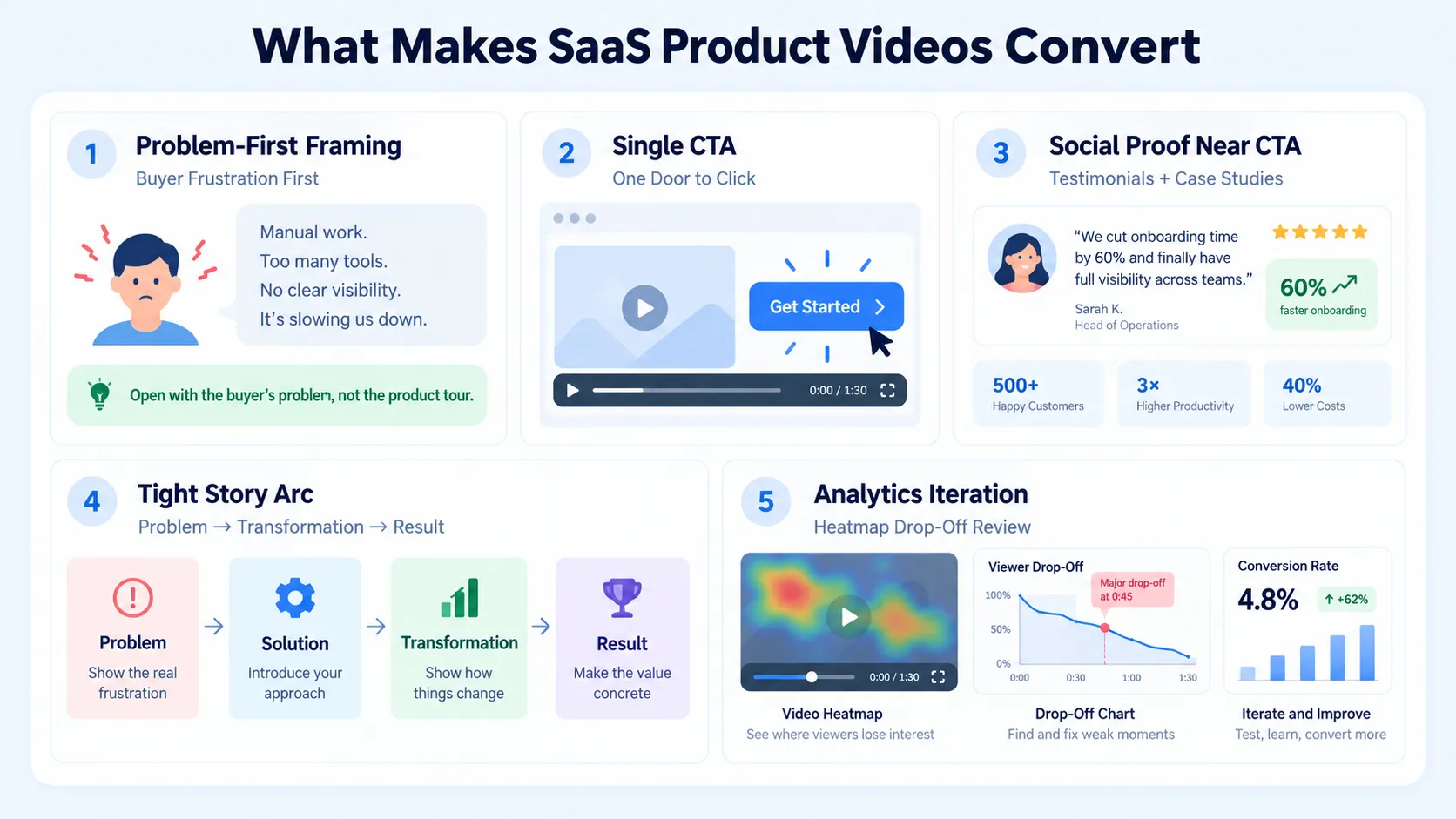
Here is what the data and the best-performing videos have in common:
- Problem-first framing: Open with the specific frustration your buyer lives with every day. Not "our platform does X" but "you're losing 4 hours a week to Y."
- A single, clear CTA: Don't ask viewers to follow you on social media and sign up simultaneously. Give them one door: "Start Your 14-Day Free Trial" or "Book a Demo."
- Social proof woven in: Adding social proof near CTAs, such as testimonials or case studies, can improve conversions by 15-25%, while video testimonials near CTAs drive an 80% lift.
- A tight storytelling framework: Problem, before-state, transformation, results. Four beats. No padding.
- Analytics-driven iteration: Use heatmaps to see where users drop off. If 80% leave at 30 seconds, your script is failing there.
According to Wyzowl's 2026 Video Marketing Report, 91% of businesses now use video as a marketing tool, and 87% of buyers say a demo video convinced them to purchase a product. The baseline is set. The only variable left is execution. The strongest performing SaaS product video examples that convert share one more trait: they are built for a specific funnel stage, not as a generic "about us" clip. An awareness video and a trial-activation video are different products. Treating them the same is where most B2B SaaS and AI startup teams leave pipelines on the table.
Real SaaS Product Video Examples That Increased Signups and Trial Conversions
These examples are worth studying because each solves a specific conversion problem.
Dropbox's homepage screencast: Dropbox used a 3-minute screencast demo on their homepage that drove 75,000 signups overnight and lifted conversions by 10% on a page already generating thousands of daily signups. The video was not polished. It was founder-led, conversational, and showed exactly what would happen after you signed up. That specificity is the conversion driver.
Figma's Config demo: Figma's Config 2025 demo video skips the usual voiceover and lets the product speak for itself with clear, in-action screen recordings of new features. The showcase briskly moves through engaging visuals that make complex functionality look effortless. The lesson: if your UI is strong, let it do the talking.
Asana's onboarding video: The faster someone sees value in your product, the less likely they are to drop off during that critical first month. Asana pulled this off in their onboarding video by moving users to their first "aha moment" in under 90 seconds, reducing support volume and improving user retention simultaneously.
Webflow's product tour: Webflow's tour captures both the designer's fine-grained control and the editor's ease for marketing updates. It directly addresses the big fear for pros, that automation will ruin quality, by showing that precision and speed can live in the same place.
The pattern across all four: they show a real use case, with real UI, for a specific buyer persona. None of them describe the product. They demonstrate it.
The Best SaaS Product Video Formats in 2026 (Compared)
Modern SaaS teams combine several formats to cover all stages of the funnel: an explainer or UI demo for attraction and first contact, a screencast plus animation for showing concrete capabilities, and an interactive walkthrough for those already in the trial period or considering purchase. Here is how the core formats compare against conversion goals:
Explainer videos are the most popular singular use case for video marketing in 2025, with 73% of video marketers having created them. But for funded SaaS and AI teams, the highest-leverage format is often the product demo video placed on the homepage or a dedicated landing page. It compresses the entire buyer education cycle into under two minutes.
For sales teams using platforms like Vidyard or Loom, the format splits by use case: Vidyard for tracking sales demo views, and Wistia for building a private training and customer onboarding library. If you are at Komet Media and need help deciding which format fits your current funnel stage, our video editing services page is a good starting point.
SaaS Explainer Video vs. Product Demo Video, Which Converts Better?
This is one of the most common questions I get from SaaS founders and growth teams. The direct answer: neither format wins universally. They serve different jobs. A SaaS product demo video demonstrates the actual use and functionality of the software, often through screen recordings or interactive tours. In contrast, a SaaS product explainer video uses animation or storytelling to simplify complex concepts and explain the product's value more broadly. An explainer video attracts and explains value at early stages, while a demo video shows the product in action and helps the user make a decision. The most effective teams combine both formats.
For B2B SaaS and funded AI teams specifically, here is the practical split:
- Use an animated explainer when your product is new to market, your category needs education, or you are running paid social to cold audiences. Animated video production keeps the message clean and removes UI complexity as a barrier.
- Use a product demo video when buyers are already category-aware and need to see that your specific product delivers on the promise.
- Use a Video Sales Letter (VSL) for high-ACV deals where the buyer needs to be walked through the entire problem-solution-proof arc before booking a call.
Video-driven campaigns see up to 40% higher conversion rates in B2B SaaS compared to static content, but the lift only holds when the format matches the buyer's awareness level. Sending a cold prospect a 4-minute feature walkthrough is the fastest way to lose them. Sending a warm, demo-ready lead for a 60-second overview is equally wasteful.
The short-form video editing services we run at Komet Media are built precisely for this—whether building brand new concepts from scratch or repurposing existing content—matching format, length, and message to the right funnel stage so every clip earns its place in the pipeline.
How Long Should a SaaS Product Demo Video Be to Maximize Conversions?
Length is one of the most debated variables in SaaS video production, and there is a counterintuitive truth hiding in the data. Short videos get the highest engagement, but the lowest conversion rates. Long videos get the lowest engagement, but the highest conversion rates. This means length should be chosen based on conversion goal, not viewer comfort.
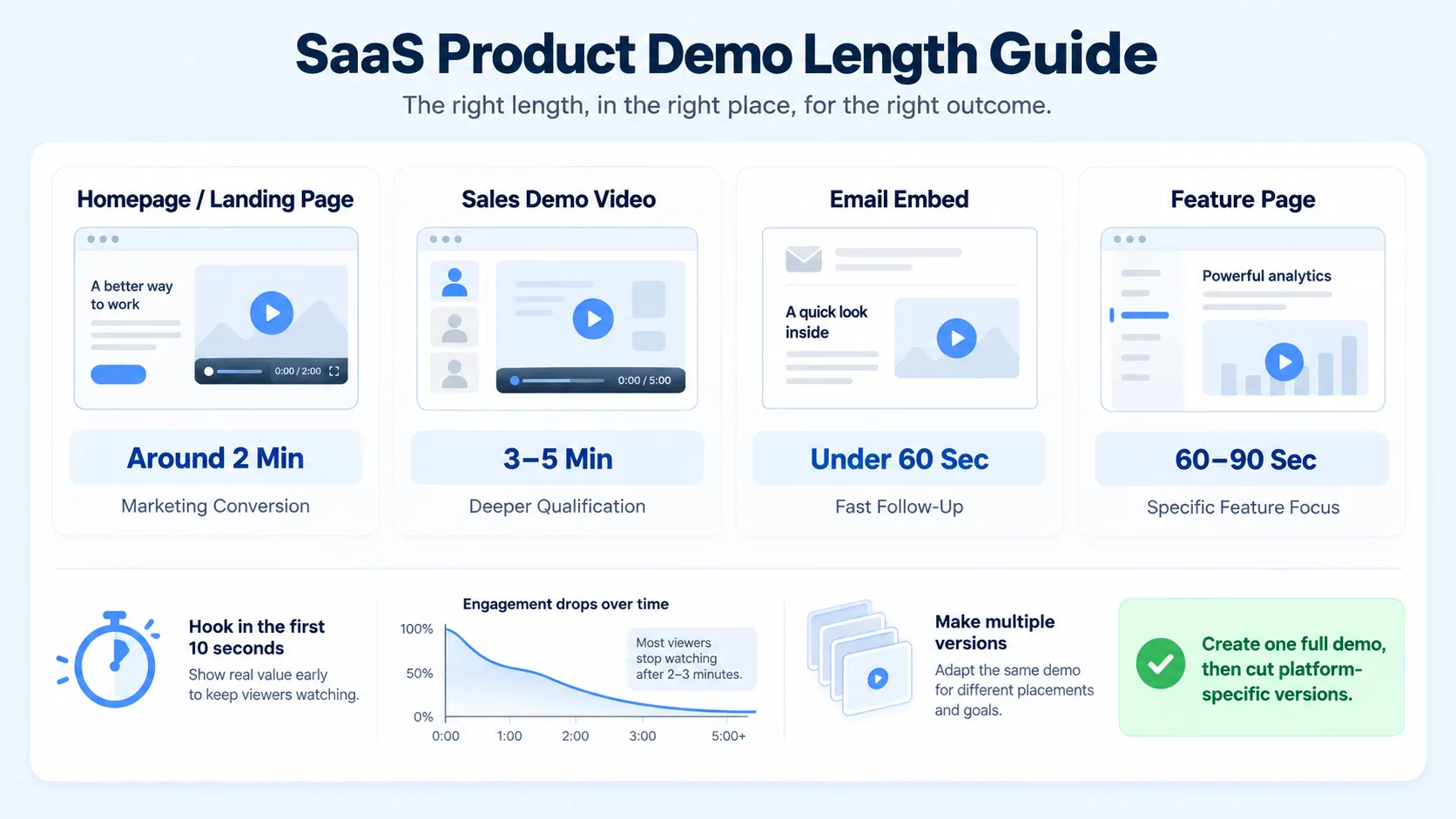
Here is the data-backed framework by placement:
- Homepage or landing page: The ideal product demo video is 2 minutes for marketing, 3-5 minutes for sales, and under 60 seconds for email.
- Feature-specific pages: For specific feature demos, even 60-90 seconds can be effective.
- Top-of-funnel awareness: 73% of marketers find 30-second to 2-minute videos most effective for top-of-funnel engagement.
In 2026, engagement drops by 40% after the 2-minute mark. So if your video runs longer, every second past that point needs to be justified by qualification value, not production habit. The most efficient production approach: produce one full-length demo (2-3 minutes) and then cut platform-specific versions from it. This gives you a homepage version, a social cut, an email embed, and a sales sequence asset, all from a single production cycle. At Komet Media, this is exactly how we build video systems for SaaS teams via our video marketing services: whether starting completely from scratch or using existing recordings, we create one core source to produce multiple conversion-ready outputs.
One rule that overrides all length guidance: the first 10 seconds are the most critical. If you don't hook the viewer there, length doesn't matter.
How Top SaaS Companies Structure Product Videos That Convert Customers
The structure behind the best-performing SaaS product video examples that convert is more predictable than most teams expect. It follows a four-part arc that mirrors the buyer's internal decision process.
- Open with the pain (seconds 0-10): Name the specific frustration your ICP feels. Be precise. "You're spending 3 hours each week manually pulling CRM data into reports" outperforms "data management is a challenge for growing teams" every time.
- Show the before-state (seconds 10-25): Let the viewer see themselves in the problem. A brief screen recording of the painful workflow is more powerful than any spoken description.
- Demonstrate the transformation (seconds 25-80): Walk through the product solving the exact pain from step one. Not a tour. Not a feature list. One workflow, start to finish.
- Land the social proof and CTA (seconds 80-120): Video testimonials on sales pages can lift conversions by up to 34% in VWO testing, and up to 80% in individual case studies. Drop one customer voice here, then close with a single, frictionless call to action.
The SaaS teams reporting the largest gains from explainer video are not measured by view counts. They are measuring downstream pipeline impact: demo-call conversion rate, sales-cycle length, and trial-to-paid activation.
This is the standard I hold every Komet Media project to. If a video cannot be traced to a pipeline metric, it is a content expense, not a growth asset. Founder-led content, webinar clips, podcast repurposing, or brand new videos produced entirely from scratch—everything we build for B2B SaaS clients through our content repurposing and video production services runs through this same structural filter. If you want to see how we approach building video systems from scratch or from your existing content, our about page has full context on the process.
Conclusion
- Adding a product video increases your conversion probability by 2.5x, the gap between static and video pages is real and measurable.
- The best SaaS product video examples that convert lead with buyer pain, show a single workflow, and close with one CTA.
- Match format and length to funnel stage: explainer for awareness, demo for mid-funnel, VSL for high-ACV close.
- Measure downstream, not vanity: track demo bookings, trial activations, and trial-to-paid rates, not view counts.
- Build a video system, not a one-off asset. Whether created entirely from scratch or built from existing recordings, one core video source can fuel homepage, social, email, and sales sequences simultaneously.
Frequently Asked Questions
Q1: What are the most effective SaaS product video formats in 2026?
The highest-converting formats are product demo videos (screen recording with narrative), animated explainers for cold audiences, and customer testimonial videos near pricing CTAs. In 2026, successful demos are short, concentrated, and animated, with a clear focus on the result for the user. Match the format to your funnel stage.
Q2: How long should a SaaS product video be on a landing page?
The ideal length for a SaaS product demo video is typically between 1 to 2 minutes. Keeping it short and focused helps maintain viewer interest while effectively communicating the app's features and value proposition. For feature-specific pages, 2-3 minutes is acceptable.
Q3: What is the difference between a SaaS explainer video and a product demo video?
An explainer uses animation or storytelling to communicate product value to buyers who are not yet category-aware. A demo shows the live product UI solving a specific problem. A SaaS product explainer video uses animation or storytelling to simplify complex concepts and explain the product's value more broadly. Use both for full-funnel coverage.
Q4: Do SaaS product videos actually increase free trial conversions?
Yes. The numbers are clear: pages with video convert at 4.8% versus 1.9% without video. The lift is most significant when the video is placed above the fold on a trial signup page and ends with a single, friction-free CTA directly tied to the trial offer.
Q5: Can I repurpose existing content like webinars or podcasts into SaaS product videos?
Yes, repurposing existing long-form content like webinars or podcasts is one of the highest-ROI moves a SaaS team can make. A 45-minute webinar contains enough material for 8-12 short-form clips, a product explainer, and multiple sales enablement assets. Additionally, Komet Media creates video assets completely from scratch for teams without existing footage. Building video systems from scratch or repurposing long-form content is a core part of how we build pipeline assets. See our webinar and event repurposing services for specifics.
Q6: What metrics should I track to know if my SaaS product video is converting?
Skip vanity metrics. Track these: landing page conversion rate (with vs. without video), free trial signup rate, demo booking rate from video CTA, and trial-to-paid activation rate. What matters is retention, completion rate, click-throughs, and sales, especially for complex B2B products where video does the heavy lifting of buyer education before a human sales touchpoint ever occurs.