
🪄 AI Summary
Heading 1
Heading 2
Heading 3
Heading 4
Heading 5
Heading 6
Lorem ipsum dolor sit amet, consectetur adipiscing elit, sed do eiusmod tempor incididunt ut labore et dolore magna aliqua. Ut enim ad minim veniam, quis nostrud exercitation ullamco laboris nisi ut aliquip ex ea commodo consequat. Duis aute irure dolor in reprehenderit in voluptate velit esse cillum dolore eu fugiat nulla pariatur.
Block quote
Ordered list
- Item 1
- Item 2
- Item 3
Unordered list
- Item A
- Item B
- Item C
Bold text
Emphasis
Superscript
Subscript
Most SaaS teams know they should be posting on LinkedIn. Few have a system that actually moves pipelines. The LinkedIn Video Playbook for B2B SaaS is that system, built for founders, marketing heads, and growth teams who want video to educate buyers, generate demo demand, and compress the trust gap. This guide covers strategy, content formats, posting cadence, and the algorithm realities that determine whether your videos get seen or suppressed. No filler. Just the playbook.
TL;DR
- LinkedIn video hit a 5.90% average engagement rate in Q1 2026 , making it one of the highest-performing native formats on the platform.
- Founder-led, insight-driven video consistently outperforms polished brand content on both reach and pipeline influence.
- The algorithm now rewards dwell time, niche authority, and authentic engagement, not volume or production budget.
- Content repurposing (webinars, podcasts, demos) is the fastest path to a consistent B2B video presence without burning out your team.
Does LinkedIn Video Actually Work for B2B Marketing?
Short answer: yes, but not the way most SaaS teams are doing it. LinkedIn video hit 154 billion views in 2024, with viewership up 36% year-over-year. Video impressions rose 73.39% and views climbed 52.17% between 2024 and 2025, making it a format worth prioritizing. Those aggregate numbers look great. The nuance is in who's winning. Company pages now reach roughly 1.6% of their followers. Organic company page content makes up just 1–2% of the LinkedIn feed, down from 7% in 2021. Personal profiles account for 65% of feed content.
This is the single most important structural truth in The LinkedIn Video Playbook for B2B SaaS: your founder's face on camera will always beat your company logo in the feed. B2B SaaS leads LinkedIn engagement at a 2.8% median engagement rate, 1.5x the platform average, due to alignment between the platform's audience of decision-makers and content focused on thought leadership and product launches.
That's a meaningful edge. SaaS buyers are on LinkedIn. They're actively researching vendors, following founders, and forming trust signals long before they book a demo. SaaS companies that share transparent metrics, failed experiments, and founder stories see 47% higher engagement than those posting generic industry insights. That's not a creative preference, it's a measurable pipeline lever. When your buyer sees a founder unpacking a real pricing decision or a failed feature launch, they're building a mental model of what working with you looks like.
Tools like Vidyard and Wistia help B2B teams track video engagement beyond LinkedIn, view rates, drop-off points, and replay data that feeds directly into sales conversations. But the first priority is getting the video seen. That means understanding the algorithm before investing in production. The LinkedIn algorithm now measures how long people actually engage with your content, not just whether they clicked. A post someone reads for 30 seconds outperforms one with 50 quick likes. For video, this translates directly: a 60-second clip that holds attention beats a polished 3-minute brand film that gets skipped at the 10-second mark.
LinkedIn Video Strategy for B2B SaaS Companies
The biggest mistake I see SaaS teams make is treating LinkedIn like a broadcast channel. Post a video, wait for leads. That's not a strategy. That's hope. A proper LinkedIn video strategy for B2B SaaS sits inside a go-to-market system. It serves three jobs simultaneously: buyer education, personal branding for the founder, and sales enablement for the team. Every video should map to one of those.
The LinkedIn algorithm prioritizes 2–3 substantial, valuable posts per week over daily superficial updates. Don't rely on one format. The most successful brands mix anchor content (videos and carousels 2–3x per week), engagement drivers like polls (1–2x per week), and quick-value text posts (1–2x per week).
For video specifically, build around three content pillars:
- Founder POV: Camera-facing takes on category problems, pricing philosophy, product decisions. This is the highest-trust format in B2B.
- Product education: Short demos, feature explanations, use-case walkthroughs that shorten the sales cycle.
- Social proof in motion: Customer stories, implementation wins, before/after outcomes, video versions of your case studies.
In August 2025, LinkedIn's engineering team revealed they implemented large language models to surface useful content. The algorithm now matches posts to users' interests with significant accuracy. If your content resonates with a specific professional audience, the AI will put it in front of exactly those people. This is good news for niche SaaS verticals. Specificity wins. A video about "how we cut churn in our mid-market HR SaaS by 18% in one quarter" will reach HR tech buyers more effectively than "5 tips to reduce churn."
Connect your video content to a broader content distribution system. LinkedIn is the top-of-funnel amplifier. The video drives awareness. A link to a longer webinar, case study, or product demo page deepens the consideration.
What Types of Videos Perform Best on LinkedIn for SaaS Brands?
Not all videos are equal on LinkedIn. Here's what the 2026 data actually shows:
Native LinkedIn videos outperform YouTube links by 312%, so upload directly to the platform. This is non-negotiable. If you're sharing a YouTube link, you're leaving the majority of your potential reach on the table. LinkedIn's algorithm penalizes external links and rewards content that keeps users on-platform.
LinkedIn's Creative Labs study found large lifts for "Expert Takes" and "Human Touch" formats. The practical implication: production value is not the only lever, framing, message structure, and native cultural cues can materially shift engagement and dwell time.
For short-form video editing that works on LinkedIn, the format rules are simple: vertical or square framing, captions always on (most users watch muted), hook in the first 3 seconds, and a clear single point per video. A 45–90 second clip that teaches one thing will consistently outperform a 3-minute brand piece trying to cover five.
The only video types that consistently outperform are lighthearted or funny content and repurposed clips from live sessions. That's a clear directive for SaaS teams: mine your webinars, your podcast episodes, and your recorded demos. The content already exists. Repurposing it is faster, cheaper, and often more authentic than scripted production.
How to Use LinkedIn Video to Generate B2B SaaS Leads
Video on LinkedIn generates pipeline through trust compression, not direct CTA clicks. The buyer watches three founder videos over two weeks, forms a point of view, and then books a demo because the friction of the first call feels low. That's the mechanism.

Here's how to make it systematic:
- Map videos to buyer journey stages: Awareness-stage videos challenge a belief ("Why your churn metric is lying to you"). Consideration-stage videos show capability ("How our API handles enterprise SSO in 20 minutes"). Decision-stage videos remove risk ("What onboarding actually looks like at week one, two, and four").
- Use video comments as a sales signal: When someone with VP or Director in their title leaves a substantive comment, that's a warm signal. Have your sales team follow up via LinkedIn DM within 24 hours.
- Pair video posts with a Thought Leader Ad: Organic video reaches your existing network. Thought Leader Ads push that same founder video to your ICP outside your network.
- Track beyond views: Use Vidyard or HubSpot video integrations to see which prospects from your CRM are watching videos and for how long. That data feeds directly into sales prioritization.
- End with a low-friction CTA: Not "Book a demo." Instead: "If you're dealing with this problem, drop a comment, happy to share how we approached it." Comments drive algorithmic reach. Replies become pipeline conversations.
Social sellers achieve quota 78% of the time versus 38% for traditional sellers. Video is the fastest way to scale social selling behavior across your entire go-to-market team. When your AEs share founder videos with their own commentary, it extends reach without additional production cost. Multi-channel campaigns see 31% uplift in leads compared to single-channel approaches. LinkedIn video works best when it's synchronized with email outreach, retargeting, and your webinar and podcast content strategy.
How to Create a LinkedIn Video Content Calendar for SaaS
Without a calendar, video becomes reactive. You post when inspiration strikes. Buyers never see a consistent signal. Trust doesn't compound.
Here's a 4-week repeatable structure for a SaaS team posting 3x per week:
Brands have made a deliberate move to post more frequently, especially when it comes to visual-first formats. Video posting frequency has doubled from 2 to 4 posts per month on average. The winning teams aren't posting 4 times per month. They're posting 3x per week with a system, not grinding out content manually.
Batch your production. Record 4–6 founder videos in one session, then repurpose 2–3 webinars or podcast clips alongside them. That's a full month of LinkedIn video from roughly 90 minutes of work. Services like podcast editing and video editing services turn that raw footage into a publication-ready pipeline without requiring your founder to touch an edit.
Early engagement in the first 60 to 90 minutes predicts whether a post reaches a wider audience. LinkedIn calls this the "golden hour." If your post gets meaningful interaction quickly, the algorithm pushes it to more feeds. If it sits without engagement, LinkedIn assumes nobody cares and suppresses it further. Schedule posts when your ICP is most active (typically Tuesday through Thursday, 8–10 AM in your buyers' timezone) and have two or three teammates ready to engage substantively in the first hour.
LinkedIn Video vs. Text Posts for B2B Engagement: What the Data Says
This is the question every SaaS marketer asks. The honest answer: both belong in your mix, but for different jobs. In Q1 2026, video content hit a 5.90% average engagement rate. Text-only posts registered 4.30% engagement in Q1 2026. Video wins on raw engagement rate. But the picture is more nuanced than a head-to-head comparison. Text posts drive more substantive comments within existing networks despite lower overall reach compared to video. Substantive comments are what the algorithm values most.
Comments carry the highest algorithmic weight. Responding to comments within 15 minutes generates a 90% algorithmic boost by demonstrating active creator participation. Video generates broader reach and trust. Text generates depth of conversation and relationship. In a B2B SaaS context, here's how to position each:
- Use video for: Buyer education, product positioning, founder authority, social proof, and top-of-funnel awareness among cold audiences.
- Use text for: Sharing a contrarian take, posting a data insight, sparking debate in your category, and nurturing your existing warm network.
The combination is what compounds. A video on Tuesday builds credibility. A text post on Thursday referencing that video's key insight draws the engaged audience back in. HubSpot's own content research reinforces this pattern: multi-format content creates stronger recall across the buyer journey than any single format alone.
Posts with links to external websites see approximately 60% less reach than identical posts without links. The "link in first comment" workaround was also penalized as of early 2026. Whether video or text, keep the value self-contained. Put links in DMs or on profile pages, not in the post itself.
LinkedIn Video Best Practices for Software Companies: Mistakes to Avoid
Most SaaS teams don't fail at LinkedIn video because their content is bad. They fail because of execution habits that the algorithm actively penalizes.
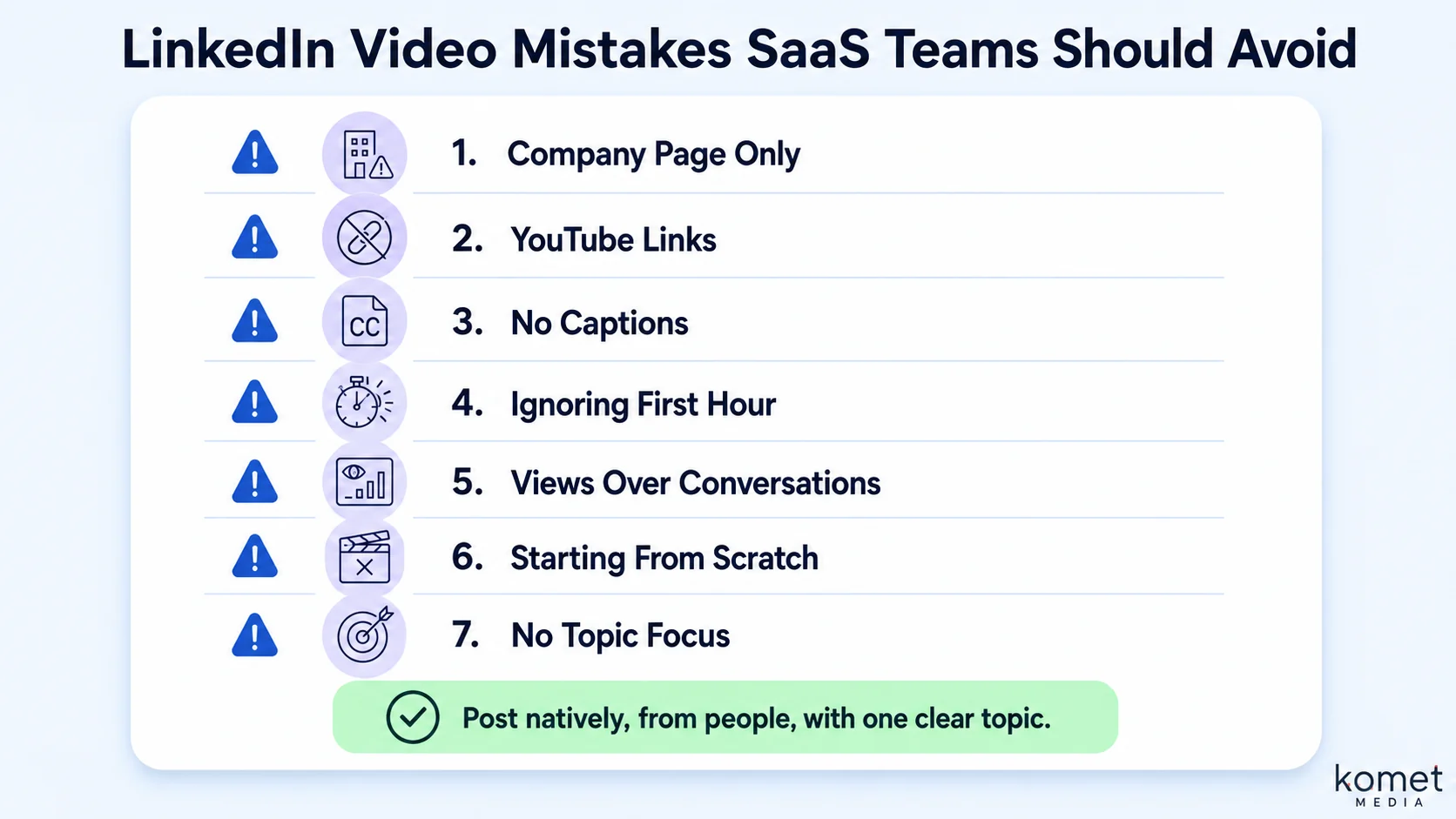
Mistake 1, Posting from the company page only: The reach strategy needs to run through people: the founder, subject matter experts, team members whose professional background aligns with what the company sells. The company page still earns its place for ads, recruitment, and brand credibility. It is no longer a reliable organic reach engine.
Mistake 2, Uploading YouTube links instead of native video: Native LinkedIn videos generally perform best, often getting 3x higher engagement than external links. Upload directly, always.
Mistake 3, Skipping captions: The majority of LinkedIn video is watched on mobile with sound off. Uncaptioned video loses its message before it even starts. Captions are not optional, they're the difference between a completed view and a scroll-past.
Mistake 4, Ignoring the first hour: The initial small group of engagers determines wider distribution. Only 5% of underperforming posts in the first hour recover to reach broader audiences. Notify your team when a video goes live and have them engage with genuine responses, not generic "great post" reactions.
Mistake 5, Optimizing for views, not conversations: A post with twelve substantive comments that spark discussion will outperform a post with fifty generic reactions. Posts with fewer but deeper comment threads reached 3.2 times more people and drove eight times more profile visits.
Mistake 6, Producing everything from scratch: The highest ROI LinkedIn video strategy for most SaaS teams is content repurposing. A 45-minute webinar contains 8–12 LinkedIn clips. A podcast episode contains 4–6 short founder moments. Your events and recorded demos are a content library you already own, they just need to be cut.
Mistake 7, No consistent posting topic: Post about one topic consistently and LinkedIn recognizes your expertise. Post about everything and the algorithm cannot categorize you. Pick your niche and own it completely.
How to Grow a B2B SaaS Audience on LinkedIn Using Video
Audience growth on LinkedIn in 2026 is slower than it was in 2022. That's a fact. Richard van der Blom's Algorithm Insights 2025 report, analyzing 1.8 million posts across 58,000 profiles and 31,000 company pages, found that overall views fell 50%, engagement dropped 25%, and follower growth slowed by 59%. Winning in this environment requires a compounding strategy, not a viral play.
Four growth levers that work in 2026:
- Founder-led video series: Commit to 12 consecutive weeks of one video per week on a single theme. The consistency trains the algorithm and signals expertise. Viewers who return weekly are your highest-intent audience segment.
- Strategic engagement before you post: Spend fifteen minutes commenting thoughtfully on posts from accounts serving your target audience before and after you post. The algorithm tracks your activity and rewards engaged users with better distribution. Your comments become discovery opportunities for new followers.
- Employee amplification: When teammates share a founder's video with their own added perspective, each share triggers a second distribution wave. A SaaS team of 10 active employees can multiply a founder post's reach by 5–8x with no additional content production.
- Content repurposing across channels: Turn your LinkedIn video into a podcast clip, a newsletter section, and a sales enablement asset. Each channel reinforces the LinkedIn signal without duplicating production effort.
Profiles with Creator Mode turned on enjoy up to 35% more reach, and in 2025, over 16 million users activated it. If your founder isn't running Creator Mode, that's the first setting to switch before anything else. It unlocks the "Follow" button prominently on the profile and increases distribution of video content to non-connections.
Audience segmentation matters here too. A founder of a DevOps SaaS and a founder of an HR tech SaaS should be building different audiences, engaging different communities, and repurposing different types of content. The LinkedIn algorithm's LLM-based matching means your topic DNA determines your distribution. Specificity attracts the right ICP, not just a large following.
Conclusion
The LinkedIn Video Playbook for B2B SaaS comes down to four decisions made consistently:
- Post from personal profiles first. Founder and team voices drive the reach that company pages can no longer generate organically.
- Repurpose before you produce. Your webinars, demos, and podcast episodes are already a video library, treat them that way.
- Prioritize engagement depth over post volume. The algorithm rewards dwell time, substantive comments, and niche authority, not frequency.
- Measure pipeline signals, not vanity metrics. Views tell you what's resonating. Comments from your ICP and demo requests tell you what's working.
If you're building The LinkedIn Video Playbook for B2B SaaS from scratch, start with one founder video per week and one repurposed webinar clip. That alone outperforms most SaaS teams currently on the platform. Explore how Komet Media builds these systems for B2B teams who need a repeatable engine, not a one-off campaign.
Frequently Asked Questions
Q1: How long should LinkedIn videos be for B2B SaaS?
For organic LinkedIn posts, 45–90 seconds is the sweet spot. This length is long enough to deliver a single insight and short enough to maintain dwell time. Product demos can extend to 2–3 minutes if they're tightly edited with captions. Anything longer requires a very strong hook and clear structure to prevent drop-off in the first 10 seconds.
Q2: Should my SaaS founder be the one posting videos, or should it come from the company page?
Post from the founder's personal profile first, always. Company pages now reach roughly 1.6% of their followers and make up only 1–2% of the LinkedIn feed. Personal profiles have dramatically more organic reach. Use the company page to reshare, run ads, and build brand credibility, not as your primary distribution channel.
Q3: How often should a B2B SaaS team post a video on LinkedIn?
For most B2B SaaS companies, 3–5 high-quality posts per week outperforms daily low-effort content. For video specifically, 2–3 videos per week is sustainable and sufficient. Pair those with 1–2 text or carousel posts to keep the content mix varied and the comment depth high.
Q4: Do LinkedIn video views translate into pipeline for SaaS companies?
Directly, rarely. Indirectly, consistently. Video builds the trust and familiarity that makes a cold outreach feel warm, shortens the consideration phase, and increases demo-to-close rates. Track video performance alongside demo requests, inbound DMs from ICP accounts, and comment engagement from target personas, not views in isolation.
Q5: What is content repurposing and how does it apply to LinkedIn video for SaaS?
Content repurposing means taking existing long-form content, webinars, podcasts, demos, recorded sales calls, and extracting short-form clips for LinkedIn. A single 45-minute webinar can yield 8–12 LinkedIn video posts. This approach drastically reduces production cost while maintaining authenticity, since the insight and the founder's voice already exist in the source material.
Q6: Is it worth investing in polished video production for LinkedIn, or does raw footage perform better?
Raw, authentic footage consistently outperforms heavily produced brand video on LinkedIn. Framing, message structure, and native cultural cues can materially shift engagement and dwell time, production value alone is not the primary lever. A founder recording on a decent webcam with good lighting and a sharp point of view will outperform a studio-shot brand reel in both reach and trust every time.