
🪄 AI Summary
Heading 1
Heading 2
Heading 3
Heading 4
Heading 5
Heading 6
Lorem ipsum dolor sit amet, consectetur adipiscing elit, sed do eiusmod tempor incididunt ut labore et dolore magna aliqua. Ut enim ad minim veniam, quis nostrud exercitation ullamco laboris nisi ut aliquip ex ea commodo consequat. Duis aute irure dolor in reprehenderit in voluptate velit esse cillum dolore eu fugiat nulla pariatur.
Block quote
Ordered list
- Item 1
- Item 2
- Item 3
Unordered list
- Item A
- Item B
- Item C
Bold text
Emphasis
Superscript
Subscript
I'm Rajan Soni, Founder and Video Director at Komet Media. Every week I talk to SaaS founders and marketing heads sitting on hours of webinar recordings, podcast episodes, and product demos, and getting zero pipeline from any of it. This guide is The Short-Form Video Playbook for B2B SaaS teams who want to fix that. It covers strategy, formats, platforms, content ideas, distribution, and ROI, backed by 2026 data. If you've wondered whether short-form video actually moves deals, this is your answer.
TL;DR
- 60% of marketers now use short-form video, the most widely adopted format, and 49% cite it as delivering the highest ROI.
- LinkedIn, YouTube Shorts, and TikTok for Business are the three platforms that matter most for B2B SaaS buyers in 2026.
- Your existing content (webinars, demos, podcasts) is your fastest source of short-form video assets, repurpose before you produce.
- Pipeline, not views, is the only metric worth optimizing toward.
Does Short-Form Video Actually Work for B2B Software Companies?
The honest version: yes, and the data from 2026 removes any remaining doubt. 70% of B2B buyers and researchers watch video content during their purchasing journey. Seven in ten B2B buyers actively incorporate video into their research and evaluation process, making it a critical touchpoint at every stage of the funnel. 96% of B2B buyers say video is an important factor when deciding whether to advance in the buying journey. Nearly all B2B buyers report that video influences their willingness to move forward with a vendor.
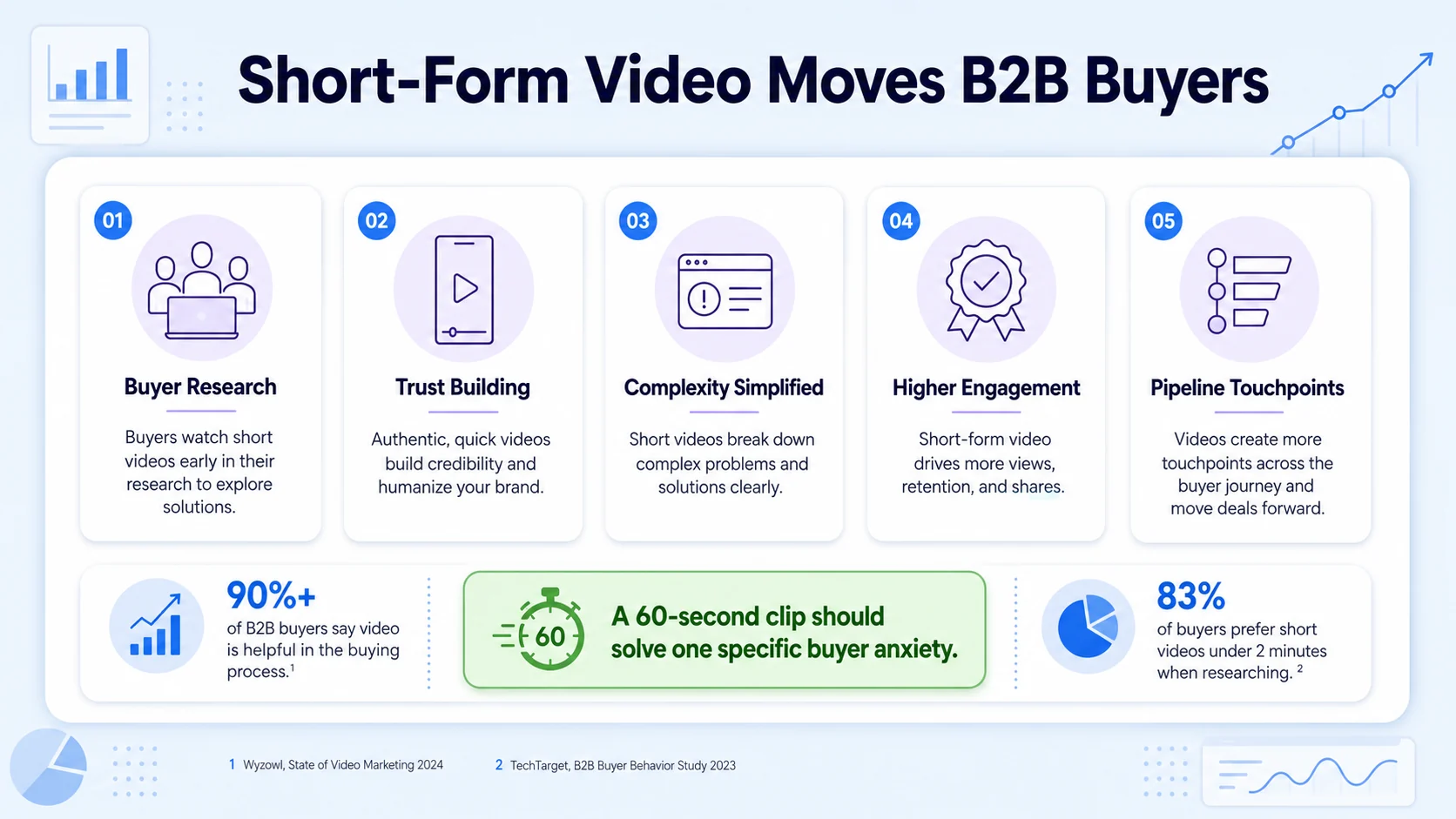
What changed in 2026 is where short-form specifically fits. It's no longer just an awareness play. Short-form video is not a content experiment anymore. It is the primary trust-building layer in the modern B2B SaaS buyer journey. Buyers are watching, evaluating, and making decisions based on video long before they fill out a demo form.
The fear I hear most from SaaS marketing teams is: "Our product is too complex for a 60-second clip." That fear is backwards. Complexity is exactly why short-form video works. A 60-second clip that solves one specific buyer anxiety does more pipeline work than a five-page white paper nobody finishes reading.
Videos under 60 seconds generate 2.5x more engagement per impression than any other content type. For a B2B team trying to stay visible with a busy buying committee across a 90-day sales cycle, that engagement efficiency is the entire game. Short-form video delivers the highest returns by a wide margin and is now the most leveraged content format. In 2025, 104% more marketers named it their most valuable channel compared to 2024, and it's where investment is growing fastest for 2026.
The question isn't whether it works. The question is whether you have a system for it.
The Short-Form Video Strategy for B2B SaaS Companies: Building the Foundation
The Short-Form Video Playbook for B2B SaaS starts with one decision: what does a video need to accomplish at each stage of your buyer journey? Without that map, you're producing content, not building a pipeline.
There are three jobs a short-form video can do for a SaaS team:
- Educate: Teach your ideal customer profile something useful before they've heard of you. This is top-of-funnel awareness on LinkedIn, YouTube Shorts, or TikTok for Business.
- Evaluate: Help a buyer who knows you understand why you fit their specific situation. Product walkthroughs, use-case clips, and founder-led objection handling live here.
- Enable: Give your sales team video assets they can drop into outreach, follow-up sequences, and HubSpot or CRM automations. These are the Loom-style personalized clips and leave-behind explainers that close deals faster.
The format mix that works best for funded B2B SaaS teams in 2026:
The biggest mistake SaaS teams make: they treat these as separate productions. They aren't. Every webinar, product demo, and podcast episode is a short-form video library waiting to be cut. Komet Media's content repurposing service is built entirely around this model.
According to the 2025 Edelman-LinkedIn report, 86% of B2B decision-makers see thought leadership as a more trustworthy way to assess a company's capabilities than marketing materials or product sheets. That stat tells you everything about where founder-led video clips belong in your funnel.
LinkedIn Video Strategy: Where B2B SaaS Pipeline Actually Lives
For B2B SaaS, LinkedIn is the non-negotiable platform. Everything else is supplementary. LinkedIn video drives 80% of all B2B social media leads, with a 5.60% average engagement rate. Founder-led content gets a 4x engagement multiplier on the platform. LinkedIn company page reach has collapsed to 1.6% in 2026. Content posted from employee personal accounts gets 8x more engagement than the same content from a company page.
This is the single most important structural fact for any SaaS team designing their LinkedIn video strategy. Founders and executives posting under their own names will always outperform brand pages, by an enormous margin. LinkedIn's watch time has increased 36% year-over-year, and in Q4 of 2025, video uploads increased 20% year-over-year.
The platform is actively rewarding video in its algorithm. The window to capture organic reach at a low cost is still open, but it won't stay that way. LinkedIn reports that short-form video creation is growing twice as fast as other post formats on the platform. Yet only 49% of businesses run LinkedIn video ads, and just 24% use them regularly. This gap creates a competitive advantage for those who move quickly.
A practical LinkedIn video system for SaaS teams in 2026:
- Post 3–4 videos per month from the founder or a senior executive, not the company page.
- Lead with a pattern interrupt in the first 3 seconds, call out the role, the pain, or the contrarian take immediately.
- Add captions, most LinkedIn videos are watched without sound.
- Tag relevant accounts in the first comment, this extends reach without triggering the algorithm penalty for external links in the post body.
- Repurpose top-performing clips into LinkedIn video ads once organic engagement validates the message.
For firms also running paid distribution, Dreamdata's 2025 benchmarks report highlights that LinkedIn Ads' share of total B2B ad budgets grew from 31% in H1 2024 to 39% by year-end, generating the highest ROAS among major networks.
How to Use TikTok, YouTube Shorts, and Reels for B2B SaaS Marketing
The objection: "Our buyers aren't on TikTok." The reality: they are, they just aren't there in buying mode yet. That's the opportunity. YouTube Shorts generates over 70 billion daily views, and 50.9% of B2B decision-makers use YouTube for product research.
That last number should settle the debate. YouTube Shorts isn't just a consumer platform. It's a research channel your buyers already use, and short-form clips that surface through Video SEO can drive inbound discovery from people actively researching solutions.
YouTube Shorts' 200 billion daily views, TikTok's 1.6 billion users, and Instagram's 3 billion monthly users (spending 50% of in-app time on Reels) together mean that video dominates attention across both B2B and B2C.
How each platform earns its place in a B2B SaaS distribution framework:
The cross-platform repurposing system: produce one core 60–90 second vertical video per week, optimized for LinkedIn. Distribute it natively to YouTube Shorts, Reels, and TikTok with platform-specific captions and hooks. This is exactly the content distribution framework Komet Media builds for SaaS growth teams. TikTok videos under 30 seconds have an average completion rate of 72%. Get your core message into the first half of every clip, regardless of platform. (Bravery Technology, via Zelios Agency, 2026)
How to Explain a Complex SaaS Product in Under 60 Seconds
This is where most SaaS teams get stuck. The product has fifteen features, three personas, and six integration paths. How do you fit it in 60 seconds? You don't fit the product. You fit one buyer problem.
The framework I use at Komet Media for every complex SaaS product explainer:
- Open with the cost of the problem (5–8 sec): Name the specific pain in language the buyer uses internally. Not "inefficient workflows", "your onboarding takes 14 days and you lose 30% of new users before week two."
- Name the category you're in (3–5 sec): One sentence. "We're a customer onboarding automation tool for mid-market SaaS teams."
- Show the mechanism (15–20 sec): A screen recording, a product clip, or a motion graphic showing the core workflow, not every feature. One flow.
- Anchor the outcome (8–10 sec): Specific, if possible. "Teams using [Product] cut onboarding time from 14 days to 3." If you have a customer quote, use it.
- Close with a frictionless next step (5 sec): "Watch the full demo at [URL]" or "DM me 'onboarding' for the walkthrough."
81% of B2B buyers say they trust video more than text-based content, and 74% prefer short, straightforward videos that highlight immediate value. Notice the word "immediate." Buyers do not want a tour of your product. They want to see their problem disappear.
For podcast episodes and webinars with complex content, the same logic applies: find the 45-second moment where the speaker names a real problem with precision and cut from there. That clip will outperform a produced highlight reel every time. Wistia and Vidyard both provide the analytics layer to confirm which clips actually drive downstream action.
Landing pages with embedded video convert at 86% higher rates than text-only equivalents, with the effect being strongest for complex products and services, B2B SaaS pages with explainer videos see conversion lifts exceeding 100% in controlled testing.
Short-Form Video ROI for B2B SaaS: Measuring What Matters
Most SaaS teams track views. Views are a vanity metric. Here's what to track instead.
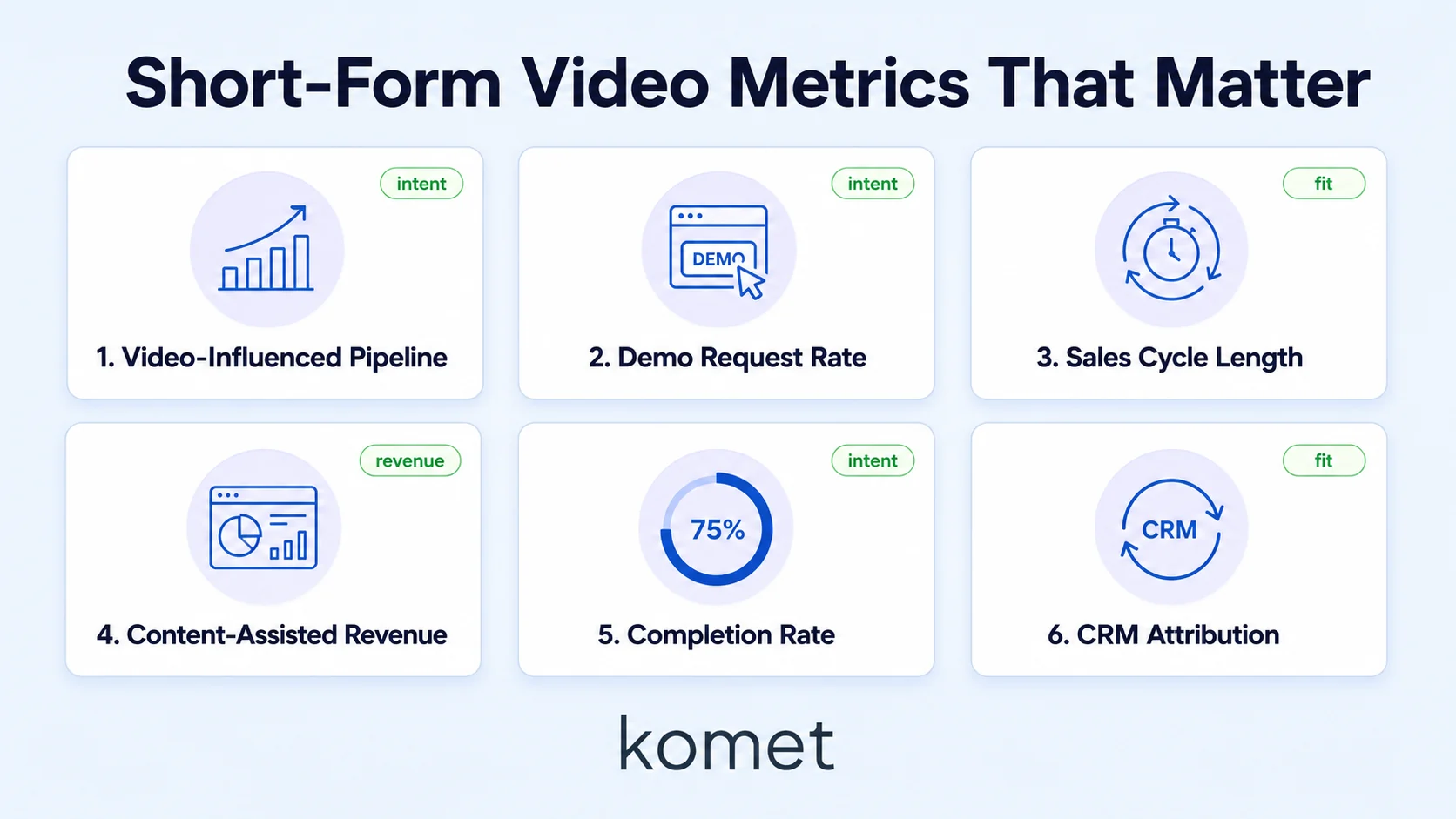
Metrics that connect short-form video to pipeline:
- Video-influenced pipeline: Track prospects who engaged with at least one video asset before booking a demo. Tools like Vidyard and Wistia allow you to tie video views to named accounts in your CRM.
- Demo request rate from video CTAs: Each video should carry one CTA. Measure the conversion rate on that specific CTA separately from other sources.
- Sales cycle length for video-engaged vs. non-engaged accounts: If video is educating buyers before they hit sales, your reps should be spending less time on qualification.
- Content-assisted revenue: Attribute revenue to video touchpoints using multi-touch marketing attribution in HubSpot or a dedicated tool like Dreamdata.
82% of video marketers report that video delivers a positive ROI. Landing pages with embedded video see up to 86% higher conversion rates than those without. The top three ROI-driving content formats are all video: short-form video (49%), long-form video (29%), and live streaming (25%). For funded SaaS teams under CAC pressure, the efficiency argument is decisive.
The customer acquisition cost for the average SaaS business has risen 40–60% since 2023. Short-form video, especially repurposed from content you already own, produces compounding pipeline assets at a fraction of the cost of paid acquisition. A single webinar clipped into 8–12 short videos generates distribution across six months. That's not a content budget. That's leverage. Short-form video (under 60 seconds) is the #1 format marketers plan to invest more in for 2026, cited as the #1 format for video ROI. (Levitate Media, 2026)
Short-Form Video Content Calendar for B2B SaaS Marketing Teams
Consistency beats creativity in short-form video. A repeatable publishing cadence, tied to your sales calendar, is worth more than any single viral clip.
A 4-week rolling system for a lean SaaS marketing team:
Stack this against your pipeline calendar: run product clips the week before a conference, run customer stories the week after a campaign launch, and run objection handlers at the start of every quarter when budget conversations are live. For events, every panel, session, and fireside chat is a clip factory. Pull the three strongest 45-second moments from each event and schedule them across the following two weeks.
The production principle that makes this sustainable: batch, don't produce one at a time. Record 4–6 talking-head clips in a single hour-long session. Edit them in one workflow pass. Distribute across four weeks. This is the exact system Komet Media installs for B2B SaaS teams that need volume without a full in-house production team.
The shift toward in-house production, remote recording, and AI-assisted workflows means speed and volume matter more than ever. Teams that build a scalable, repeatable video pipeline in 2026 will outperform those relying solely on one-off production.
Conclusion
The data is settled: short-form video is where B2B SaaS buyer trust is built in 2026. The teams winning pipeline from it aren't posting more, they're building systems.
Key takeaways:
- Start with what you have: webinars, demos, and podcasts are your fastest clip library.
- Post from people, not pages: founder and executive accounts drive 8x the reach of company pages on LinkedIn.
- Tie every video to one buyer problem and one CTA, not a feature tour.
- Measure pipeline influence, not views, use Vidyard, Wistia, or HubSpot attribution to connect video to revenue.
Ready to build this system? Talk to the Komet Media team.
Frequently Asked Questions
Q1: How many short-form videos should a B2B SaaS team post per month?
Four to six is a sustainable floor for most SaaS teams with a lean content operation. One per week, distributed natively to LinkedIn and YouTube Shorts, with a second cut repurposed for Reels or TikTok. Consistency across 90 days beats a burst of 20 videos in a single week.
Q2: What's the ideal length for a B2B SaaS short-form video in 2026?
30–60 seconds for LinkedIn and TikTok, 60–90 seconds for YouTube Shorts when the topic needs a slightly fuller explanation. Videos shorter than 90 seconds are more likely to keep half of their viewers engaged until the end, and TikTok videos under 30 seconds have an average completion rate of 72%. Lead with the payoff, don't bury it.
Q3: Can a SaaS company with no existing video content start from scratch?
Yes. Start with a founder talking directly to your ideal customer profile about the most common objection your sales team hears. Film vertically on a smartphone. Add captions. Post to LinkedIn. That's your baseline. From there, build the production system around webinars, demos, and customer interviews.
Q4: Do B2B SaaS companies need to be on TikTok?
Not as their first platform, LinkedIn should come first for most SaaS teams. But 50.9% of B2B decision-makers use YouTube for product research, and TikTok for Business reaches younger buyers who will be budget-holders within the next two to three years. Use LinkedIn to drive the pipeline now; use TikTok and Shorts to build a brand with tomorrow's buyers.
Q5: How is short-form video different from a product demo video?
A product demo video shows the full product. A short-form video shows one buyer problem being solved in under 90 seconds, no login flows, no feature tours, no UI walkthroughs unless they're essential to the point. Think of it as the trailer that earns the right to show the full demo. The goal is a booked meeting, not a complete product education.
Q6: What tools do B2B SaaS teams use to measure video ROI?
Vidyard and Wistia are the standard for connecting individual video views to named accounts in a CRM. HubSpot's native video integration tracks video engagement inside email sequences and landing pages. For multi-touch marketing attribution across the full buyer journey, Dreamdata provides pipeline-level visibility. All three allow teams to report video-influenced revenue rather than just play counts.