
🪄 AI Summary
Heading 1
Heading 2
Heading 3
Heading 4
Heading 5
Heading 6
Lorem ipsum dolor sit amet, consectetur adipiscing elit, sed do eiusmod tempor incididunt ut labore et dolore magna aliqua. Ut enim ad minim veniam, quis nostrud exercitation ullamco laboris nisi ut aliquip ex ea commodo consequat. Duis aute irure dolor in reprehenderit in voluptate velit esse cillum dolore eu fugiat nulla pariatur.
Block quote
Ordered list
- Item 1
- Item 2
- Item 3
Unordered list
- Item A
- Item B
- Item C
Bold text
Emphasis
Superscript
Subscript
Hiring an Instagram agency can remove a major workload from your internal team. You no longer need to plan every post, write every script, chase approvals, edit every video, and remember when to publish.
That does not mean the agency starts posting on day one and delivers predictable growth by the end of the week.
The first 90 days usually involve research, setup, production, testing, and adjustment. Your agency needs time to understand your business, create a workable content system, publish enough content to see patterns, and use those findings to improve the next batch.
A good agency should make this process clear from the start. You should know what happens each month, what your team needs to provide, what the agency owns, and how progress will be measured.
This guide explains what your first 90 days may look like, which results you can reasonably expect, and how to tell whether the partnership is moving in the right direction.
Before Day One: Get Clear on What the Agency Actually Owns
Instagram agencies offer different levels of support.
Some agencies edit videos that your team has already recorded. Others provide strategy and leave production to you. A full-service Instagram agency may handle research, content planning, scripting, recording support, editing, publishing, and reporting.
These are very different engagements. Before onboarding begins, confirm who owns each part of the process.
This conversation prevents a common problem: the business assumes it has hired a fully managed service, but the agency expects the internal team to provide finished recordings, topic ideas, and captions.
Komet Media, for example, runs the full content system for clients. Its service covers research, strategy, scripting, recording, editing, posting, and cross-platform distribution. The client mainly needs to share business input, attend the recording session, and review content batches.
That level of ownership suits teams that want Instagram handled without adding another full-time role.
What the First 90 Days Are Designed to Achieve
Your first quarter with an agency should create more than a polished feed.
It should produce a repeatable system for turning your expertise, customer knowledge, product insights, and existing content into Instagram posts that support the business.
By day 90, you should understand:
- Which topics interest the right audience
- Which formats suit your brand
- Which people from your team should appear on camera
- Which hooks hold attention
- Which posts drive profile visits, saves, shares, or enquiries
- How much content your team can approve and produce consistently
- How Instagram fits into your wider marketing activity
The agency may generate strong reach during this period. It may also produce a post that outperforms your existing content by a wide margin.
Treat those wins as signals, not guarantees. The larger goal is to build a system that can produce useful content every month without depending on occasional viral posts.
Days 1–30: Research, Positioning, and Content Setup
The first month creates the foundation for everything that follows.
You may see fewer published posts during the opening weeks because the agency needs to understand your brand before it can represent it accurately.
An agency that skips this work may produce content quickly, but that content often sounds generic. It may use familiar industry advice, broad hooks, and polished templates without saying anything specific about your business.
Days 1–30: Building the Foundation
Week 1: Discovery
The agency learns about your audience, offer, competitors, goals, and sales process.
You will usually share brand guidelines, customer insights, case studies, past content, and upcoming campaigns.
Week 2: Research and Strategy
The agency reviews your Instagram account, studies competitors, and identifies useful topics and formats.
It then builds a strategy around content pillars, posting frequency, audience needs, and business goals.
Week 3: Topics and Recording
The agency prepares scripts, talking points, or interview questions before recording.
Content may include founder videos, product demos, educational Reels, customer questions, and B-roll.
Week 4: Editing and Publishing
The agency edits the footage, adds captions and branding, writes post copy, and sends the content for approval.
By the end of the month, you should have a clear strategy, an improved profile, and your first batch of content ready or already published.
What You Should Have by Day 30
Do not measure the first month only by follower growth.
You should have a stronger operating foundation, including:
- A completed account audit
- An improved and SEO optimized profile
- A documented content direction
- Clear content pillars
- A calendar of approved topics
- Initial scripts
- A recording process
- Edited content
- A publishing schedule
- Baseline performance data
You should also know who approves content and how long approvals take.
That workflow matters. A strong agency cannot maintain consistency when six stakeholders review every post at different times.
Days 31–60: Publishing, Testing, and Learning
The second month gives the agency enough live content to begin learning from audience behaviour. This period may feel less dramatic than onboarding, but it often determines whether the strategy improves or stays generic.
The agency should start comparing topics, formats, openings, lengths, visual styles, and calls to action.
Testing Content Topics
Your agency may find that the audience responds differently from what your internal team expected.
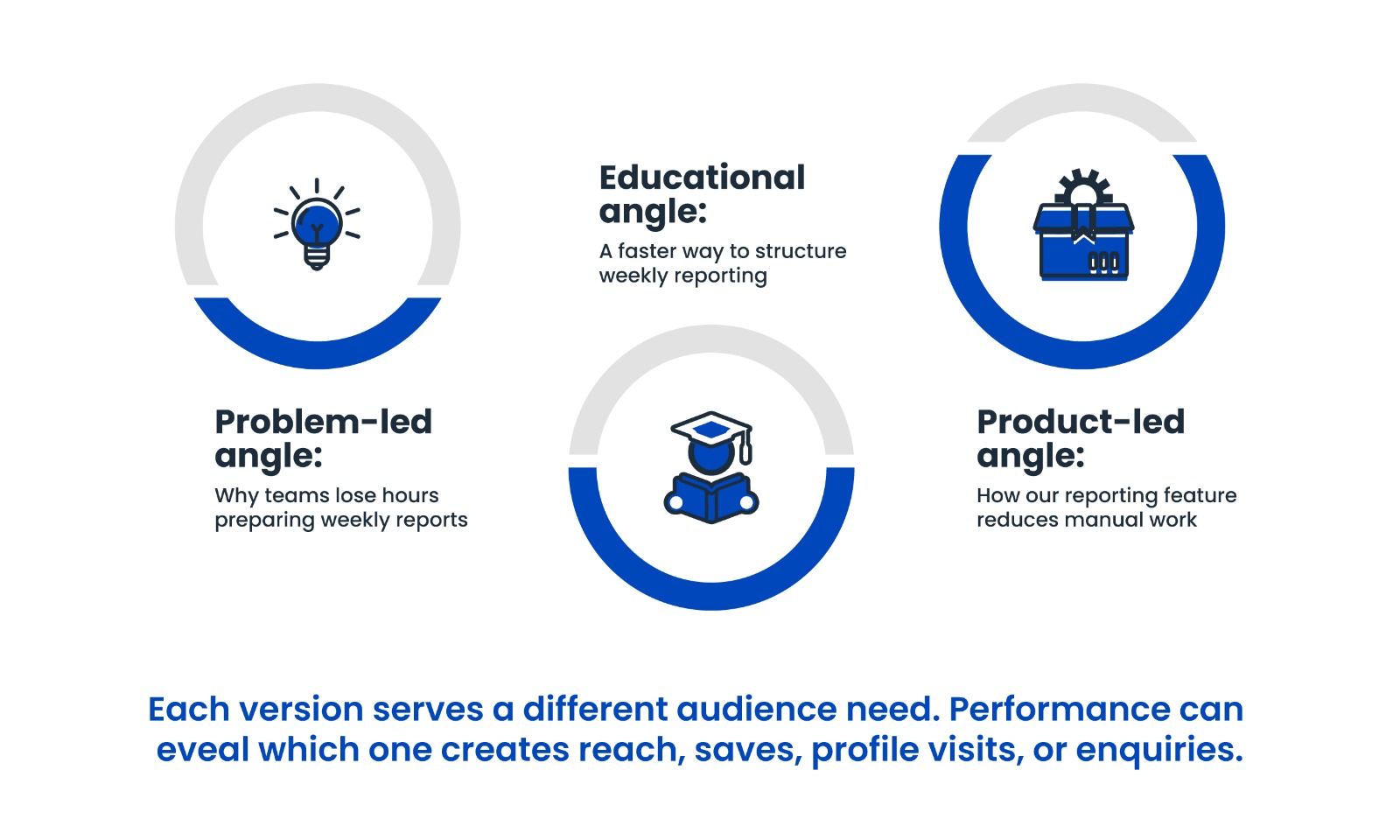
For example, a SaaS business may assume people want feature announcements. Performance data may show that buyers engage more with workflow problems, industry mistakes, or founder explanations.
The agency can then change the balance without abandoning product content completely.
A useful test may compare three versions of the same broad topic:
Testing Formats
A topic that performs poorly as a static post may work well as a Reel.
A strong Reel may also become a carousel for people who prefer to read and save information. A longer founder answer may create several short videos instead of one dense post.
Expect the agency to test a mix that may include:
- Talking-head Reels
- Interview clips
- B-roll videos
- Carousels
- Stories
- Customer examples
- Founder observations
- Product walkthroughs
The goal is to identify which format communicates each type of idea most effectively.
Testing Hooks
The opening of a Reel or carousel affects whether someone keeps watching. A broad introduction gives people little reason to stop scrolling.
For example:
Weak:
“Today, we are going to discuss content strategy.”
Stronger:
“If your team needs three weeks to approve one post, your content calendar is not the real problem.”
The stronger version introduces a specific situation and creates immediate relevance.
Your agency should test several opening styles rather than repeat the same template on every post.
These may include:
- A common mistake
- A direct observation
- A clear outcome
- A customer question
- A step-by-step promise
- A useful comparison
- A strong founder opinion
The opening still needs to match the content. An exaggerated hook may increase initial views but damage trust when the video fails to deliver.
Building a Consistent Publishing Rhythm
By the second month, publishing should feel more organized.
Content should move through a predictable cycle:
- Topics receive approval.
- Scripts or prompts are prepared.
- The team records in batches.
- The agency edits the content.
- Weekly batches go through review.
- Approved posts get published.
- Performance is recorded.
- Findings shape the next batch.
This process gives the agency enough consistency to test ideas properly. Posting five times one week and disappearing for the next three weeks makes performance difficult to evaluate. It also weakens audience familiarity.
Reviewing More Than Views
Views show how far a post travelled. They do not explain what happened next. Your agency should track metrics that relate to the purpose of each post.
A Reel with fewer views may still perform well if it attracts relevant profile visits or sales conversations. A post with very high reach may create little business value when it reaches people outside your target audience.
Reviewing Audience Quality
Your agency should check who engages, not just how many people engage.
For a B2B brand, the right 200 followers may matter more than 10,000 broad followers who never buy, invest, apply, or refer to someone.
Look for signs that your desired audience has started paying attention:
- Decision-makers follow the account
- Prospects mention a post during sales calls
- Industry peers share the content
- Potential employees engage
- Partners respond to founder videos
- Customers send posts to colleagues
- Website visitors arrive from Instagram
These signals often appear before Instagram becomes a direct lead source.
What You Should Have by Day 60
By the end of the second month, the agency should know more about what works for your account.

Your agency should also explain what it plans to change.
Reports should not simply state that reach increased by 18%. They should explain why the agency thinks it happened and how that finding affects the next month.
Days 61–90: Refinement, Repetition, and Stronger Business Alignment
By the third month, the agency should have enough data to make clearer content decisions. It can reduce weak formats, repeat strong topics, and connect content more closely to business goals.
Turn Strong Topics Into Series
A successful topic can become a repeatable series instead of a one-off post.
For example, a strong Reel about founder-led content could lead to posts on what founders should discuss, how to record efficiently, and how founder content supports sales or hiring.
Refine the Content Mix
The agency should adjust the format mix based on performance.
Founder videos may drive reach, carousels may earn saves, and customer stories may generate profile visits. The content plan should give more space to formats that support your goals.
Connect Content to the Sales Journey
Content should guide people from discovery to action.
Extend Content Across Platforms
One recording session can support Instagram, LinkedIn, YouTube Shorts, TikTok, email, and website content.
The agency should adapt each piece for the platform instead of reposting the same version everywhere.
Add Stronger Conversion Content
By month three, the agency can introduce more service-led posts around your process, client outcomes, common questions, and what makes your approach different.
Komet Media manages this full process, from research and scripting to recording, editing, publishing, and cross-platform distribution. Businesses that want a consistent Instagram presence without building an internal content team can book a demo call.
What Results Can You Expect After 90 Days?
There is no fixed number of followers, views, or leads that every brand should reach in 90 days. Results depend on your starting audience, industry, offer, content quality, posting consistency, founder involvement, and sales cycle.
A new B2B account may need more time to build momentum. A recognized founder with an existing audience may see faster traction.
After 90 days, you should expect progress in areas the agency can control. Your account should publish consistently, your profile should explain the business clearly, and the agency should have identified stronger topics, formats, and calls to action.
You may also see higher reach, more profile visits, stronger saves or shares, and better audience engagement. For companies with longer sales cycles, Instagram often supports trust and familiarity before it generates a direct enquiry.
What an Agency Cannot Guarantee
Be cautious when an agency promises viral posts, a specific follower count, instant leads, or sales within a fixed period.
A reliable agency can commit to research, production, testing, reporting, and improvement. It cannot control platform changes, audience behaviour, competition, or buying decisions.
How Your Team Can Help the Agency Get Better Results
A done-for-you service still needs access to your company’s knowledge.
The agency needs accurate information, timely feedback, and subject-matter expertise to create content that sounds specific.
Give the Agency Access to Real Customer Questions
Sales calls, support tickets, demos, and onboarding conversations contain strong content ideas.
Share questions such as:
- Why should we choose this approach?
- How long does implementation take?
- Is this suitable for a small team?
- How do you compare with another option?
- What does the service include?
- What happens if we already have internal resources?
- Which mistakes should we avoid?
Content based on real conversations usually feels more useful than generic trend-based posts.
Keep Approvals Simple
Choose one main reviewer whenever possible.
The reviewer should understand the business, brand, and audience well enough to make decisions without sending every post through several departments.
Set a review deadline. Content that waits ten days for approval can disrupt the entire publishing plan.
Give Specific Feedback
“Make it better” does not give the agency useful direction.
Explain what needs to change and why.
For example:
This claim sounds too broad. Our software reduces the manual review stage, but it does not automate the full workflow.
That feedback protects accuracy and teaches the agency how to discuss the product in future content.
Show Up Prepared for Recording
Review the scripts or questions before the recording session.
You do not need to memorize every line. You should understand the topic and know which examples you want to include. Bring energy, speak directly, and focus on one idea at a time.
The agency can improve pacing and remove mistakes during editing. It cannot manufacture useful expertise when the speaker gives vague answers.
Reviewing the First 90 Days and Planning What Comes Next
What Warning Signs Should You Watch For?
A slow first month does not always mean the agency is underperforming. Research, setup, recording, and testing take time.
You should be concerned when the agency publishes without understanding your business, creates generic content, repeats factual errors, or relies on trends that do not suit your audience. Reports should explain what the data means, not just list views and follower growth.
Your workload should also decrease over time. You should not have to provide every idea, write every script, chase approvals, or manage the agency’s daily work.
What Should You Ask at the 90-Day Review?
Use the review to understand which audience segments engaged, which topics performed best, and which posts drove profile visits, enquiries, or other useful actions.
Ask what the agency plans to repeat, reduce, stop, or test next. It should also explain how the next quarter will support your wider marketing and business priorities.
The answers should come from real performance data. The agency should also be clear about areas that still need more testing.
What Happens After the First 90 Days?
The next quarter should build on what the agency has already learned.
This may include expanding successful content series, adding more founder videos, strengthening product education, using more customer proof, improving Stories, testing collaborations, or repurposing content across other channels.
The agency should not treat every month as a fresh start. Each quarter should use previous performance, audience feedback, production experience, and business priorities to improve the strategy.
Over time, this creates a stronger content library, a smoother recording process, more natural scripts, and a clearer brand voice that your audience begins to recognize.
Final Thoughts
Your first 90 days with an Instagram agency should establish a reliable content system.
The first month focuses on research, positioning, planning, and production. The second month provides enough published content to test ideas and study audience response. The third month uses those findings to refine the mix and connect Instagram more closely to your business goals.
Do not judge the partnership only by follower growth.
Look at content quality, publishing consistency, audience relevance, profile activity, business conversations, internal workload, and the agency’s ability to learn.
A good agency should give your brand a stronger Instagram presence without turning content production into another full-time responsibility for your team.
Komet Media runs organic Instagram content from strategy through distribution for B2B brands, founders, funded startups, VC firms, and PE firms. The team handles research, scripts, recording support, editing, publishing, Stories, and cross-platform distribution.
One recording day can provide the source material for a full month of content.
Book a demo call with Komet Media to see what your first 90 days could look like.