
🪄 AI Summary
Heading 1
Heading 2
Heading 3
Heading 4
Heading 5
Heading 6
Lorem ipsum dolor sit amet, consectetur adipiscing elit, sed do eiusmod tempor incididunt ut labore et dolore magna aliqua. Ut enim ad minim veniam, quis nostrud exercitation ullamco laboris nisi ut aliquip ex ea commodo consequat. Duis aute irure dolor in reprehenderit in voluptate velit esse cillum dolore eu fugiat nulla pariatur.
Block quote
Ordered list
- Item 1
- Item 2
- Item 3
Unordered list
- Item A
- Item B
- Item C
Bold text
Emphasis
Superscript
Subscript
Most B2B teams are now investing in short-form video, yet most are still making the same preventable errors that kill views, waste budget, and generate zero pipeline. 92% of B2B marketers plan to spend the same or more on video marketing in 2026 , so the spend is there. The strategy is not. These are the common short-form video mistakes B2B brands make in 2026 that I see repeatedly at Komet Media, and exactly how to fix each one.
TL;DR
- Most B2B short-form video fails because it is built for brand ego, not buyer education.
- Misaligned messaging, wrong platforms, and no funnel-stage logic are the core problems.
- The fix is treating video as a pipeline asset, not a content checkbox.
- Repurposing existing knowledge (webinars, demos, podcasts) is the fastest path to consistent output.
Why B2B Brands Keep Failing at Short-Form Video
The single biggest reason B2B brands fail at short-form video is that they import B2C creative habits into a B2B buying context. Slick aesthetics and trend-chasing hooks work when you are selling consumer goods. They fall flat when your buyer is a CTO evaluating a $50K SaaS contract. 70% of B2B buyers review video content while making a purchase decision, and 74% of B2B buyers prefer short, simple video formats that immediately convey benefits.
The demand is real. The gap is execution. Teams either produce content that is too polished and promotional, or too loose and unstructured to build credibility. The other failure mode is organisational. Short-form video gets handed to a junior marketer with no clear brief, no defined audience stage, and no distribution plan. The result is content that looks like it was made just to fill a content calendar. Buyers notice.
Short-form video under 30 seconds achieves the highest completion rates on LinkedIn, and educational videos generate 3x more engagement than promotional videos. The pattern I see most: a founder has genuine product expertise and sharp buyer insight, but none of it makes it into video. Instead, the brand posts generic trend content that any competitor could have made. That is a positioning failure disguised as a content problem.
The fix starts with a mindset shift. Short-form video is not a social media task. For B2B teams, it is a buyer education tool, a trust mechanism, and a pipeline lever. Every clip should answer a question a real buyer is already asking, or dismantle an objection already blocking a deal.
The 5 Common Short-Form Video Mistakes B2B Brands Make in 2026
These are the patterns I fix most often across SaaS, funded AI startups, and B2B service teams.
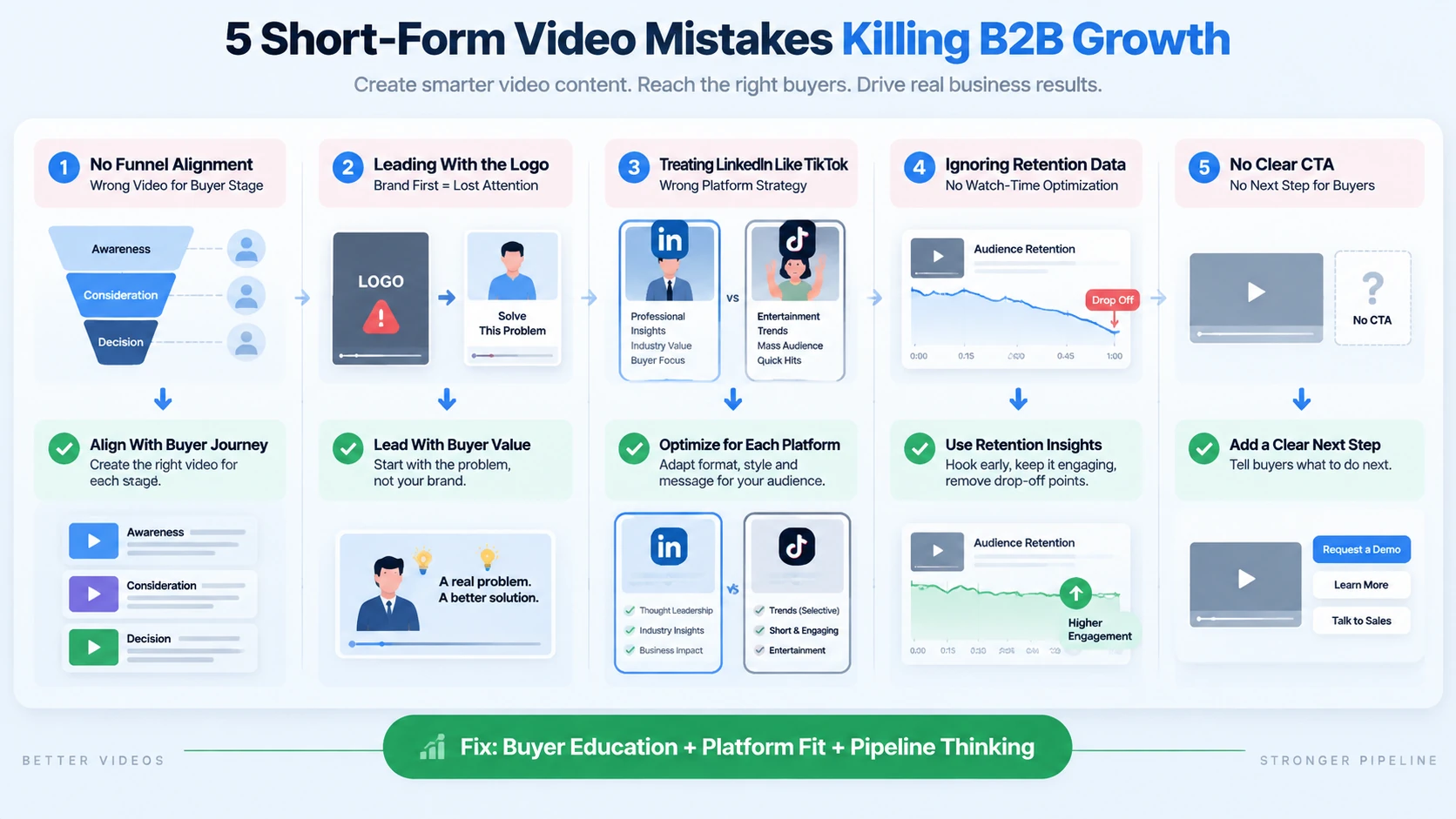
Mistake 1: No funnel-stage alignment. Most teams produce one type of video and blast it everywhere. A product demo clip is not right for someone who has never heard of your category. A brand awareness clip will not close a warm prospect. Every video needs to map to a specific stage of your buyer journey, whether that is awareness, consideration, or decision.
Mistake 2: Leading with the logo. The first 5 seconds determine whether your video gets watched, so you must lead with the problem or outcome, not your logo or company name.
Brands that open with a 3-second intro animation lose the scroll battle before the message begins.
Mistake 3: Treating LinkedIn like TikTok for Business. Distribution strategy matters as much as content quality. Short-form brand video engagement varies across platforms: Instagram 52%, YouTube 52%, Facebook 48%, and LinkedIn 27%. LinkedIn's lower raw engagement number does not mean it is the wrong platform. It means the content format, tone, and hook must be calibrated for a professional mindset, not entertainment.
Mistake 4: Ignoring video retention rate. Videos under one minute achieve a 65% completion rate among B2B viewers, while videos over 20 minutes drop to 20%, according to Vidyard's 2025 benchmark report based on nearly one million B2B videos. Most teams never check completion data at all.
Mistake 5: No clear call-to-action optimisation. The video ends and nothing happens, because there was no next step built in. Even a soft CTA ("full breakdown in the comments" or a link to a demo) dramatically increases conversion behaviour from short-form content.
What B2B Brands Are Doing Wrong on LinkedIn, TikTok, and YouTube Shorts
Platform-specific errors are a distinct category from general strategy mistakes. Here is what I see teams getting wrong on each major channel.
On LinkedIn Video: The most common error is repurposing B2C-style Reels with trending audio and meme formats. Native video earns 5x more engagement than text posts on LinkedIn, and short-form video under 90 seconds is now prioritised by the LinkedIn algorithm above longer uploads. The opportunity is huge, but the format must match the professional audience. Decision-makers on LinkedIn are in work mode. They respond to specificity, expertise, and insight, not viral audio.
On TikTok for Business: B2B teams either ignore it entirely or post corporate content that gets no organic reach. TikTok's algorithm rewards genuine teaching and pattern interrupts. If your product solves a problem a buyer Googles, there is a TikTok audience for that exact problem. The mistake is treating TikTok as frivolous rather than as a top-of-funnel demand generation channel.
On YouTube Shorts: Most B2B brands clip long-form content randomly rather than intentionally. A good Shorts strategy starts with identifying the highest-insight moments from webinars, podcasts, and demos, then editing those into standalone 45–60 second clips with clear context. YouTube Shorts generates $0.50 to $3.00 per 1,000 views, and educational clips compound in search for 12 to 18 months after posting. That compounding value makes it one of the highest-leverage platforms for B2B content repurposing frameworks.
The cross-platform mistake that connects all three: no consistent content distribution strategy. Teams post once, see low initial numbers, and quit. Short-form video on B2B platforms requires consistency over 60–90 days before algorithmic traction builds.
Why Your B2B Short-Form Video Feels Too Salesy or Corporate
This is the feedback I hear from buyers more than almost anything else. The video is slick, the message is clear, but something about it feels like a brochure. The root cause is almost always POV. Corporate B2B video speaks from the brand's perspective about the brand's product. Thought leadership content speaks from the buyer's reality about the buyer's problem. The first feels like an ad. The second builds trust.
A 60-second product walkthrough conveys confidence and transparency in ways product descriptions cannot match, and for B2B buyers evaluating high-ticket solutions, this rapid trust-building is critical to moving through the sales cycle. The issue is most brands script walkthroughs to sell rather than to educate, and buyers feel the difference immediately.
Three specific signals that make B2B video feel too corporate:
- Every clip ends with a direct purchase CTA, regardless of where the viewer is in the buyer journey.
- The script is polished to the point of sounding like no human actually talks that way.
- There is no founder or expert voice, just voiceover on stock footage or screen recordings.
Founder-led video is the fastest fix. A founder speaking plainly about a problem their buyers face, without a hard sell, builds more trust in 45 seconds than a produced brand video in two minutes. This is why founder-led growth through short-form video is one of the highest-leverage strategies for B2B SaaS and funded AI teams right now.
At Komet Media's short-form video editing service, we structure clips to lead with buyer pain, deliver genuine insight, and save any CTA for the very end, keeping the trust intact throughout.
Short-Form Video Strategy Mistakes B2B Marketers Keep Repeating
Beyond individual clip errors, there are systemic strategy failures that compound over time. These are the common short-form video mistakes B2B brands make in 2026 that drain the entire content programme.
Producing without repurposing. 78% of B2B marketers now use video and more than half plan to increase video investment in the year ahead. Yet most teams create net-new clips from scratch every week instead of building a content repurposing framework around assets they already have. Every webinar, podcast episode, and demo contains 10–20 clippable moments. Ignoring that library is an operational failure.
Chasing platform trends over buyer intent. Trending audio and viral formats drive vanity metrics. Buyer education content drives the pipeline. The goal for a B2B team is not to go viral. It is to reach the right 200 decision-makers repeatedly until they trust you enough to book a call.
Ignoring dark social. A significant share of B2B video consumption happens in private Slack channels, email forwards, and DMs. That means video engagement metrics visible in platform dashboards undercount actual reach. Tracking downstream signals (inbound demo requests, mentions in sales calls, email replies referencing a clip) gives a more accurate picture of real impact.
No decision-maker targeting layer. Content distribution strategy without audience targeting is broadcasting into noise. LinkedIn's targeting lets you reach by job title, seniority, company size, and industry. If your short-form video is not being distributed with a paid amplification layer to your exact ICP, you are relying entirely on organic reach from an already-subscribed audience.
Measuring views instead of pipeline influence. Video engagement metrics matter, but they are proxies. The real questions are: did this video generate demo demand? Did it come up in a sales call? Did it accelerate a deal? In B2B, where buying cycles are long and purchase decisions are complex, creating videos without clear goals or measurement plans is a common and costly mistake.
How B2B Should Approach Short-Form Video Differently Than B2C
The clearest difference: B2C video needs to convert strangers in seconds. B2B video needs to educate known buyer types over weeks. That changes everything from hook structure to CTA design to distribution cadence. 72% of B2B buyers report that video content from vendors influences their vendor shortlist decisions. That means short-form video is doing real commercial work even when it looks like awareness content. It earns the brand a seat on the shortlist before a single sales conversation happens.
B2C short-form video is optimised for entertainment and impulse. B2B short-form video should be optimised for social proof, product trust, and buyer education across the full buyer journey. Here is how the approach differs practically:
This is why common short-form video mistakes B2B brands make in 2026 so often trace back to copying B2C playbooks wholesale. The format is the same. The strategy is completely different.
One practical fix: run your video marketing strategy through a buyer journey map before production starts. Ask: which stage does this video serve? What does the viewer already know? What objection does this clip remove? If you cannot answer all three, rewrite the brief.
Best Practices for B2B Brands on Short-Form Video Platforms in 2026
Fixing the common short-form video mistakes B2B brands make in 2026 comes down to five operational practices that most teams skip.
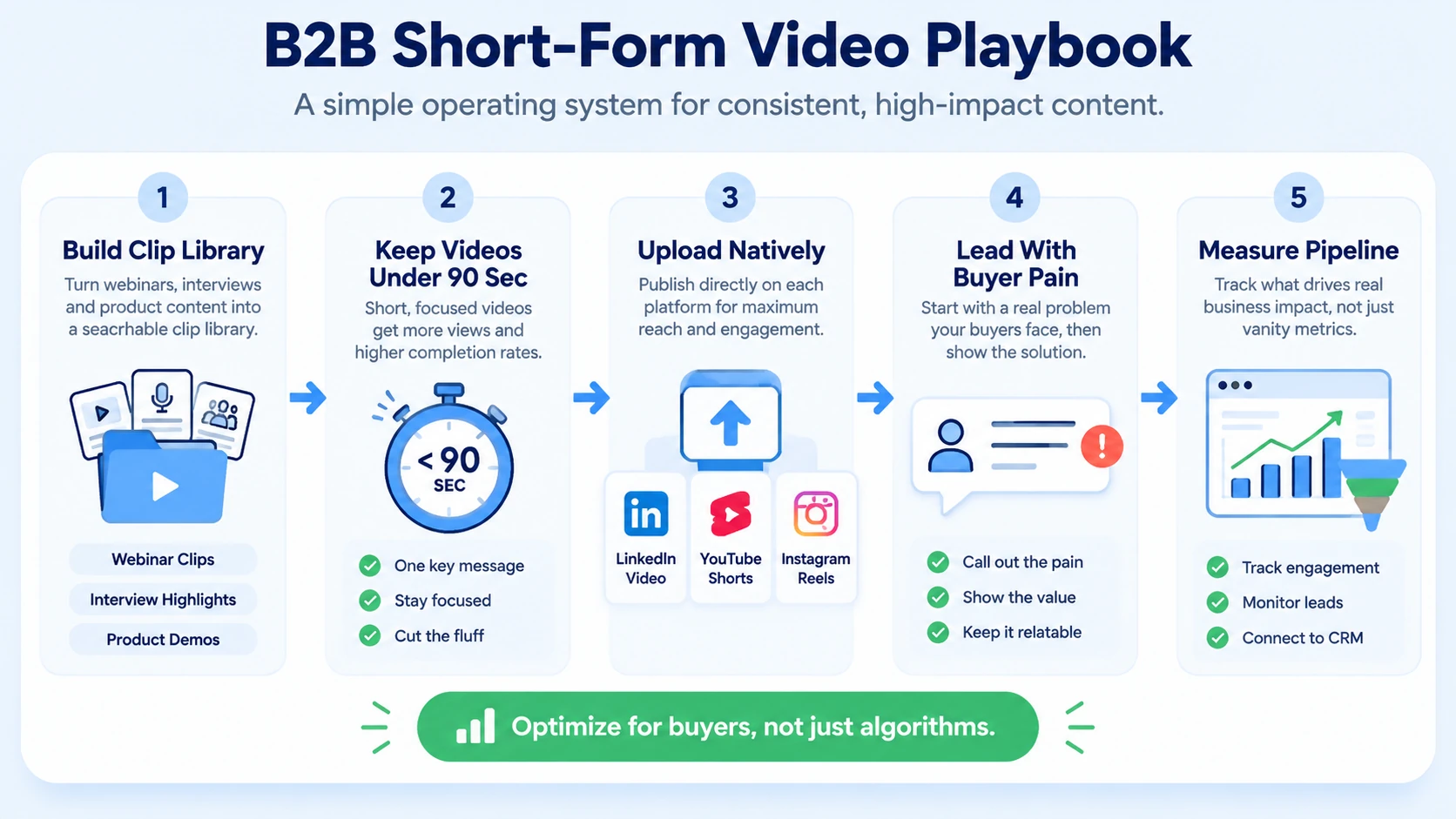
- Build a clip library from existing content: Audit every webinar, sales call recording, podcast, and demo from the last 12 months. Each one contains multiple clips. This is the fastest way to produce consistent short-form video without a weekly production burden.
- Set a 90-second ceiling: The average B2B video length has compressed from 168 seconds in 2024 to just 76 seconds in 2026, reflecting both platform algorithm changes and viewer behaviour as busy professionals prefer concise, high-value content. Match that expectation.
- Post natively and consistently: Native uploads always outperform cross-posted links. In Q4 of 2025, LinkedIn video uploads had increased by 20% year-over-year , signalling that the algorithm rewards consistent native posting.
- Lead with the decision-maker's problem: Every clip should open with a line that names a pain your ICP recognises immediately. Not "Today I want to talk about..." but "If your pipeline stalled after your last product launch, here is why."
- Amplify with targeting: Organic reach alone is not a distribution strategy. Use LinkedIn's job-title and company-size filters to put every clip in front of exactly the right decision-makers during the first 48 hours after posting. Short video ads under 30 seconds drive higher completion and engagement, and platforms like LinkedIn put that content in front of decision-makers where they already research vendors.
The teams I work with that execute these five steps consistently are the ones who stop treating video as a content checkbox and start treating it as a pipeline asset. That shift in intent changes everything: brief quality, hook structure, edit pacing, CTA design, and distribution all improve when the goal is a booked demo, not a view count.
If your team needs help turning existing assets into a consistent short-form video system, Komet Media's video editing services are built exactly for that.
Conclusion
The common short-form video mistakes B2B brands make in 2026 are not creative problems. They are strategic ones. The fix is not a bigger production budget. It is clearer thinking about buyers, platforms, and pipeline.
- Stop producing for brand ego. Produce for buyer education.
- Match every clip to a funnel stage before you edit a single frame.
- Repurpose what you already have before commissioning new production.
- Measure pipeline influence, not vanity metrics.
Short-form video is the highest-leverage content format available to B2B teams right now. Use it like one.
Frequently Asked Questions
Q1: Why does B2B short-form video get low views on LinkedIn in 2026?
Most low-view B2B videos fail in the first 3 seconds because the hook is brand-first, not problem-first. Short-form video under 90 seconds is now prioritised by the LinkedIn algorithm. Post natively, lead with buyer pain, and publish consistently for at least 60 days before evaluating reach.
Q2: How long should a B2B short-form video be?
The average B2B video length has compressed to just 76 seconds in 2026. For LinkedIn and YouTube Shorts, target 45–90 seconds. For TikTok for Business and Instagram Reels, 30–60 seconds tends to perform better with top-of-funnel audiences.
Q3: What makes B2B short-form video feel too salesy?
Content feels salesy when it speaks from the brand's perspective instead of the buyer's. Removing direct CTAs from early-funnel clips, using a real founder or expert voice, and leading with a genuine insight rather than a product claim all reduce the "ad feel" significantly.
Q4: Should B2B brands use TikTok for Business?
Yes, selectively. TikTok works for B2B when the content teaches something a buyer actively searches for. Treat it as a top-of-funnel demand generation channel for founders and product experts, not as a platform for brand announcements or trend-chasing.
Q5: How do we measure B2B short-form video ROI?
Track downstream signals: demo requests that cite a video, mentions in sales discovery calls, inbound leads from content-specific landing pages, and pipeline value from contacts who engaged with video before converting. View counts alone are not ROI.
Q6: What content repurposing framework works best for B2B short-form video?
Start with long-form assets your team already owns: webinars, podcasts, demos, and sales calls. Identify the highest-insight 60–90 second moments, clip them with clean captions, add a funnel-stage appropriate CTA, and distribute natively on LinkedIn Video and YouTube Shorts first.