
🪄 AI Summary
Heading 1
Heading 2
Heading 3
Heading 4
Heading 5
Heading 6
Lorem ipsum dolor sit amet, consectetur adipiscing elit, sed do eiusmod tempor incididunt ut labore et dolore magna aliqua. Ut enim ad minim veniam, quis nostrud exercitation ullamco laboris nisi ut aliquip ex ea commodo consequat. Duis aute irure dolor in reprehenderit in voluptate velit esse cillum dolore eu fugiat nulla pariatur.
Block quote
Ordered list
- Item 1
- Item 2
- Item 3
Unordered list
- Item A
- Item B
- Item C
Bold text
Emphasis
Superscript
Subscript
Reels for funded AI/tech startups matter more than most founders assume, and not for the reason people usually think. This is not about chasing reach for its own sake. It is about proof. B2B buyers are more skeptical of AI claims than at any point I have seen, and a short, honest product clip does more to earn trust than another paragraph of marketing copy. I have watched small AI teams get this backwards, spending their limited hours on polished brand videos while the demo footage that would actually convince someone sits unused.
Quick Answer
Reels for funded AI/tech startups work when they show the product actually doing something real, not when they lean on hype or generic AI-brand aesthetics that buyers have grown skeptical of.
Why Reels for Funded AI/Tech Startups Carry Extra Weight Right Now
Buyer skepticism toward AI claims has hardened. TrustRadius's 2026 B2B Buying Disconnect Report, based on a survey of 1,862 technology buyers and 444 vendors, found that 94% of B2B buyers now fact-check AI-generated research outputs, and 47% trust online resources less than they did a year earlier, up from 39% the year before. The same report found that vendor marketing collateral ranked last among resources buyers actually consult, while 74% of buyers use reviews and 53% spoke to a peer about a product before buying.
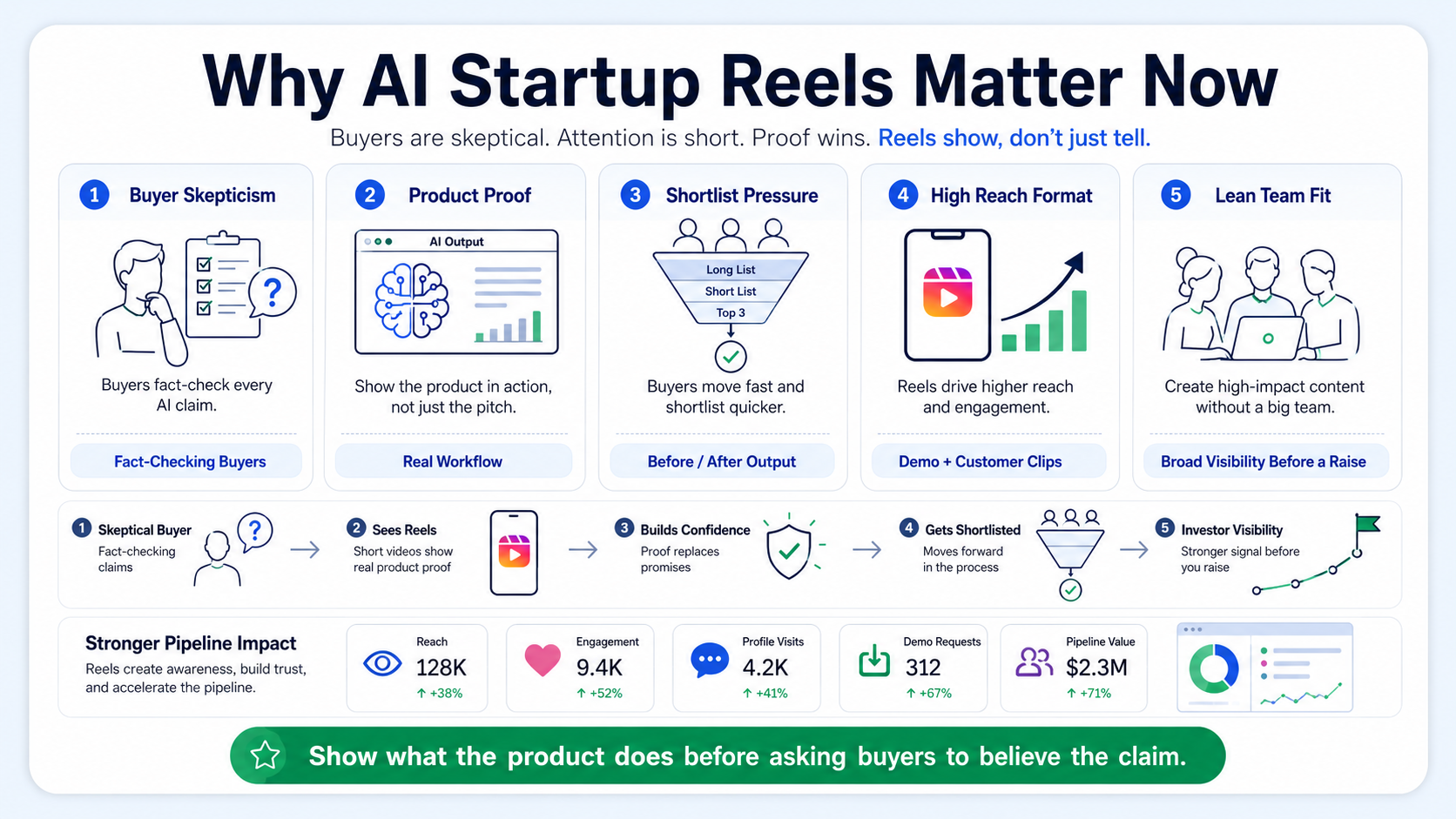
That shift matters directly for how a funded AI startup should use video. A Reel that lets the product speak for itself, a real workflow, a real output, a real before-and-after, carries more weight than a Reel built around a claim the viewer has no way to verify. Omnibound's 2026 compilation of B2B buying statistics found that 83% of buyers now consider three or fewer products before deciding, which means an AI startup has a narrow window to be one of the products a buyer actually trusts enough to shortlist.
The reach math still works in a startup's favor too. Reels carry an average reach rate of roughly 30.81%, more than double the rate of carousels, image posts, and Stories, according to Digital Applied's 2026 Instagram statistics report. Vidico's 2026 Instagram Reels statistics report notes that established software companies including Slack, Canva, HubSpot, and Notion already use Reels for product demos and tutorials, which is the same lane a funded AI startup can use, at a much smaller scale.
Team size makes this format especially practical. AI startups tend to run lean. Thunderbit's 2026 AI startup statistics report found that top AI startups generate roughly 5 to 6 times more revenue per employee than leading SaaS firms, a pattern that reflects small, high-output teams rather than large marketing departments. A format built from existing product demos and customer calls fits that reality better than a production schedule built for a company with a dedicated content team.
Video also does two different jobs for a funded AI or tech startup, and it helps to know which one a given Reel is meant to serve. One is building inbound pipeline, where the goal is converting attention into demo requests. The other is growing brand awareness ahead of a funding round, where the goal is being recognized by investors and buyers before an active outbound conversation starts. Our guide on Instagram growth for AI and ML startups goes further into how these goals shape a content plan for this specific category.
Where Funded AI/Tech Startups Get Reels Wrong
A handful of patterns account for most of the wasted effort.
- Leaning on hype instead of proof. A Reel built around a bold claim with nothing to back it up runs directly into the skepticism buyers already bring to AI marketing.
- Sounding generic and AI-produced. Content that feels automated rather than made by a real team can actively work against a brand. Research cited by AI Business Weekly's 2026 report on AI in social media found that half of Gen Z users have unfollowed, muted, or blocked an account they suspected was AI-generated.
- Waiting for a big production budget. Small teams often delay publishing until they can afford a polished shoot, when a clean screen recording of the actual product usually performs better anyway.
- Never repurposing demo calls and customer conversations. Sales calls, onboarding sessions, and investor updates often contain the exact proof points a Reel needs, unused.
- Explaining the technology instead of the outcome. Buyers care more about what changes for them than how the underlying model works.
- Publishing once and stopping. A single strong Reel before a launch does not build the recognition a startup needs heading into its next funding round.
These mistakes tend to reinforce each other. A team that leans on hype instead of proof also tends to skip repurposing real demo footage, since the honest version of the product feels less exciting than the pitch. Breaking that pattern usually means starting from what the product actually does on camera, not from what the team wishes it looked like.
What Good Reels for Funded AI/Tech Startups Actually Look Like
Reels for Funded AI/Tech Startups work best when they map to a small set of formats built from what the team is already doing, rather than a long list of ideas nobody has time to produce.
That range fits how Influencer Marketing Hub's 2026 benchmark analysis describes format performance, with Reels between 30 and 60 seconds producing the strongest engagement and median views in large-scale testing.
Most funded AI startups do not need all five formats running at once. A reasonable starting point is one product demo and one customer proof clip per week, adding a technical concept explainer or build-in-public update once the first two formats find an audience. Our short-form video content guide for AI and ML startups covers how other teams in the category have sequenced this in practice.
A Practical Workflow for a Small Team
Most funded AI and tech startups do not need a bigger content team. They need a system for pulling more out of what a small team already records.
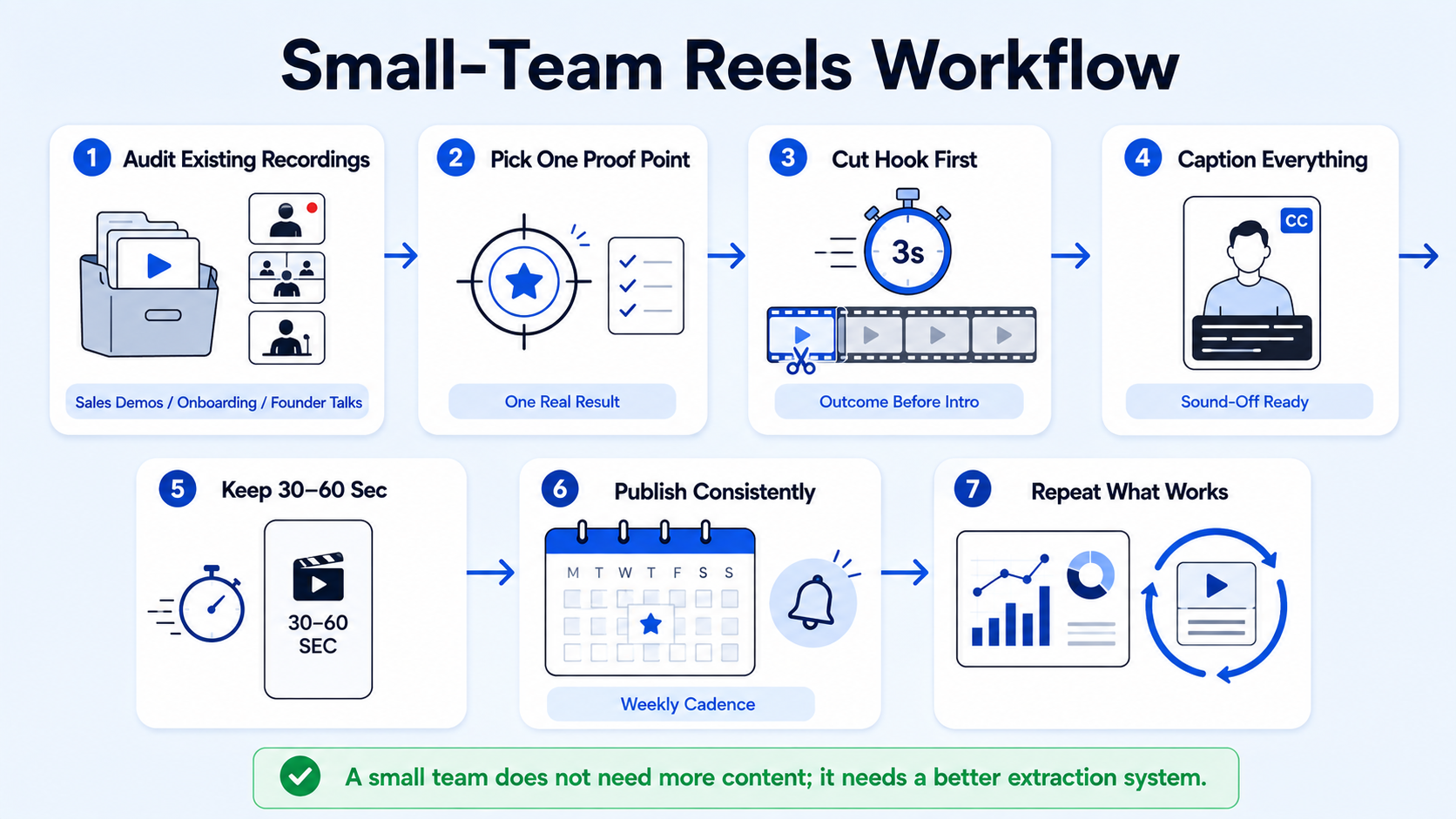
- Audit existing recordings first. Sales demos, onboarding calls, founder talks, and investor updates usually contain several usable clips nobody has pulled out yet.
- Pick one proof point per Reel. A single real result or a single clear explanation works better than trying to summarize the whole product.
- Cut for the hook first. Open on the outcome or the specific claim, not a company introduction or a logo animation.
- Caption everything. Most viewers watch with the sound off, so the message needs to hold up as on-screen text alone.
- Keep most formats in the 30 to 60 second range. Shorter product demos can run closer to 20 seconds when the action is simple.
- Publish on a consistent cadence, even if it is modest. A steady weekly rhythm from a small team beats a large batch published once and abandoned.
- Review what earned real engagement and repeat the pattern. A format that resonates with the target buyer is worth running again with a new example.
This is the same discipline behind our short-form video editing and Instagram growth work, applied to what a lean AI or tech team already has recorded. Our guide on how a one-person marketing team can ship daily video covers the same constraint in more depth.
What Changes the Price of Reels for Funded AI/Tech Startups
Cost depends mostly on scope, not on the platform. The factors that move the price the most:
- Number of Reels per month. A handful of clips pulled from existing demos costs less than a full weekly publishing schedule across several formats.
- Whether new footage needs to be filmed. Reels built from existing screen recordings and sales calls are faster to produce than net-new founder or customer shoots.
- Motion graphics for technical concepts. Explaining a model, workflow, or system visually takes more editing time than a straight screen recording.
- Number of source recordings available each month. More demo calls, customer conversations, and internal talks to pull from generally means more Reels can come out of the same production cycle.
- Strategy and selection support. Some engagements cover editing only, while others include deciding which moments are worth turning into Reels in the first place.
Komet Media typically works with funded AI and tech startups through retainers in the range of roughly $2,500 to $5,000, with final scope set by the factors above rather than a fixed public package. Our B2B video editing pricing models resource breaks this down further, and our video editor cost guide compares freelancer, subscription, and retainer pricing.
Measuring What Reels Actually Produced
Views and reach describe attention. They do not tell a startup whether Reels are building the trust that shows up in a demo request or an investor conversation. Match the metric to the purpose of each Reel.
Treat these signals together rather than relying on one number. Attribution is often imperfect at this stage, since an investor or buyer may follow a startup's Reels for months before a term sheet or a demo request ever gets logged as connected to it. Our notes on video KPIs B2B teams should track go further into building a measurement plan that connects social activity to pipeline and investor visibility over a full quarter.
Conclusion
Reels for Funded AI/Tech Startups work when a small team treats them as proof rather than promotion, built from demos, customer calls, and founder talks the company is already producing. In a market where buyers fact-check most AI claims by default, showing the product doing something real earns more trust than another polished but unverifiable pitch. We work with funded AI and technology startups on turning existing demo and customer content into exactly this kind of Reel.
FAQ
What are Reels for funded AI/tech startups? They are short vertical videos, typically 15 to 60 seconds, published to Instagram to show a product demo, a technical concept explained simply, or a real customer result. For AI startups specifically, they work best as proof rather than promotional claims.
How much does it cost to produce Reels for an AI or tech startup? Cost depends on how many Reels get produced per month, whether new footage needs filming, and how much motion graphics or captioning each format needs. Komet Media typically works in the $2,500 to $5,000 range per retainer. See our B2B video editing pricing models breakdown for detail.
What does the production process look like? It usually starts with auditing existing recordings such as demo calls and founder talks, picking one proof point per Reel, cutting for the hook, captioning for sound-off viewing, and publishing on a consistent cadence.
How long does it take to see results? A single Reel rarely changes anything by itself. Most startups need a few months of consistent publishing before reach, engagement, and any connection to demo requests become clear enough to evaluate.
What deliverables should a startup expect? Expect a set of captioned, vertical Reels per month, usually pulled from existing product demos, customer calls, and founder talks, formatted to the 30 to 60 second range that tends to perform best.
Is a freelancer or an agency better for this work? A freelancer can work well for a startup producing a handful of Reels a month with one founder directing every edit. An agency tends to fit better once the team wants a repeatable weekly system without pulling a founder's time into every decision. Our freelancer versus agency comparison covers the trade-offs in more depth.
Does every AI startup need to be on Instagram before the next funding round? Not automatically. A team with almost no product or customer footage yet will likely get more value from LinkedIn first, where most B2B buyers and investors already spend research time. Instagram earns its place once there is real demo or proof content worth repurposing and a team wants to build visibility with a broader audience ahead of a raise.
Does Komet Media produce Reels for funded AI and tech startups? Yes. We edit product demos, customer proof clips, and founder content into Reels for funded AI-native and technology startups, usually built from footage the team already has. You can see our approach on the Instagram growth service page or book a call to talk through a specific product's content.