
🪄 AI Summary
Heading 1
Heading 2
Heading 3
Heading 4
Heading 5
Heading 6
Lorem ipsum dolor sit amet, consectetur adipiscing elit, sed do eiusmod tempor incididunt ut labore et dolore magna aliqua. Ut enim ad minim veniam, quis nostrud exercitation ullamco laboris nisi ut aliquip ex ea commodo consequat. Duis aute irure dolor in reprehenderit in voluptate velit esse cillum dolore eu fugiat nulla pariatur.
Block quote
Ordered list
- Item 1
- Item 2
- Item 3
Unordered list
- Item A
- Item B
- Item C
Bold text
Emphasis
Superscript
Subscript
If you're a founder, marketing head, or growth team trying to budget for video, the first question is always the same: how much does a video editor cost? The short answer is $25 to $300+ per hour depending on experience, scope, and engagement model. But that range is nearly useless without context. This guide breaks down every pricing tier, engagement model, and hidden cost factor so your team can make a clear, defensible decision on where to spend and what to expect.
TL;DR
- Freelance video editors run $25–$150/hr on platforms like Upwork and Fiverr; senior talent reaches $200–$300+/hr.
- Agencies charge $150–$500+/hr or $2,000–$15,000+ per project depending on scope.
- Subscription services offer flat monthly rates ($500–$3,000/mo) but often lack strategic input.
- Scope of work, post-production complexity, and turnaround time drive the final number more than anything else.
What Is the Average Cost of a Professional Video Editor in 2026?
Understanding how much a video editor costs starts with the three main engagement models: hourly, project-based, and retainer. Each has a different risk profile and output expectation.
What moves the number:
- Complexity: Basic cuts cost less than projects requiring motion graphics, color grading, or sound design.
- Software stack: Editors fluent in Adobe Premiere Pro, Final Cut Pro, or DaVinci Resolve command higher rates than generalists.
- Turnaround: Rush timelines typically add 20–50% to a project quote.
- Deliverable count: A single YouTube production edit differs sharply from a full content repurposing campaign with 10+ short-form video assets.
On freelance marketplaces like Upwork and Fiverr, entry-level editors start around $25–$40/hr. Mid-tier editors with a solid reel and platform-specific knowledge (vertical video ratios, caption pacing, hook structure) sit between $60–$120/hr. Senior editors who own the full post-production workflow, including sound design and motion graphics, typically charge $150–$300+/hr.
Rates on Toptal and similar curated platforms skew higher because the vetting process filters for proven talent; expect $100–$250+/hr as a baseline on those networks.
For B2B SaaS teams producing buyer education content, webinar clips, or demo repurposing assets, a mid-to-senior freelancer or a specialist agency is usually the right tier. A $35/hr editor on Fiverr may cut the footage correctly but will miss the strategic layer: hook architecture, audience pacing, and the positioning language that makes a clip work for pipeline, not just views.
If you want to see what specialist short-form video editing looks like at the B2B level, the scope differences become clear immediately.
Freelance vs. Agency Video Editor Cost: A Direct Comparison
This is the most common fork in the road for funded startups and marketing heads. Here is how the two models stack up across the factors that actually matter.
When freelance makes sense:
- You have a one-time deliverable with a tight budget.
- Your internal team handles strategy and the editor just executes.
- You have a clear scope of work and don't need back-and-forth on positioning.
When an agency makes sense:
- You need a repeatable content pipeline, not a single video.
- Your team lacks bandwidth to manage a freelancer's post-production workflow.
- You want the editing to serve a business outcome (demo demand, inbound leads, founder-led growth visibility) not just look good.
For most B2B SaaS teams I work with, the hidden cost of the freelance model is project management overhead. Someone on your team spends 3–5 hours per project briefing, reviewing, and chasing revisions. At the agency level, that coordination is built into the retainer agreement.
Companies like Vidpros and TastyEdits offer subscription-based editing at flat monthly rates, which works for raw volume. But volume without strategy produces content that fills a feed without moving a pipeline. If you're a funded startup where every piece of content needs to pull weight, the agency retainer model tends to outperform on ROI, even if the monthly number looks higher.
How Much Does a Video Editor Cost for SaaS and Startup Pitch Content?
Startup pitch videos, product demos, and founder thought leadership clips sit in a specific pricing tier because they require more than technical editing. They require positioning judgment.
Typical price ranges for startup-specific video types:
- Short product demo clips (60–90 sec, repurposed from screen recording or live demo): $300–$1,200 per asset
- Founder thought leadership clips (cut from long-form interviews or podcasts): $200–$800 per asset
- Investor pitch video (scripted, produced, branded): $3,000–$12,000+
- Webinar repurposing campaign (1 webinar into 8–12 short clips): $1,500–$5,000
A pitch video that looks polished but opens with the wrong hook or buries the product value prop is not a cheap video. It's an expensive mistake made at the wrong stage of the funnel.
For webinar and podcast repurposing specifically, the pricing depends heavily on raw footage length and deliverable count. A 60-minute webinar repurposed into 10 short-form clips with captions, branded lower-thirds, and platform-specific formatting typically runs $1,500–$3,500 depending on post-production complexity.
What separates a good SaaS video editor from a generalist is their ability to identify the three or four moments in a 45-minute product walkthrough that a buyer actually cares about. That editorial judgment is what you're paying for at the higher end of the range, and it's the variable that most budget conversations miss entirely.
For teams building video editing services workflows from scratch, the first question to answer is whether you're producing for awareness (top-of-funnel LinkedIn clips, YouTube production) or conversion (demo request, sales enablement). The answer changes both the editorial approach and the budget.
Video Editor Pricing for VC Firms and Investment Fund Marketing
VC firms and PE funds are increasingly using short-form video for LP relations, founder recruitment, and thought leadership distribution. The pricing model here overlaps with B2B SaaS but with some distinct scope differences.
Common video needs for investment firms:
- Partner interview clips for LinkedIn and YouTube
- Fund thesis explainer videos
- Portfolio company founder spotlights
- LP update summaries (non-confidential, brand-facing)
- Event recap content from industry events
Typical investment firm video costs in 2026:
The question of whether VC firms should hire in-house video editors or outsource is less about cost and more about volume and consistency. An in-house hire at $70,000–$110,000/year (salary only, before tools, benefits, and management overhead) only pencils out if the firm is producing at high enough volume to justify full-time bandwidth.
For most firms producing 8–20 assets per month across partners and portfolio content, an agency retainer agreement delivers more output per dollar and eliminates the hiring, onboarding, and management cost entirely. The post-production workflow is owned externally, which matters when a fund's communications team is lean.
For investor relations content specifically, the risk of a substandard edit is reputational. A poorly produced LP-facing video signals operational sloppiness, regardless of the underlying fund performance.
Hidden Costs in Video Editor Pricing Most Teams Miss
The quoted rate is never the full number. These are the line items that inflate budgets for teams who don't plan for them.
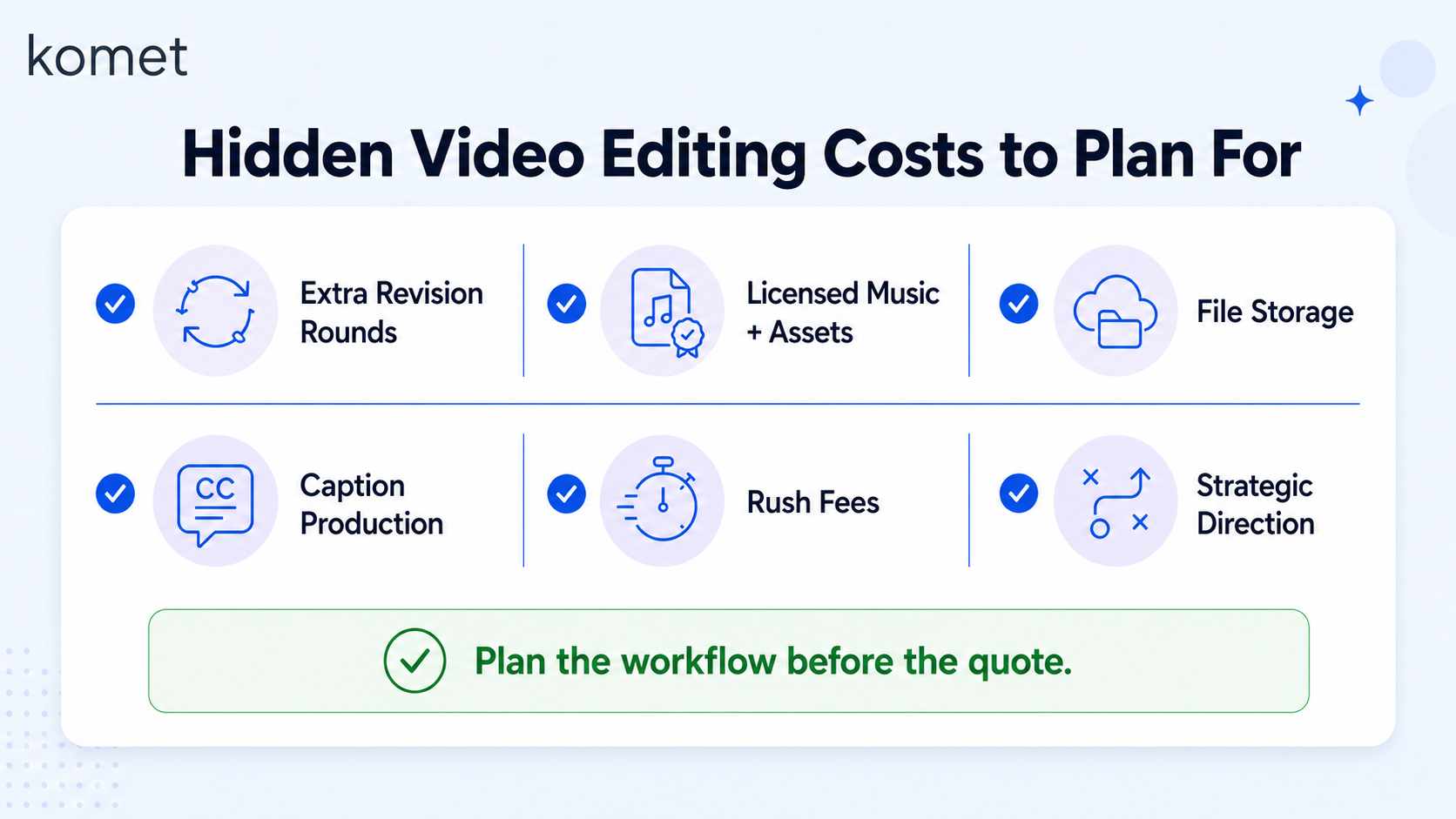
Revision cycles: Most freelance engagements include one or two revision rounds. Every round beyond that adds $50–$300+ depending on the scope of changes requested. Agencies with retainer agreements typically include unlimited revisions within defined parameters.
Software and asset costs: If you need licensed music, stock footage, or custom motion graphics, those are often passed through at cost or quoted separately. Motion graphics packages alone can add $200–$1,500 to a project budget.
File delivery and storage: Large file transfers, proxy workflows, and cloud storage costs are rarely discussed upfront. For teams managing high-volume content repurposing pipelines, this is a real line item.
Caption and subtitle production: Platform-accurate captions (burned-in for LinkedIn, SRT for YouTube) are often not included in base rates. Budget $50–$150 per video if this is a requirement.
Rush fees: A 24–48 hour turnaround on a standard project typically carries a 25–50% premium. Build realistic timelines into your scope of work to avoid this.
Strategic direction: A freelance editor working in Adobe Premiere Pro or DaVinci Resolve will execute what you give them. If you need someone to decide what to clip, how to hook the audience, and where to cut for maximum retention, that strategic layer costs more and is rarely priced into a standard editing quote.
For teams learning to hire a video editor who can operate at a strategic level, the cheapest quote rarely reflects the total cost of getting a usable, on-brand deliverable.
Conclusion
- How much does a video editor cost ranges from $25/hr for a generalist freelancer to $500+/hr for a senior agency with strategic capability.
- Scope of work, post-production complexity, and engagement model drive the final number more than any single rate.
- For B2B SaaS teams and investment firms, the real cost is not the editing rate; it's the cost of content that doesn't move pipeline.
- If you're producing more than 8 assets per month, a retainer agreement almost always outperforms per-project hiring on both output and total spend.
Frequently Asked Questions
Q1: How much does a video editor cost per hour on average in 2026?
Freelance editors on platforms like Upwork run $25–$150/hr for standard work. Senior editors with motion graphics and color grading skills charge $150–$300+/hr. Agency rates start around $150/hr and scale with specialization and output volume.
Q2: Is a subscription video editing service worth it for a SaaS team?
Subscription services work well for high-volume, lower-complexity editing. For B2B SaaS teams that need strategic repurposing of demos, webinars, and founder content, a specialist agency retainer typically delivers stronger pipeline-aligned output than a volume subscription.
Q3: What does it cost to hire a video editor for fund marketing?
VC and PE firms typically spend $3,000–$8,000/month on a content retainer or $400–$2,000 per asset for individual thought leadership clips. Full production of a fund thesis or LP-facing video runs $5,000–$15,000 depending on complexity.
Q4: Should I hire in-house or outsource video editing for my startup?
Outsourcing makes more financial sense for most funded startups. An in-house editor at $70,000–$110,000/year in salary only pencils out at high production volume. An agency retainer gives you a full post-production workflow without the overhead.
Q5: What is project-based pricing for video editing?
Project-based pricing means a fixed fee per deliverable rather than hourly billing. Typical ranges: $500–$2,000 for short-form clip packages, $3,000–$12,000+ for fully produced brand or pitch videos. Always define the scope of work in writing before work begins.
Q6: How does content repurposing affect video editing costs?
Repurposing (turning a webinar or podcast into multiple short-form clips) is usually more cost-efficient than producing from scratch. A 60-minute source file repurposed into 10 assets typically runs $1,500–$3,500, making the per-asset cost significantly lower than individual productions.