
🪄 AI Summary
Heading 1
Heading 2
Heading 3
Heading 4
Heading 5
Heading 6
Lorem ipsum dolor sit amet, consectetur adipiscing elit, sed do eiusmod tempor incididunt ut labore et dolore magna aliqua. Ut enim ad minim veniam, quis nostrud exercitation ullamco laboris nisi ut aliquip ex ea commodo consequat. Duis aute irure dolor in reprehenderit in voluptate velit esse cillum dolore eu fugiat nulla pariatur.
Block quote
Ordered list
- Item 1
- Item 2
- Item 3
Unordered list
- Item A
- Item B
- Item C
Bold text
Emphasis
Superscript
Subscript
You're one person. You have a product roadmap, a pipeline to feed, a LinkedIn presence to maintain, and your CEO asking why you're not posting video yet. The pressure to figure out how a one-person marketing team can ship daily video without burning out or hiring a full production crew is completely real. I've built video systems for solo B2B marketers, and this guide is the exact playbook I'd hand you today.
TL;DR
- Repurposing existing long-form content (webinars, podcasts, demos) is the fastest path to daily video output as a solo marketer.
- Content batching, a locked editorial calendar, and scheduling tools eliminate daily decision fatigue.
- The right tool stack (CapCut, Canva, DaVinci Resolve) keeps production lean without sacrificing quality.
- A three-pillar content framework turns one recording session per week into five to seven clips.
Can One Person Realistically Post Video Content Daily?
The short answer is yes, but only if you stop treating every video as a new production and start treating it as a system output. According to HubSpot's 2026 State of Marketing report, short-form video generated the highest ROI among all content formats, with 48.6% of marketers ranking it among their top-performing assets. That stat matters for solo marketers because it justifies every minute you spend building a repeatable workflow rather than one-off videos.
Fully 78% of B2B marketers currently use video in their programs, and 56% plan to increase their investment in B2B video marketing within the next year, according to the 2025 B2B Marketing Benchmark Report from LinkedIn and research firm Ipsos. If over half of B2B marketing teams are scaling up video, a solo marketer who ships nothing is falling visibly behind.
The key shift: daily video is not about filming every day. It's about batching production into one or two focused sessions per week and scheduling the output across platforms. The companies winning in 2026 will be the ones producing consistent, multi-format video content without reinventing the wheel each time.
Here's what makes daily shipping realistic for a single person:
- Repurposing framework: One webinar or podcast episode becomes five to seven short clips.
- Content batching: Film four to six raw clips in a single 90-minute session.
- Editorial calendar: Decisions are made on Monday. The rest of the week is execution.
- Scheduling tools: Buffer, Publer, or native schedulers queue everything in advance.
- Template-based editing: Canva and CapCut templates eliminate reformatting time.
Short-form video is relatively easy to produce, and it's more effective than polished brand content. That's exactly the right effort-to-reward ratio for teams who are often overstretched and underfunded.
Solo Marketer Daily Video Workflow: The Three-Layer System
How a one-person marketing team can ship daily video comes down to structure, not heroics. Use a three-layer system that separates thinking, filming, and editing into distinct blocks.
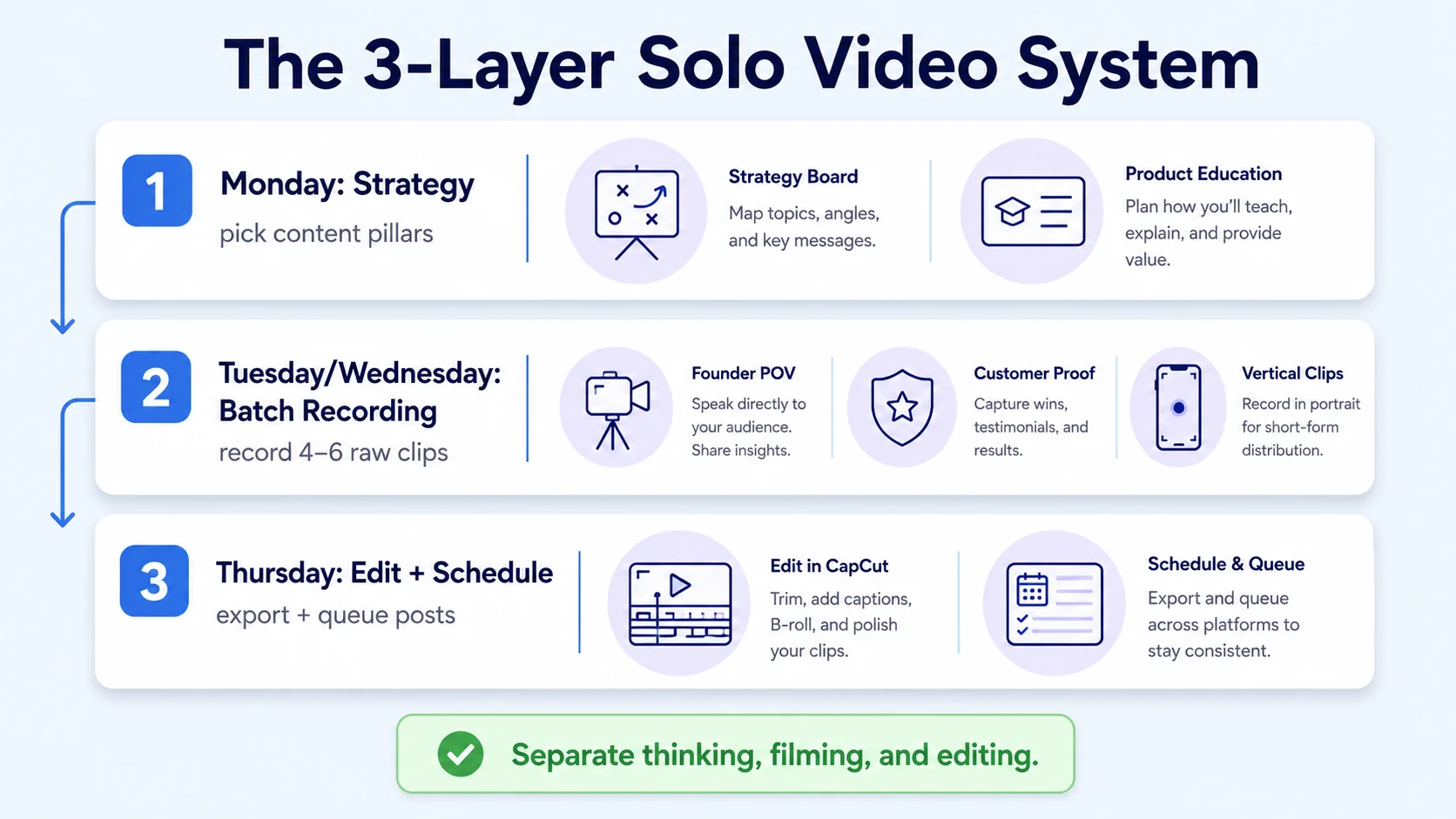
Layer 1: Strategy (Monday, 30 minutes)
Set your week's content pillars before you touch a camera. At Komet Media, we use three recurring pillars for B2B SaaS teams:
- Product education: How a feature works, a demo walkthrough, a common use case.
- Founder/executive POV: A take on an industry shift, a lesson learned, a bold prediction.
- Social proof/pipeline: A customer outcome, a result stat, an objection handled.
These three pillars alone generate 15 to 21 clip ideas per month without repeating yourself.
Layer 2: Batch Recording (Tuesday or Wednesday, 90 minutes)
Record four to six raw clips back-to-back. No wardrobe changes, no set redesign. Vertical format (9:16), phone camera or webcam, decent ring light. Vertical video (9:16 aspect ratio) is the dominant format, perfect for mobile viewing and creating concise SaaS product demos. Keep each raw recording under three minutes. You'll edit it down to 45 to 75 seconds.
Layer 3: Edit and Schedule (Thursday, 60–90 minutes)
Edit all four to six clips in one session using CapCut or DaVinci Resolve. Apply your template (captions, logo bug, opening hook card). Export and load into your scheduler. Done for the week. The most efficient B2B teams start with a single, insight-dense "anchor" asset, then break it into smaller, platform-ready pieces that keep the conversation going long after the original launch. That anchor is usually a webinar, podcast episode, or recorded demo call, assets you already have.
How to Batch Create Videos as a One-Person Marketing Team
Content batching is what separates solo marketers who ship daily from those who post twice a month and call it a strategy. The most efficient strategy involves repurposing one piece of long-form content (like a webinar) into multiple short video assets for different channels.
Here's the repurposing framework I recommend for B2B SaaS teams:
From one 45-minute webinar or podcast, extract:
- A 60-second clip of the sharpest insight or "aha moment"
- A 30-second clip of a specific product tip or feature explanation
- A 45-second founder commentary clip (record your reaction or expansion on a key point)
- A text-overlay quote clip from the best line of the episode (Canva, 20 seconds)
- A "what we covered" recap clip with three bullet takeaways (45 seconds)
That's five clips from one recording session. Run this once a week and you have 20 clips per month, covering every weekday plus weekends with room to spare. Check out our podcast production and repurposing services if you want this handled end-to-end.
Repurposing is not cutting corners. It's the highest-leverage move a solo marketer has. Every clip that comes from an existing asset is a video you didn't have to script, film, or concept from scratch.
Repurpose existing content, like webinars or whitepapers, into bite-sized, engaging video shorts tailored for platforms like Instagram. LinkedIn and YouTube Shorts are equally critical channels for B2B buyers evaluating SaaS products. You can explore Komet Media's webinar content repurposing workflow if you need a structured starting point.
Best Tools for Solo Video Marketing in 2026
The right tool stack removes friction. Wrong tools create it. Here's what actually works for a lean B2B setup:
For most solo B2B marketers, CapCut handles 80% of editing needs, Canva handles static assets and simple overlays, and DaVinci Resolve steps in when you need a more polished output for a campaign video or a demo. You don't need all three at once, start with CapCut and Canva. AI tools can streamline video production, from ideation to post-production, the biggest efficiency gains come from AI-powered repurposing, which can reduce hours of editing work to just minutes.
For captioning: always caption. 50% of silent video viewers rely on captions to understand the content, reinforcing why caption-free videos fail to connect with half their potential audience. CapCut and Descript both auto-generate captions that take under two minutes to review and correct. For scheduling, connect Buffer or Publer to your LinkedIn, Instagram Reels, TikTok, and YouTube Shorts channels. Schedule the full week on Thursday and don't touch it again until the following Monday.
How to Automate Video Content Creation for Small Marketing Teams
Automation for a solo marketer doesn't mean robots filming your videos. It means removing every manual decision that doesn't require your brain. Here's where automation creates real content velocity:
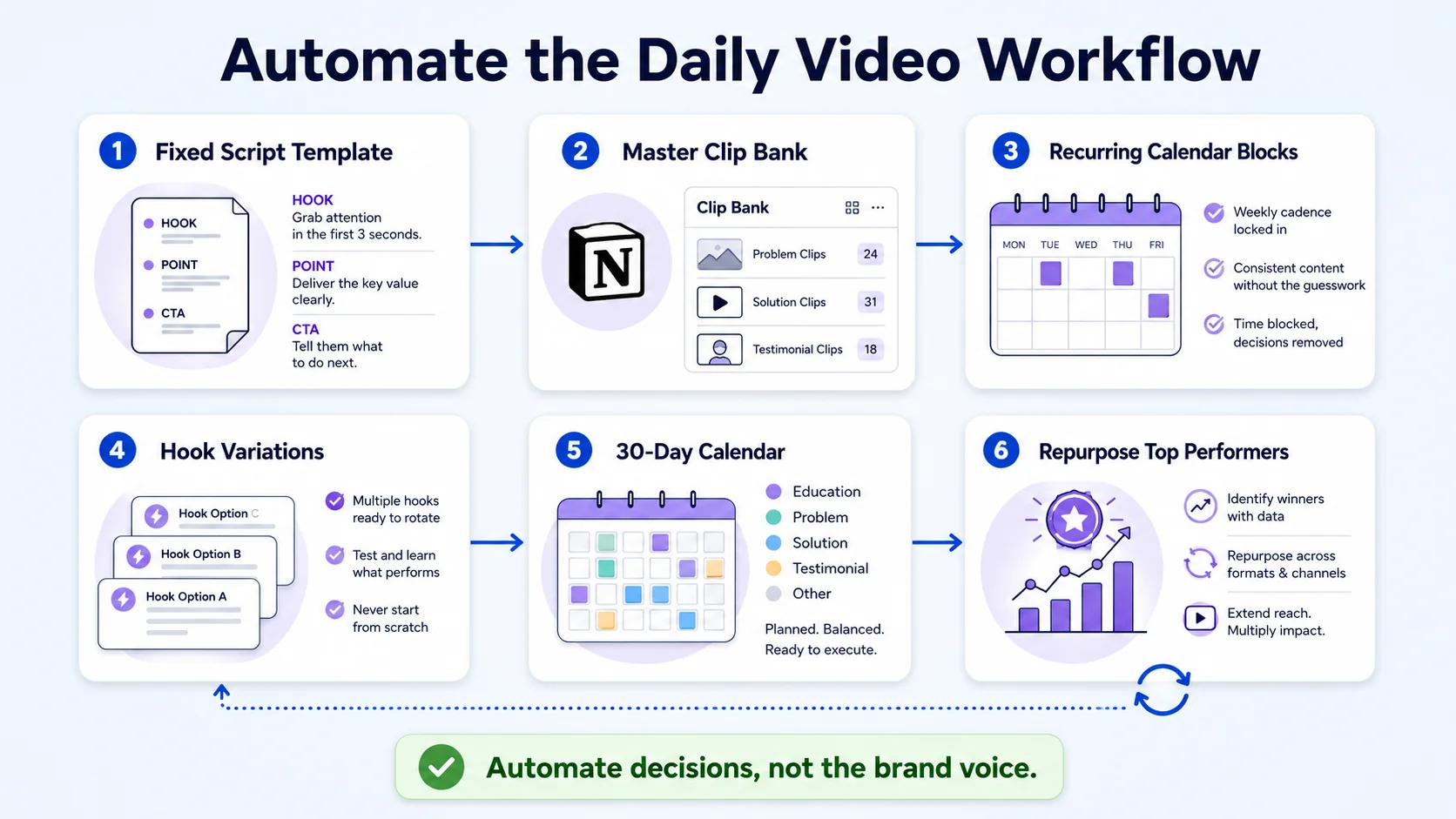
- Use a fixed filming script template. Hook (one sentence), point (two to three sentences), CTA (one sentence). Every clip follows this. Zero scripting from scratch.
- Create a master clip bank in Notion or Airtable. Every recorded clip gets logged with a title, pillar tag, platform target, and status (raw/edited/scheduled/published). This eliminates "what should I post?" forever.
- Set recurring calendar blocks. Strategy on Monday, filming on Tuesday, editing and scheduling on Thursday. Treat these like client meetings: non-negotiable.
- Use AI for hooks and captions. Tools like ChatGPT or Claude generate five hook variations from a topic sentence in seconds. Test two per clip.
- Pre-build a 30-day content calendar. Spend two hours per month mapping which clips hit which pillars on which days. Execution becomes mechanical.
- Repurpose top performers. When a clip exceeds average watch time or engagement, record a follow-up or expansion. Your analytics are your next content brief.
Teams are using AI to generate content ideas, create scripts, develop storyboards, edit footage, write captions, and optimise publishing schedules, allowing brands to produce more content without significantly increasing production costs or turnaround times. Check out our short-form video editing service if editing is the bottleneck preventing you from shipping consistently.
One-Person Marketing Team Video Distribution Strategy That Actually Works
Shipping daily video means nothing if it reaches no one. A smart video distribution strategy for a solo B2B marketer prioritises two to three platforms, not six.
Primary channel: LinkedIn. For B2B SaaS, this is non-negotiable. LinkedIn reported a 34% year-over-year increase in video uploads in Q4 2024 and a 36% year-over-year growth in total video viewership in 2025. The algorithm currently favours native video from individual profiles over company pages, meaning founder-led and marketer-led content gets more organic reach than branded posts. Post natively, not via a scheduling tool link, to maximise reach.
Secondary channel: YouTube Shorts. YouTube Shorts averages over 70 billion daily views, showcasing how audiences have embraced bite-sized video content. The TikTok algorithm and the YouTube Shorts algorithm both reward content velocity, consistent posting trains the algorithm to distribute your content more broadly. Upload the same clips you created for LinkedIn, removing any watermarks or TikTok branding.
Tertiary channel: Instagram Reels. 71% of marketers affirmed that short-form video content provides the most ROI compared to long-form video content (22%) and live video (6%). Instagram Reels surface well with warm audiences and paid amplification. If you're running any Instagram marketing or video advertising alongside organic, Reels become your testing ground for creative that you can then put behind.
Platform posting frequency guide:
One clip, reformatted and scheduled across three platforms: that's how a one-person marketing team can ship daily video without tripling the workload. Learn more about our video marketing services if you need support scaling distribution.
Conclusion
Daily video from a one-person marketing team is a systems problem, not a headcount problem. Here's what makes it work:
- Batch, don't grind. One 90-minute filming session per week powers a full week of content across three platforms.
- Repurpose relentlessly. Every webinar, podcast, and demo call you already have is a content library waiting to be cut.
- Automate decisions. A fixed editorial calendar, clip bank, and scheduling workflow eliminates daily friction.
- Distribute with focus. LinkedIn first, YouTube Shorts second, Instagram Reels third. Don't scatter, stack wins on two to three channels before expanding.
If editing or strategy is the bottleneck, Komet Media's video production team handles the heavy lifting while you stay focused on the pipeline.
Frequently Asked Questions
Q1: How many videos per week should a one-person marketing team aim for?
Start with five per week, one per day on LinkedIn. Batch-film four to six clips in a single 90-minute session on Tuesday or Wednesday. Once your workflow is stable, layer in YouTube Shorts and Instagram Reels using the same clips, reformatted.
Q2: What's the fastest way to produce daily marketing videos alone?
Repurpose existing long-form content. Pull a 45-second insight from a webinar, podcast episode, or recorded sales call. Add captions in CapCut, apply a hook card in Canva, and export in under 15 minutes per clip. No new filming required.
Q3: Do B2B buyers actually watch short videos on LinkedIn and Instagram?
Yes. 73% of B2B buyers say video is their preferred way to learn about a product or solution. Decision-makers are active on LinkedIn daily, and short clips under 75 seconds perform consistently in B2B feeds because they respect a buyer's limited time.
Q4: How long should B2B short-form videos be?
The sweet spot for engagement is between 30 and 60 seconds. For LinkedIn and YouTube Shorts, 45 to 75 seconds is the practical range for B2B content that delivers one clear point with a CTA.
Q5: What is content batching and why does it matter for solo marketers?
Content batching means recording multiple video clips in a single session rather than filming one at a time. It reduces setup friction, keeps your energy consistent across clips, and means you're making creative decisions once per week instead of daily. For a solo marketer, it's the difference between sustainable and burned out.
Q6: When should a one-person marketing team consider outsourcing video production?
When editing is consuming more than four hours per week, or when posting has become inconsistent because production is overwhelming. Outsourcing editing (not strategy) to a specialist like Komet Media's short-form video editing team lets you stay in control of messaging while removing the production bottleneck entirely.