
🪄 AI Summary
Heading 1
Heading 2
Heading 3
Heading 4
Heading 5
Heading 6
Lorem ipsum dolor sit amet, consectetur adipiscing elit, sed do eiusmod tempor incididunt ut labore et dolore magna aliqua. Ut enim ad minim veniam, quis nostrud exercitation ullamco laboris nisi ut aliquip ex ea commodo consequat. Duis aute irure dolor in reprehenderit in voluptate velit esse cillum dolore eu fugiat nulla pariatur.
Block quote
Ordered list
- Item 1
- Item 2
- Item 3
Unordered list
- Item A
- Item B
- Item C
Bold text
Emphasis
Superscript
Subscript
Proptech companies sell into an industry that runs on relationships, reputation, and word of mouth. Their podcasts often feature brokers, property managers, developers, and investors talking candidly about how deals and buildings actually work. Podcast creation and repurposing turns those conversations—from initial production to short-form clips—into content that travels through the networks real estate people already trust. The challenge is that real estate audiences are practical and time-poor. They want specific answers, not software language. This guide covers how I build podcasts, select moments, protect guest relationships, and distribute clips for proptech brands.
Quick Answer
Podcast creation and repurposing for proptech brands means launching shows from scratch and turning episodes into clips and assets real estate operators find useful. It works when content uses the industry's language, features credible practitioners, and travels through channels agents and operators already use.
Why Proptech Podcasts Carry So Much Weight
Real estate is a referral business. Agents, brokers, property managers, and investors rely heavily on peers when they decide what tools to try. A proptech podcast that features respected operators taps directly into that trust.
The audience is also active on social channels. According to the National Association of REALTORS® 2025 Technology Survey, 75% of agents who are REALTORS® use social media, second only to eSignature at 79%. NAR also reported that social media remains agents' top lead-generating technology, cited by 39% of respondents. These figures describe residential agents, not every proptech buyer, but they show that a large part of the market already spends working time on social platforms.
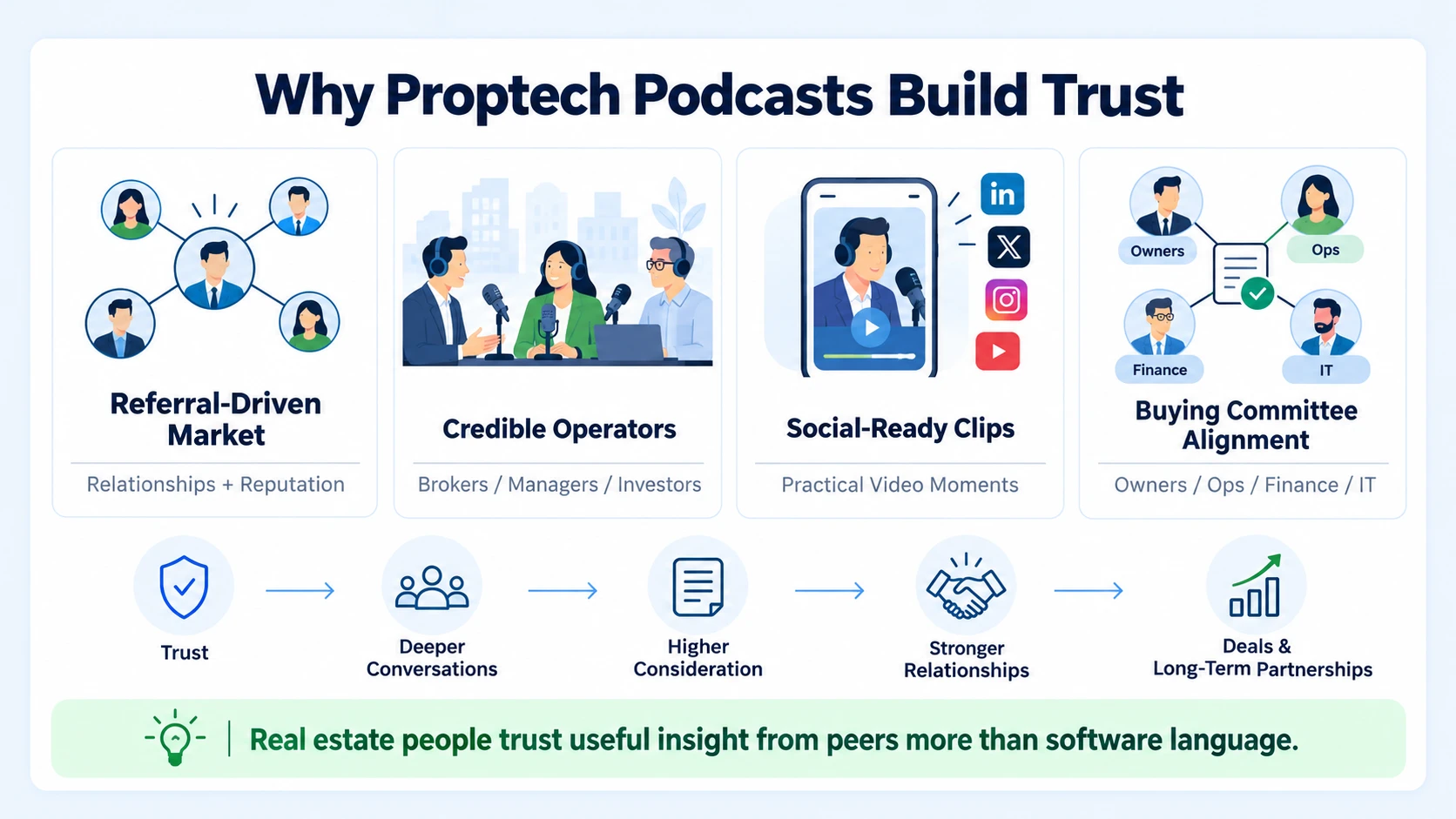
The wider format habit is strong too. The Infinite Dial 2026 from Edison Research at SSRS found that 58% of Americans age 12 and older consumed a podcast in the last month, and 57% have both listened to and watched one. These are general population figures, but they confirm that video clips from podcasts are a familiar way for professionals to take in long conversations.
The B2B reason matters most. Proptech purchases often involve owners, asset managers, operations leads, finance, and IT. The 2025 Edelman and LinkedIn B2B Thought Leadership Impact Report, based on a survey of nearly 2,000 management-level professionals, found that more than 40% of B2B deals stall because of internal misalignment within buying groups. Short clips aimed at each stakeholder can help keep a decision moving.
Different Proptech Buyers Need Different Clips
Proptech is not one market. A tool for residential agents, a platform for commercial landlords, and software for multifamily operators each speak to very different buyers. One mistake I see repeatedly is cutting the same clip style for all of them.
Here is how I think about audience fit:
The example angles above illustrate framing. They are not quotes from real episodes.
Each group also uses a different language. A multifamily operator talks about turns, delinquency, and resident retention. A commercial asset manager talks about occupancy, operating expenses, and lease-up. If a caption swaps their words for generic software terms, the clip loses the voice that made it credible.
Within each segment, the strongest moments tend to fall into a few types. Shared-pain moments describe a problem everyone in the segment recognizes. How-we-fixed-it moments show a practical change, with or without your product. Market-shift moments explain a rate, regulation, or labor trend affecting the business. Objection moments capture a guest explaining why they hesitated to adopt new software and what changed their mind. Good podcast repurposing pulls from all four, so your feed builds recognition, credibility, and sales support at the same time.
What to Watch for Before Publishing Proptech Clips
Real estate content has a few review points that are easy to miss.
Guest and client details. Brokers and operators often mention specific properties, tenants, deal terms, or clients. Many of those details are confidential or sensitive. Confirm before recording what guests can share, and review any clip that names a property, a counterparty, or a price.
Performance claims. A guest might say a tool "increased occupancy" or "cut vacancy." Without the timeframe, market, and other changes involved, that statement can overstate what happened. Keep the qualifiers attached or add a short context line.
Housing advertising rules. If your clips reach residential renters or buyers, federal fair housing law prohibits discriminatory statements in housing advertising, and many states add their own rules. I am not a lawyer, and your legal team decides how this applies to you. From a production view, the lesson is to avoid casual language about who a property "suits" and to have someone review any clip that describes a neighborhood or resident profile.
Footage and permissions. Property tours, drone shots, and on-site footage need the right permissions from owners and any people visible on camera.
Practical rules we follow:
- Brief guests on where clips will appear before recording.
- Flag any mention of specific properties, prices, tenants, or deal terms.
- Keep claims about results tied to the context the guest gave.
- Get written approval for on-site footage.
Captions deserve care as well. Real estate has its own acronyms and local terms, and automatic transcription often gets them wrong. A misspelled property type or market term tells an experienced operator that nobody checked the work.
A Podcast Creation and Repurposing Workflow for Proptech Teams
Most podcast repurposing fails before editing starts. The team has not decided who the content is for, or where it will go. Proptech adds seasonality, since many real estate segments have busy periods that change attention.
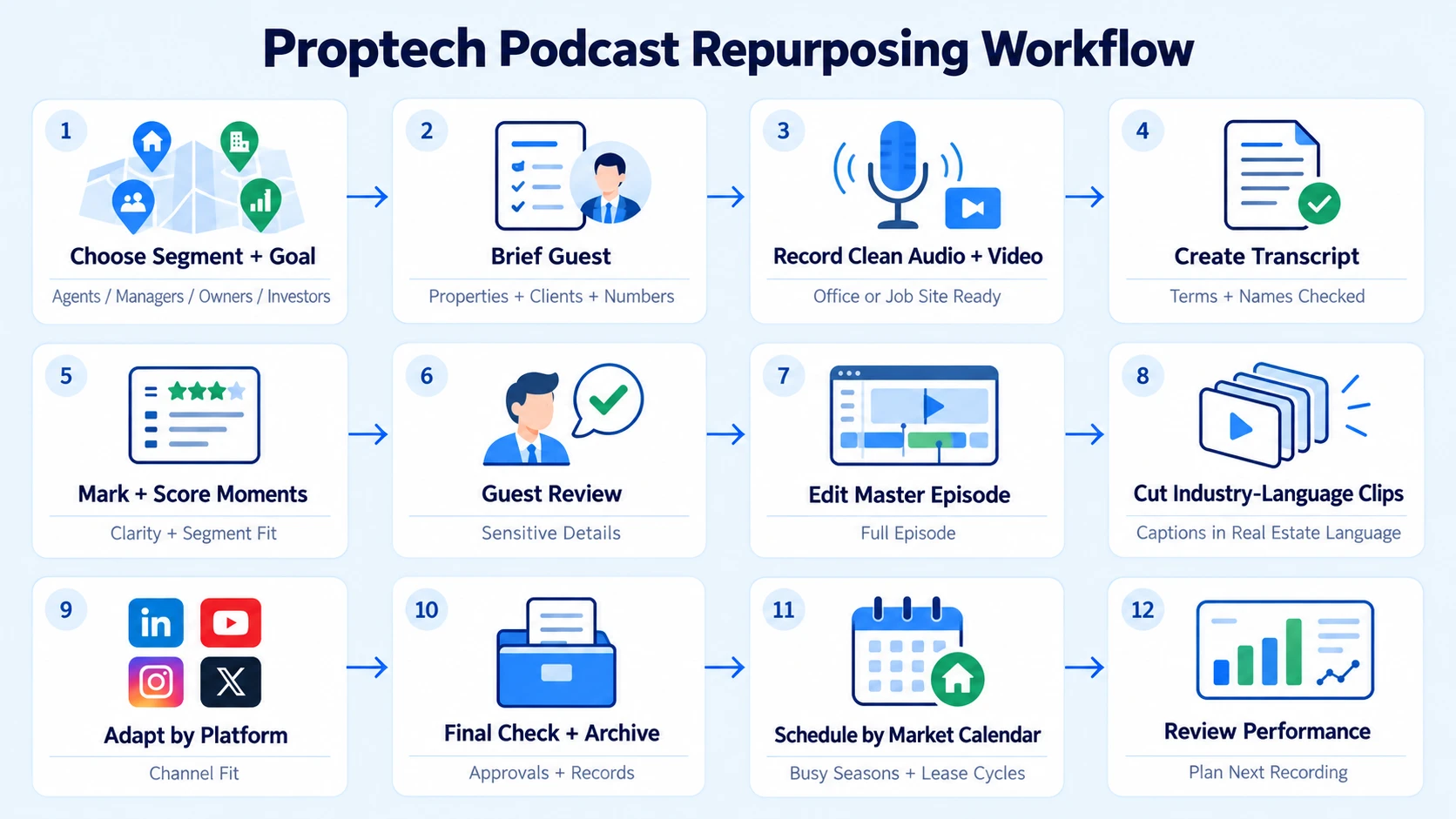
This is the cycle I recommend:
- Choose the segment and goal. Agents, property managers, commercial owners, or investors?
- Brief the guest. Confirm what they can share about properties, clients, and numbers.
- Record clean audio and video. Guests sometimes record from offices or job sites, so plan for noise.
- Create a transcript. Check industry terms and property names carefully.
- Mark and score moments. I score on clarity, segment relevance, whether it stands alone, and review risk.
- Review sensitive moments with the guest. Especially properties, numbers, and counterparties.
- Edit the master episode.
- Cut clips with captions in the industry's language.
- Adapt for each platform.
- Final check and archive.
- Schedule distribution around the market calendar.
- Review performance and feed lessons into the next recording.
A few recording habits make clipping easier. Ask one question at a time. After any general answer, ask the guest for a recent, specific example from a property or deal they can discuss. Close each episode by asking for their best practical advice in two sentences, which often becomes a strong opening clip.
Small teams can combine steps 4 and 5 and use one template for short formats. I would not skip the guest brief or the sensitive-moment review. A clip that exposes a guest's client relationship can cost you that guest and their network.
Plan around the real estate calendar. Residential markets often see seasonal changes in activity, and commercial teams have budget and lease cycles. Schedule planning clips before busy periods and lessons-learned clips after them. Our podcast-to-clips framework for B2B teams walks through the selection stage in more detail.
What one strong episode can usually become:
These are planning ranges, not promises. A guest with strong opinions and real stories produces far more usable moments than a polite overview. I would rather produce six strong clips than fifteen weak ones.
Distribution: Following the Real Estate Network
A polished clip with no distribution plan is still an underused asset. Proptech distribution works best when it follows how real estate information already moves.
Instagram and Facebook matter a great deal for residential agents and brokerages, who already use these platforms for their own marketing. Clips that help agents with daily problems fit naturally there.
LinkedIn works better for commercial real estate, multifamily operators, institutional investors, and enterprise property managers. These buyers evaluate vendors and follow industry voices there. Commercial guests often have strong followings among owners and lenders, so their shares can reach decision-makers directly.
YouTube gives full episodes a long shelf life and supports how-to searches. YouTube reported more than 1 billion monthly active viewers of podcast content as of January 2025. That is a platform-wide figure, not real estate data, but it supports publishing full episodes there with practical, searchable titles.
Brokerages, associations, and trade events are distribution partners. Many run newsletters, member groups, and conferences. A clip featuring a respected local broker can spread through an entire office or association if it is genuinely useful.
Email newsletters are underrated in real estate. A short monthly email with two clips and one written takeaway gives busy operators an easy way to keep up with the show. It is also a channel you control when social reach changes.
Guests are often your strongest channel. Real estate professionals have dense local networks. Send every guest their clips with suggested captions, and make it easy for them to share with their teams and clients.
Sales and onboarding benefit from a clip library organized by segment and objection. A peer operator explaining how they rolled out a new system across buildings can reassure a prospect better than a feature list. Our guide to short-form video for proptech companies covers formats in more depth.
For teams selling into specific metro markets, such as New York commercial real estate or growing Sun Belt rental markets, local guests can make clips feel more relevant. Use that when it fits, but keep the main message useful for buyers anywhere.
How to Measure What the Podcast Does for the Business
Do not judge clips only by views. A clip watched by a few hundred property managers in your target segment can matter more than one with broad reach among consumers browsing homes.
When agents or operators start asking to be guests, the podcast has become part of the industry conversation. That is one of the strongest signals you can get.
Attribution will be imperfect. Add a "how did you hear about us" field to your demo form, ask sales to log podcast mentions, and review results monthly. Over time, podcast repurposing should shape your guest list: more of the voices and topics that start conversations, less of what gets polite silence.
Comments are a useful signal too. When operators share their own experiences under a clip, that topic usually deserves a follow-up episode.
Conclusion
Proptech brands have an advantage many software companies lack. Their podcasts can feature the brokers, managers, and investors whose opinions shape what the rest of the industry adopts. The opportunity is to get those voices in front of every stakeholder, not just the few who listen to every episode.
The decision that matters is to run podcast creation and repurposing as a segment-aware, relationship-first system. Keep the industry's language, review sensitive details with guests, and distribute through the networks real estate already uses. That is how one conversation keeps working for months.
FAQ
1) What is podcast creation and repurposing for a proptech company?
It is the end-to-end process of producing full podcast shows from scratch and turning episodes into shorter assets such as clips, quote cards, show notes, and sales follow-up videos. For proptech, it also means protecting guest relationships and speaking the language of each real estate segment.
2) How much does it cost?
Freelancers usually charge per clip or per hour, subscription services charge a flat monthly fee for editing volume, and agencies price by scope. At Komet Media, engagements typically fall in the range of about $2,500 to $5,000, depending on whether you need full show launch and production or repurposing, as well as episode volume, clip count, review needs, turnaround, and distribution support.
3) How long does it take to turn one episode into clips?
It depends on episode length, clip count, and how quickly guests confirm sensitive details. Teams that brief guests before recording and review a moment list before editing usually publish faster.
4) What deliverables should we expect from one episode?
A typical plan includes the full edited episode, several short clips, one or two objection-handling clips, quote cards or carousels, and show notes. The mix should follow your segment and channels.
5) Should we hire a freelancer or an agency?
A skilled freelancer can handle editing at low volume. An agency is usually a better fit when you need moment selection, guest coordination, platform adaptation, and distribution support handled together. Ask any partner how they handle confidential property and client details.
6) Can our internal team handle this?
Yes, if someone has editing skills and owns it every week. Proptech marketing teams are often small, so the risk is consistency during product launches and conference season.
7) Which platforms matter most for proptech clips?
It depends on the segment. Residential agents are often most active on Instagram and Facebook, while commercial and institutional buyers tend to use LinkedIn. YouTube works for full episodes and how-to searches across segments.
8) How does Komet Media work with proptech brands?
We handle end-to-end podcast production from scratch, as well as moment selection, editing, captions, platform adaptation, and distribution support, with guest review built into the workflow. We can also create original video from scratch or help launch your show if you do not have one yet. If you want to talk through your show, you can book a call with our team.