
🪄 AI Summary
Heading 1
Heading 2
Heading 3
Heading 4
Heading 5
Heading 6
Lorem ipsum dolor sit amet, consectetur adipiscing elit, sed do eiusmod tempor incididunt ut labore et dolore magna aliqua. Ut enim ad minim veniam, quis nostrud exercitation ullamco laboris nisi ut aliquip ex ea commodo consequat. Duis aute irure dolor in reprehenderit in voluptate velit esse cillum dolore eu fugiat nulla pariatur.
Block quote
Ordered list
- Item 1
- Item 2
- Item 3
Unordered list
- Item A
- Item B
- Item C
Bold text
Emphasis
Superscript
Subscript
If your HR tech product solves a real problem, but your buyers can't see that in the first 30 seconds of a video, you're losing deals before a demo is ever booked. Short-form video for HR tech companies is no longer a nice-to-have experiment. It's where founder credibility is built, software features get explained without a 40-minute webinar, and recruitment marketing finally reaches the people doing the actual hiring. This guide covers the entire strategy: channels, formats, content ideas, cadence, common mistakes, and how to measure what actually matters to your pipeline.
TL;DR
- Short-form video outperforms every other content type on ROI for B2B SaaS , making it the highest-leverage channel for HR tech teams right now.
- LinkedIn and TikTok/Reels each serve a distinct role: LinkedIn drives pipeline; TikTok and Reels build category awareness with buyers before they're searching.
- The best HR tech videos explain one feature, pain point, or outcome in under 60 seconds, not a product tour.
- Consistency and repurposing beat one-off productions every time.
Is Short-Form Video Actually Effective for B2B HR Technology Marketing?
The short answer: yes, and the data makes a strong case for urgency. Videos under one minute achieve a 65% completion rate among B2B viewers, while videos over 20 minutes drop to 20%. For an HR tech brand competing against Workday and BambooHR for buyer attention, a 65% completion rate on a 45-second product proof clip is a meaningful signal.
73% of B2B marketers report a positive impact on ROI from video marketing , and the HR tech space is particularly well suited to short-form because its buyers are already visual learners. HR leaders evaluating human capital management platforms want to see the workflow, not read about it. They want to watch 30 seconds of an employee value proposition being communicated before they'll sit through a 45-minute sales call.
Customer outcomes and results are the most persuasive proof type at 42.7%, according to Vidico's 2026 State of Creative in Tech report surveying 230+ B2B tech marketing leaders. That's a direct instruction for HR software brands: show the before and after. Show the talent acquisition funnel before your tool and after. Show the candidate experience numbers improving. 67% of B2B buyers now prefer a rep-free buying experience, and 45% report using AI during their most recent purchase, per Gartner's March 2026 sales survey.
Your short-form video content is now doing the job your SDR used to do in the first three touchpoints. It needs to educate, differentiate, and build trust with HR directors and CHROs before they ever speak to anyone on your team. 78% of B2B marketers now use video, and mature video strategies correlate with 2.2x higher trust scores. For HR tech companies selling into skeptical enterprise buyers, that trust differential is the difference between a qualified pipeline and a graveyard of unresponded emails.
The question for HR tech teams in 2026 is not whether to invest in short-form video. It's whether to start before or after your competitors do.
Short-Form Video Strategy for HR Tech Companies That Builds Pipeline
Strategy without structure is just intentions. Here's how HR tech teams should approach this systematically.
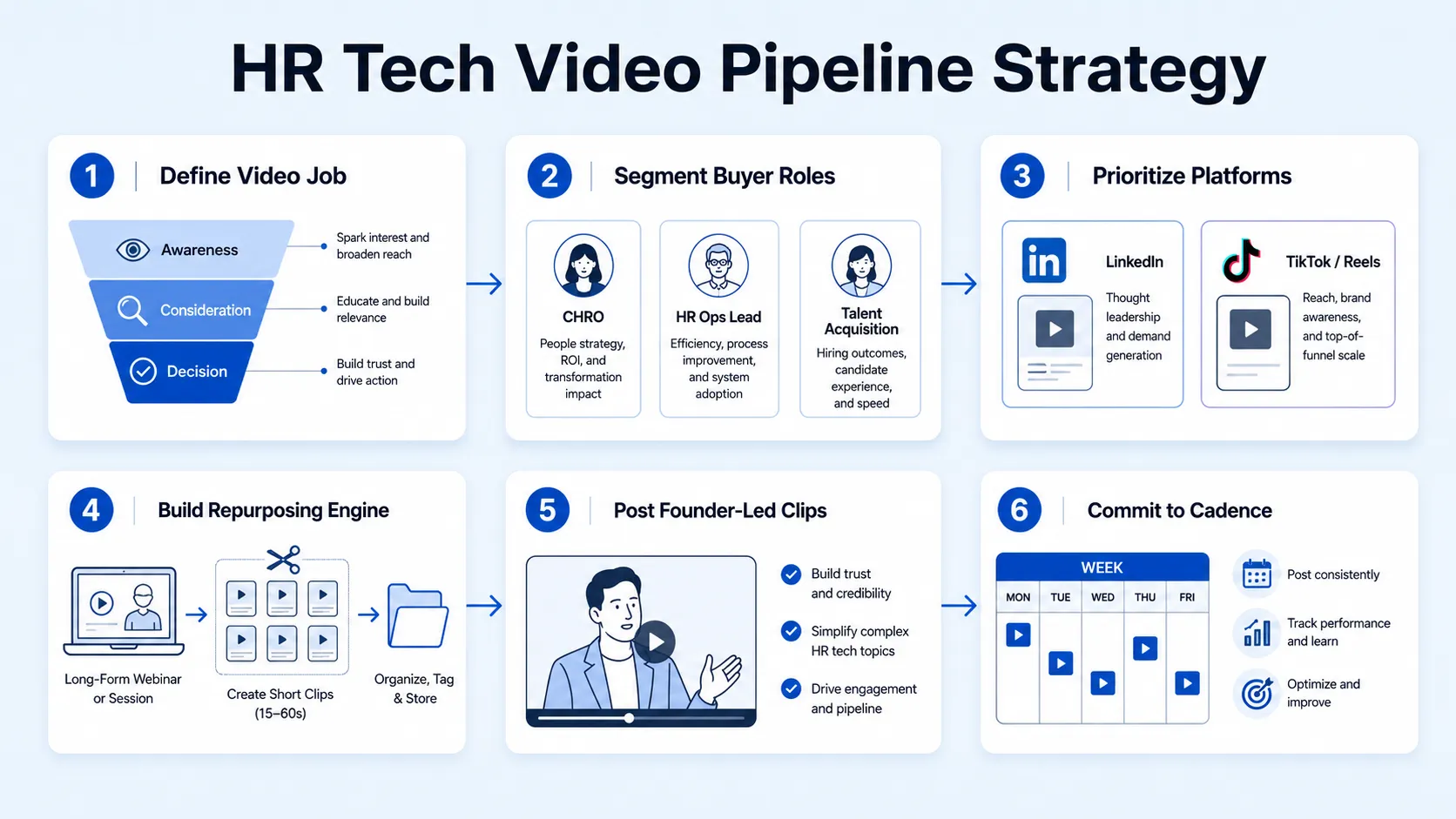
Step 1: Define the job each video does. Every video should map to a pipeline moment: awareness, consideration, or decision. A 30-second LinkedIn clip explaining "why your HRIS onboarding flow is costing you 12% retention" does awareness. A 60-second product walkthrough of your SaaS onboarding module does consideration. A founder-led customer proof clip makes a decision.
Step 2: Assign content themes per buyer role. HR tech companies sell to multiple stakeholders: CHROs, HR operations leads, talent acquisition heads, and finance. Each needs a different angle. Segment your content by role before you produce anything.
Step 3: Prioritize LinkedIn for pipeline, TikTok and Reels for reach. LinkedIn is now the top distribution platform for B2B video, with 81% of B2B teams sharing video there, overtaking YouTube for the first time. For HR tech, this is where your buyers live during working hours. TikTok and Instagram Reels reach the same decision-makers during personal browsing time.
Step 4: Build your production and repurposing engine. While original content creation from scratch allows you to capture specific marketing hooks, every webinar, podcast episode, and product demo you've already recorded is also a content library waiting to be clipped. A balanced strategy uses both new shoots and repurposed highlights to maximize ROI.
Step 5: Post founder-led content. Personal profiles generate 8x more engagement than company pages on LinkedIn. Your founder or CPO sharing a 45-second take on workforce analytics trends will outperform a polished brand video from your company page every week.
Step 6: Commit to cadence. Most successful brands post at least five to seven short-form videos per week across platforms. Start at three per week, establish a workflow with Komet Media's short-form video editing services, then scale.
How HR Tech Companies Can Use TikTok and Reels to Generate Leads
B2B advertisers on TikTok grew 142% in 2025. HR and people operations is one of the clearest use cases. The buyers you're targeting, including HR directors, talent acquisition leads, and people ops managers, are scrolling TikTok and Instagram during their personal time. Business decision-makers don't stop being consumers when they leave work. They scroll TikTok during personal time and are receptive to relevant business content that doesn't feel like traditional corporate advertising. That's the platform premise HR tech brands should build around.
What works on TikTok and Reels for HR software companies specifically:
- Myth-busting clips: "3 things HR teams think onboarding software does that it actually doesn't." Contrarian, specific, and useful.
- Before/after workflows: Show a hiring workflow without your tool versus with it. No narration needed, just screen recording with captions.
- Founder commentary on HR news: React to a LinkedIn article on candidate experience in 45 seconds. Real-time relevance beats polished production.
- Employee story snippets: One employee, one outcome, 30 seconds. Employer branding and product proof in the same clip.
The biggest mistake B2B companies make on TikTok is overproducing content. The platform rewards raw, authentic content over glossy corporate videos. An HR tech founder explaining a complex people operations problem at a whiteboard will outperform a motion-graphics explainer. Raw authority is the creative direction.
TikTok's Instant Forms feature delivers 5.17% higher conversion rates than standard landing pages by auto-populating user information , making it the right format for demo request CTAs. Pair a short educational clip with a TikTok Instant Form for a demo booking, and you have a complete demand generation loop.
Best Short-Form Video Content Ideas for HR Software Brands
The format determines whether buyers watch. The content determines whether they act. Here are the video types that move HR tech buyers at each funnel stage.
For HR tech companies, the opportunity lies in a hybrid approach. While original shoots capture current trends and product launches, repurposing long-form assets provides volume. A 45-minute product demo webinar can yield 8–12 short clips, while a dedicated 2-hour shoot can produce a month's worth of original content. Platforms like Komet Media's video marketing services are built to handle both from-scratch production and content infrastructure.
LinkedIn added native short-form video in 2025, and it's already outperforming text-only posts by 5x in impression volume. For HR software brands, this is the most accessible high-ROI move available: take your existing founder's thinking or product expertise and publish it in native video format on LinkedIn.
How to Explain Complex HR Software Features in 60 Seconds or Less
This is where most HR tech content teams get stuck. Your product does something genuinely complex, whether that's workforce analytics, multi-country payroll automation, or AI-assisted talent matching. The instinct is to explain all of it. That's the wrong instinct.
The framework I use with B2B SaaS clients at Komet Media follows three steps:
- Name the pain in plain language. Not "streamline your human capital management workflows." Say: "Most HR teams spend 6 hours a week copying data between systems that don't talk to each other."
- Show one moment where your product solves it. Not a product tour. One screen, one action, one result. Thirty seconds of screen recording with captions.
- State the outcome in a number. "Our clients cut that to 20 minutes." If you don't have a number yet, use a customer quote.
98% of B2B decision-makers have watched explainer videos , which means your HR tech buyers expect them. The standard is high. Generic product tours no longer convert. What works is radical specificity: one persona, one problem, one outcome, per video.
Landing pages with embedded video convert at 86% higher rates than text-only equivalents. The effect is strongest for complex products and services, where B2B SaaS pages with explainer videos see conversion lifts exceeding 100% in controlled testing. For HR tech companies with demo request pages, a 60-second "here's what you'll see in the demo" video placed above the form is one of the highest-leverage conversion optimizations available.
The production rule: the sweet spot for short-form video in 2026 is between 30 and 60 seconds. If your HR software explainer is running past 75 seconds, it needs to be cut, not padded. Split it into two videos.
How to Build a Short-Form Video Content Calendar for Your HR Tech Brand
Consistency beats virality for B2B content strategy. A content calendar removes the weekly "what do we post?" decision and replaces it with a system.
Step 1: Audit your existing content. List every webinar recording, podcast episode, product demo, and sales call recording from the last 12 months. Each is a potential clip source.
Step 2: Map content pillars to buyer concerns. For HR tech, four pillars cover the full buyer journey:
- Product education (how features solve specific HR problems)
- Thought leadership (founder/executive takes on people operations, talent acquisition, workforce analytics)
- Social proof (customer outcomes, implementation results)
- Employer branding (team culture, employee value proposition)
Step 3: Assign publishing frequency by platform. A realistic starting cadence for a lean HR tech marketing team:
Step 4: Build a 4-week sprint, then review. Don't plan six months of content before you know what resonates. Publish for four weeks, identify the top two or three performing formats, and double down.
Step 5: Measure pipeline signals, not just views. Track profile visits after viewing, link-in-bio clicks as a direct measure of traffic, and DM volume increases as a signal that content is prompting people to reach out. Views are a vanity metric for HR tech companies. Demo requests and warm DMs are the signal.
Check Komet Media's services page for production and calendar support if your team is running this without a dedicated video operator.
Biggest Mistakes HR Tech Companies Make with Short-Form Video
Most HR tech video content underperforms for predictable, fixable reasons.
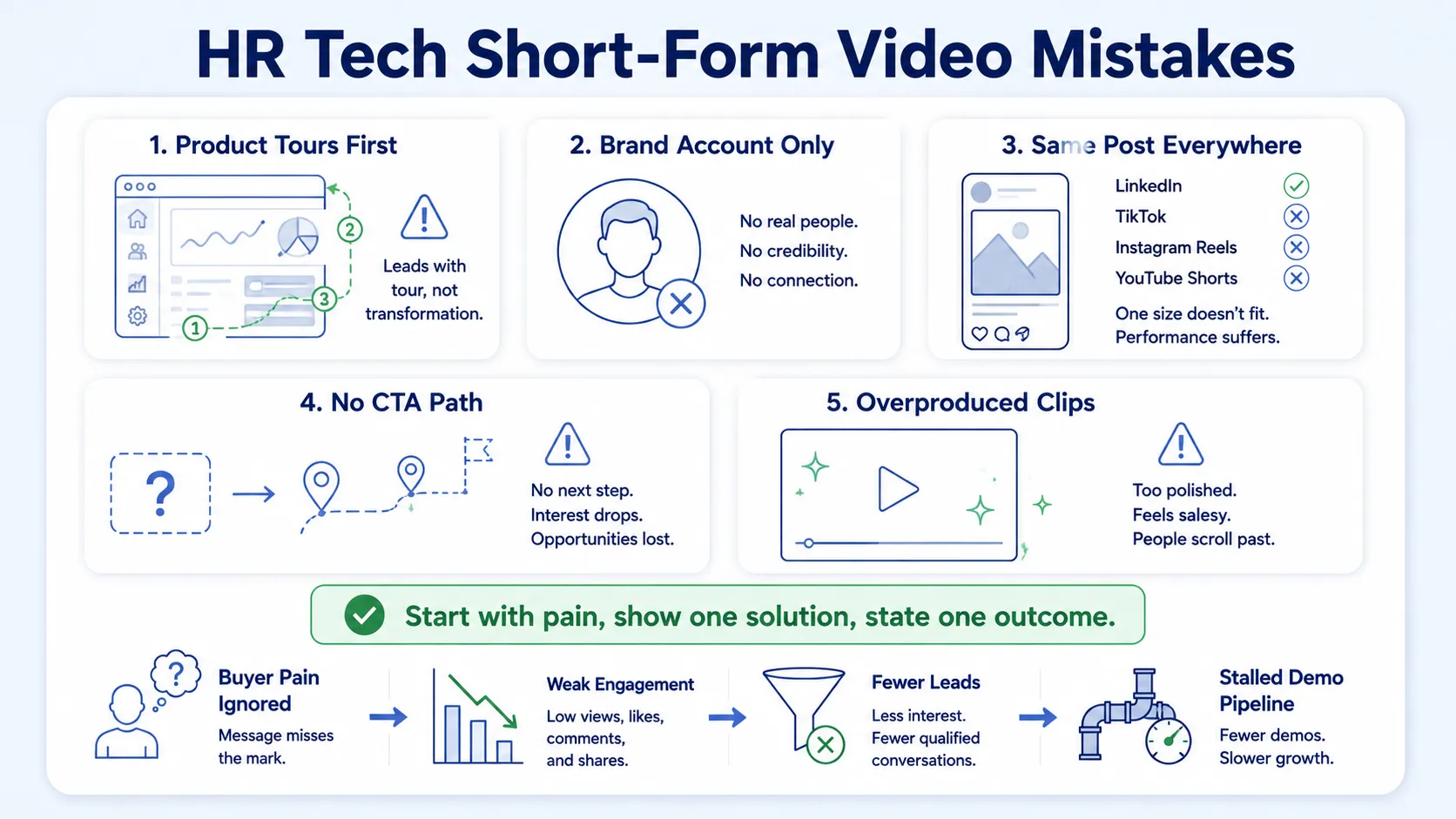
Mistake 1: Building product tours instead of pain-point clips. A 90-second walkthrough of every dashboard tab is a demo, not a video. Buyers don't watch full product tours unprompted. Lead with the pain, then show the one feature that solves it.
Mistake 2: Only posting from the brand account. LinkedIn users are 3x more likely to trust content from an individual than from a brand. Your founder's account, your CPO's account, and your head of customer success posting short clips will each outperform your company page posting the same content. Build a founder-led video system, not just a content calendar for the brand account.
Mistake 3: Treating every platform identically. The LinkedIn audience is B2B professionals, so the content needs to be substantive. No dance trends. Think 30-second insights, product walkthroughs, quick case study summaries, and expert takes. TikTok rewards native, less polished delivery. Reposting without reformatting kills performance.
Mistake 4: No CTA architecture. The mistake most brands make is treating every short-form video as an entertainment piece. While entertainment drives views, it rarely drives business outcomes. Without a clear call-to-action, a connection to your offer, and a strategy for warming up viewers over time, even viral content can produce little to no ROI. Every HR tech video needs a next step: book a demo, download the guide, watch the longer case study.
Mistake 5: Overproducing. Glossy explainers no longer win. When B2B buyers spot corporate shine, they scroll past it. Put your subject matter experts and founders in front of the camera. HR tech companies spend budget on motion graphics when a founder talking directly to the camera about a candidate experience problem would perform better.
Conclusion
Short-form video for HR tech companies works because it meets buyers where they are, educates before the demo, and builds the kind of trust that shortens sales cycles. The playbook is clear:
- Prioritize LinkedIn for pipeline, TikTok and Reels for reach and category awareness.
- Keep every video under 60 seconds, focused on one pain point or outcome.
- Combine original content creation from scratch with a repurposing system for webinars and demos.
- Measure demo requests, DMs, and profile visits, not just views.
If you're ready to build that system, Komet Media works with B2B SaaS and HR tech teams to produce original videos from scratch and turn existing content into short-form video pipelines. Start the conversation here.
Frequently Asked Questions
Q1: How long should short-form videos be for HR tech companies?
The sweet spot for short-form video in 2026 is between 30 and 60 seconds. For HR software explainers and feature walkthroughs, 45–60 seconds allows enough time to name a pain point, show one feature, and state a measurable outcome without losing the viewer.
Q2: Should HR tech companies use TikTok for B2B marketing?
Yes. Industries seeing the strongest B2B results on TikTok include SaaS, professional services, recruiting, and education , all closely adjacent to HR tech. Decision-makers in HR and talent acquisition use the platform personally, making it effective for category awareness and demand generation that LinkedIn misses.
Q3: What's the difference between short-form and long-form video for HR tech marketing?
Short-form dominates engagement and reach metrics, while long-form wins on SEO value, lead generation, and audience depth. The most effective video strategies in 2026 use both formats for complementary purposes. Short-form creates awareness and earns attention; long-form webinars and demos close it.
Q4: How many short-form videos should an HR tech company post per week?
A lean team should target five to seven videos per week across all platforms. The most efficient way to maintain this is through a mix of from-scratch production and repurposing existing long-form content. Komet Media helps teams script new content and identify high-value moments in old webinars for clipping.
Q5: Does short-form video actually generate demos for HR SaaS companies?
Yes, when structured correctly. 87% of B2B buyers say video influenced their purchase decisions. Pair educational short clips with a direct demo CTA or TikTok Instant Forms, and video becomes a measurable demand generation channel, not just a brand awareness play.
Q6: What's the biggest short-form video mistake HR tech marketers make?
Producing polished product tours instead of specific pain-point clips. Buyers won't watch a 90-second dashboard walkthrough unprompted. They will watch a 40-second clip that opens with a problem they experience every week. Start with the pain, show one solution moment, state one outcome, and add a clear next step.