
🪄 AI Summary
Heading 1
Heading 2
Heading 3
Heading 4
Heading 5
Heading 6
Lorem ipsum dolor sit amet, consectetur adipiscing elit, sed do eiusmod tempor incididunt ut labore et dolore magna aliqua. Ut enim ad minim veniam, quis nostrud exercitation ullamco laboris nisi ut aliquip ex ea commodo consequat. Duis aute irure dolor in reprehenderit in voluptate velit esse cillum dolore eu fugiat nulla pariatur.
Block quote
Ordered list
- Item 1
- Item 2
- Item 3
Unordered list
- Item A
- Item B
- Item C
Bold text
Emphasis
Superscript
Subscript
Most SaaS teams create video. Few create videos with a system. The difference between a content library that sits dormant and one that books demos, moves MQLs to SQL, and reduces churn is a deliberate A Video Content Strategy Framework for SaaS built around your buyer's journey, not your product roadmap. I'm Rajan Soni, Founder and Video Director at Komet Media. This guide is the exact framework my team applies for funded SaaS teams every week.
TL;DR
- A Video Content Strategy Framework for SaaS maps specific video types to each funnel stage, awareness, consideration, decision, and retention.
- Short-form video drives the highest ROI of any content format; long-form builds the trust needed to close B2B deals.
- Your existing long-form content (webinars, podcasts, demos) is already a video engine waiting to be activated.
- Measure what matters: demo bookings, video-qualified leads, and pipeline velocity, not views.
What Is a Video Content Strategy for SaaS Companies, and Why Does It Matter in 2026?
A video content strategy for SaaS is a documented system that defines which video types to produce, for which buyer stage, on which channels, and with which KPIs are attached. It is not a content calendar. It is not a production checklist. It is a revenue instrument. 91% of businesses now use video as a marketing tool in 2026 , so the question is no longer whether to invest in video. Growth now comes from doing it better, not doing it at all.
For B2B SaaS specifically, the stakes are higher. According to Gartner's 2025 survey, 61% of B2B buyers now prefer a rep-free buying experience, and 83% prefer to self-serve during the discovery phase alone. That means your video content is doing sales work whether you've planned for it or not. A clear majority, 73%, of B2B decision-makers now prefer to watch product demo videos over reading whitepapers. If your team is producing whitepapers and gated PDFs while your buyers are watching 60-second clips on LinkedIn, the mismatch costs you pipeline.
The companies winning in 2026 treat video as a system with three layers:
- Content production: What gets made and from what source material.
- Distribution architecture: Where each video lives and why.
- Measurement framework: Which signals tell you video is doing revenue work.
Without all three, you have video activity. With all three, you have a video content strategy framework for SaaS that compounds.
The shift is clear: video has moved from brand storytelling to direct revenue driver. Lead generation is now the primary goal for 38% of B2B video marketers, with product education at 31% running a close second. (Wistia State of Video Report) The fastest way to build this system without starting from scratch is to treat your existing long-form content, founder webinars, product demos, podcasts, sales calls, as raw material. One 45-minute webinar contains 10 to 15 short-form assets if you have the right editorial process. That is the repurposing model Komet Media is built on.
SaaS Video Content Strategy Framework Explained: The Four-Stage Model
Every video your SaaS team produces should map cleanly to one of four stages. Here is the framework:
Aligning video formats, goals, and KPIs with each stage of the B2B SaaS customer journey means: at Awareness, using short-form social clips and thought leadership with branded search lift as the primary KPI; at Consideration, using in-depth product walkthroughs, webinar recordings, and customer testimonials with Video-Qualified Lead rate as the primary KPI.
This is why most SaaS video strategies underperform. Teams produce brand-level awareness content and then wonder why it doesn't generate demos. Or they invest heavily in BOFU assets without building the trust infrastructure that gets buyers there in the first place. For B2B SaaS, the average sales cycle ranges from 84 to 120 days, emphasizing the need for nurturing content like explainer videos and product walkthroughs. A single hero video cannot carry a 90-day buying process. A distributed video system can.
The framework also determines how you repurpose. A 30-minute founder webinar becomes an awareness short-form clip on LinkedIn, a consideration-stage walkthrough for your nurture sequence, and a social proof asset if customer stories were included. Komet Media's video services exist specifically to run this extraction and distribution process for SaaS teams.
What Types of Videos Should a SaaS Company Make?
The format decision should follow the funnel stage decision, not the other way around. Here is what the data and buyer behavior say in 2026:
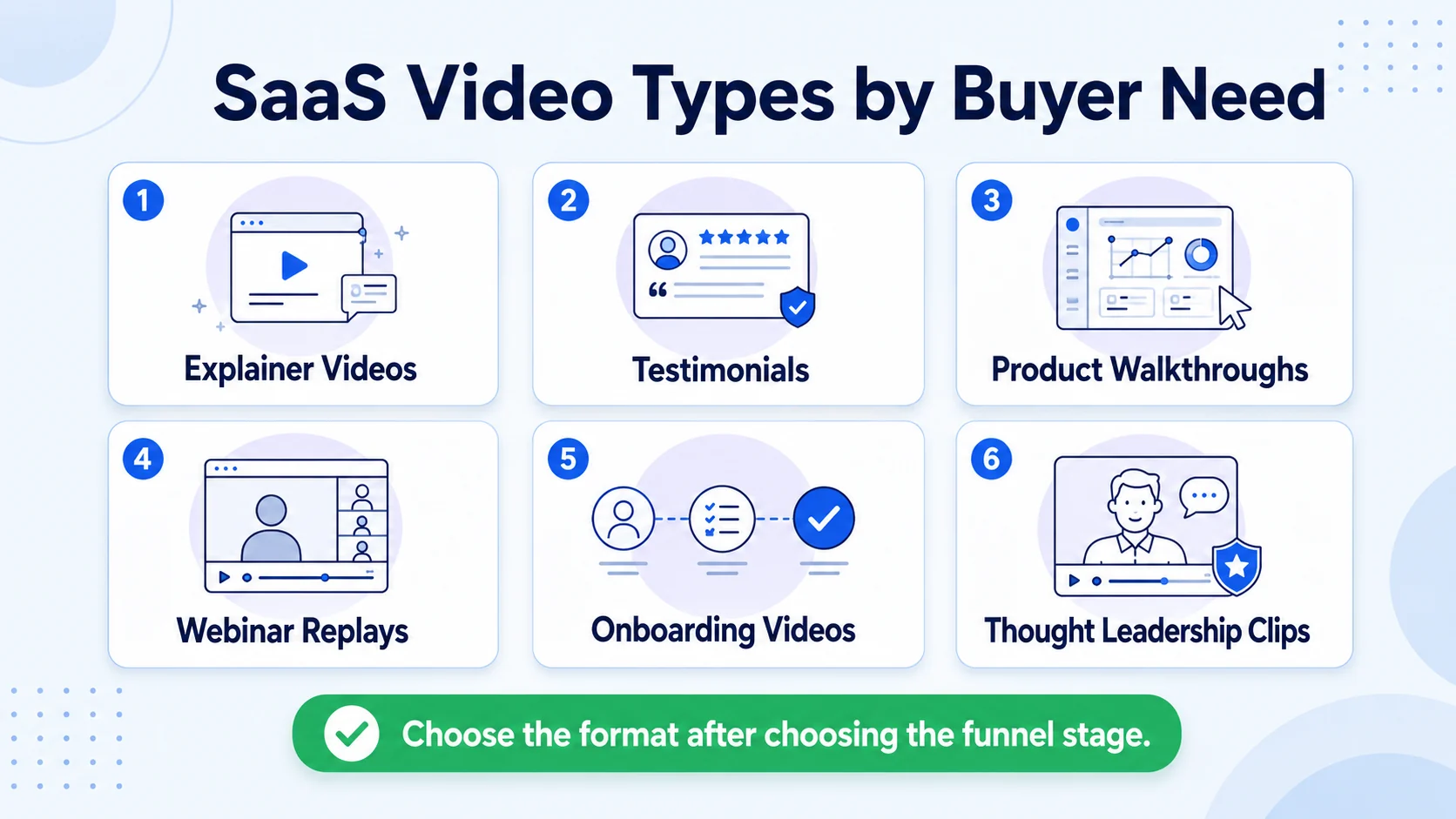
Explainer videos: 68% of marketers create explainer videos. They remain a top format for reducing buyer friction, especially for SaaS and tech products where software walkthroughs can directly influence conversion. These live at the top of the funnel and on high-traffic landing pages.
Testimonial videos: Testimonial videos are trending sharply upward, from 17% in 2023 to 47% in 2026. According to Wistia's State of Video Report, customer testimonials are now the fastest-growing video format. Social proof at the BOFU stage is what converts warm leads who are already comparing options.
Product walkthroughs and demos: For B2B SaaS companies, the tactical shift looks like less polished brand films and more authentic product walkthroughs. Tools like Loom make it possible to record and send personalized walkthroughs inside a sales sequence without a full production team.
Webinar and podcast replays: On-demand webinars keep getting plays for up to 12 months after the live event. Every webinar your team produces is a MOFU asset with a 12-month shelf life if properly clipped and distributed. Komet Media's webinar repurposing turns these recordings into an ongoing content stream.
Onboarding video sequences: These sit at the retention layer and directly reduce churn. A user who understands your product through structured video instruction activates faster, reaches their first value moment sooner, and churns less.
Thought leadership clips: Short founder or executive video clips on LinkedIn build brand awareness metrics and trust at scale. LinkedIn is now B2B's #1 video channel, with 8 in 10 teams saying LinkedIn is their primary place to share videos.
How to Build a Video Funnel for SaaS Products: Step-by-Step
Building a working video marketing funnel for SaaS is a sequenced process, not a batch content sprint:
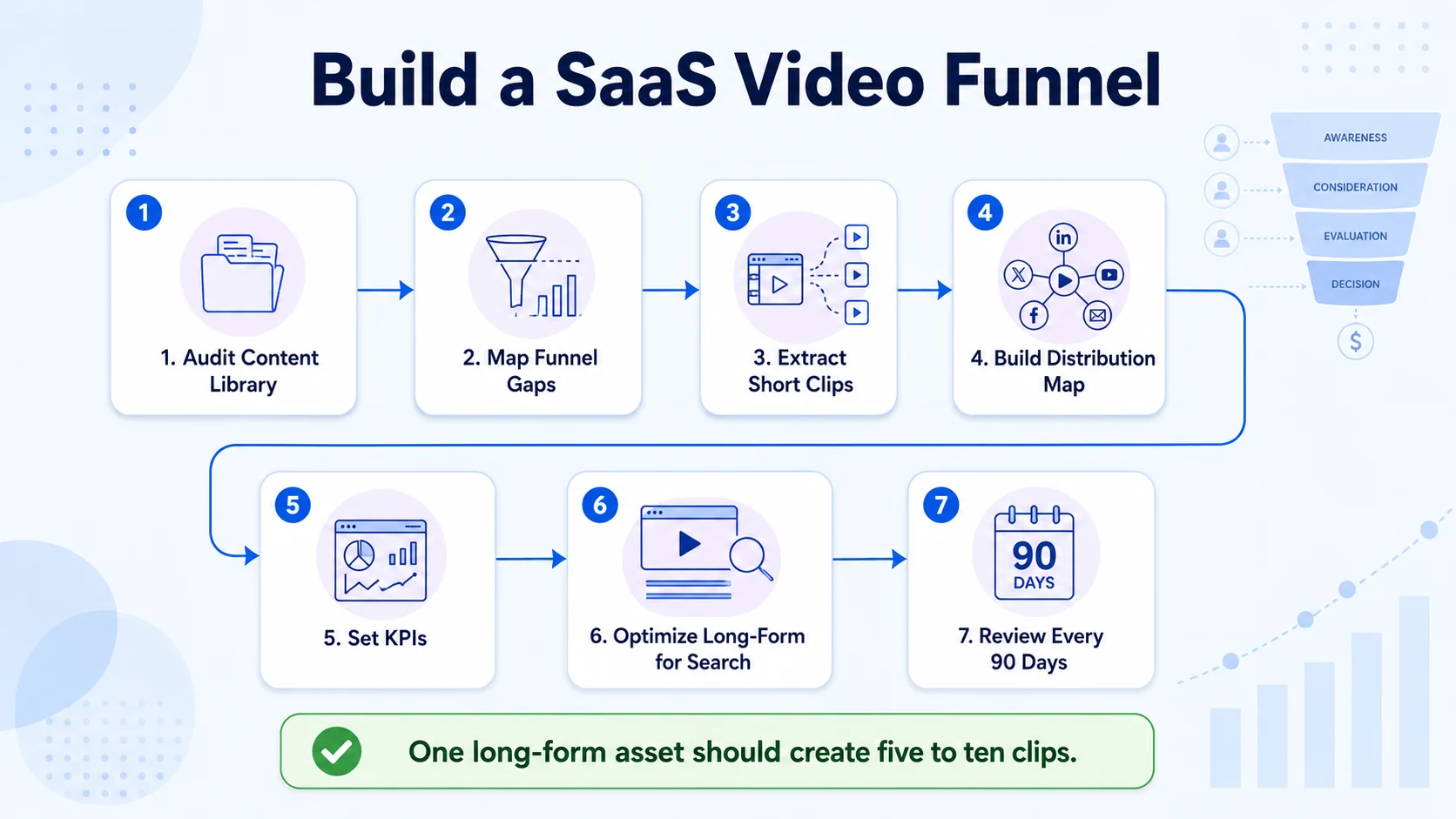
- Audit your existing content library: Identify every webinar, podcast episode, sales demo recording, and founder interview you already have. These are your raw materials.
- Map content to funnel gaps: Which stage has the least coverage? Most SaaS teams are over-indexed on TOFU brand content and underweight on MOFU trust-builders.
- Extract short-form clips first: A 90-second clip from a webinar takes 48 hours to produce and can run as a LinkedIn awareness asset for 30 days. Start there. Komet Media's short-form video editing service handles this extraction at scale.
- Build a distribution map: Decide where each video type lives, LinkedIn for short-form thought leadership, your website and Wistia for MOFU walkthroughs, HubSpot nurture sequences for BOFU testimonials, Vidyard for personalized sales outreach.
- Set KPIs before publishing: At the middle of the funnel, Click-Through Rate and Lead-to-MQL Conversion Rate become critical. Benchmarks show CTRs between 1.5% and 3% for B2B video CTAs, while Lead-to-MQL conversion averages around 39%.
- Apply YouTube SEO for long-form assets: Keyword-optimized titles, chapters, and descriptions on YouTube build organic discovery over time. This is compound demand generation, not one-time reach.
- Run a 90-day review: Identify which video types drove demo bookings, influenced pipeline, or reduced support ticket volume. Double down. Cut what produced only views.
One long-form video should become five to ten short-form clips through omnichannel repurposing. That ratio is your production efficiency target.
Best Video Content Strategy for B2B SaaS: Distribution and Channel Decisions
Production is only half the system. Where your video lives determines who sees it and at what stage of their buying journey.
LinkedIn: LinkedIn is the top platform where teams pay to promote their videos, followed by YouTube, Instagram, Facebook, and TikTok. For B2B SaaS founders and executives, organic thought leadership clips here build the trust that drives inbound demo requests. This is founder-led growth at scale.
Your own website: Your own website is an even more powerful channel, where videos generate 48% engagement compared to 32% on social media. Landing pages with embedded product explainers convert at significantly higher rates. Video on landing pages increases conversions by 86% compared to text-only equivalents.
Wistia and Vidyard: These platforms embed video directly into your site and HubSpot with analytics tied to individual leads. When a prospect watches 80% of your product walkthrough, that is a buying signal your CRM should capture. Advanced video analytics tools like Vidyard, Wistia, and YouTube Studio offer detailed insights into viewer engagement, including watch time, drop-off points, and interaction rates, and integrate with HubSpot, Salesforce, and GA4.
YouTube: The rise of video-first search means YouTube SEO is becoming as important as traditional text-based SEO. Product tutorials, founder interviews, and in-depth feature walkthroughs optimized for YouTube search create compounding organic discovery that paid ads cannot replicate.
Email sequences (HubSpot): Video in email nurture sequences increases click-through rates and moves MQLs toward SQL faster than text-based emails. Personalized Loom videos sent at BOFU stage by sales reps are now a standard play for sales-led SaaS teams.
Podcast repurposing: Every podcast episode your founders or executives appear on is a content source. Komet Media's podcast editing and repurposing service clips these into short-form video assets that extend the reach of existing thought leadership content across channels.
The distribution question to ask: is each video asset doing active work in your pipeline, or is it sitting on YouTube with 40 views and no CTA?
How to Measure a SaaS Video Content Strategy: KPIs That Connect to Revenue
82% of marketers say video marketing has given them a good ROI, but the ones who can prove it are measuring the right things. Views are not a revenue metric. Here is how to measure video across the funnel:
Video's ability to shorten sales cycles by 23% is a critical benchmark input for modeling the impact of your video strategy on cost per lead and customer acquisition cost.
Attribution model: Use multi-touch attribution inside HubSpot or your CRM. First-touch tells you what created awareness. Last-touch tells you what closed. Multi-touch tells you what the whole video funnel contributed. Set revenue-focused KPIs that align with quarterly business goals: pipeline influenced by content, marketing-qualified leads from content, and content's impact on sales cycle velocity.
The video engagement signal: Tag contacts in your CRM by video watch percentage. A lead who has watched 75% or more of three product videos in seven days is a different kind of lead than someone who clicked one link. It is time to measure video-driven intent and pipeline acceleration, transform video from a passive asset into an intelligent, active component of your revenue strategy, and identify high-value buying signals hidden in video engagement data.
For Komet Media clients, the metric we track hardest in the first 90 days is demo bookings influenced by video, because that is the number that makes CFOs approve the next quarter's budget.
Conclusion
A Video Content Strategy Framework for SaaS is not a production decision, it is a revenue decision. Here are the four things to take away:
- Map before you make: Every video should have a funnel stage, a distribution channel, and a KPI assigned before production starts.
- Repurpose what exists: Your webinars, podcasts, and demos are already a video library. Extract and distribute them systematically.
- Distribute where buyers are: LinkedIn, your own website, and Wistia drive more B2B pipeline than any other video channels in 2026.
- Measure pipeline, not views: Video-qualified leads, demo bookings, and sales cycle velocity are the numbers that prove video ROI to a CFO.
If your team is ready to build this system, Komet Media's services are designed specifically for SaaS and funded tech teams who need it running without adding headcount.
Frequently Asked Questions
Q1: What is a video content strategy framework for SaaS?
A video content strategy framework for SaaS is a documented system that maps specific video types to each stage of the B2B buyer journey, from awareness through retention, with defined distribution channels and revenue-linked KPIs for each. It connects production decisions to pipeline outcomes.
Q2: How many videos does a SaaS company need to start?
You do not need a large library to start. One long-form asset (webinar, demo recording, or podcast episode) can be repurposed into five to ten short-form clips that cover multiple funnel stages. Start with what you have rather than producing from scratch.
Q3: What is the best video type for generating SaaS demos?
Product walkthrough videos and testimonial videos perform best at the consideration stage for driving demo demand. Testimonial video adoption has grown from 17% in 2023 to 47% in 2026, reflecting how strongly social proof influences B2B purchase decisions.
Q4: How do I measure whether my video strategy is working?
Track video-qualified leads (VQLs), CTR on in-video CTAs (benchmark: 1.5%–3%), lead-to-MQL conversion rate (benchmark: 39%), and pipeline velocity. Connect your video platform (Wistia, Vidyard) to HubSpot or your CRM to link watch data directly to deal records.
Q5: Should a B2B SaaS startup invest in short-form or long-form video first?
Start with short-form clips extracted from existing long-form content. They deploy faster, reach your ICP on LinkedIn immediately, and generate brand awareness metrics while your longer MOFU assets are being produced. Use short-form to drive traffic toward long-form, not to replace it.
Q6: How does video content reduce SaaS churn?
Structured onboarding video sequences accelerate time-to-value for new users, reducing early-stage churn. Feature tutorial videos reduce support dependency and increase product adoption depth. Both increase the likelihood a customer reaches their "aha moment" before their first renewal date.