
🪄 AI Summary
Heading 1
Heading 2
Heading 3
Heading 4
Heading 5
Heading 6
Lorem ipsum dolor sit amet, consectetur adipiscing elit, sed do eiusmod tempor incididunt ut labore et dolore magna aliqua. Ut enim ad minim veniam, quis nostrud exercitation ullamco laboris nisi ut aliquip ex ea commodo consequat. Duis aute irure dolor in reprehenderit in voluptate velit esse cillum dolore eu fugiat nulla pariatur.
Block quote
Ordered list
- Item 1
- Item 2
- Item 3
Unordered list
- Item A
- Item B
- Item C
Bold text
Emphasis
Superscript
Subscript
Most founders send a text email, hope investors read it, and move on. The problem: investors have 10–20 portfolio companies competing for their attention, and a wall of text rarely cuts through. Investor update videos for startups change that equation. They are short, engaging, multimedia messages that pair visual product demos and data trends with founder narratives, offering a transparent view of your startup's traction and runway. This guide covers everything you need to build a video-first investor communication system that keeps capital flowing.
TL;DR
- Investor update videos combine visual product demos and data trends with founder narratives to build trust and secure future capital.
- Send monthly at seed/pre-Series A; quarterly for growth-stage companies.
- Include MRR, burn rate, runway, key wins, and a specific ask in every video.
- Video in email drives significantly higher engagement than text-only updates.
What Are Investor Update Videos for Startups and Why Do They Work?
Investor update videos for startups are short, engaging, multimedia messages sent to current and prospective investors to maintain momentum, build long-term trust, and secure future capital. They pair visual product demos and data trends with founder narratives, offering a transparent view of your startup's traction and runway. That combination is what separates them from a plain text report.
The mechanism is straightforward: when an investor sees your face, hears your tone, and watches your product in motion, they get a signal that no spreadsheet delivers. Founder credibility is built through presence, not paragraphs. Venture capital communication has always been relationship-driven, and video compresses the relationship-building cycle between quarterly board meetings.
Startups that implement regular investor updates are 3x more likely to secure follow-on funding. When that update is delivered as video rather than plain text, the engagement advantage compounds. The average time spent on video-enhanced emails is 2.1x longer than on text-only emails. For a seed-stage founder trying to hold LP attention between rounds, that extra dwell time translates directly into recall and relationship equity. The investor relations strategy case is also structural.
Companies that regularly communicate with investors are twice as likely to raise follow-on funding, yet many startups neglect this simple, powerful tool. Investor update videos make consistency easier: once your format is locked, each update is a matter of recording, not redesigning. Asynchronous communication via Loom or a polished short-form video means investors can watch on their own schedule, on any device, without scheduling a call.
The landscape of investor communications has shifted dramatically in 2026. Modern investors expect more than just financial metrics, they want transparency, strategic insight, and evidence of operational excellence. A well-produced video update delivers all three in under five minutes, which is precisely why portfolio company updates in video format are gaining ground against the traditional board meeting prep memo.
For Komet Media clients, this is also a content repurposing opportunity: your all-hands recording, product demo, or webinar footage can be edited into a polished investor update without starting from scratch.
What Should You Include in an Investor Update Video?
The content structure that works for SaaS founders and funded tech startups maps directly to what investors need for due diligence documentation and LP communications.
Core segments every investor update video must cover:
- Performance snapshot: Lead with MRR reporting and growth rate. For SaaS companies, track MRR/ARR (growth rate is key), churn rate, ARPU/ACV, and unit economics like LTV:CAC ratio, aiming for 3:1 or better.
- Financial health: Report your gross and net burn rate, cash in bank, and your cash runway, perhaps the most critical number. Investors tracking your runway metrics need this on screen, not buried in an attachment.
- Wins and lowlights: New logo wins, product launches, and key hires go in the wins section. Be honest about what isn't working. Startups are more volatile and have growing pains, and those pains will be evident in your updates. Experienced investors will expect this, so don't be afraid to share your challenges.
- Product demo clip: A 60–90 second screen recording of a new feature beats a bullet point every time. This is where startup growth metrics become visible, not just legible.
- The Ask: Every update should close with one specific request, whether that's an intro, a hire referral, or a beta customer connection. As a founder, the asks section is an opportunity to send a bat signal for things you want help on.
Format guidance by video type:
An investor update should include recent wins and losses, key performance metrics, financial highlights, team changes, product updates, and clear asks for help or introductions.
How Often Should Startups Send Investor Update Videos?
Cadence is where most founders fail. They send an update at close, go silent for six months, then resurface only when they need to raise again. That pattern destroys founder credibility. Many early-stage founders share investor updates on a monthly basis, whereas growth or late-stage companies typically do this quarterly. The better your relationship with an investor, the more likely they are to participate in another round.
The rule for video updates specifically is to match your cadence to your stage:
- Pre-seed and seed: Monthly video updates. You are building the relationship from zero and need consistent proof-of-progress signals.
- Series A: Monthly or bi-monthly, depending on board meeting frequency. Use video to supplement board decks with a more conversational layer.
- Series B and beyond: Quarterly video updates tied to formal reporting cycles, with ad hoc clips for major milestones or product announcements.
- Between rounds: At minimum, one video per quarter to maintain stakeholder engagement and keep prospective investors warm on AngelList or via direct outreach.
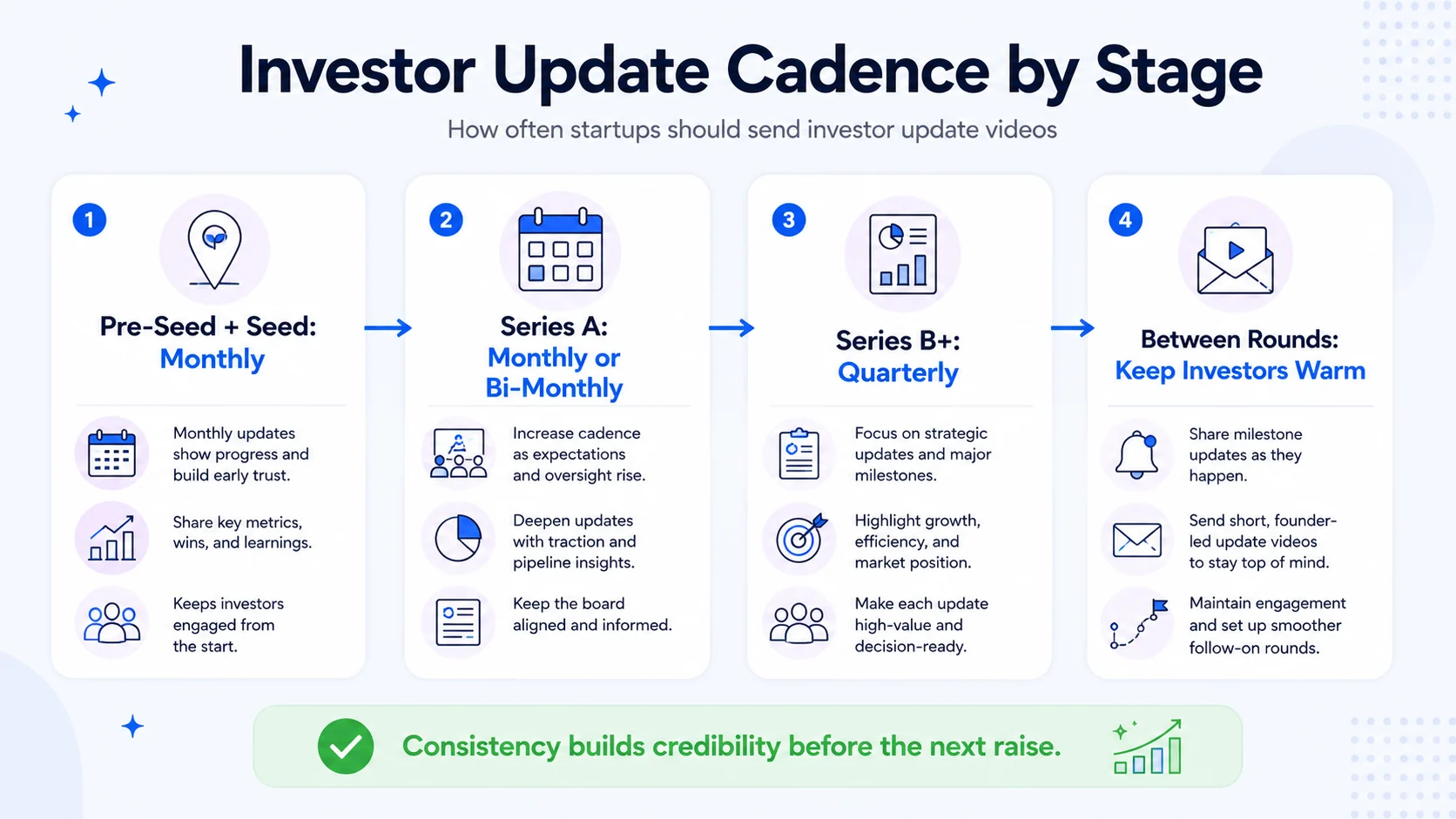
Consistency matters more than frequency; regular updates build trust, transparency, and engagement. A three-minute video every 30 days beats a polished 15-minute production that shows up twice a year. A good practice is to set a baseline schedule, such as monthly videos, while adding ad-hoc updates for major announcements or critical changes. Product launches, team changes, or runway events warrant an unscheduled update. Investors should never hear material news from a press release before they hear it from you.
The signal investors watch for: Founders who communicate consistently without being prompted are the ones who get the call-back when a follow-on check is available.
Video vs. Email Investor Updates: Which Works Better?
Short answer: video wins on engagement; email is the delivery wrapper. The highest-performing investor communication strategy in 2026 uses both together.
Here is how they compare across the metrics that matter for investor relations strategy:
Emails that include the word "video" in the subject line see a 19% boost in open rates. For venture capital communication where you may be competing against 10–15 other portfolio companies for investor attention, a 19% open rate lift is material. Emails with video thumbnails see a 34% higher click-through rate than those without. Pair that with a tight subject line ("March Update: MRR hit $X, here's the demo") and you have an update that gets watched, not archived.
The practical workflow: record your video, upload to Loom or Vimeo, embed the thumbnail in your email, and send. Tools like Komet Media's short-form video editing service can turn a raw founder recording into a polished, branded update that feels intentional rather than improvised. Venture capitalists typically want detailed financial models, operational KPIs, and clear growth projections. They need depth and precision to report to their own LPs. Video covers the narrative layer; your attached data room or one-pager covers the depth.
Best Practices for Recording Investor Update Videos That Build Trust
Production quality signals execution quality. A shaky webcam recording with no lighting and background noise tells investors something about how you run the rest of your operation. It doesn't have to be studio-level, but it needs to be intentional.
Technical non-negotiables:
- Audio first: Poor audio or shaky screen recordings can make even the best software look like vaporware. High-stakes videos require broadcast-quality sound to maintain authority. A $60 USB microphone solves 80% of audio problems.
- Lighting: Ring light or a window in front of you. Backlit faces communicate nothing.
- Background: Clean, branded, or blurred. Clutter competes with your message.
- Length discipline: For an initial teaser or hook, aim for 60 to 90 seconds. For a deep-dive technical briefing intended for the due diligence phase, 3 to 5 minutes is acceptable, provided the content is structured around hard proof-points.
Narrative best practices:
- Open with your biggest win or the most important metric. Don't bury the lead.
- Show the product on screen. A live demo clip inside your update is more compelling than any slide.
- Every briefing should end with a clear next step, whether it's a link to the data room or a calendar invite.
- Angel investors often have a more personal connection and appreciate a narrative-driven update that helps them feel connected to your journey. Adjust tone by investor type: warmer and narrative for angels, data-dense for VC partners reporting to their own LPs.
Batch recording saves time: Record three months of updates in one sitting using a script template. Swap out the specific numbers each month and re-record only the data-heavy segment. This keeps consistency high without consuming a full day every 30 days. Komet Media's video editing services are built for exactly this kind of systematic content production for B2B teams.
How Investor Update Videos Help Secure Future Funding
The funding mechanics are direct. Every investor update video is a touchpoint in a long due diligence process that starts long before you send a pitch deck. By the time you formally raise your Series A, the investors who have been watching your monthly videos for 12 months already know your product trajectory, your leadership presence, and your ability to execute.
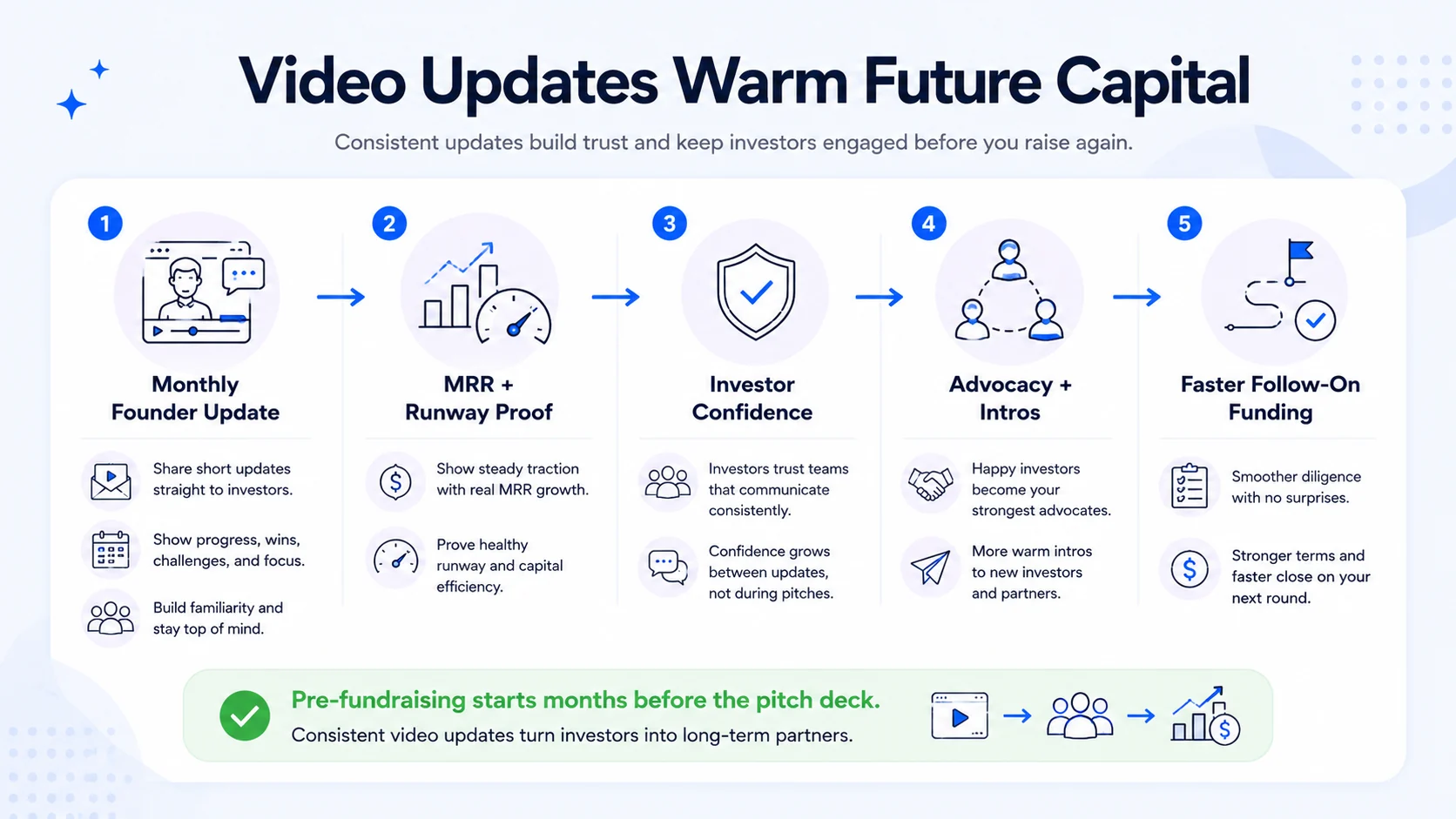
The most successful updates transform passive investors into active advocates. When investors understand your challenges, celebrate your wins, and see clear evidence of progress, they become natural champions for your next funding round. This advocacy extends beyond capital, engaged investors provide introductions, strategic guidance, and credibility that can accelerate your growth trajectory.
From a practical cap table management and fundraising standpoint, video updates also compress the due diligence timeline. An investor who has watched 12 monthly updates showing consistent MRR growth, transparent burn rate reporting, and a founder who communicates clearly under pressure has already done a significant portion of their diligence informally. The formal process moves faster because trust is already built. Within six months of adopting monthly stakeholder update videos, one tech firm saw investor inquiries decrease by 35%, as most questions were proactively answered in the videos. This streamlined communication improved investor relations and boosted confidence during funding rounds.
For seed-stage startups in the Y Combinator or AngelList ecosystem, video updates are also a competitive differentiator. Most of your peer companies are sending a quarterly text email or nothing at all. The startups that treat reporting as a strategic advantage, not an administrative burden, are the ones that maintain strong relationships and secure follow-on funding when they need it most.
The pitch deck narrative you'll use in your Series A is also built update by update. Every month, you are stress-testing your story, sharpening your data, and demonstrating that the company you described at seed is the company you are actually building.
Conclusion
Investor update videos for startups are one of the highest-leverage, lowest-cost tools available to funded founders. The core takeaways:
- Send consistently: Monthly for seed stage, quarterly for growth stage, and never only when you need money.
- Structure every video around the same framework: wins, metrics (MRR, burn, runway), product demo, and a specific ask.
- Use video inside email to drive 2.1x longer engagement and a 34% higher click-through rate versus static updates.
- Treat every update as pre-fundraising: investors who watch 12 months of your updates arrive at your Series A already convinced.
Komet Media helps B2B founders and funded teams turn their existing content, demos, and recordings into polished short-form investor update videos. Explore our services or contact us to build your investor communication system.
Frequently Asked Questions
Q1: What is an investor update video?
An investor update video is a short, multimedia message sent asynchronously to current or prospective investors. It pairs founder-to-camera narrative with product demos and data trends, providing a transparent view of traction, burn rate, and runway in a format investors can watch on their own schedule.
Q2: How long should an investor update video be?
Keep monthly progress updates between 3 and 5 minutes. Teaser-style updates between rounds should run 60 to 90 seconds. Deep-dive pre-raise briefings can run 5 to 8 minutes, provided they are built around hard data points, not general narrative.
Q3: What metrics should I show in an investor update video?
For SaaS startups, lead with MRR growth rate, net churn, and LTV:CAC ratio. Always show gross burn rate, net burn rate, and cash runway. Add a win (new logo, feature shipped, key hire) and one specific ask. Consistency across updates is more valuable than adding new metrics each month.
Q4: How do I make my investor update video look professional without a big budget?
Invest in a USB microphone (audio is more important than camera quality), use a window or ring light for front-facing light, and keep your background clean or blurred. Record your product demo separately and cut it in. A professional editor can turn a clean raw recording into a polished final asset quickly.
Q5: Should I send investor update videos to prospective investors, not just current ones?
Yes. Sending updates to a warm prospect list is one of the most effective pre-fundraising tactics available. It gives future investors 6 to 12 months of traction evidence before you formally pitch, which compresses due diligence and accelerates the decision cycle significantly.
Q6: How do investor update videos differ from a pitch deck?
A pitch deck is a one-time persuasion tool. An investor update video is an ongoing relationship-building asset. The pitch deck closes the first check; the video series builds the trust that closes the next one. Think of your pitch deck narrative as the story you tell once and your video updates as the proof you deliver monthly.