
🪄 AI Summary
Heading 1
Heading 2
Heading 3
Heading 4
Heading 5
Heading 6
Lorem ipsum dolor sit amet, consectetur adipiscing elit, sed do eiusmod tempor incididunt ut labore et dolore magna aliqua. Ut enim ad minim veniam, quis nostrud exercitation ullamco laboris nisi ut aliquip ex ea commodo consequat. Duis aute irure dolor in reprehenderit in voluptate velit esse cillum dolore eu fugiat nulla pariatur.
Block quote
Ordered list
- Item 1
- Item 2
- Item 3
Unordered list
- Item A
- Item B
- Item C
Bold text
Emphasis
Superscript
Subscript
Martech buyers are drowning in feature comparisons, long whitepapers, and demo request forms. They are not reading your gated PDF. Short-form video for martech companies cuts through that friction by delivering your product's value in under 90 seconds, on the exact channels where your buyers already spend time. I'm Rajan Soni, Founder and Video Director at Komet Media, and this guide covers every strategic decision your team needs to move from "we should do video" to a pipeline-generating video system.
TL;DR
- 72% of B2B buyers say vendor video content influences their vendor shortlist decisions , meaning the battle is won before your sales team calls.
- Short-form video (under 60 seconds) is the format with the highest ROI for martech buyers moving through the consideration stage.
- The right formats, platforms, and distribution system matter far more than production budget.
- Content repurposing, turning webinars, demos, and podcasts into clips, is the fastest path to consistent video volume.
Why Martech Companies Need Short-Form Video Right Now
The case for short-form video for martech companies is no longer a forward-looking argument. It is a current-state reality. According to Wyzowl's 2026 State of Video Marketing report, 91% of businesses now use video as a marketing tool.
Martech buyers are swimming in vendor content. The companies that get shortlisted are the ones whose value proposition is easiest to understand, fastest to consume, and most memorable. Short-form video is the format that delivers all three. 87% of B2B buyers say video influenced their purchase decisions.
For martech brands specifically, where products are complex, integrations are layered, and buyer committees are large, a 60-second clip that shows your platform solving a specific problem does more persuasive work than any static asset.
The data on attention is equally unambiguous. Videos under one minute achieve a 65% completion rate among B2B viewers, while videos over 20 minutes drop to 20%. If your primary demand generation asset is a 45-minute recorded demo or a feature-heavy webinar, you are losing most of your audience before they reach your value proposition.
Short-form video under 60 seconds is the number one format marketers plan to invest more in for 2026, driven by its leading ROI performance in 2025. For martech companies competing for attention in a crowded ecosystem alongside tools like HubSpot, Salesforce, and Sprout Social, being visible in short-form feeds is table stakes, not a growth experiment.
In an internet flooded with AI-generated content, video remains the strongest way to capture attention and build credibility. Martech buyers are skeptical. They have been oversold on features. Short video lets a real founder or product expert speak directly to a real pain point, which builds the kind of trust that fills the pipeline.
The martech ecosystem is also uniquely suited to this format. Your buyers live on LinkedIn during working hours. They scroll Reels in the margins of their day. They are precisely the "busy executives" who need their research compressed into snackable, decision-supporting content. A well-built short-form video strategy meets them exactly where they are.
What Types of Short-Form Video Work Best for B2B Martech Brands
Not every format earns its place in a martech company's video marketing strategy. The formats below consistently perform across the buyer journey for marketing technology brands.
Testimonial videos, product demos, and explainer videos consistently rank as the highest-converting B2B video types. For martech brands, these three formats address the top buyer objections: "Does this work?", "Will it fit our stack?", and "Can we trust this vendor?" Short, platform-native clips are beneficial for boosting visibility on LinkedIn Video and YouTube and for driving traffic to longer-form video assets or landing pages.
While the repurposing pipeline is a dramatically efficient engine, the most effective martech strategies balance this with original, from-scratch video production. Original content allows brands to capture trending narratives and specific value props that existing webinars might miss, while one 45-minute webinar can still yield 8–12 short clips to maintain volume.
Founder-led content is especially high-value in the martech space. When a founder speaks directly to a segmentation challenge in HubSpot or a data pipeline issue in Salesforce, it signals category expertise that a produced brand video cannot replicate. Thought Leader Ads, where companies can boost content from employee accounts, earned much higher engagement than typical ads from business profiles in 2025 testing.
Short-Form Video Strategy for Marketing Technology Companies
A martech short-form video strategy is a system, not a content calendar. Build it in this order:
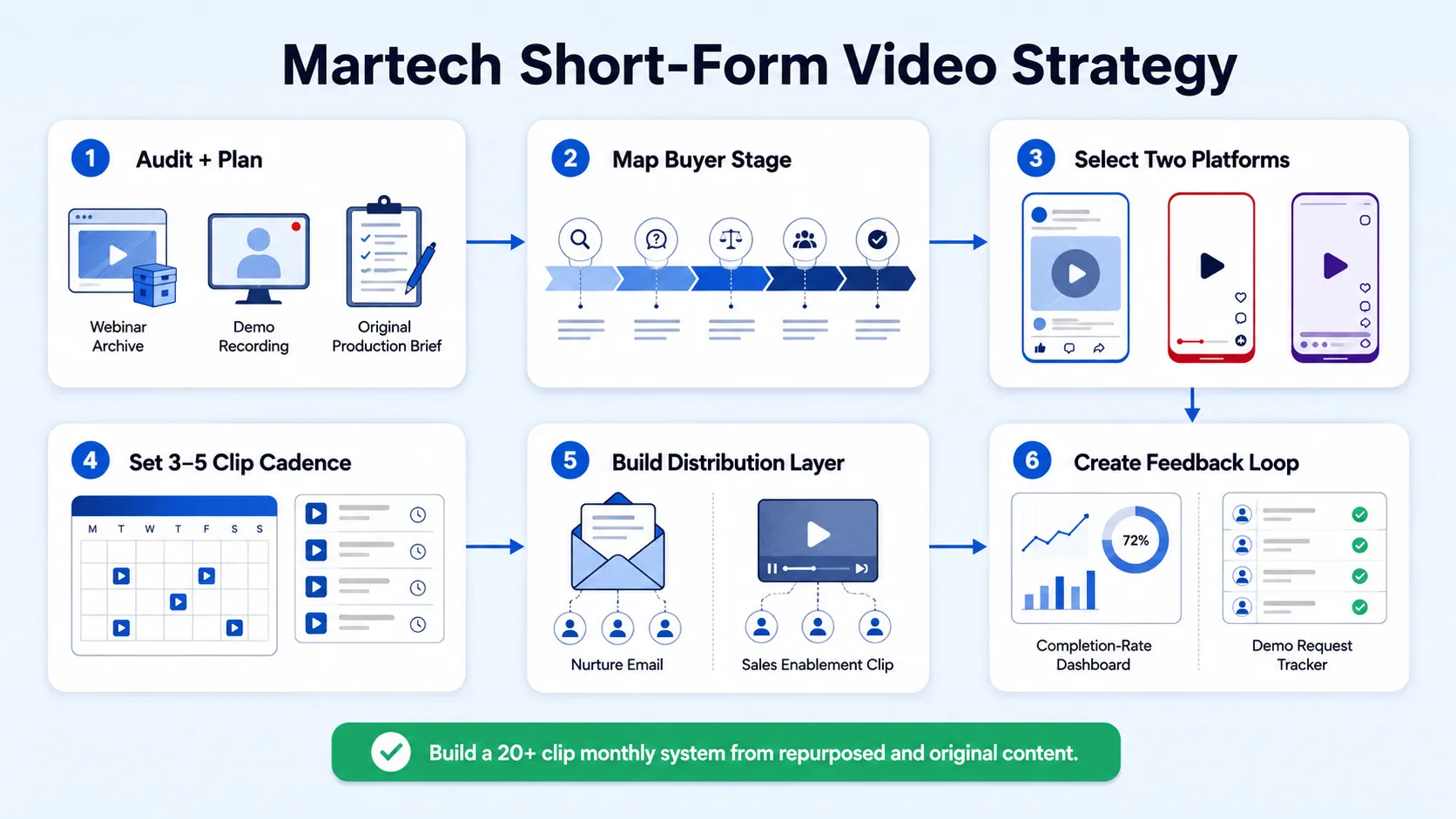
- Audit and plan: Identify existing webinars and demos for repurposing, but also map out original production themes for content created from scratch.
- Map content to buyer stage: Each clip should have one job: create awareness, educate, or support a sales conversation.
- Select two primary platforms: For most martech companies, this means LinkedIn Video (for direct B2B reach) and YouTube Shorts or Instagram Reels (for discovery and retargeting).
- Establish a content cadence: Aim for 3–5 short clips per week. While repurposing existing long-form content provides a fast start, incorporating original, from-scratch video production allows for higher-impact, platform-specific storytelling.
- Build a distribution layer: Drop your explainer clips into onboarding sequences, nurture campaigns, and sales enablement follow-ups.
- Create a feedback loop: Track completion rate, click-through on CTAs, and downstream demo requests. Adjust format and hook style based on retention data.
High-performing programs rely on a layered approach that meets prospects where they are. While turning existing webinars, demos, and podcasts into clips is a dramatically efficient engine, the most effective strategies balance this with original, from-scratch video production. Original content allows brands to jump on trending topics and create highly targeted narratives that repurposed assets might not cover. At Komet Media, we help teams integrate both paths to scale from occasional posts to a robust, 20+ clip monthly system.
How Martech Companies Use LinkedIn Video and Reels for Lead Generation
Demand generation for martech brands is no longer driven by gated whitepapers and cold outreach alone. Short-form video for martech companies on LinkedIn, TikTok for Business, and Instagram Reels is now a primary pipeline input, particularly at the consideration stage where buyers are actively comparing vendors.
LinkedIn Video is the highest-priority platform for martech B2B teams. Your buyers, marketing ops leaders, CMOs, and growth heads, are active there during business hours.
Upload video natively to LinkedIn rather than sharing a YouTube link, as social algorithms penalize outbound links.
Native uploads also autoplay in-feed, dramatically improving watch rates.
For LinkedIn lead generation, use these clip types:
- Pain-point clips: 30–45 seconds that name a specific martech problem (e.g., CRM data fragmentation, attribution gaps) with no pitch.
- Mini-demos: 60-second screen recordings showing one feature solving one problem, captioned for silent viewing.
- Social proof clips: 30-second customer quotes focused on a measurable outcome, not general satisfaction.
Add captions since most LinkedIn users scroll with sound off.
This is non-negotiable for martech content because your buyer is often watching during a meeting or between calls.
Instagram Reels and TikTok for Business work for martech companies in a different way. They function as brand awareness and remarketing channels. A marketing director who sees your clip in their professional feed and then encounters a Reel on their phone is twice touched before your sales team calls.
Short-form video delivers the highest ROI of any content format, with videos under 60 seconds generating 2.5x more engagement per impression than any other content type.
The conversion path for video-led demand generation: clip drives profile visit or link click, profile or landing page captures intent, sales team follows up with a personalized video or demo offer.
Personalized video thumbnails in cold outreach increase response rates because they signal effort.
The Biggest Mistakes Martech Companies Make With Short-Form Video
Most martech teams that invest in short-form video and see no results are making one of these structural errors:
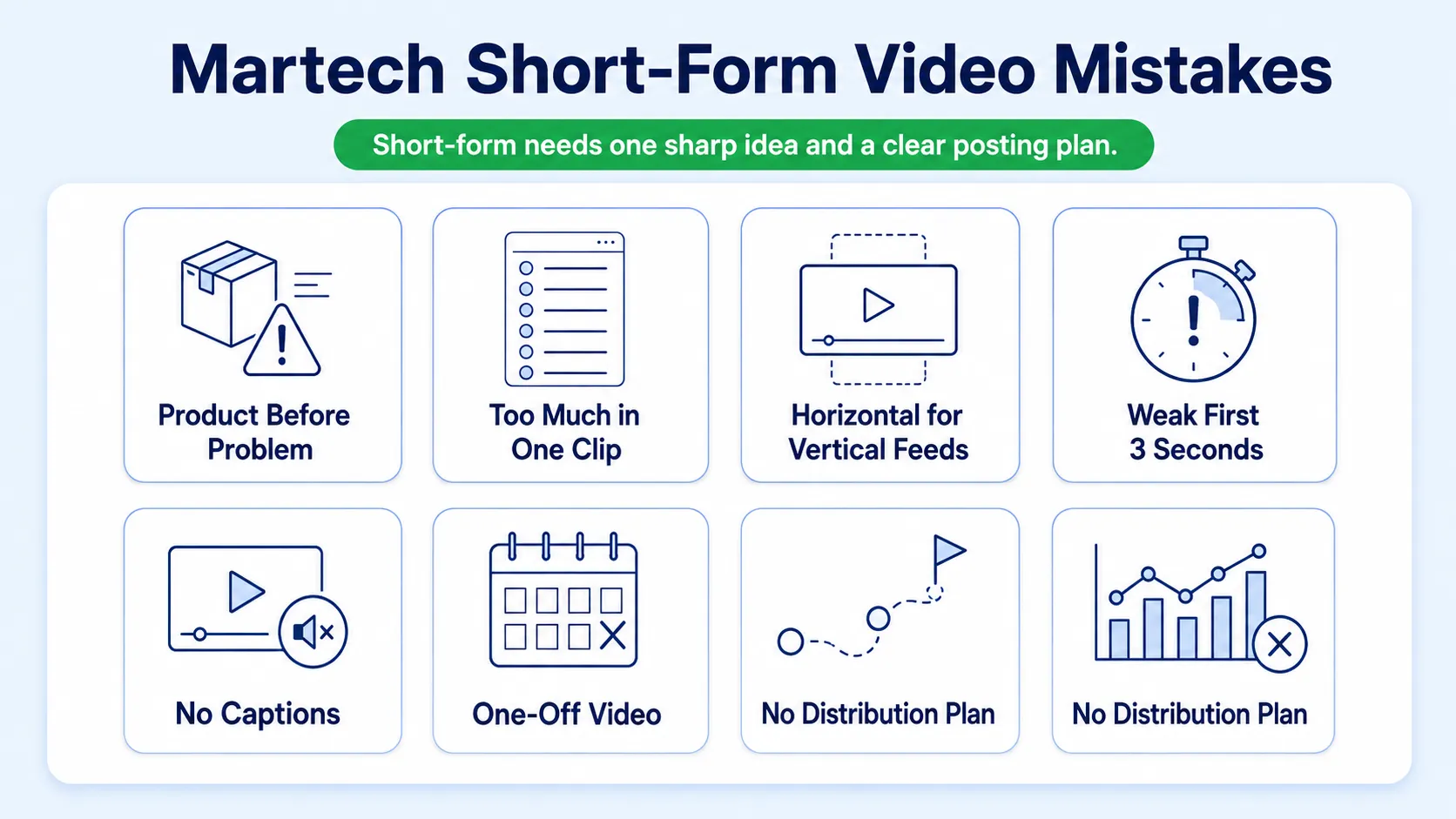
- Leading with the product, not the problem: Always start with the problem, not the product, within the first 10 seconds. Martech buyers shut off the moment a clip opens with a logo or a "we're excited to introduce" line.
- Covering too much in one clip: Trying to cover an entire product in one clip instead of one clear idea per video is one of the most common short-form production mistakes. Martech products are complex; accept that and build a series instead.
- Shooting horizontal video for vertical feeds: Shooting horizontal video for a feed built for vertical instantly signals a brand that does not understand the platform. LinkedIn, Reels, and TikTok are all mobile-first, vertical environments.
- No hook in the first 3 seconds: With average attention spans down to 8 seconds, your hook must land immediately or viewers swipe away.
- Posting without captions: Most B2B buyers watch videos on mute. An uncaptioned video loses the majority of its audience before it communicates a single word.
- Treating video as a one-off instead of a system: One video per quarter is noise. A consistent cadence of 3–5 clips per week across LinkedIn Video and Reels is a pipeline asset.
- Ignoring distribution: Production without distribution is a waste. Every clip needs a posting plan, a repurposing route (clip to email, clip to sales enablement), and a performance feedback loop.
Many of these mistakes carry over directly from long-form production habits, where there was more room for a slow build. Short-form has almost none of that margin, which means every production decision needs to be re-evaluated against a much tighter window for holding attention.
How to Explain Complex Martech Products in 60 Seconds or Less
This is the core creative challenge for short-form video for martech companies. Your product has 47 features, 12 integrations, and three distinct use cases by role. A 60-second clip cannot hold all of that. It should not be tried.
The framework that works:
- Open with the exact pain (0–8 seconds): Name the specific problem your buyer experiences. "Your sales team doesn't know which leads are actually ready to buy" is a hook. "Our platform uses AI-powered scoring" is not.
- Introduce the mechanism (8–25 seconds): Show, do not tell. A 5-second screen recording of your UI in action communicates more than 20 seconds of voiceover description.
- State the outcome (25–45 seconds): One specific, concrete result. "Teams using this cut their pipeline review time by half" lands better than "improved efficiency."
- Single CTA (45–60 seconds): One action only: "Link in bio to see a demo" or "Comment 'demo' and we'll send it." Multiple CTAs produce no action.
SaaS explainer videos are short, engaging videos that break down how a software product works minus the tech jargon. Think of them as your product's elevator pitch, told through clean visuals, friendly voiceovers, and smart storytelling. If your product is complex, consider breaking it into multiple focused videos rather than one long one.
For a martech platform with CRM, attribution, and automation modules, that means three separate clip series, each speaking to the marketing ops persona, the demand gen lead, and the CMO differently. Landing pages with embedded video convert at 86% higher rates than text-only equivalents, with B2B SaaS pages with explainer videos seeing conversion lifts exceeding 100% in controlled testing. Place your best 60-second explainer above the fold on your homepage and key product pages. That single placement compounds across every paid and organic traffic source you already have.
Our short-form video editing service and video advertising service are built specifically for this workflow, taking your existing long-form assets and engineering them into crisp, buyer-ready clips that work across your marketing technology stack.
Conclusion
Short-form video for martech companies is a strategic system, not a content tactic.
- 73% of B2B marketers report a positive impact on ROI from video marketing, and martech brands have every structural advantage to lead this shift.
- The highest-performing approach combines efficient content repurposing with original, from-scratch video production to ensure maximum impact across LinkedIn Video, Reels, and YouTube Shorts.
- Avoid the common failure modes: starting with the product, covering too much in one clip, skipping captions, and treating video as a one-off rather than a system.
- If your team is sitting on webinars, demos, and podcast recordings, you already have everything you need to start. The system just needs to be built. Komet Media can build it with you.
Frequently Asked Questions
Q1: How long should short-form video for martech companies actually be?
Short videos under 30 seconds achieve the highest completion rates but may lack depth for complex product explanations. Mid-length videos of 60–90 seconds balance engagement with substantive content, making them ideal for most B2B use cases. For martech, target 45–75 seconds for social clips and 90 seconds for product demos.
Q2: Which platform should a martech company prioritize for short-form video?
LinkedIn Video is the non-negotiable starting point because that is where your buyers, marketing ops leaders, demand gen directors, and CMOs, are professionally active. Add Reels and YouTube Shorts as secondary channels for discovery and remarketing once your LinkedIn cadence is established.
Q3: How often should a martech company post short-form video?
Three to five clips per week is the minimum threshold for algorithmic visibility and buyer familiarity. A hybrid approach works best. Content repurposing from existing recordings is the most efficient path to maintain volume, but it should be supplemented with original video production for high-impact, timely, or specific brand-building messages. because it removes the bottleneck of constant new production. One webinar can fuel two weeks of clips.
Q4: Do martech companies need a big production budget for short-form video?
No. Short-form video allows marketers to distill complex information into digestible, memorable content that captures the attention of busy executives in just a few seconds , and a well-lit founder talking directly to camera outperforms over-produced brand videos in authenticity and trust. The budget should go into editing, captioning, and distribution before cameras.
Q5: Can I repurpose existing webinars and demos into short-form video?
Yes, and while this should be your foundation, you should also create original content from scratch. Repurposing a 60-minute webinar can yield 8–15 sharp insights, but original videos allow for tighter hooks and platform-native trends. Our services are designed to manage both the repurposing of your IP and the production of net-new original content.
Q6: How do I measure whether short-form video is actually supporting the pipeline?
Track completion rate (are people watching past 30 seconds?), click-through on CTAs, and downstream demo requests tagged to video as the source. 72% of B2B buyers say vendor video content influences their vendor shortlist decisions, so also ask new demo contacts directly how they first encountered your brand. Video influence is often underreported in attribution.