
🪄 AI Summary
Heading 1
Heading 2
Heading 3
Heading 4
Heading 5
Heading 6
Lorem ipsum dolor sit amet, consectetur adipiscing elit, sed do eiusmod tempor incididunt ut labore et dolore magna aliqua. Ut enim ad minim veniam, quis nostrud exercitation ullamco laboris nisi ut aliquip ex ea commodo consequat. Duis aute irure dolor in reprehenderit in voluptate velit esse cillum dolore eu fugiat nulla pariatur.
Block quote
Ordered list
- Item 1
- Item 2
- Item 3
Unordered list
- Item A
- Item B
- Item C
Bold text
Emphasis
Superscript
Subscript
Fintech buyers do not just evaluate features. They evaluate whether they can trust you with money, data, and their own reputation. Video marketing helps because it shows the people, thinking, and product behind the brand in a way a landing page cannot. In fintech, though, every video carries more risk than in most B2B categories. A loose claim about rates, returns, or security can create real problems. This guide covers what fintech teams should produce, how to fit compliance review into production, and how to distribute and measure video that supports pipeline.
Quick Answer
Video marketing for fintech companies works when it explains complex products clearly, shows credible people, and stays accurate. Produce a focused mix of explainers, founder and customer videos, and repurposed clips, with compliance review built into the workflow.
Why Video Matters More in Fintech Than Most Categories
Fintech products are often hard to picture. Payments infrastructure, lending platforms, treasury tools, and compliance software solve serious problems, but their value sits in processes buyers cannot see. Video makes those processes visible.
Trust is the other reason. Buying a fintech product often means connecting it to bank accounts, customer data, or financial reporting. Buyers want to see who built it and how they think about risk. A clear video from your head of risk explaining your controls can do more for a deal than a long security questionnaire response alone.
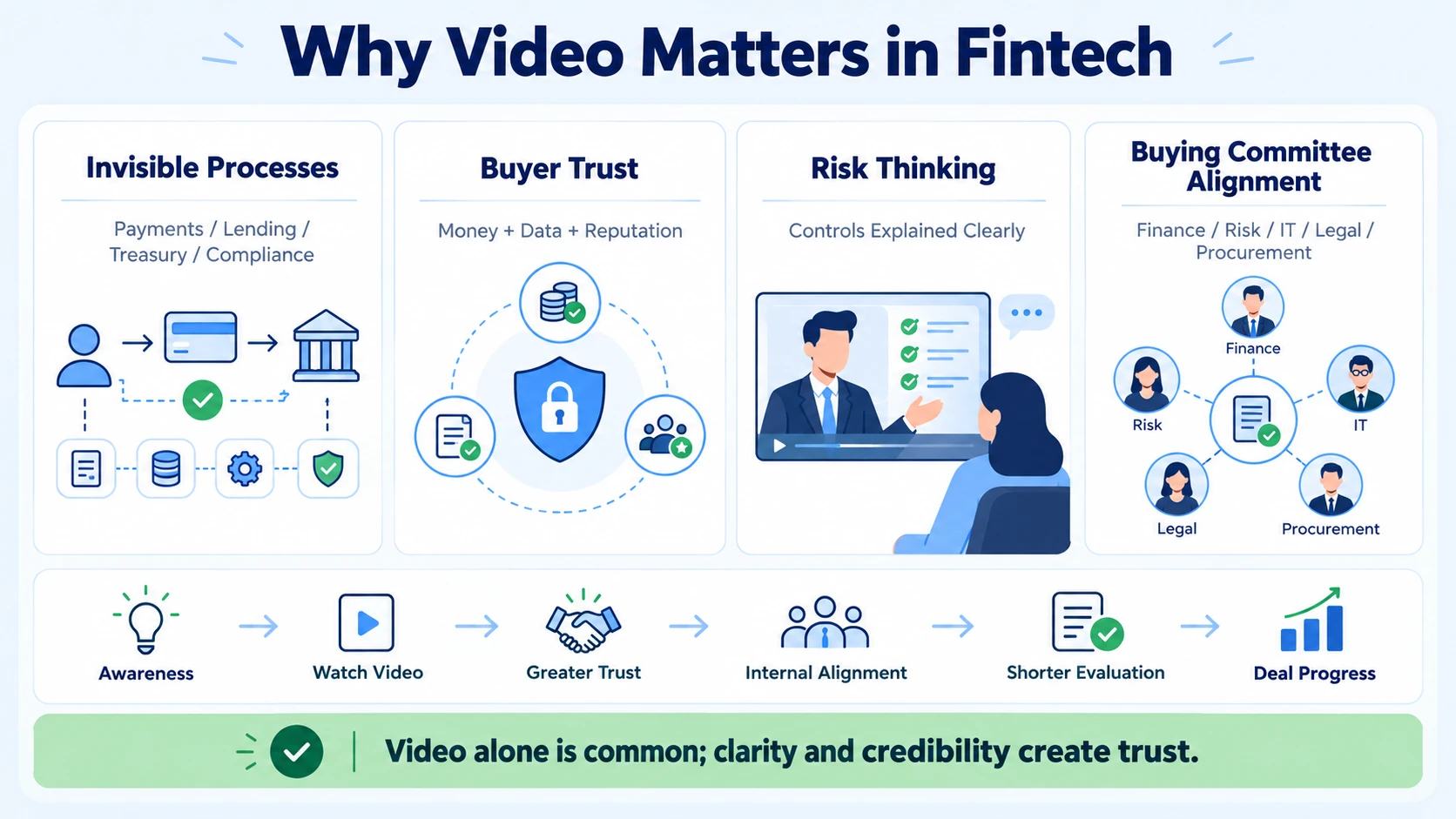
The challenge is that almost everyone uses video now. Wyzowl's 2026 survey of 266 marketers found that 91% of businesses use video as a marketing tool, and 92% plan to spend the same or more on it in 2026. Video alone no longer sets you apart. Clarity, credibility, and consistency do.
Buying committees make this harder. Fintech deals often involve finance, risk, IT, legal, and procurement. The 2025 Edelman and LinkedIn B2B Thought Leadership Impact Report, based on a survey of nearly 2,000 management-level professionals, found that more than 40% of B2B deals stall because of internal misalignment within buying groups. Short, specific videos for each stakeholder can help a deal keep moving.
The Fintech Video Mix: What to Actually Produce
One mistake I see repeatedly is fintech teams producing one expensive brand video and then nothing for six months. A better approach is a focused mix that supports each stage of the buying process.
There are two ways to build this mix. Some teams already have webinars, podcasts, and recorded panels that can be repurposed into clips. Others need original video created from scratch: research, scripting, recording, and editing. Most fintech teams benefit from both. Repurposing keeps volume steady, while original pieces cover topics that existing recordings miss.
If your team already runs a podcast, our guide to turning fintech podcast episodes into clips covers that workflow in detail.
Production style matters too. Fintech audiences respond to calm, clear editing. Clean motion graphics that show a payment flow or approval process can explain more than a minute of talking. Flashy transitions and loud music usually work against credibility.
What makes a strong fintech explainer? In my experience, it starts with the buyer's problem, not the product. A treasury tool explainer might open with the pain of reconciling cash across ten bank accounts every Friday. Then it shows, step by step, how the product changes that routine. It names the controls that keep the process safe, and it ends with the one outcome the buyer cares about. Ninety seconds of that is worth more than five minutes of feature tours.
Good fintech video marketing also respects the viewer's time. Many finance leaders watch at their desks with the sound off, so captions and clear on-screen labels carry the message. Every number on screen should match the approved script exactly.
Fitting Compliance Review into Production
I am not a lawyer, and nothing here is legal advice. What I can share is how compliance review fits into a video workflow without stalling it. Your legal and compliance teams decide what applies to you.
The rules depend on what kind of fintech you are. A B2B infrastructure company has a different review burden from a broker-dealer, an investment adviser, or a consumer lender. For FINRA member firms, Rule 2210 governs communications with the public. As FINRA explains in Regulatory Notice 26-14, the rule currently requires an appropriately qualified registered principal to approve retail communications before use, with specified exceptions. Its content standards require communications to be fair and balanced and prohibit false, exaggerated, promissory, or misleading claims.
That July 2026 notice also proposes moving to risk-based supervision of retail communications, citing social media and generative AI. The comment period closed on September 11, 2026, so treat it as a proposal, not a change in effect. FINRA stated that the substantive content standards would not change.
For production teams, the lesson is practical: review should happen on scripts and selected moments, not only on finished videos.
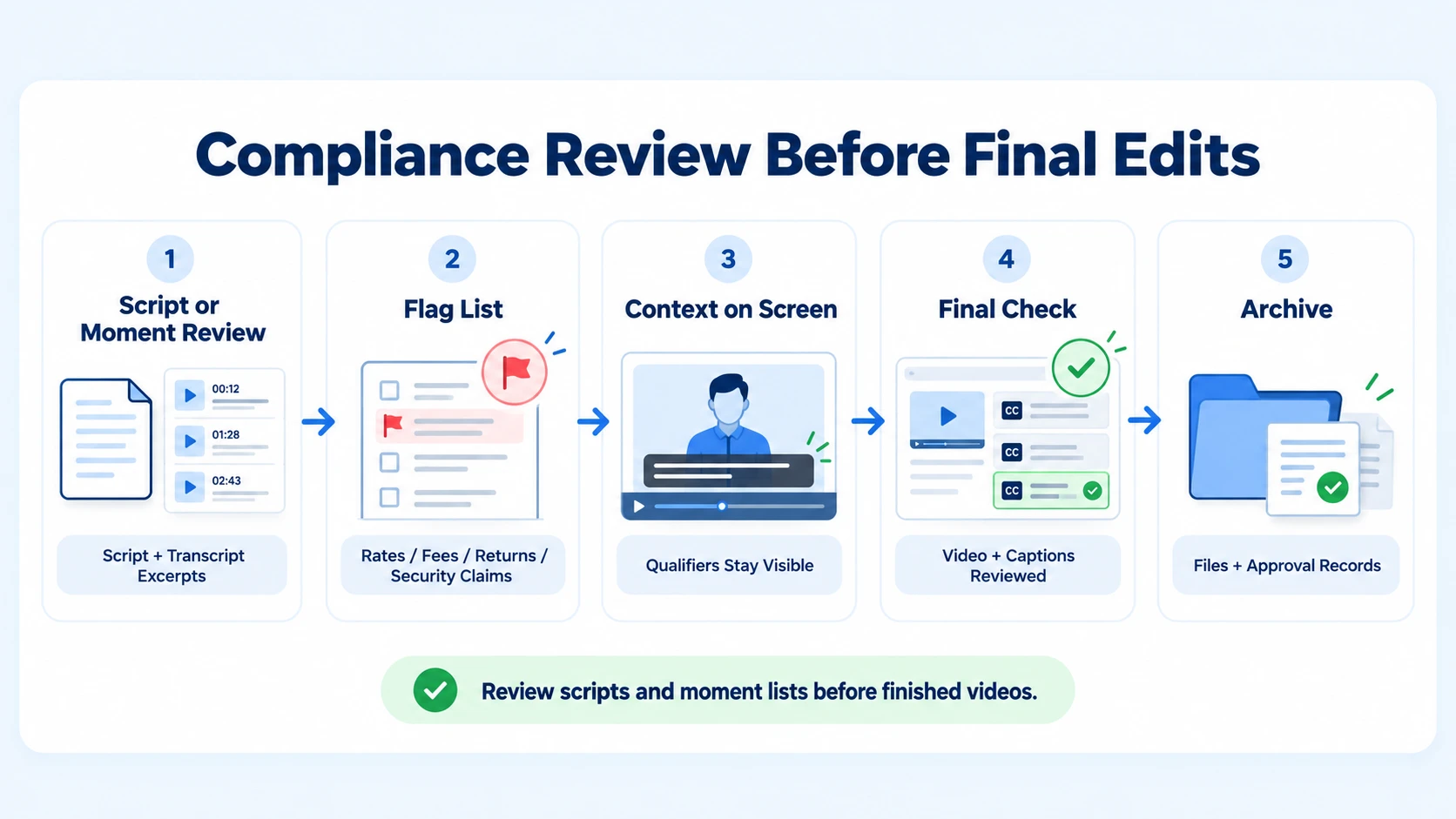
How we usually structure it:
- Script or moment review first. For original videos, compliance reviews the script. For repurposed clips, they review timestamped transcript excerpts.
- Flag list. We mark statements about rates, fees, returns, guarantees, comparisons, named customers, and security claims.
- Context on screen. Where a claim needs qualifiers, we keep the full sentence or add an on-screen line.
- Final check. Compliance sees the finished video with captions, because on-screen text can change meaning.
- Archive. Final files, captions, and approval records are stored together.
Customer stories need an extra step. Confirm in writing what the customer is comfortable sharing, including their name, logo, and any figures, before recording. Many financial institutions have their own approval processes for vendor content, and those can take time.
A common pattern in our work is that teams lose weeks by sending finished edits for review. When a sentence gets rejected late, the video has to be rebuilt. Reviewing scripts and moment lists first saves that rework.
Building a Repeatable Video Marketing System
Fintech video marketing works best as a system, not a series of one-off projects. A system means the team knows what gets produced each month, who reviews it, and where it goes.
A typical monthly rhythm for a fintech team might look like this:
This is an example rhythm, not a fixed package. Teams with heavier review requirements may need a longer cycle.
What makes the system work:
- Batch recordings. Executives can record several topics in one session, which protects their calendars.
- One owner for distribution. Someone must own scheduling, posting, and reporting, or finished videos sit unused.
- A shared glossary. Product names, regulatory terms, and acronyms stay consistent across captions.
- A clip library for sales. Organized by objection, so reps can find the right video in seconds.
Small teams can simplify by combining recording and scripting weeks. I would not skip the compliance step or the distribution owner. Those are the two places fintech video programs most often break down.
The most common reasons fintech video programs stall are predictable:
- No clear owner. Videos get made, but nobody schedules or promotes them.
- Late compliance review. Finished edits get rejected and rebuilt.
- Executive availability. Recordings get cancelled when the calendar fills up.
- One-off thinking. Each video is treated as a separate project, so nothing builds momentum.
Each of these is a process problem, not a creative one. Fix the process, and quality usually follows.
Distribution: Matching Videos to Fintech Buyers
A polished video with no distribution plan is still an underused asset. Decide where each video goes before you produce it.
LinkedIn is usually the main channel for B2B fintech. CFOs, finance operations leaders, and banking partners are active there. Video consumption on the platform has grown: Digiday reported that total video viewership on LinkedIn rose 36% year over year for the period from October 30, 2024, to January 29, 2025, based on figures shared by the company. Our guide to LinkedIn video for fintech companies covers formats and posting in more depth.
YouTube works for explainers and full webinar or podcast episodes. Clear titles that match how buyers search, such as "how payment reconciliation works," help videos stay discoverable for months.
Your website should host explainers and customer stories on the pages where buyers make decisions: product pages, security pages, and pricing pages.
Sales enablement is often the highest-value channel. A 90-second video from your head of risk answering "how do you protect customer funds?" can be a stronger follow-up than another PDF.
Instagram Reels suits consumer-facing fintech and founder visibility. For infrastructure companies, I treat it as secondary unless the founder is building a personal audience. Our guide to short-form video for fintech companies covers short formats across platforms.
Paid distribution can extend your best-performing organic videos to specific account lists or job titles. I usually recommend proving a video organically first, then putting budget behind the pieces that already earn engagement from the right roles. Check whether paid placements need separate compliance review, since some firms treat ads differently from organic posts.
For teams selling into New York financial services, partner and guest networks often overlap heavily with the buyer list. Test that organic reach before spending on paid promotion.
Email is another dependable channel. A short monthly update with one explainer and two clips keeps prospects and customers informed on a channel you control.
How to Measure What Video Is Doing for the Business
Do not judge fintech videos only by views. A video watched by a few hundred finance leaders at target accounts can matter more than one with broad reach among people who will never buy.
Attribution will be imperfect. A buyer may watch three clips on LinkedIn and later book a demo through search. Combine platform data with a "how did you hear about us" field and regular sales feedback.
Review results monthly. Look at which topics, formats, and speakers perform best with your target roles, then use those lessons to plan the next month's production. Over time, video marketing data should change what you make: more of the explainers and speakers that move buyers, less of what only collects polite views.
Conclusion
Fintech companies have a specific problem that video is well suited to solve: complex, high-trust products that buyers cannot see. The teams that do this well are not the ones with the biggest budgets. They are the ones with a clear mix, a dependable review process, and a distribution plan for every video.
The decision that matters is to run video marketing as a system rather than a campaign. Combine repurposed and original video, build compliance into production, give every asset a destination, and measure what it does for trust and pipeline. That is how video becomes a dependable part of how fintech companies sell.
FAQ
1) What does video marketing for fintech companies include?
It usually includes original video production from scratch (such as product explainers and founder or risk videos), customer stories, short clips repurposed from webinars and podcasts, and sales follow-up videos. The mix should follow your buyers and sales process.
2) How much does it cost?
It depends on the model and scope. Freelancers often charge per video or per hour, subscriptions charge a flat monthly fee for editing volume, and agencies price by scope. At Komet Media, engagements typically fall in the range of about $2,500 to $5,000, depending on volume, original production needs, motion graphics, review requirements, and distribution support.
3) How long does it take to produce fintech videos?
Editing time depends on length and complexity, but compliance review often sets the timeline. Teams that review scripts and moment lists before editing usually move faster than teams that review finished videos.
4) Do we need compliance approval for every video?
That depends on your business and the rules that apply to you. FINRA member firms, for example, currently face principal approval requirements for retail communications. Ask your compliance team which video types need pre-approval.
5) Should we hire a freelancer or an agency?
A skilled freelancer can work well for editing alone. An agency fits better when you need end-to-end support—from strategy, scripting, and original video production from scratch to repurposing, distribution, and reporting as one cohesive system.
6) Can our internal team handle this?
Yes, if you have people with editing skills and time to own production and distribution every week. The common failure point is consistency when launches or audits take priority.
7) Which video type should a fintech company start with?
Start with the video that answers your most common sales objection. For many fintech teams, that is a clear product explainer or a risk and security explainer. Once that video is working in sales conversations, add founder point-of-view clips and customer stories to build reach and proof.
8) How does Komet Media work with fintech companies?
We help fintech teams plan, script, produce, edit, and distribute video, including original content created from scratch and clips repurposed from existing recordings. Review steps are built into the workflow. If you want to talk through your plans, you can book a call with our team.