
🪄 AI Summary
Heading 1
Heading 2
Heading 3
Heading 4
Heading 5
Heading 6
Lorem ipsum dolor sit amet, consectetur adipiscing elit, sed do eiusmod tempor incididunt ut labore et dolore magna aliqua. Ut enim ad minim veniam, quis nostrud exercitation ullamco laboris nisi ut aliquip ex ea commodo consequat. Duis aute irure dolor in reprehenderit in voluptate velit esse cillum dolore eu fugiat nulla pariatur.
Block quote
Ordered list
- Item 1
- Item 2
- Item 3
Unordered list
- Item A
- Item B
- Item C
Bold text
Emphasis
Superscript
Subscript
Edtech podcasts often feature the voices buyers trust most: teachers, principals, district leaders, and university administrators. Those conversations are full of practical lessons about adoption, outcomes, and classroom reality. Creating original podcasts or repurposing existing episodes turns them into clips that reach the many people involved in an education purchase. Education content carries extra responsibility, though. Student privacy, outcome claims, and the gap between educators and administrators all affect what you can publish. This guide covers how I select moments, protect privacy, and produce or distribute clips for edtech brands.
Quick Answer
Podcast creation and repurposing for edtech brands means producing original episodes or turning existing episodes into clips and assets for educators and education buyers. It works when you protect student privacy, keep outcome claims grounded, and match each clip to the right stakeholder and channel.
Why Edtech Buyers Listen to Educators, Not Vendors
Education purchases involve many people with different priorities. A district decision might include the superintendent, curriculum leaders, IT directors, principals, teachers, and the school board. In higher education, provosts, faculty, IT, and procurement all have a say.
Each group asks different questions. Teachers want to know whether a tool will save time or add work. IT leaders ask about data security and integrations. Administrators want evidence of outcomes and a realistic implementation plan. A sales deck rarely answers all of these well.
A respected educator explaining what changed in their classroom carries more weight than any brochure. That is why edtech podcasts are so valuable. The challenge is that most of the people involved in the decision will never listen to a full episode.
The 2025 Edelman and LinkedIn B2B Thought Leadership Impact Report, based on a survey of nearly 2,000 management-level professionals, found that more than 40% of B2B deals stall because of internal misalignment within buying groups. Education buying groups are often larger and slower than corporate ones, so short clips aimed at each stakeholder can help a decision keep moving.
The format itself is familiar to most adults. The Infinite Dial 2026 from Edison Research at SSRS, based on a national survey of 2,050 people age 12 and older, found that 80% of Americans have ever listened to or watched a podcast. These are general population figures, not educator-specific data, but they show that podcast clips are a natural format for busy professionals.
Higher education adds another layer. University buyers often include faculty who value evidence and nuance, and administrators who must justify spend to boards and budget committees. Podcast creation and repurposing let you give each group the part of the conversation that speaks to them, rather than one generic recap for everyone.
Student Privacy and Outcome Claims: The Two Review Points
A common pattern in education content is a strong episode that produces clips nobody can publish. The cause is usually one of two issues that nobody planned for before recording.
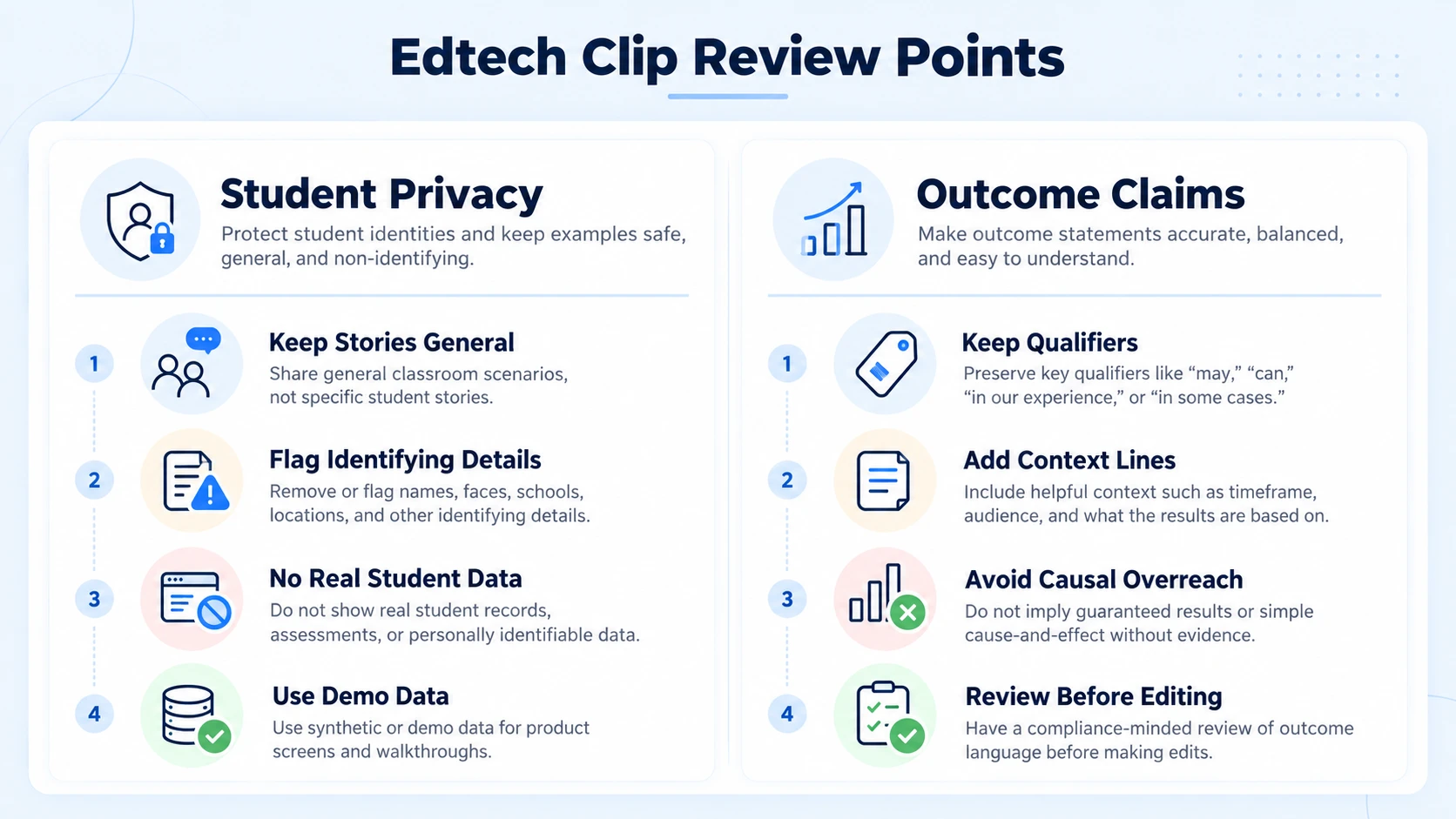
Student privacy
Educators naturally tell stories about students. Those stories are often the most moving part of an episode. They can also include details that identify a child, even without a name: grade, school, a specific challenge, or a recognizable event.
Rules depend on your product and customers. Federal student privacy law and district policies govern many education records. For products directed to children under 13, the FTC's COPPA Rule also applies. The FTC published amendments to that rule in the Federal Register in April 2025, effective June 23, 2025, with a general compliance date of April 22, 2026. The same notice said the FTC chose not to finalize proposed ed tech amendments at that time, to avoid conflict with potential changes to FERPA regulations, and would keep enforcing COPPA in ed tech under existing guidance.
I am not a lawyer, and your privacy and legal teams decide how these rules apply to you. From a production view, the rules are simple:
- Brief educator guests to keep student stories general.
- Flag any detail that could identify a student for review.
- Never use classroom footage or product screens showing real student data without the approvals your privacy team requires.
- Use synthetic or demo data in every product walkthrough.
Outcome claims
Education buyers care about outcomes, and edtech marketing often leans on them. A clip that says "test scores went up" without context can overstate what the guest actually said. The qualifiers matter: which students, over what period, compared with what, and alongside which other changes.
Keep those qualifiers attached to any outcome statement. If a clip needs context to be accurate, add an on-screen line or keep the full sentence. Correlation is not causation, and education buyers, many of whom have research training, notice when a clip implies otherwise.
Choosing Moments for Each Education Stakeholder
The best moment in an edtech episode is rarely the guest's broad view on the future of learning. It is usually a specific account of what changed for teachers or students, told by someone who was there.
I sort moments by audience:
The example angles above illustrate how to frame clips. They are not quotes from real episodes.
One mistake I see repeatedly is building every clip around the company founder. Founder clips have value, especially for investor and partner audiences. Education buyers, however, tend to trust practicing educators more than vendors. A teacher describing a real classroom moment can outperform a polished founder message.
Tone matters too. Education audiences respond to warm, clear, unhurried editing. Fast cuts and dramatic effects can feel out of place. Clean captions and simple lower thirds with name, role, and school or institution usually work best, with permission from the guest.
Accessibility is not optional for this audience. Many schools and universities have strict accessibility expectations, and educators notice when content ignores them. Accurate captions, readable on-screen text, and good audio are baseline requirements. Our article on why B2B videos need captions covers the reasoning in more depth.
A Podcast Production and Repurposing Workflow for Edtech Teams
Most podcast creation or repurposing fails before editing starts. The team has not decided which stakeholder each episode serves, and nobody owns privacy reviews. A clear workflow fixes both.
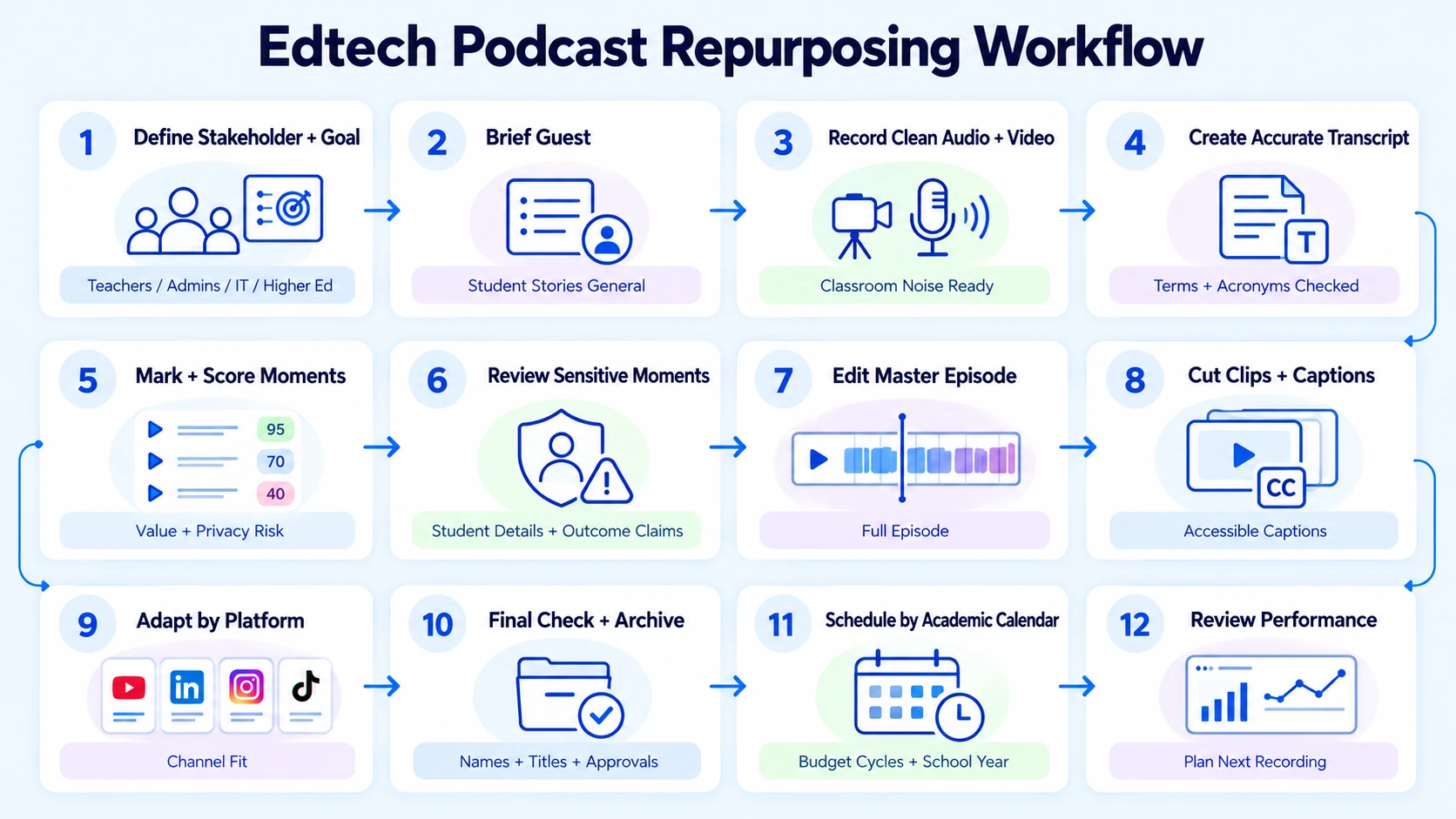
Podcast Production and Repurposing Workflow for Edtech Teams
This is the cycle I recommend:
- Define the stakeholder and goal. Teachers, administrators, IT leaders, or higher education buyers?
- Brief the guest. Explain where clips will appear, ask them to keep student stories general, and confirm what they can say about their school or institution.
- Record clean audio and video. Educator guests often record from classrooms or offices, so plan for noise and lighting.
- Create an accurate transcript. Education terms, program names, and acronyms often need a manual check.
- Mark and score moments. I score on clarity, stakeholder value, whether it stands alone, and privacy or claims risk.
- Review sensitive moments. Your team, and where needed the guest's institution, confirms student details and outcome statements.
- Edit the master episode.
- Cut clips and add accurate captions.
- Adapt for each platform.
- Final check and archive. Confirm names, titles, institutions, and approvals.
- Schedule distribution around the academic calendar.
- Review performance and feed lessons into the next recording.
Small teams can combine steps 4 and 5 and use one export template for short formats. I would not skip the guest brief, the sensitive-moment review, or the caption check. Those steps protect trust with an audience that pays close attention to privacy and accessibility.
The academic calendar deserves its own planning. Many K-12 buying decisions follow budget cycles, and educators have very different attention in August than in May. Schedule clips about planning and implementation before the school year, classroom practice clips during the term, and outcome reflections near the end. Matching the calendar makes your content feel timely without chasing trends.
What one strong episode can usually become:
These are planning ranges, not promises. A candid educator with specific classroom stories produces more usable moments than a general conversation.
Batching also helps lean edtech teams. Review a full episode's moment list in one session, approve it in one pass, and spread the clips across several weeks. That rhythm is far easier to sustain than handling every clip as a separate request.
Distribution: Reaching Educators and Education Buyers
A polished clip with no distribution plan is still an underused asset. Educators and education leaders are spread across different channels, and each one needs its own approach.
LinkedIn works well for district leaders, university administrators, and edtech partners. Video consumption on the platform has grown: Digiday reported that total video viewership on LinkedIn increased 36% year over year for the period from October 30, 2024, to January 29, 2025, based on company figures.
YouTube matters for educators, many of whom search there for practical teaching ideas. YouTube reported more than 1 billion monthly active viewers of podcast content as of January 2025. That is a platform-wide number, not education-specific, but it supports publishing full episodes there with titles that match how educators search.
Instagram and teacher communities can reach classroom educators directly. Many teachers follow peers who share practical ideas. Clips that teach a specific classroom technique tend to fit better than promotional content.
Education associations, conferences, and newsletters are major channels for this market. Clips featuring respected educators can fit naturally into association newsletters and conference follow-ups.
Sales and customer success should have a clip library organized by stakeholder and objection: teacher workload, data privacy, integration, training, and budget. A peer administrator explaining how they handled a board question can be more persuasive than any slide. Our guide to short-form video for edtech companies covers formats in more depth, and our article on video marketing for edtech companies covers the wider strategy.
Guests often have strong networks among fellow educators. Send them their clips with suggested captions, and check whether their school or institution needs to approve posts first.
Takeaway: match each clip to the stakeholder and the channel they actually use.
How to Measure Results in a Long Education Sales Cycle
Do not judge edtech clips only by views. A clip watched by a few hundred district curriculum leaders can matter more than one with broad reach among students or general audiences.
Attribution is especially hard in education because buying cycles follow budgets and school years. A district leader might watch clips for months before a formal evaluation. Ask sales to log podcast mentions, add a "how did you hear about us" field to demo and pilot forms, and review results monthly.
Over time, podcast creation and repurposing should shape what you record. If classroom practice clips consistently start conversations among teachers, book more educator guests. If administrator clips drive pilot requests, plan more episodes around implementation and budgeting.
Takeaway: combine platform data with sales feedback, and read results against the academic calendar.
Conclusion
Edtech brands have access to the voices education buyers trust most: educators and leaders who have lived through adoption, training, and change. The opportunity is to get those voices in front of every stakeholder in a long, complex decision.
The decision that matters is to run podcast production and repurposing as a careful, stakeholder-aware system. Whether creating a podcast from scratch or repurposing existing episodes, protect student privacy, keep outcome claims grounded, plan around the academic calendar, and give every clip a clear audience and channel. That is how one conversation keeps building trust across a full buying cycle.
FAQ
What is podcast creation and repurposing for an edtech company?
It is the process of creating podcasts from scratch or turning existing podcast episodes into shorter assets such as clips, carousels, show notes, and sales follow-up videos. For edtech brands, it also means protecting student privacy, keeping outcome claims accurate, and meeting accessibility expectations.
How much does it cost?
Freelancers often charge per clip or per hour, subscriptions charge a flat monthly fee for editing volume, and agencies price by scope. At Komet Media, engagements typically fall in the range of about $2,500 to $5,000, depending on episode volume, clip count, review needs, turnaround, and distribution support.
How long does it take to turn one episode into clips?
It depends on episode length, clip count, and approvals. Schools and universities sometimes need to review content featuring their staff, which can add time. Briefing guests early and reviewing moments before editing keeps things moving.
What deliverables should we expect from one episode?
A typical plan includes the full edited episode, several short clips, one or two stakeholder-specific clips for sales, quote cards or carousels, and show notes. The mix should follow your buyers and the academic calendar.
Should we hire a freelancer or an agency?
A skilled freelancer can handle editing well at low volume. An agency is usually a better fit when you need moment selection, privacy review coordination, platform adaptation, and distribution support handled together. Ask any partner how they handle student privacy and captions.
Can our internal team handle this?
Yes, if someone owns the work every week and has editing skills. Edtech marketing teams often get stretched during back-to-school and conference seasons, which is exactly when buyers are paying attention.
Do educator guests need approval from their school or institution?
Often, yes. Many districts and universities have policies on staff appearing in vendor content. Confirm this before recording so approvals do not delay publishing.
How does Komet Media work with edtech brands?
We offer end-to-end podcast creation from scratch as well as repurposing. We handle concepting, moment selection, editing, accurate captions, platform adaptation, and distribution support, with privacy review built into the workflow. We can also create original videos from scratch or help you launch a podcast if you do not have one yet. If you want to talk through your show, you can book a call with our team.