
🪄 AI Summary
Heading 1
Heading 2
Heading 3
Heading 4
Heading 5
Heading 6
Lorem ipsum dolor sit amet, consectetur adipiscing elit, sed do eiusmod tempor incididunt ut labore et dolore magna aliqua. Ut enim ad minim veniam, quis nostrud exercitation ullamco laboris nisi ut aliquip ex ea commodo consequat. Duis aute irure dolor in reprehenderit in voluptate velit esse cillum dolore eu fugiat nulla pariatur.
Block quote
Ordered list
- Item 1
- Item 2
- Item 3
Unordered list
- Item A
- Item B
- Item C
Bold text
Emphasis
Superscript
Subscript
Fintech teams are sitting on gold, webinars, demo recordings, founder interviews, product walkthroughs, and publishing almost none of it in the format buyers actually watch. Short-form video for fintech companies is no longer an experiment. It is the primary discovery channel for financial products in 2026, and the brands building consistent video systems around their existing content are pulling ahead in pipeline, trust, and brand awareness. This guide breaks down exactly how to use it, strategically, compliantly, and efficiently.
TL;DR
- Short-form video has crossed from experimental to primary discovery channel for fintech brands.
- Explainer videos, founder clips, and social proof clips are the highest-ROI formats for financial services.
- Compliance with FINRA, SEC, and platform rules is non-negotiable, but it is manageable with the right workflow.
- B2B fintech teams can use short-form video directly for sales enablement, demo demand, and pipeline acceleration.
What a Short-Form Video Strategy for Fintech Companies Actually Looks Like
Most fintech teams approach video the wrong way: they produce one polished brand film per quarter and wonder why it gets no traction. A real short-form video strategy is a system, not a one-off.
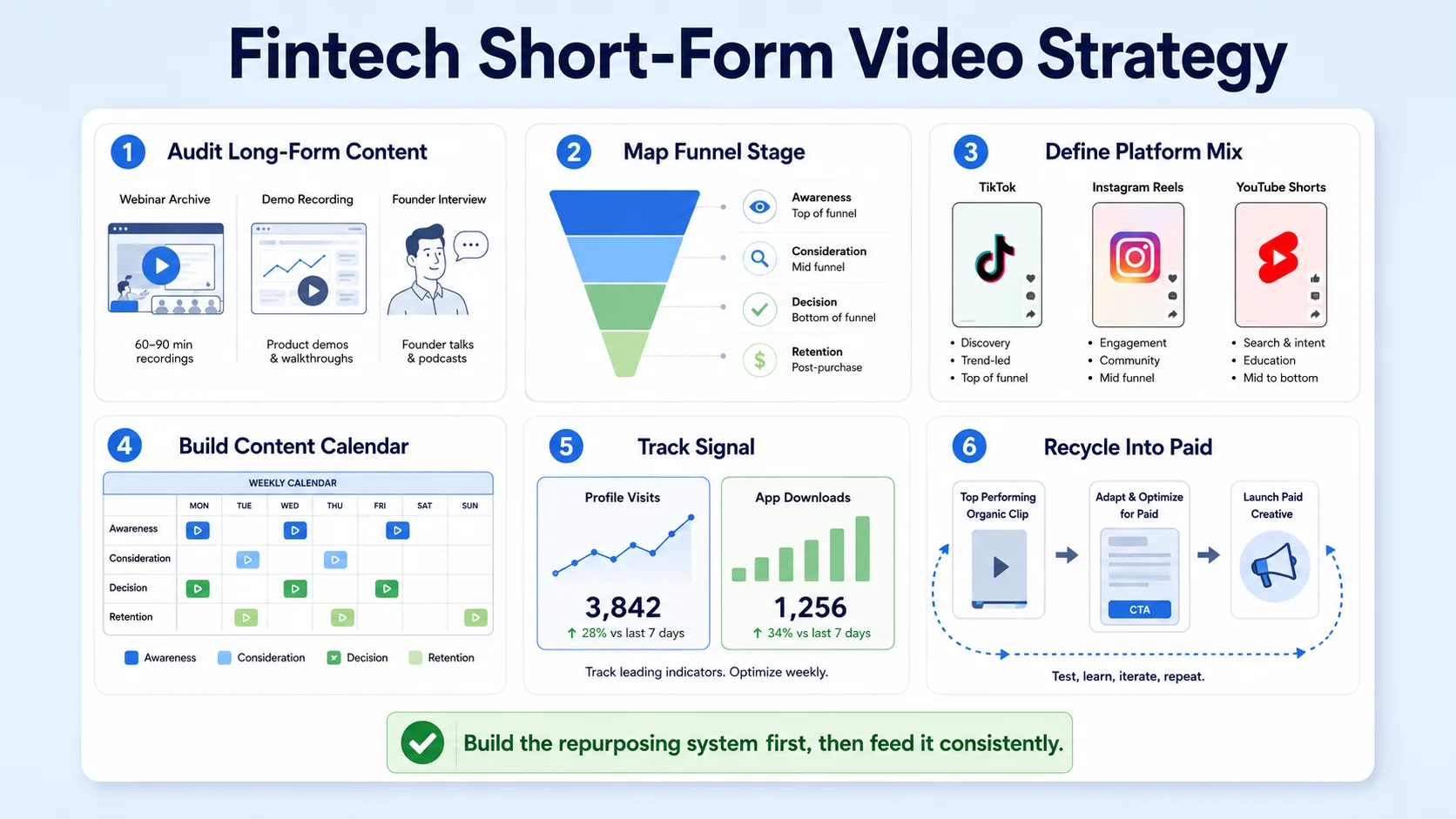
Here is how to build it:
- Audit existing long-form content: Pull your recorded webinars, podcasts, demo calls, and founder interviews. Each is a content mine.
- Map content to the funnel stage: Awareness (education, neobank storytelling), consideration (product walkthroughs, comparison clips), and decision (social proof, case study snippets).
- Define your platform mix: TikTok commands roughly 40% of the short-form market, followed by Instagram Reels and YouTube Shorts at roughly 20% each. Pick two primary platforms and dominate them before expanding.
- Build a content calendar: Post 3 to 5 short-form videos per week across TikTok, Instagram Reels, and YouTube Shorts.
- Track signal, not vanity: Track which topics drive profile visits and app downloads, then double down on what works.
- Recycle into paid: Use top-performing organic content as paid creative through whitelisting.
The content strategy framework comes down to one rule: volume and authenticity beat production budget. One polished brand video per month will always underperform 15 authentic clips in both reach and conversion. For fintech startups in Series A or earlier, this is especially critical. Your founder is your most credible asset. Put them on camera, short, direct, 60-second takes answering buyer objections, and your content strategy is already ahead of most funded competitors.
The rule: A content calendar without a repurposing system is just extra work. Build the system first, then feed it consistently.
At Komet Media, we build exactly this kind of video system for B2B fintech teams, offering short-form video creation from scratch in addition to turning existing long-form assets into a pipeline of content.
How Fintech Brands Can Use TikTok and Reels to Grow
In 2026, TikTok will be a mainstream part of the financial marketing mix. With nearly 1.9 billion monthly active users globally and 136 million in the United States alone, the platform is no longer a question of if, it is a question of how. Instagram Reels compounds the opportunity. TikTok leads with a 5.69% average engagement rate, followed by Instagram Reels at 2.80% and YouTube Shorts at 1.90%.
For fintech brand awareness, these are the most efficient organic reach channels available.
What works on both platforms:
- Product explainer clips (60 to 90 seconds): Answer "what does this do and why should I care" in plain language. No jargon.
- Feature comparison clips: Position your payment processing or digital banking product directly against the alternative buyers are considering.
- Founder POV posts: Short, direct takes from the founder or executive voice build consumer trust and drive Reels engagement faster than branded content.
- Customer story snippets: Real clients telling their story, nothing builds trust in financial services like credible proof from people who have been there.
A 2025 Chime/Talker Research survey of 2,000 FinTok users found that the average user watched over 400 hours of financial content in 2025, with Millennials averaging 10 hours per week. That is an enormous amount of attention, and most fintech brands are not claiming their share of it. 42% of US adults aged 18 to 29 sought financial advice from social media in 2025, compared to 20% of Americans overall.
For consumer-facing fintech and investment app onboarding, this is the primary discovery path for your highest-value demographic. The TikTok algorithm rewards watch time and replays. Keep hooks under three seconds, deliver the payoff within the first 15, and always include a clear next step, whether that is a link in bio, a download, or a demo request.
What Types of Short-Form Videos Work Best for Financial Services
Not every video format works in fintech. Here is a clear breakdown of the formats with the strongest performance in financial services marketing:
91% of consumers watch explainer videos to learn about products or services, making them the single most effective format for fintech companies with complex products. Fintech companies embed explainer videos in onboarding flows, welcome emails, and help centers to reduce support tickets and improve activation rates. 96% of marketers agree videos help audiences understand products better.
In fintech, where trust and clarity drive adoption, that is not a marketing stat, it is a product metric. For B2B fintech specifically, the demo clip is the workhorse. A master product demo can be 5 to 15 minutes, with 60 to 90-second cut-downs created for specific feature highlights. Those cut-downs become your short-form social content, your sales email inserts, and your LinkedIn posts simultaneously.
Visual content marketing in fintech performs best when it leads with a problem the viewer recognizes, not the product. Start with the pain (slow payroll, broken reconciliation, opaque fees), then show the fix in the last 30 seconds.
How to Explain Complex Financial Products in 60 Seconds or Less
This is the question every fintech marketing team faces. The answer is structure, not simplification. Follow this five-part framework for every short-form video on a complex financial topic:
- Hook with the problem (0–3 seconds): Name the exact frustration. "Your international wire takes 3 days and costs $30 in hidden fees."
- Validate the frustration (3–8 seconds): One line that confirms this is a real, common problem, not just theirs.
- Introduce the mechanism (8–25 seconds): How your product solves it, shown visually. Use motion graphics or screen recording. Visual metaphors, motion graphics, and clear voiceovers make the complex simple, reducing cognitive load and increasing comprehension.
- Show the outcome (25–50 seconds): What life looks like after: instant settlement, zero hidden fees, one dashboard.
- Call to action (50–60 seconds): One clear next step. Link in bio. Free trial. Book a demo.
A fintech explainer video is typically 60 to 120 seconds and breaks a complex financial technology product or concept into a clear, trust-building narrative using motion graphics, voiceover, and structured storytelling. For educational finance content on Instagram Reels, the same framework applies with one addition: on-screen text captions for every spoken word. 63% of consumers prefer watching a short video over any other format for learning about products or services, but a significant share watch with sound off. Captions keep them watching.
The best fintech explainer videos do not bury people in financial language, they answer real concerns, show the first useful moment, explain the process, and build trust without overpromising. Whether you need original short-form video creation from scratch or help turning webinar recordings into polished clips, our video editing services are built specifically for this.
Is Short-Form Video Effective for B2B Fintech Marketing and Sales Enablement?
Yes, and the data is clear. 48.6% of marketers cited short-form video as a top-three content format with the highest ROI in 2026, up 104% in perceived value since 2024. That jump in perceived value reflects what B2B fintech teams are actually experiencing: short video accelerates pipeline.
Here is why it works for B2B fintech specifically:
- It shortens the education cycle. Sales cycles in B2B fintech run 4 to 12 months and almost always involve compliance, security, finance, and product committees. Short videos that pre-educate each stakeholder reduce the number of live meetings needed to move a deal.
- It supports multi-stakeholder decisions. B2B buying typically involves 6 to 10 stakeholders and rising reliance on peer proof and reviews. A 60-second product clip is something a champion inside the account can forward to every committee member without scheduling another call.
- LinkedIn is now a short-form video platform. LinkedIn increased creator-led, short-form video programming for B2B decision-makers in 2025, with a 36% increase in year-over-year video views.
The practical application for a B2B fintech growth team is a tiered video library organized by deal stage:
Our video marketing services are designed to build and populate exactly this kind of B2B sales enablement library—through both new video creation and strategic repurposing—without requiring your team to become video producers.
What Are the Compliance Rules for Fintech Companies Posting on TikTok and Social Media?
This is the section most fintech teams skip. It is also the one that can end campaigns before they start. FINRA Rule 2210 applies to all public communications, including TikTok content posted on behalf of broker-dealers. The SEC's Marketing Rule covers investment advisers and governs how testimonials and finfluencer endorsements can be used.
TikTok allows financial advertising for banking apps, payment services, and licensed investment platforms, while cryptocurrency, payday loans, and unregulated schemes are prohibited in most markets. Regional compliance varies: the US requires state licensing and SEC/FINRA compliance, the EU demands MiFID II adherence, and the UK mandates FCA authorization with specific risk warning formats.
The compliance failure rate in the market right now is staggering. An analysis found that 68% of posts from TikTok finfluencers broke Financial Conduct Authority rules. For regulated fintech brands, this creates a direct competitive opening: show up with accurate, compliant content and you automatically own the trust positioning in your category.
Here is the minimum compliance workflow for every short-form video your fintech team publishes:
- Pre-publish review: Assign a named compliance officer to approve all scripts before filming.
- Disclosure overlays: Include required risk disclaimers as on-screen text, not just in captions or pinned comments.
- Comment-response protocol: General financial questions can receive educational replies; specific investment questions must be redirected to a licensed advisor.
- Record retention: Archive every published video and comment thread per SEC and FINRA recordkeeping requirements.
- Finfluencer vetting: Creator partnerships must include rigorous vetting and ongoing compliance monitoring to meet FINRA and SEC requirements.
Non-negotiable: Compliance is not a reason to avoid short-form video, it is a reason to build a proper content system. The brands that do this correctly own the trust positioning in their category.
For fintech teams repurposing podcast content or webinar recordings into short-form clips, the same compliance review process applies to every derivative asset, not just new recordings.
Short-Form Video Ideas for a Fintech App Launch and Ongoing Growth
Whether you are launching a neobank, a payment processing app, or an investment platform, here are the specific video formats that move the needle, organized by phase:
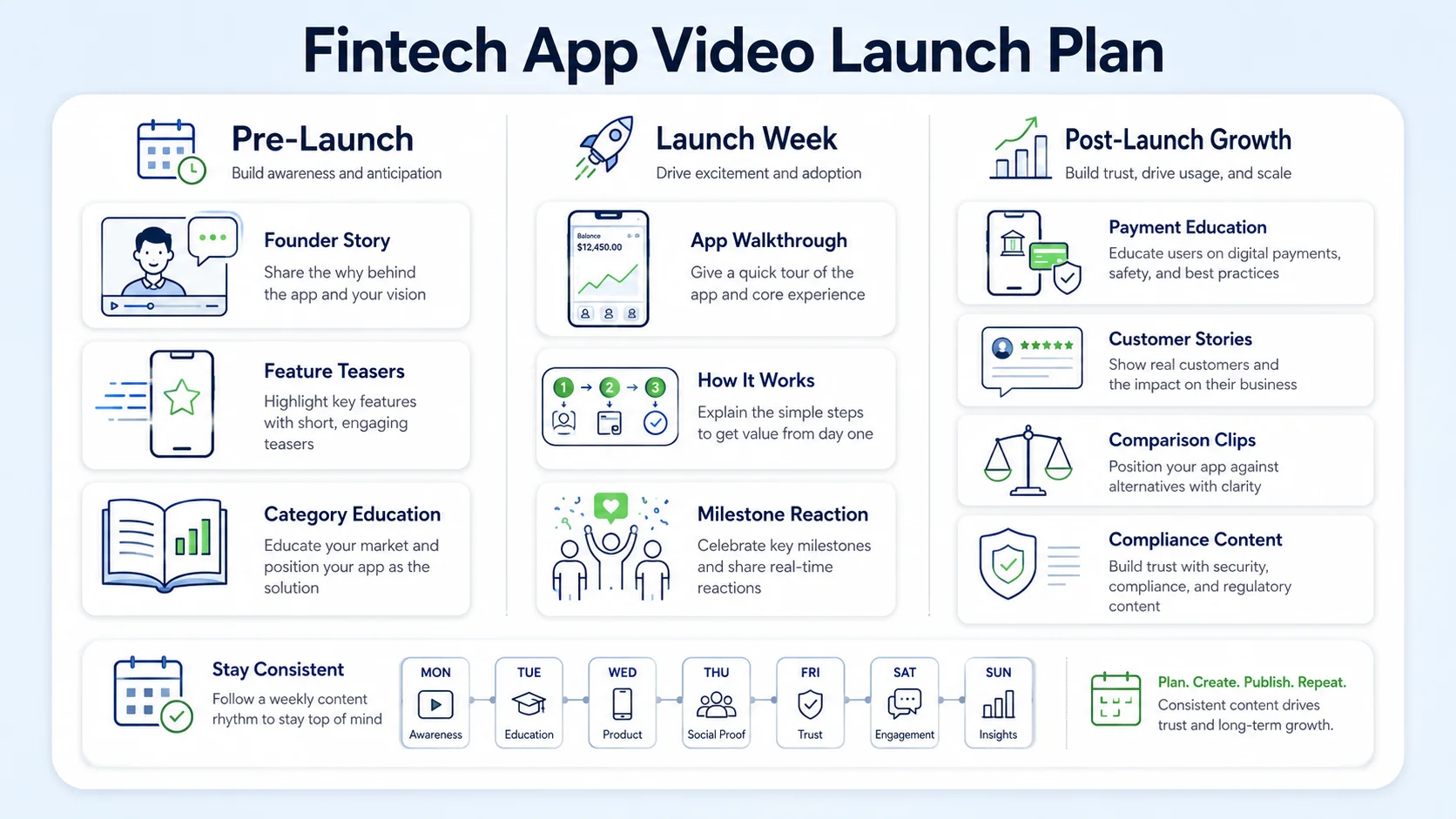
Pre-Launch (build awareness and email list):
- Founder story: 45 seconds on why you built this and what problem it solves
- "Coming soon" feature teasers using motion graphics
- Category education: "Why [existing solution] is broken", no product mention yet
Launch Week:
- App onboarding walkthrough (screen-recorded, 60 seconds, captions on)
- "How it works in 3 steps" explainer using animated UI flows
- Founder reacting to first customer milestones (authentic, low-production)
Post-Launch Growth (ongoing):
- Weekly payment processing education clips tied to trending financial topics
- Customer story snippets (testimonials formatted for Reels engagement)
- "Did you know your [bank/broker] does this?" competitive comparison clips
- Regulatory compliance content that positions your brand as the transparent choice
- SeedInvest-style investor update clips if you are in a fundraising cycle
A two-minute fintech explainer video can be re-cut for social media posts, used in investor decks, or embedded in app onboarding flows. That is the repurposing model: produce one anchor asset, then extract 8 to 12 derivative clips from it. With 48.6% of marketers citing short-form video as a top ROI format and 91% of marketers using video marketing in 2026, the bar for standing out is rising, but so is the opportunity for fintech teams that publish consistently with a real content strategy framework behind them.
If you are building a video content engine, our short-form video editing service handles both original creation from scratch and expert repurposing so your team focuses on the strategic side. You can also contact us directly to talk through what a custom content system looks like for your fintech product.
Conclusion
Short-form video for fintech companies is not a trend to watch, it is a growth lever to activate now. Here is what matters most:
- Build a video system, not a one-off campaign: repurpose existing long-form content into weekly short-form assets across TikTok, Reels, and YouTube Shorts.
- Use the five-part framework (hook, validate, mechanism, outcome, CTA) for every complex product explanation.
- Compliance is non-negotiable: assign a named reviewer, include on-screen disclosures, and archive everything.
- B2B fintech teams should map video formats to deal stages and use short clips as sales enablement tools, not just awareness content.
- Founder-led growth through short-form video consistently outperforms polished brand content on both trust metrics and reach.
Frequently Asked Questions
Q1: How long should fintech short-form videos be?
Product explainer videos of 60 to 90 seconds work best for answering "what does this do and why should I care." For awareness-stage content on TikTok and Reels, 30 to 45 seconds often outperforms longer formats. Match length to platform and objective, not to how much you want to say.
Q2: Do I need a big production budget to do short-form video for fintech?
No. A creator filming a genuine product walkthrough on their phone outperforms a $20,000 brand spot. The TikTok algorithm and Reels engagement reward authenticity and watch time, not production value. Start with screen recordings, founder clips, and motion graphics for the more complex explainers.
Q3: Can fintech startups use user-generated content (UGC) on social platforms?
Yes, but with structure. The SEC's Marketing Rule governs how testimonials and finfluencer endorsements can be used by investment advisers. Any UGC or creator partnership must be vetted for compliance before publishing. Educational UGC that does not constitute a financial promotion carries far lower regulatory risk than performance-based claims.
Q4: What is the best platform for B2B fintech short-form video?
LinkedIn is the primary B2B distribution channel. LinkedIn video watch time grew 36% year over year in 2025, and it is where fintech buyers, CFOs, and compliance officers actually scroll. TikTok and Reels are stronger for consumer-facing fintech products targeting Millennials and Gen Z.
Q5: How does short-form video support fintech sales pipelines?
Short clips pre-educate the multiple stakeholders in a B2B buying committee before any live call. Feature explainers, demo cut-downs, and customer testimonials shared by your champion inside the account reduce the number of discovery calls needed and compress deal cycles. Short-form videos under 60 seconds deliver the highest ROI for attention and recall at the awareness and consideration stages.
Q6: How many short-form videos should a fintech company post per week?
Consistency beats quality at the early stages. Start with three posts per week across your two primary platforms, track which topics generate the most profile visits and demo requests, and scale from there. Algorithms reward consistency, showing up every week builds compounding reach that a monthly posting schedule never achieves.