
🪄 AI Summary
Heading 1
Heading 2
Heading 3
Heading 4
Heading 5
Heading 6
Lorem ipsum dolor sit amet, consectetur adipiscing elit, sed do eiusmod tempor incididunt ut labore et dolore magna aliqua. Ut enim ad minim veniam, quis nostrud exercitation ullamco laboris nisi ut aliquip ex ea commodo consequat. Duis aute irure dolor in reprehenderit in voluptate velit esse cillum dolore eu fugiat nulla pariatur.
Block quote
Ordered list
- Item 1
- Item 2
- Item 3
Unordered list
- Item A
- Item B
- Item C
Bold text
Emphasis
Superscript
Subscript
Fintech podcasts rarely fail because the guests are weak. They fail because the best ten minutes of each episode never leave the audio feed. Podcast repurposing fixes that by turning one recorded conversation into clips, posts, and sales assets that buyers actually see. Whether you already have recorded episodes or need original video produced from scratch, Komet Media supports the full creation and repurposing lifecycle. The catch is that fintech content carries more risk than most B2B content. A clipped sentence about rates, returns, or security can read very differently out of context. This guide covers how I approach selection, editing, review, and distribution when the subject is money.
Quick Answer
Podcast repurposing works for fintech teams when each episode becomes short clips, posts, and sales assets. Select moments by buyer value, keep context intact, and build compliance review in before editing starts.
Why Fintech Podcasts Are Worth More Than Their Download Numbers
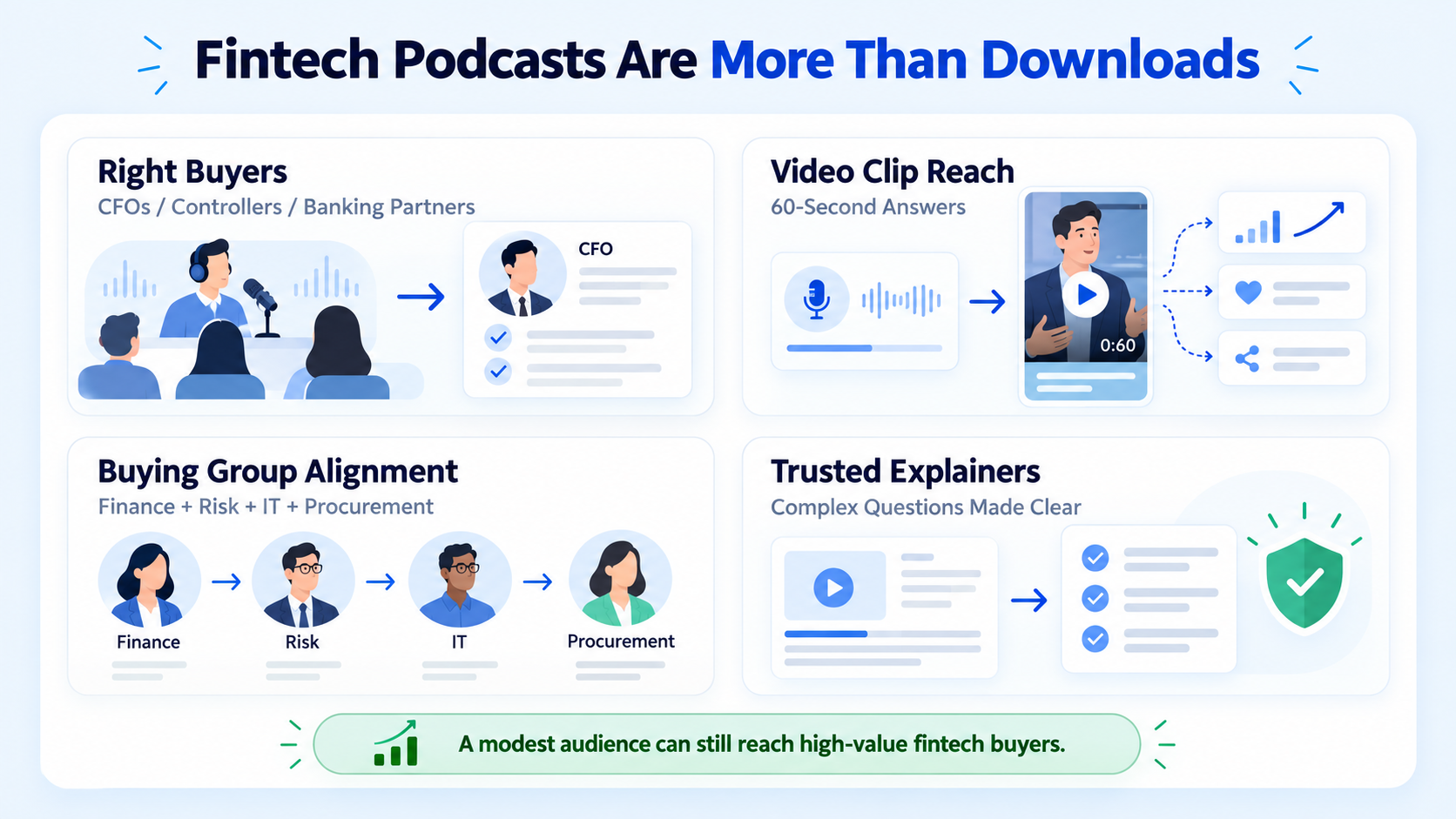
Most fintech marketing leaders I speak with judge their podcast by downloads. That is the wrong scoreboard for a B2B show. A payments or lending infrastructure podcast might have a modest audience, but the right 400 listeners can include CFOs, controllers, and banking partners your sales team cannot reach any other way.
The audience is also there in volume. According to The Infinite Dial 2026 from Edison Research at SSRS, 58% of Americans age 12 and older consumed a podcast in the last month, and that figure rises to 68% among 35 to 54 year olds. The same study found that 57% of Americans age 12 and older have both listened to and watched a podcast. That matters because video clips are now a natural extension of the show, not a separate project.
YouTube is part of the same shift. In early 2025, YouTube reported more than 1 billion monthly active viewers of podcast content on its platform. That is a platform-wide figure, not a fintech figure, so I treat it as a sign of format habits rather than proof of B2B demand.
Here is the B2B part. The 2025 Edelman and LinkedIn B2B Thought Leadership Impact Report, which surveyed nearly 2,000 management-level professionals, found that more than 40% of B2B deals stall because of internal misalignment inside buying groups. Fintech deals often involve finance, risk, IT, and procurement at once. Most of those people will never listen to a 45-minute episode. Many of them will watch a 60-second clip that answers the exact question blocking their decision.
Where Fintech Teams Go Wrong with Clips
In my experience, editing is rarely the only problem. Most weak fintech clips come from decisions made before anyone opens the editing timeline.
Here are the patterns I see most often:
The qualifier problem deserves special attention. In fintech, a phrase like "in most cases" or "depending on your risk profile" is not filler. It is often what makes the statement accurate. A good editor cuts for pace, but a good fintech editor knows which words cannot be cut.
The best moment in an episode is not always the most exciting one. It is often the guest's plain-language explanation of something buyers find confusing: how settlement timing works, why reconciliation breaks at scale, or what a bank partner actually checks during onboarding.
How Compliance Review Fits into Podcast Repurposing
I am not a lawyer, and nothing here is legal advice. What I can share is how compliance review fits into a production workflow without stalling it. Your legal and compliance team decides what applies to your company.
The rules depend on what kind of fintech you are. A B2B payments infrastructure company has a different review burden from a FINRA member broker-dealer or a registered investment adviser. Lenders and consumer-facing apps have their own considerations. Start by asking your compliance lead which rules govern your public communications.
For FINRA member firms, Rule 2210 is the main reference point. As FINRA explains in Regulatory Notice 26-14, the rule defines a retail communication as a written communication to more than 25 retail customers within 30 days. It currently requires an appropriately qualified registered principal to approve retail communications before use, with specified exceptions. Its content standards require communications to be fair and balanced and prohibit false, exaggerated, unwarranted, promissory, or misleading claims.
That same notice, published in July 2026, proposes replacing the prescriptive pre-use approval requirement with risk-based supervision standards. Social media and generative AI are named as reasons. The comment period closed on September 11, 2026, so treat this as a proposal, not a change in effect. FINRA also states that the substantive content standards would not change. The same notice references the separate SEC marketing rule that governs investment adviser advertisements.
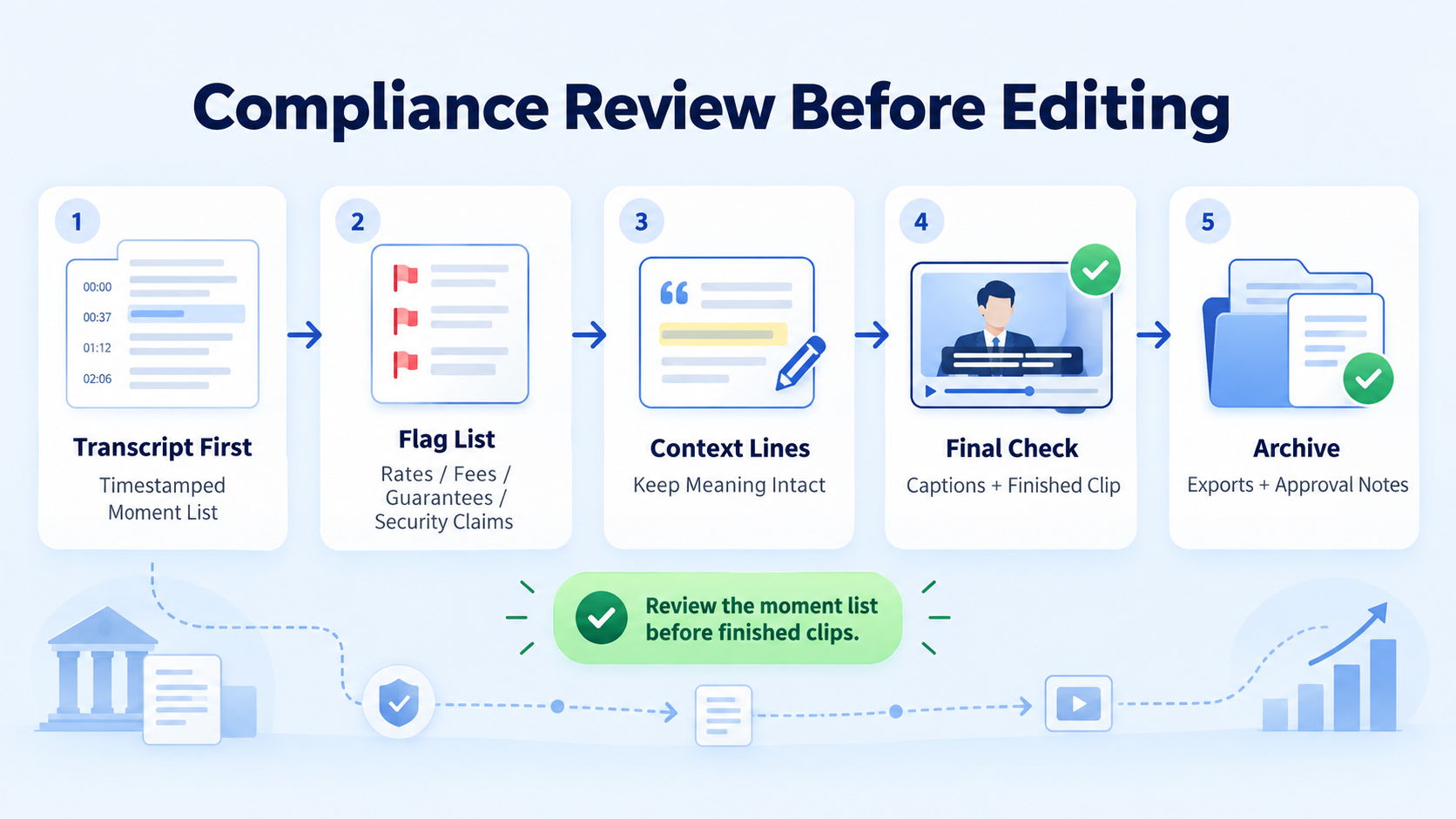
For production teams, the practical lesson is simple. Compliance review should happen on the moment list, not on twenty finished clips.
Here is how we usually structure it:
- Transcript first. Compliance reviews a timestamped transcript of the selected moments before any clip is edited.
- Flag list. We mark statements that mention performance, rates, fees, guarantees, comparisons, named customers, or security claims.
- Context lines. Where a statement needs context, we add an on-screen line or keep the full sentence rather than trimming it.
- Final check. Compliance sees the finished clip with captions, because on-screen text can change meaning.
- Archive. Final exports, captions, and approval notes are stored together so the team can find them later.
A common pattern in our work is that teams lose weeks by sending finished edits for review. When a sentence gets rejected late, the clip has to be rebuilt. Reviewing the moment list first saves that rework.
A Repurposing Workflow Built for Fintech
Most podcast repurposing fails before editing starts. The team has not decided who the content is for. A workflow fixes that by making each decision once, in the right order.
This is the full cycle I recommend for fintech shows:
- Define the buyer and goal for the episode. Is this episode for CFOs evaluating a payments platform, or for bank partners judging your risk controls?
- Record with clips in mind. Ask guests to define terms out loud and to check before naming clients or partners.
- Create a clean transcript. This becomes the working document for producers, editors, and compliance.
- Mark strong moments. Look for clear arguments, buyer objections, short stories, and plain explanations of complex topics.
- Score each moment. I score on clarity, buyer value, whether it stands alone, and review risk.
- Send the moment list for compliance review. Resolve concerns before editing.
- Edit the master episode. Clean audio, tighten pacing, and keep the full conversation trustworthy.
- Cut the clips. Add captions, a clear opening line, and any context the review required.
- Adapt for each platform. Aspect ratio, length, caption style, and opening hook change by channel.
- Run final checks and archive. Spelling of names, accuracy of on-screen numbers, and approval records.
- Schedule distribution. Spread clips across weeks rather than releasing everything on launch day.
- Review performance. Feed what you learn into the next recording.
Small teams can compress steps 4 and 5 into one pass and combine platform adaptations into a single export template. I would not skip steps 1, 6, or 10 in fintech. Those are the steps that protect accuracy and trust.
Here is what one 45-minute episode can realistically become when the conversation is strong:
These are planning ranges, not promises. A tight interview with a sharp guest produces more usable moments than a rambling one. I would rather produce six strong clips than fifteen weak ones.
If you want a step-by-step version of the clip selection stage, our podcast-to-clips framework for B2B teams walks through it in more detail.
Distribution: Matching Clips to Fintech Buyers
A polished clip with no distribution plan is still an underused asset. Fintech buyers are spread across several channels, and each one needs a slightly different version of the same idea.
LinkedIn is usually the first channel for B2B fintech. Finance leaders, risk teams, and banking partners are active there. LinkedIn video consumption has also grown: Digiday reported that total video viewership on LinkedIn rose 36% year over year for the period from October 30, 2024, to January 29, 2025, based on figures shared by the company. If LinkedIn is your main channel, our guide to LinkedIn video for fintech companies covers formats and posting in more depth.
YouTube works on two levels. The full episode gives serious prospects a place to go deeper, and Shorts let you test which topics pull attention. Clear titles that match how buyers search, such as "how payment reconciliation works at scale," help episodes stay discoverable.
Instagram Reels suits founder visibility, recruiting, and consumer-facing fintech. For pure infrastructure companies, I usually treat it as a secondary channel unless the founder is building a personal audience.
Sales enablement is the channel most fintech teams ignore. A 60-second clip of a respected CFO explaining why they changed vendors can do more in a follow-up email than another product PDF. I always ask sales which objections come up most, then look for clips that answer them. For many fintech teams, this is where podcast repurposing pays back most directly.
Guests and partners are a free distribution channel. Send every guest their clips with suggested captions. Many will share them with their own networks, which often include exactly the buyers you want.
For teams selling into New York, where many financial services firms are based, guest and partner networks tend to overlap heavily with the buyer list. Test that organic reach before you spend on ads.
How to Measure Whether It Is Working
Do not judge every clip only by views. A fintech clip with 900 views from the right finance leaders can be worth more than one with 50,000 views from people who will never buy.
Match the metric to the purpose of the asset:
Attribution will be imperfect. Someone may watch three clips on LinkedIn, forget about it, and book a demo through search a month later. That is why I recommend a simple self-reported field on your demo form asking how people heard about you. Combined with sales feedback, it often tells you more than any single dashboard.
Review results monthly, not daily. Look at which topics, guests, and opening lines performed best, then use those lessons to plan the next recordings.
Conclusion
Fintech teams do not need more episodes to get more value from a podcast. They need a better system for what happens after each recording. That means choosing moments by buyer value, protecting context, scheduling compliance review early, and giving every clip a clear destination.
The central decision is this: treat video content creation and podcast repurposing as a production system with defined steps, owners, and review points, not as a side task for whoever has spare time. Whether starting with original video production from scratch or repurposing existing episodes, having that system in place allows one conversation to support marketing, sales, and partnerships for weeks.
FAQ
What is podcast repurposing for a fintech company?
It is the process of turning each podcast episode into shorter assets such as clips, carousels, newsletter summaries, and sales follow-up videos. For fintech, it also includes keeping statements accurate and in context, and fitting compliance review into the workflow.
How much does it cost to repurpose a fintech podcast?
It depends on the model. Freelancers often charge per clip or per hour, subscriptions charge a flat monthly fee for editing volume, and agencies price by scope. At Komet Media, engagements typically fall in the range of about $2,500 to $5,000, depending on episode volume, clip count, motion graphics, turnaround, and distribution support.
How long does it take to turn one episode into clips?
Editing time depends on episode length and clip count, but in fintech the review step often sets the timeline. Teams that review a moment list before editing usually move faster than teams that review finished clips. Agree on review turnaround with your compliance team at the start.
What deliverables should I expect from one episode?
A typical plan includes the full edited episode, several short clips for LinkedIn and YouTube Shorts, one or two sales-ready clips, quote cards or carousels, and show notes. The exact mix should follow your buyer and channel plan, not a fixed package.
Should we use a freelancer or an agency?
A skilled freelancer can work well for editing alone, especially at low volume. An agency makes more sense when you need selection, editing, platform adaptation, distribution, and reporting handled as one system. Either way, ask how they handle podcast repurposing for regulated clients, not just to see their editing reel.
Can our internal marketing team handle this?
Yes, if someone has the time and skills to own selection, editing, scheduling, and reporting every week. The common failure point is consistency. Internal teams often start strong and then pause when launches or events take priority.
Do we need compliance approval for every clip?
That depends on your business and the rules that apply to you. FINRA member firms, for example, currently face principal approval requirements for retail communications, and a 2026 proposal would move toward risk-based supervision. Ask your compliance team to define which clip types need pre-approval.
How does Komet Media work with fintech teams?
We handle moment selection, editing, captions, platform adaptation, and distribution support, with review steps built in for teams that need them. We can also create original video from scratch or help launch a podcast if you do not have one yet. If you want to talk through your show, you can book a call with our team.