
🪄 AI Summary
Heading 1
Heading 2
Heading 3
Heading 4
Heading 5
Heading 6
Lorem ipsum dolor sit amet, consectetur adipiscing elit, sed do eiusmod tempor incididunt ut labore et dolore magna aliqua. Ut enim ad minim veniam, quis nostrud exercitation ullamco laboris nisi ut aliquip ex ea commodo consequat. Duis aute irure dolor in reprehenderit in voluptate velit esse cillum dolore eu fugiat nulla pariatur.
Block quote
Ordered list
- Item 1
- Item 2
- Item 3
Unordered list
- Item A
- Item B
- Item C
Bold text
Emphasis
Superscript
Subscript
If your target account list isn't moving, more emails won't fix it. Using video in account-based marketing (ABM) is how serious B2B teams break through buying committee inertia, educate stakeholders across a multi-channel sequence, and give sales the proof they need to close. This guide covers every layer, from the right video types per stage to the tools that make personalization at scale possible, so your team can build an ABM video system that actually moves the pipeline.
TL;DR
- Personalized video messages achieve response rates up to 8x higher than email alone, while LinkedIn video ads deliver 3x higher engagement than static ads.
- The best ABM video types are: exec thought leadership, product demos, personalized 1:1 outreach clips, and customer proof videos.
- Intent data from tools like Bombora and 6sense tells you when to send video; platforms like Vidyard tell you who watched.
- Repurposed long-form content (webinars, podcasts, demos) is the fastest, cheapest way to build a full ABM video library.
What Is an Account-Based Marketing Video Strategy?
Most B2B teams still treat video as a brand play, something you produce once and broadcast everywhere. An ABM video strategy is the opposite: it is a deliberate system for delivering the right video to the right person inside a named target account, at the precise moment buying signals indicate they are in-market.
The foundation is a target account list filtered by firmographic data, company size, industry, tech stack, revenue tier. From there, intent data layers from Bombora or 6sense surface which accounts are actively researching problems your product solves. Bombora sells Company Surge intent signals you pipe into other tools, while 6sense wraps intent, predictive scoring, advertising, and orchestration into one ABM engine. That signal tells you video content is worth deploying now, not in 30 days.
The strategy then maps video assets to each persona inside the buyer committee. ABM programs with advanced personalization see 208% higher revenue impact than generic campaigns, and buying groups now contain 6 to 11 stakeholders who each expect a relevant, personalized experience at every touchpoint. A video that lands for a VP of Engineering will miss a CFO completely. Both need to be covered. Companies using ABM report 28% faster sales cycles on average, and ABM accounts typically show 35% higher deal close rates. Video accelerates both metrics because it compresses the education phase, a two-minute product walkthrough does the work of three discovery calls.
The infrastructure side of the strategy connects your video platform (Vidyard is the go-to for B2B tracking), your CRM (Salesforce or HubSpot), and your ABM orchestration layer (Demandbase or Terminus). When a contact at a target account watches 80% of a demo video, that event triggers a sales alert and queues the next asset in the sequence. This is multi-channel orchestration working as designed: the video is not a one-off touchpoint, it is a signal-generating engine feeding revenue operations.
Using video in account-based marketing (ABM) at this level requires treating content as infrastructure, not creative. Every video you produce should have a defined place in the account journey, a defined persona it addresses, and a tracking mechanism that feeds back into your pipeline data.
Best Video Types for ABM Outreach
Not every video format performs equally across the account journey. The following types are ranked by pipeline influence for B2B SaaS and funded tech teams.
By funnel stage and persona:
Why each type works in ABM specifically:
- Executive thought leadership: Builds name recognition at the account level before any outreach lands. Short, LinkedIn-native executive content builds brand authority and triggers direct inbound from your target personas.
- 1:1 outreach clips: Reference the account's specific pain, name-drop their competitor or industry challenge, and get to the point in 90 seconds. Sales reps who send personalized follow-up videos have seen response rates jump to 36%, compared to 19% for standard email follow-ups.
- Product demo clips: Short, targeted, trackable videos help your sales reps close deals faster without needing a live meeting every time. Repurposing existing webinar or demo recordings into sub-3-minute clips is the fastest way to build this library.
- Customer proof: Specific to vertical or use case. A fintech customer story lands differently than a generic "we increased ROI" testimonial.
At Komet Media, our short-form video editing service is purpose-built to turn your long-form product demos and webinars into these account-ready formats without starting from scratch.
How Personalized Videos Improve ABM Results
Personalization in ABM video is not about adding someone's first name to a thumbnail. It is about demonstrating that you understand their specific situation, their stack, their market position, their stated priorities. SundaySky customers have reported up to a 220% lift in ABM account-to-meeting conversion when personalized video is added to outreach sequences, with corresponding gains in pipeline velocity and sales-marketing alignment.
Three variables drive most of that lift:
- Account-specific context: Reference the target account's industry, a recent funding round, a product launch, or a hiring trend visible in their LinkedIn activity. This signals that your outreach is not templated.
- Persona-matched messaging: The champion cares about implementation time. The economic buyer cares about cost-to-value. The same video will not satisfy both. Build variants by role.
- Timing against buying signals: Real-time CRM triggers boost conversion rates by delivering videos exactly when prospects are most receptive. A video sent when intent data shows active research converts at a fundamentally different rate than cold outreach.
Personalized videos achieve completion rates exceeding 60% compared with the typical 25% for generic videos, and including personalized video in emails can boost click-through rates by 200–300%. The practical production model that scales is starting from existing content. A founder podcast episode, a product webinar, or a recorded customer success call all contain raw material. Clip the segment most relevant to the target account's pain, add a short personalized intro from the AE, and distribute.
A B2B marketing video can now be produced in-house or by a specialist agency for a fraction of prior costs, and the same asset can be cut into a dozen short-form derivatives for paid social, sales enablement, and account-based outreach. This is the content repurposing approach we run at Komet Media for our video marketing clients, turning one strong piece of long-form content into an account-level video library without a full production cycle for every asset.
How to Create Video Content for Specific Target Accounts
The process below applies whether you are running a one-to-one ABM program for five enterprise accounts or a one-to-few program for 100 mid-market targets.
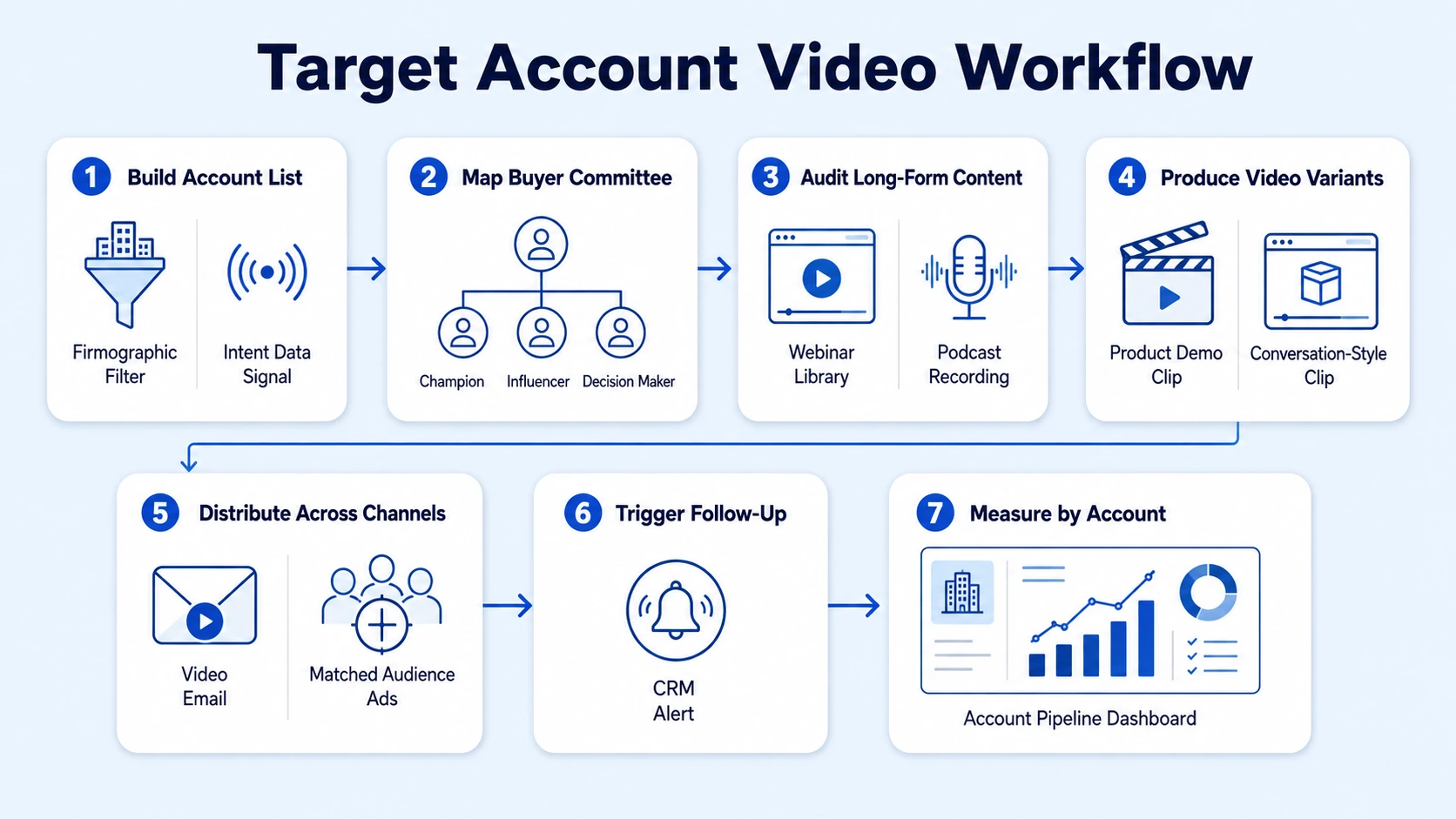
- Build your target account list with firmographic and intent filters. Use Salesforce or HubSpot CRM data alongside Bombora intent signals to identify accounts showing active research behavior. 67% of teams use intent data to shape ABM outreach.
- Map your buyer committee per account. Identify the champion, economic buyer, and any executive sponsor. Each gets a different video message.
- Audit your existing long-form content. Pull your webinar library, podcast episodes, product demos, and recorded sales calls. Tag segments by use case, persona, and objection they address.
- Produce account-level video variants. For tier-1 accounts: a fully custom intro + relevant clip. For tier-2 and tier-3: persona-specific clips from your library, distributed at scale via Vidyard or a similar platform with account-level tracking.
- Distribute across multi-channel sequences. LinkedIn Ads for awareness (matched audiences from your target account list), personalized video in email sequences via Vidyard, and video assets embedded in sales proposal pages via HubSpot or Salesforce.
- Set trigger-based follow-up workflows. When a contact watches more than 70% of a video, that event fires a sales notification in Salesforce and queues the next asset. Marketing creates content, buyers engage with it, and sales receives actionable intelligence about which contacts at which accounts are showing buying signals, the platform captures behavioral engagement data from content interactions and routes it to sales via CRM, Slack, or direct notification.
- Measure and optimize by account. Track video view rate, completion rate, account-to-meeting conversion, and pipeline influence per video type. Kill what doesn't move accounts forward.
Repurposing your existing podcast content or webinar recordings into step 3 and 4 above shortens production time dramatically.
Video vs. Traditional Content in ABM: Which Works Better?
The honest answer is that video does not replace traditional ABM content, it accelerates it. But the performance gap at specific funnel stages is significant enough to warrant a direct comparison.
Wistia research shows email click-through rates can increase 200% to 300% when video is included compared to text-only campaigns. The case for video is strongest at the moments that matter most: the first outreach to a named account, the follow-up after a demo, and the final push before a buying decision.
In 2026, 87% of B2B marketers report that video content outperforms all other formats when engaging target accounts. Traditional content still plays a support role, case studies handle late-stage skepticism, white papers build credibility with technical buyers, but video is the format that creates the emotional connection that moves a committee from consideration to decision.
Integration of video across the buyer's journey increases trust and shortens sales cycles. That trust metric is the reason video wins where static content can't: it puts a face to the company and makes your product claim feel real rather than marketed.
The critical distinction: Video earns attention at the account level. Traditional content closes detail gaps after attention is earned. You need both, but video leads.
Tools for Creating and Scaling Personalized Video for ABM
The tooling for using video in account-based marketing (ABM) falls into four layers: intent and data, video creation and personalization, distribution and tracking, and orchestration.
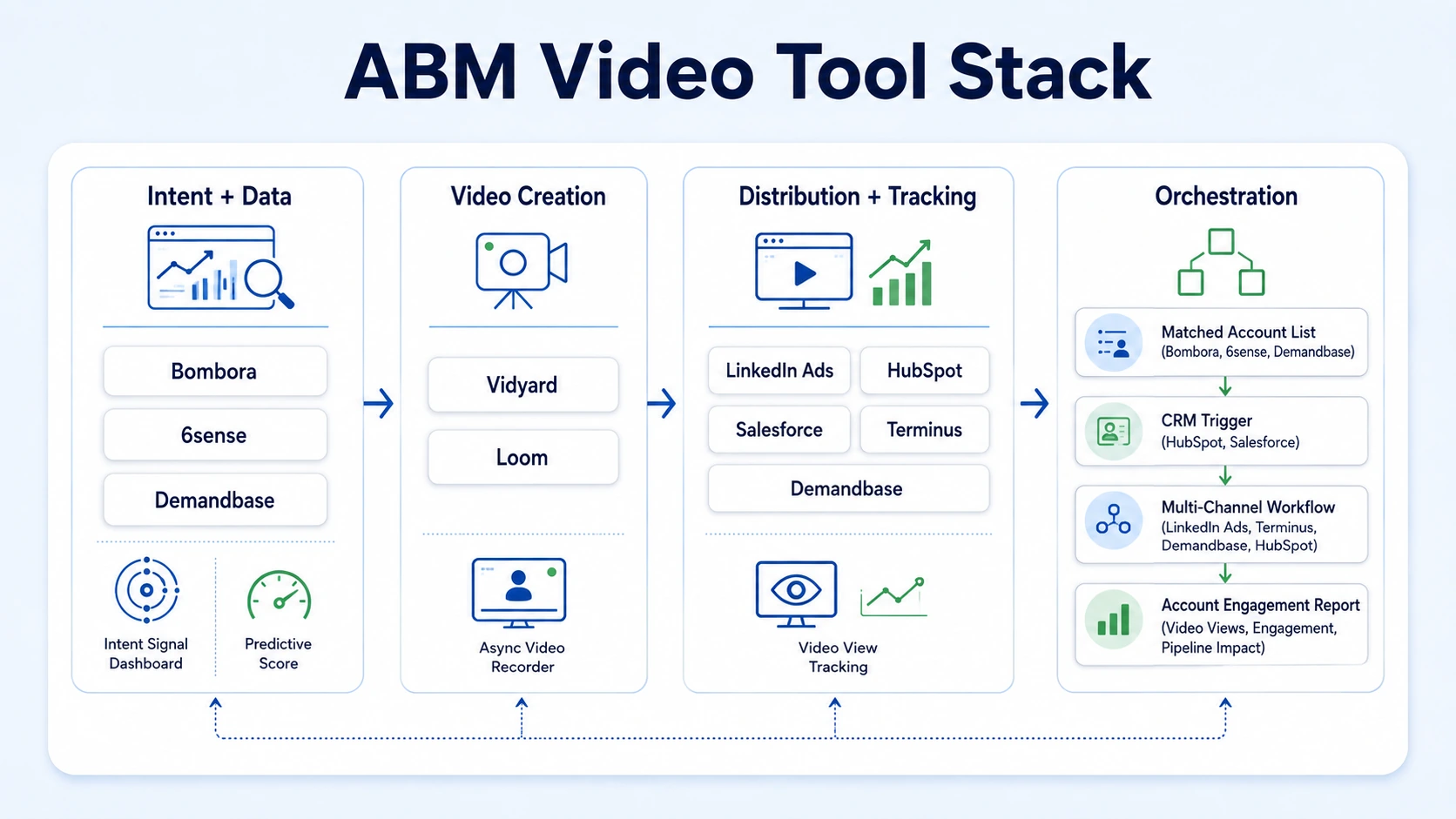
Intent and data layer:
- Bombora: Its Company Surge product tracks content consumption across 5,000+ B2B websites, categorizes it into 12,000 topic clusters, and delivers weekly updates that you plug directly into HubSpot or Salesforce.
- 6sense: The core architecture combines account identification, intent monitoring, predictive scoring, and orchestration into a workflow designed to surface accounts before they enter active evaluation, and the predictive model assigns buying-stage scores based on behavioral patterns across 450M B2B profiles.
- Demandbase: Combines intent with firmographic and technographic context, making it strong for enterprise accounts with complex stacks.
Video creation and personalization:
- Vidyard: The B2B standard for async video. Reps record, send, and track individual video views at the contact level. View data syncs back to Salesforce and HubSpot.
- Loom: Fast async video for SDR outreach. Less analytics depth than Vidyard but faster to deploy.
- Repurposing tools and agencies (like Komet Media's video editing service) handle the clip extraction and formatting from long-form content.
Distribution and tracking:
- LinkedIn Ads: Matched account lists from your target account list, served as video ads natively. A LinkedIn ABM pilot targeting 46 enterprise accounts achieved an 8.69% engagement rate and closed one enterprise deal within one month, the campaign's success stemmed from 1:1 personalized video ads delivered programmatically to members of the buying committee.
- HubSpot / Salesforce: CRM triggers fire on video engagement events, queuing the next sequence step automatically.
Orchestration:
- Terminus and Demandbase: Run multi-channel ABM orchestration, coordinating LinkedIn Ads, email sequences, and direct outreach in a single account-level workflow.
Voice and video ABM channels are projected to increase 35% in usage
as teams prioritize formats that cut through digital noise at the account level.
How to Scale Personalized Video Outreach for ABM Without Losing Quality
Scaling ABM video is where most teams stall. One-to-one custom videos for 500 accounts is not a production model, it is a burnout schedule. The answer is a tiered personalization architecture.
Tier 1 (1:1), Top 10–20 strategic accounts:
Full custom production. AE or founder records a bespoke intro referencing the account specifically. Existing long-form clips from webinars or demos are spliced in as evidence. Each video takes 30–60 minutes to produce with the right workflow.
Tier 2 (1:few), 20–100 mid-market targets:
Persona-level video variants. Three or four videos built around role (champion vs. economic buyer) and vertical (fintech vs. healthtech). The intro is pre-recorded by persona type; the core product content is consistent. Distribution is personalized at the sequence level, not the production level.
Tier 3 (1:many), 100–500 expansion accounts:
High-quality foundational content, product explainers, customer stories, exec thought leadership clips, distributed via LinkedIn Ads matched to your target account list and tracked by account engagement score. 49% of marketing decision-makers plan to allocate more budget to personalized buyer experiences, and 60% will do so by investing more in AI tools to scale that personalization across larger account lists.
The production model that makes all three tiers sustainable is content repurposing. A single strong webinar session contains raw material for 10–15 account-ready clips. A customer podcast episode becomes vertical-specific social proof. A founder's LinkedIn Live session becomes an exec awareness play across the entire target account list. 82% of B2B marketers are now prioritizing short-form video content for both buyer-facing and internal enablement use cases.
At Komet Media, our video marketing service and short-form video editing are built specifically for this production model, taking what B2B SaaS and funded tech teams already have and turning it into a scalable ABM video library without the overhead of a full in-house production team.
Conclusion
Using video in account-based marketing (ABM) is not a creative upgrade, it is a pipeline infrastructure decision. The teams winning in 2026 treat video as the operating layer of their entire ABM motion, not a one-off campaign asset.
Key takeaways:
- Map video to each stage of the account journey and each persona in the buyer committee, one video for everyone is not a strategy.
- Use intent data (Bombora, 6sense) to time your video outreach to buying signals, not the calendar.
- Repurpose existing long-form content first; it is the fastest path to a scalable ABM video library.
- Connect every video view back to your CRM so pipeline attribution is provable, not estimated.
Ready to build your ABM video system? Talk to the Komet Media team about turning your existing content into account-level video assets.
Frequently Asked Questions
Q1: What is the difference between ABM video and regular B2B video marketing?
Regular B2B video targets broad audiences or personas. ABM video is mapped to a specific named account list and delivered to identified stakeholders at the right buying stage. The content, timing, and distribution channel are all calibrated to one account's context rather than an ICP category.
Q2: How long should a personalized ABM video be?
Keep 1:1 outreach videos under 90 seconds. Product demo clips for mid-funnel use should run 2–4 minutes. Exec thought leadership clips for LinkedIn perform best at 60–90 seconds. B2B videos under 90 seconds retain 50% more viewers than longer formats, so front-load your value proposition.
Q3: Which tools do I need to get started with ABM video?
Start with Vidyard for recording and tracking, your existing CRM (HubSpot or Salesforce) for intent triggers, and LinkedIn Ads for account-level distribution. Add Bombora or 6sense for intent data once your video library and sequence logic are in place.
Q4: Can I repurpose existing content for ABM video, or do I need to create everything from scratch?
Repurposing is always the right starting point. Webinars, podcasts, product demos, and recorded sales calls all contain account-ready material. Extract the 90-second segment most relevant to a target account's pain, add a personalized intro, and you have a deployable ABM video without a full production cycle.
Q5: How do I measure ROI from video in ABM campaigns?
Track four metrics per account: video view rate, completion rate, account-to-meeting conversion rate, and pipeline influence. Connect your video platform (Vidyard) to Salesforce so video engagement events appear directly on the account and opportunity records. 53% of ABM teams measure success by pipeline contribution, your video metrics should roll up into that same number.
Q6: How many accounts should I target with personalized ABM video?
The average ABM program targets 150–500 accounts. For video specifically, run full 1:1 custom production for your top 10–20 strategic accounts, persona-level variants for your next 20–100, and broad content distribution for the remainder. Start smaller and expand as your production workflow matures.