
🪄 AI Summary
Heading 1
Heading 2
Heading 3
Heading 4
Heading 5
Heading 6
Lorem ipsum dolor sit amet, consectetur adipiscing elit, sed do eiusmod tempor incididunt ut labore et dolore magna aliqua. Ut enim ad minim veniam, quis nostrud exercitation ullamco laboris nisi ut aliquip ex ea commodo consequat. Duis aute irure dolor in reprehenderit in voluptate velit esse cillum dolore eu fugiat nulla pariatur.
Block quote
Ordered list
- Item 1
- Item 2
- Item 3
Unordered list
- Item A
- Item B
- Item C
Bold text
Emphasis
Superscript
Subscript
Most funded startups treat video like a nice-to-have. They drop $20K on a brand film, post it once, then go quiet. That is not a video marketing strategy, that is an expensive screenshot. This playbook is for founders, marketing heads, and growth teams who just raised and need video to drive pipeline, educate buyers, and build category authority. I'm Rajan Soni, founder of Komet Media. Here is how I'd build the video content system from scratch.
TL;DR
- Funded startups need a repeatable video system, not one-off productions.
- Prioritize short-form content repurposed from what you already have: demos, webinars, founder thinking.
- LinkedIn and YouTube Shorts are your primary distribution channels; own one before spreading thin.
- Measure pipeline influence, not view counts.
What Is a Video Marketing Playbook and Why Does Your Startup Need One Now?
A video marketing playbook is a documented system that defines what you make, why you make it, where it goes, and how you measure it. Most funded startups skip this and jump straight to production, that is the first mistake. 70% of B2B buyers watch video content during their purchasing journey, making video a critical touchpoint at every stage of the funnel, from awareness through final vendor selection. You are not building videos for vanity, you are building a conversion asset that works while your sales team sleeps.
The playbook has five core components:
- Goal alignment: Map every video type to a pipeline stage (awareness, consideration, decision).
- Audience definition: Identify the specific buyer personas and the questions they are asking at each stage.
- Format library: Define which formats you will produce repeatedly (product demos, founder takes, customer clips).
- Distribution rules: Assign every format to the right channel and posting cadence.
- Measurement framework: Track video-influenced pipeline, not just impressions.
A successful strategy starts with the buying committee, not the camera. Before any script gets written, document the three to five personas inside your target account, the questions each one is trying to answer at each stage of evaluation, and the format that best resolves those questions.
For SaaS and funded tech teams, the playbook also needs to account for the go-to-market stage. A seed-stage startup educating a market needs different content than a Series A company accelerating demo demand.
A CFO evaluating a six-figure SaaS purchase wants a short, evidence-heavy ROI explainer. A practitioner wants a longer, hands-on product walkthrough. A CEO wants a peer testimonial. The playbook removes the weekly question of "what should we post?" and replaces it with a repeatable system your team can run without reinventing the wheel every sprint.
What Types of Videos Should a Startup Make After Raising a Series A?
Series A is where the real positioning work begins. You have product-market fit signals. Now you need to translate them into video assets that scale buyer education and compress sales cycles. 73% of B2B decision-makers now prefer to watch product demo videos over reading whitepapers, and 96% of individuals use video to learn about products and services. This tells you exactly where to start.
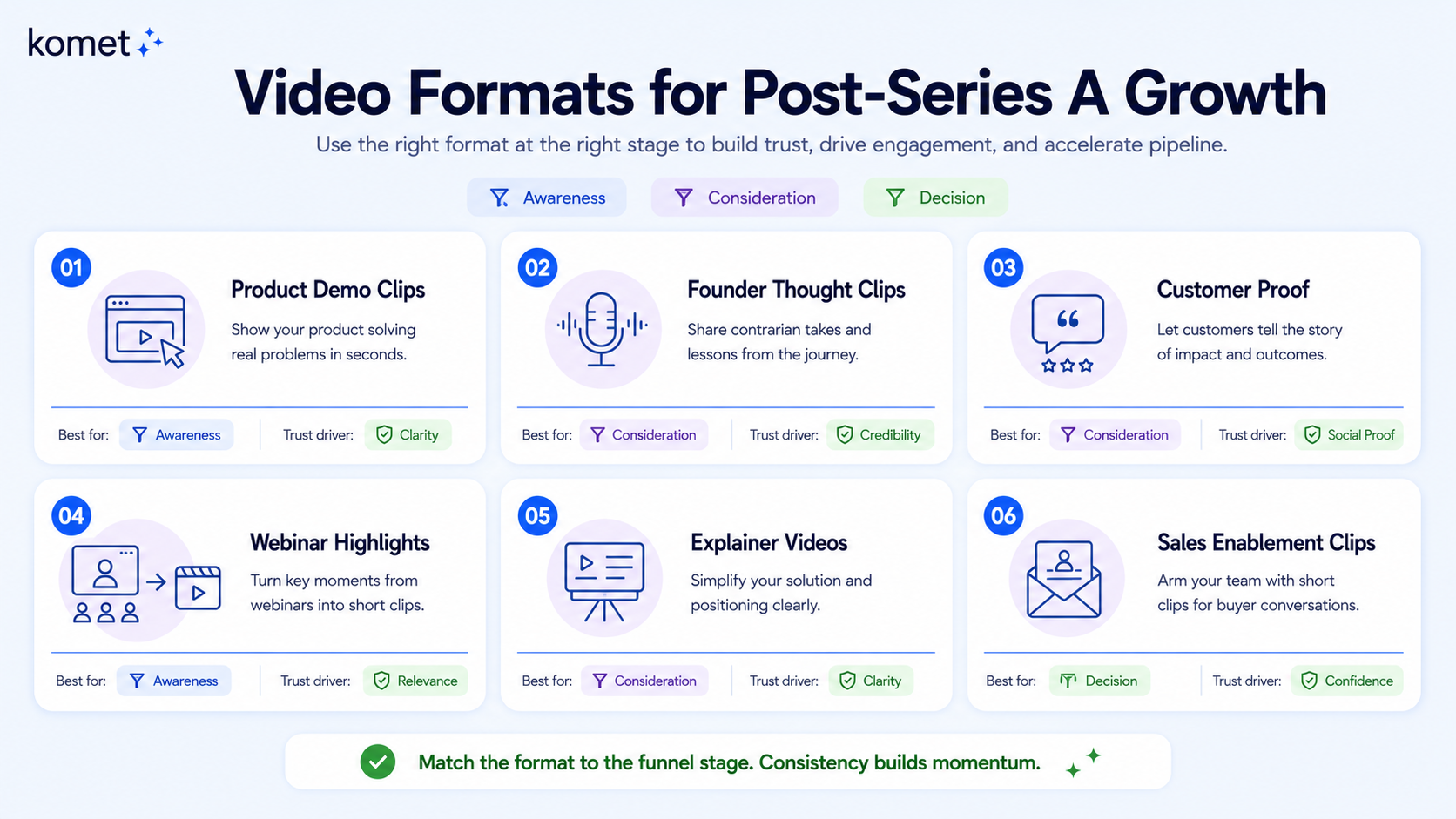
The six formats that move the needle post-Series A:
- Product demo clips (60–90 seconds): Show the before/after of a core workflow. Not a full walkthrough, a specific outcome. These support sales reps in prospecting and reduce time-to-understand for cold prospects.
- Founder thought leadership (30–60 seconds): The founder's perspective on a category problem. Founder-led thought leadership outperforms company pages 8:1 on LinkedIn, making personal brands the primary distribution channel for SaaS companies.
- Customer proof clips: A 45-second customer quote on a specific result. The most trusted format in B2B at every stage of the conversion funnel.
- Webinar and podcast highlights: Repurpose your best moments from existing long-form sessions into platform-native short clips. This is the most capital-efficient content play available.
- Explainer / "how it works" videos (90 seconds): For buyers who are considering but not yet ready to demo. These reduce customer acquisition cost by doing pre-sales education at scale.
- Sales enablement clips: Short context-setting videos your AEs drop into outbound sequences or post-demo follow-ups.
Your top-performing mix should include ultra-short content for awareness, 1–2 minute explainers for consideration, and longer walkthroughs for evaluation.
At Komet Media's video marketing services, we build exactly this kind of layered format library for SaaS teams, pulling from your existing demos, webinars, and sales calls so you are not starting from zero.
How Successful Startups Use Video Marketing to Grow After Funding
The startups winning with video marketing in 2026 are not producing more, they are producing smarter. Customer acquisition cost for the average SaaS business has risen 40–60% since 2023. Growth-at-all-costs is dead, and the companies winning now are building systems, not running campaigns. The pattern I see repeatedly:
- Turn one long-form asset into ten short-form assets. A single webinar becomes LinkedIn clips, YouTube Shorts, Instagram Reels, and a sales enablement pack. The most efficient B2B teams start with a single, insight-dense anchor asset, then break it into smaller, platform-ready pieces, starting with something that already carries weight: a webinar, research report, executive interview, or customer roundtable.
- Publish on LinkedIn with a founder face, not a logo. Company pages get skipped. Founders get watched.
- Embed video at every sales touchpoint. Outbound sequences, post-demo follow-ups, proposal decks. 96% of B2B buyers say video is an important factor when deciding whether to advance in the buying journey, underscoring why SaaS companies rely so heavily on video to move prospects through the pipeline.
- Track pipeline influence. Not views. Not likes. Connect video consumption data in tools like Wistia or HubSpot to actual CRM pipeline stages.
- Use content repurposing as a growth hack. The best-performing startups backed by Y Combinator and venture capital understand that content velocity, how fast you can deploy relevant video, matters more than production budget.
The top three ROI-driving content formats are all video: short-form video at 49%, long-form video at 29%, and live streaming at 25%. That is not a coincidence. It is the format match for how B2B buyers actually research in 2026.
Best Video Marketing Channels for B2B Startups With Limited Resources
Channel selection is where most funded startups dilute their effort. They try TikTok for Business, YouTube Shorts, Instagram Reels, and LinkedIn simultaneously, and get mediocre results on all four. The right move: own one channel before you scale to three.
Here is how the primary channels stack up for B2B SaaS:
More than 70% of enterprise marketers prioritize short-form video because it drives higher click-through rates and improved executive-level engagement. On LinkedIn alone, short-form video roughly triples the conversion rates of static posts. 65% of B2B companies have gained new customers through video marketing on LinkedIn, which remains the primary distribution channel for B2B video.
For early-stage teams with limited bandwidth, my recommendation is always LinkedIn first, then YouTube Shorts for organic reach and discoverability. Once you have a repeatable short-form video editing workflow in place, ideally pulling from existing webinars and podcasts, you scale to Instagram Reels and embed top performers directly on your website. Your own website is a powerful channel where videos generate 48% engagement compared to 32% on social media. Do not neglect embedding video on your highest-traffic landing pages and product pages.
Video Marketing Budget Allocation for Early-Stage Startups
Budget allocation is one of the most common questions I get from Series A and seed-stage teams. Most overspend on production and underspend on distribution and systems. 81% of companies say they have a dedicated video marketing budget, and for many, video accounts for 41–60% of their overall marketing budget. That is the mature-company benchmark. For early-stage SaaS, here is a more realistic allocation model:
- Content repurposing first. Before you commission new productions, audit what already exists: webinars, podcasts, demo recordings, sales call highlights. These are free raw materials.
- Organic before paid. Earn organic reach to validate messaging, then amplify what works with a paid budget. Paid amplification on unproven creative destroys CAC.
- Systems over sprints. A $5K/month content repurposing system beats a $50K brand film you produce once and forget. Build a library of branded templates, reusable motion assets, and creative frameworks that anchor your content strategy, each project makes the next one faster and cheaper.
Explore our video editing services to understand what scalable video production looks like for a startup working within a real budget.
How to Build a Video Content Strategy From Scratch for a Startup
If you have zero video assets and need to build from nothing, here is the exact sequence I recommend to every new client:
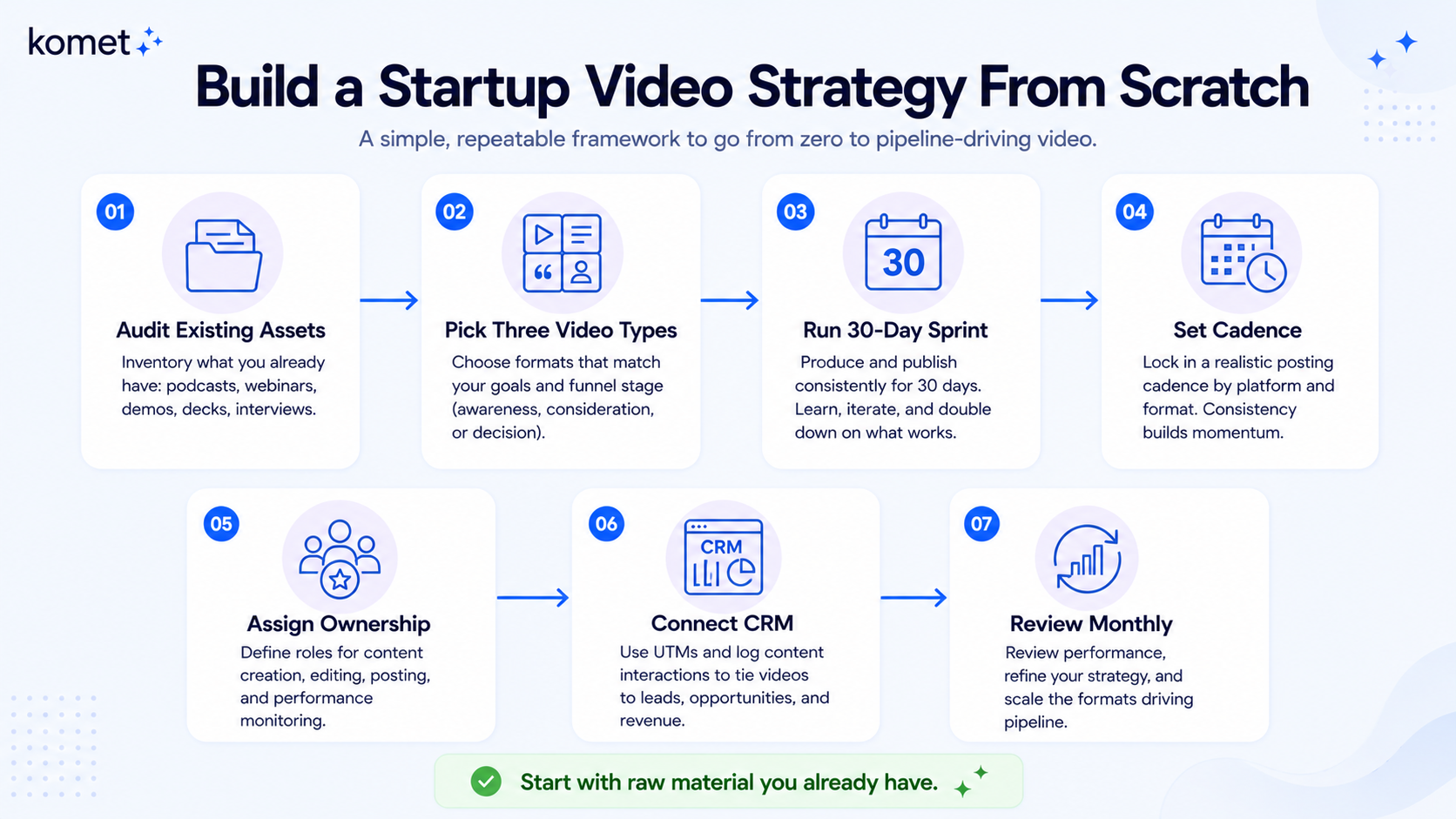
- Conduct a content audit. List every long-form asset you already have: recorded demos, sales calls, webinars, podcast episodes, all-hands recordings, founder interviews. This is your raw material library.
- Define three hero video types. Pick one awareness format (founder take), one consideration format (product explainer), and one decision format (customer clip or demo highlight).
- Build a 30-day production sprint. Batch-record founder clips in a single session. Clip highlights from your last three webinars. Record a 90-second product demo walkthrough. You now have a starting library of 10–15 assets.
- Set a publishing cadence. For LinkedIn: 3x per week minimum. For YouTube Shorts: 2x per week. Consistency beats volume. Momentum matters more than one-off viral hits, the brands that show up regularly stay more visible.
- Assign distribution ownership. Marketing owns the publishing calendar. Sales owns video use in outbound. The founder owns personal LinkedIn. Do not let distribution be an afterthought.
- Connect your video stack to your CRM. Use Wistia, HubSpot video, or a comparable tool so that every video view is tracked at the contact and account level.
- Review and iterate at 30-day intervals. Look at watch time, completion rates, and, most importantly, video-influenced pipeline. Cut what is not working. Double down on what is.
Short-form video delivers the highest ROI of any content format, videos under 60 seconds generate 2.5x more engagement per impression than any other content type. Pair this strategy with a strong podcast marketing or webinar workflow and you have a compounding content engine that feeds video indefinitely.
Video Marketing Mistakes Funded Startups Make (and How to Avoid Them)
Funding accelerates mistakes as fast as it accelerates growth. Here are the seven most common video marketing errors I see from newly funded B2B SaaS teams:
- Prioritizing production quality over message clarity. A polished video with a weak hook performs worse than an authentic founder clip with a sharp insight. Real customers and real employees outperform stock footage and AI avatars on every B2B trust metric.
- Ignoring captions. 80% of B2B video on LinkedIn is watched on mute, especially in office environments. Open captions are no longer optional.
- Publishing once and stopping. One video is not a strategy. A brand that published twice and went quiet for two months has effectively done nothing for brand awareness or algorithm momentum.
- Measuring vanity metrics. Views and likes do not pay salaries. Tie video performance to demo requests, pipeline progression, and closed-won influence. Pipeline-tier metrics are the ones that move boardroom conversations: video-influenced opportunities created, multi-touch attributed revenue, and sales cycle compression on deals where video was consumed.
- Neglecting the founder's face. In B2B, trust is the primary purchase driver. Founder-led video builds trust faster than any brand asset.
- Going wide on channels too early. Spreading video marketing across five platforms simultaneously without mastering one is a guaranteed path to mediocre results everywhere.
- Skipping content repurposing. Your best webinar is sitting unwatched in a Drive folder. 61% of B2B content marketers plan to increase video investment in 2026, but most of that increase should go into repurposing what already exists, not net-new production.
Conclusion
- Funded startups need a documented video marketing system, not isolated productions.
- Prioritize repurposing existing assets (demos, webinars, podcasts) before commissioning new ones.
- LinkedIn and YouTube Shorts are the two highest-return channels for early-stage B2B SaaS teams.
- Measure pipeline influence, video-attributed opportunities, not view counts.
- Build consistent cadence first; production quality can improve as the system matures.
If you want to stop guessing and build a video system that actually supports the pipeline, Komet Media's services exist for exactly this. We turn your product knowledge, founder thinking, webinars, and demos into short-form video that educates buyers and supports growth.
Frequently Asked Questions
Q1: What is a video marketing playbook for startups?
A video marketing playbook is a documented system that defines which video formats to create, which channels to distribute on, and how to measure results against pipeline goals. It replaces ad-hoc production decisions with a repeatable, scalable workflow aligned to your go-to-market strategy.
Q2: How much should a startup spend on video marketing after raising funding?
At seed stage, a $5K–$15K monthly budget focused on content repurposing and founder clips delivers strong ROI. Series A teams typically invest $15K–$40K/month, splitting spend across production, distribution, and analytics tooling. Start lean, validate formats, then scale the budget to what performs.
Q3: What types of videos work best for B2B SaaS after a Series A?
The six highest-impact formats are product demo clips, founder thought leadership, customer proof quotes, webinar and podcast highlights, explainer videos, and sales enablement clips. Each maps to a specific buyer persona and funnel stage.
Q4: Which platforms should funded B2B startups prioritize for video?
Start with LinkedIn for direct access to decision-makers, then add YouTube Shorts for organic discoverability. Embed your top-performing videos on your website and product pages. Expand to Instagram Reels only after you have a consistent output rhythm on the first two channels.
Q5: How do you measure video marketing ROI for a SaaS startup?
Connect your video platform (Wistia, HubSpot, or equivalent) to your CRM. Track video-influenced pipeline, demo requests attributed to video content, sales cycle length on deals where video was consumed, and MQL-to-SQL conversion rates for video-sourced leads. Avoid optimizing for views alone.
Q6: Can startups without a large content library still use video marketing effectively?
Yes. A founder recording 10-minute weekly perspective videos generates enough raw material for 8–12 short-form clips per session. Combine that with clips from your last two or three webinars and you have a 30-day content calendar before you commission a single new production. Existing assets are almost always underused.