
🪄 AI Summary
Heading 1
Heading 2
Heading 3
Heading 4
Heading 5
Heading 6
Lorem ipsum dolor sit amet, consectetur adipiscing elit, sed do eiusmod tempor incididunt ut labore et dolore magna aliqua. Ut enim ad minim veniam, quis nostrud exercitation ullamco laboris nisi ut aliquip ex ea commodo consequat. Duis aute irure dolor in reprehenderit in voluptate velit esse cillum dolore eu fugiat nulla pariatur.
Block quote
Ordered list
- Item 1
- Item 2
- Item 3
Unordered list
- Item A
- Item B
- Item C
Bold text
Emphasis
Superscript
Subscript
Your sales team has a library of case studies. Your marketing team published three whitepapers last quarter. And your pipeline is quiet. The problem isn't the content, it's the format. Turning case studies and whitepapers into short videos is the fastest way to move that expertise off a PDF and in front of buyers who won't click a download link. This guide covers every step: extraction, scripting, production, distribution, and the mistakes that kill results. Let's get into it.
TL;DR
- 73% of B2B decision-makers prefer watching product demo videos over reading whitepapers or brochures, your written assets are underperforming by default.
- Turning case studies and whitepapers into short video means extracting one sharp insight per video, not summarizing the whole document.
- Vertical video format optimized for LinkedIn and YouTube Shorts is your primary distribution channel in 2026.
- A systematic content repurposing strategy turns one whitepaper into 6–10 individual short-form assets.
Why B2B Buyers Watch Instead of Read (and What That Means for Your Content)
Your buyers are not reading your whitepapers. They're scanning LinkedIn during a 4-minute gap between calls. This is why turning case studies and whitepapers into short videos isn't optional for funded SaaS teams anymore, it's where the pipeline starts.
Last year, B2B marketers rated case studies and customer stories as the most effective content type. This year, video (58%) has taken the top spot, followed closely by case studies and customer stories (53%), according to the Content Marketing Institute's B2B Content Marketing Benchmarks 2025.
53% of B2B buyers prefer video case studies over written testimonials, which are favored by only 29%. That gap is your opportunity. A written case study reaches a buyer who opts in to read it. A 60-second video case study lands in a LinkedIn feed and earns attention the buyer didn't plan to give. 55% of B2B marketers see the highest ROI from short-form social videos, above webinars, case studies, and other formats. The format with the highest reach is also the one your existing written library can directly feed.
Consider the pipeline math: your SaaS team likely has 8–15 case studies already published and 3–6 whitepapers from the past two years. Each one contains multiple buyer-relevant insights. A systematic short-form video production approach converts that archive into months of LinkedIn video content, sales enablement clips, and demand generation assets, without writing a single new word from scratch.
72% of B2B buyers report that video content from vendors influences their vendor shortlist decisions. Founders and marketing heads running competitive sales cycles need to be in the shortlist conversation before the first demo request. Short-form video built from thought leadership content and Gartner-style research reports does exactly that.
The key insight: Your whitepaper already contains the proof. Short video is just the delivery mechanism buyers actually use.
How to Turn a Case Study into a Short Video in 6 Steps
The biggest mistake I see teams make: trying to compress the entire case study into one video. Don't. One case study = multiple videos, each covering one discrete angle.
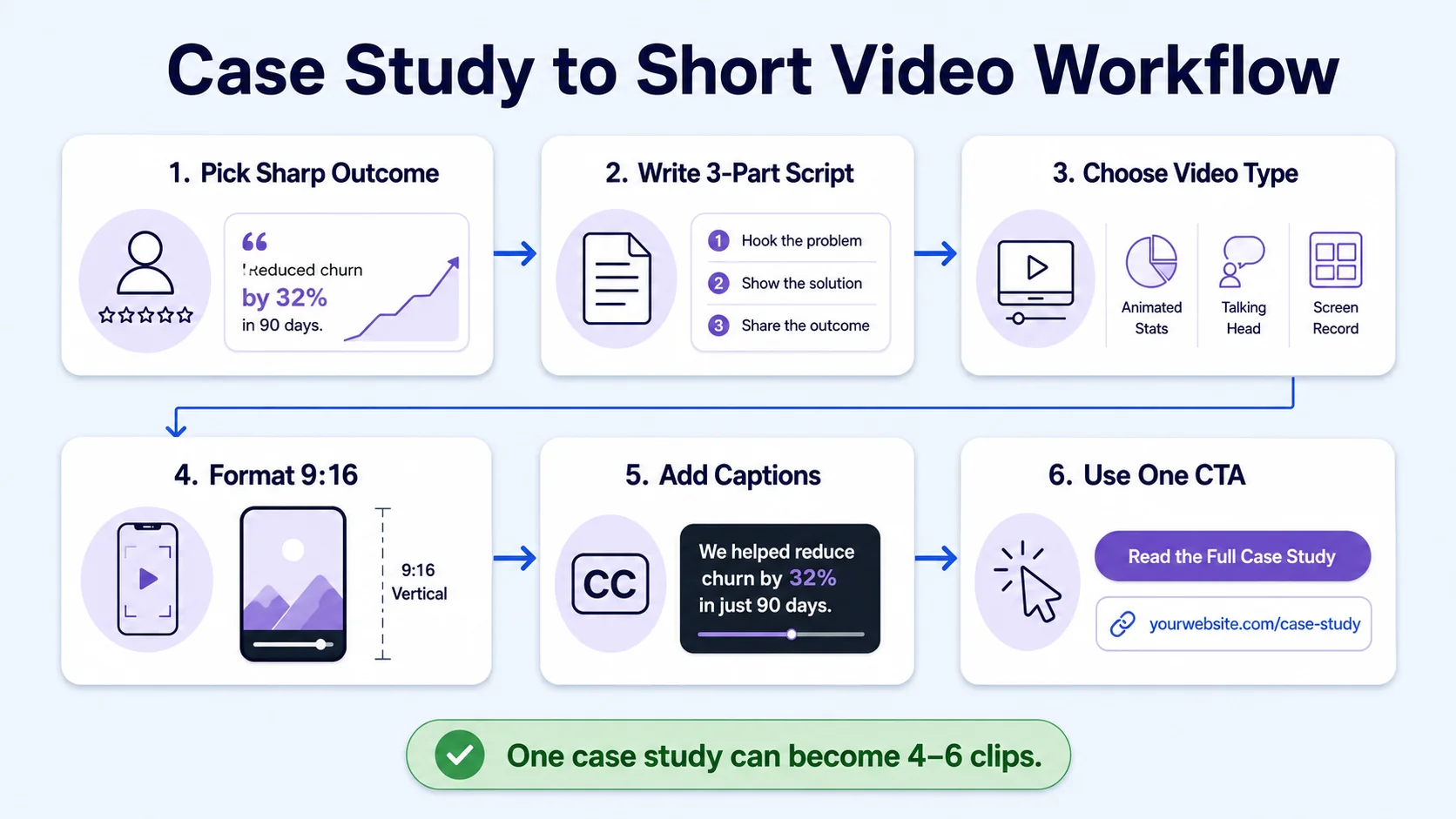
- Identify the single sharpest outcome: Pull the primary result, reduced churn by 34%, cut onboarding time in half, generated 3x pipeline. This becomes your video's headline and hook.
- Write a 3-part script structure: Open with the problem the customer had (10 seconds), show what changed (20 seconds), land the outcome with a specific number (15 seconds). That's your 45-second foundation.
- Choose your video type: Options include a talking-head clip from the founder or customer, an animated infographic, a screen-recorded product walkthrough, or a text-motion graphic. For most B2B SaaS teams without an existing customer video library, animated infographics built in tools like Canva or edited in Adobe Premiere Pro are the fastest starting point.
- Format for vertical video: Export in 9:16 for LinkedIn and YouTube Shorts. Mobile devices account for 48% of all B2B video views , meaning your buyer is watching on a phone. Vertical video fills the screen. Landscape clips get scrolled past.
- Add captions: Videos with subtitles see a 28% higher completion rate among B2B audiences compared to videos without subtitles. Burn them in, don't rely on platform auto-captions.
- Tag your CTA to one next step: Link to the full case study on your site, a demo page, or a relevant video marketing services page. One CTA. Not three.
Repeat this process per angle: the problem angle, the outcome angle, the product feature angle, and the customer quote angle. A single 800-word case study yields four distinct short videos when you apply this framework.
How to Summarize a Whitepaper into a 60–90 Second Explainer Video
Whitepapers are dense by design. A Gartner Research Report or original data study might run 20 pages. The extraction process for turning case studies and whitepapers into short videos is different here, you're not telling a customer story, you're packaging a POV.
The whitepaper-to-video extraction framework:
- Find the one contrarian or surprising stat: Readers scan whitepapers for the insight that changes how they think. That insight is your entire video.
- Frame it as a buyer problem: "Most SaaS teams believe X. Our research across 200 companies says Y. Here's why it matters for your pipeline."
- Use animated infographics for data-heavy content: When the core insight is a statistic or trend, motion graphics communicate it faster than talking heads. Tools like Canva handle simple versions; Adobe Premiere Pro handles professional-grade animation.
The sweet spot for engagement sits between 30 seconds and two minutes, that's the window to create video content that hits hard, sticks around, and gets results without losing audience attention. For whitepaper explainers, target 75–90 seconds: enough to frame the insight, explain why it matters, and point to the full report.
Whitepaper-to-video script template (90 seconds):
For distribution, host the full version on platforms like Wistia or Vidyard (for gated lead capture and audience retention metrics), and publish a native upload on LinkedIn for organic reach. On LinkedIn, native-uploaded videos receive significantly higher engagement than YouTube links , making the upload step non-negotiable.
What Tools Can You Use to Transform Whitepapers and Case Studies into Video?
You don't need a full production studio. You need the right stack. Here's what works for B2B SaaS teams at different production levels:
Many tools can help streamline the repurposing process, design tools like Canva, video editors like Descript, and AI-powered platforms assist in transforming and distributing repurposed content efficiently. For teams using HubSpot as their CRM, connecting Vidyard directly gives you per-contact video engagement data, you can see which prospects watched your case study video and for how long before they requested a demo. That's sales enablement content working at full capacity.
If you want professional-grade output without building an in-house production workflow, working with a dedicated video editing services partner handles the production layer while your team focuses on content strategy and distribution.
Turning B2B Content into Short-Form Video Without Losing Key Insights
The fear most marketing heads and founders have: "If we cut it down to 60 seconds, we lose the nuance." That fear is legitimate. Here's how to protect the insight while hitting scroll-stopping brevity.
The three-layer content repurposing strategy:
- Layer 1 (Short video, 30–90s): One insight, one outcome, one CTA. Published natively on LinkedIn and as a YouTube Short. This drives discovery and earns attention.
- Layer 2 (Medium video, 3–5 min): A deeper explainer that expands on the short video's claim with supporting data. Hosted on Wistia or Vidyard behind a lead form, or embedded on your site.
- Layer 3 (Original asset): The full whitepaper or case study PDF. Gated or ungated depending on your demand generation strategy.
Every short video should drive curious buyers toward the next layer. The insight isn't lost, it's staged across a journey. For B2B firms, content atomization is one of the most powerful repurposing strategies because it systematically extends the reach of core expertise, turning one major effort into dozens of engagement opportunities and lead magnets. LinkedIn video content thrives when it's built around a specific claim a buyer can apply or share.
B2B buyers are 44% more likely to share a product video with colleagues than a brochure. Shareability is a pipeline multiplier, every share puts your case study insight in front of a new buying committee without additional ad spend. For founder-led growth, the short video format also serves as thought leadership content that signals expertise before a prospect ever books a call. The 2025 Edelman x LinkedIn Thought Leadership Impact Report revealed that 55% of decision-makers use thought leadership as part of their vetting process. Your case study video is vetting content.
Common Mistakes When Converting Whitepapers to Short Video Content
I've seen funded SaaS teams invest real money into video repurposing and get zero pipeline movement. Every time, it traces back to one of these mistakes.
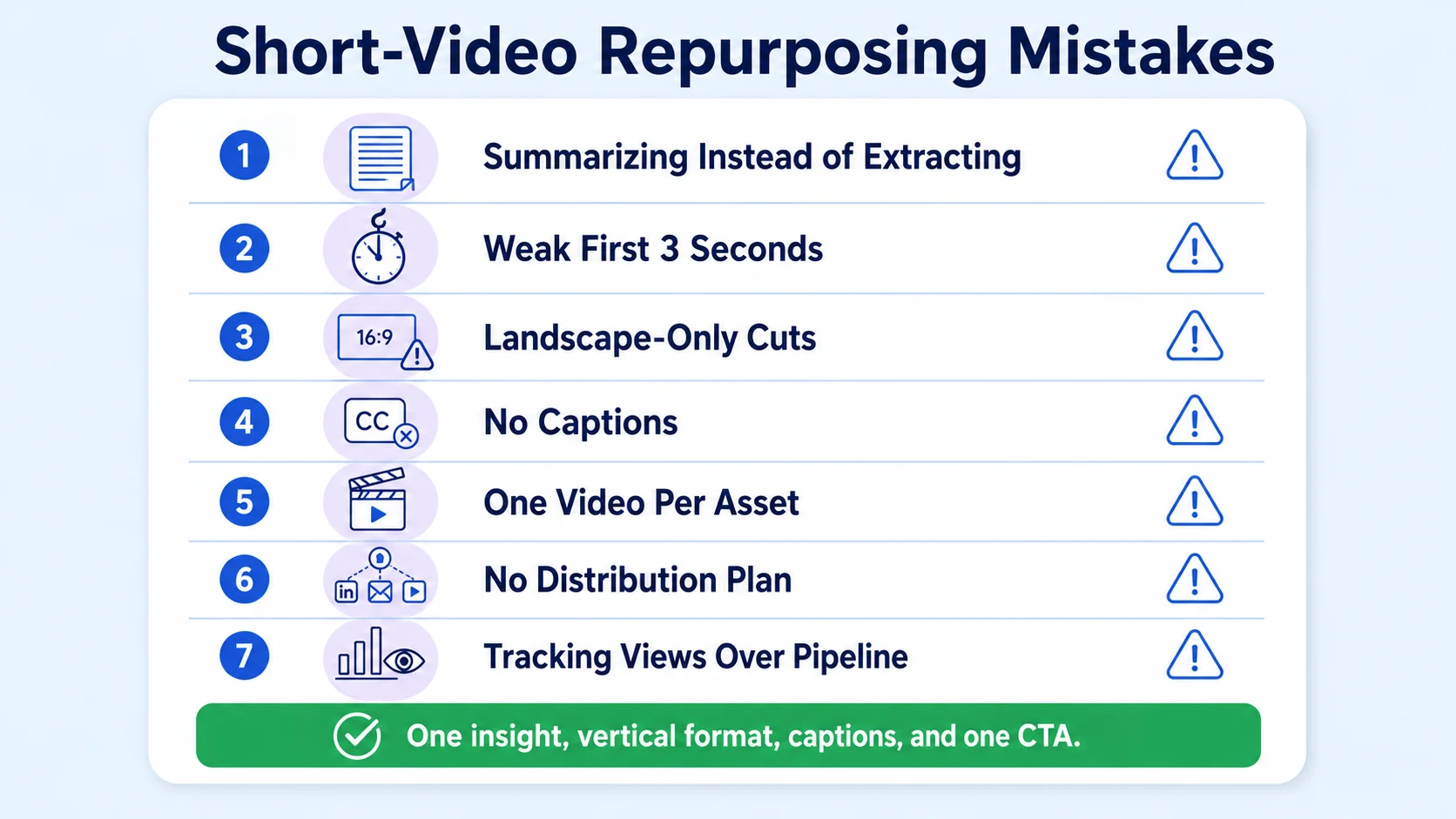
1. Summarizing instead of extracting: A 90-second "overview" of your whitepaper is not a video, it's a voiceover reading. Extract one insight. Let the viewer feel smart by watching it.
2. Skipping the hook: Modern buying committees shape opinions early through short video, expert voices, and trusted content ecosystems, long before they speak to a vendor. If your first 3 seconds don't establish the problem or the payoff, the buyer scrolls. No second chance.
3. Landscape-only production: Publishing only 16:9 video in 2026 when LinkedIn video uploads increased by 20% year-over-year in Q4 of 2025 and the platform rewards vertical, native formats is leaving reach on the table. Always produce a vertical video format cut.
4. No captions: Most LinkedIn videos are watched on silent autoplay. Without burnt-in captions, you're producing content nobody processes.
5. One video per asset: A single case study should generate 4–6 short video clips, the problem clip, the outcome clip, the product clip, the quote clip, and the "what we learned" clip. Content repurposing is a challenge for 37% of B2B marketers , and batching all possible clips in a single session eliminates that friction.
6. No distribution strategy: Publishing on LinkedIn without a posting cadence, no employee amplification plan, and no connection to your sales team's outreach means the video dies at 200 views. Every clip should have a native LinkedIn post, a version sent to relevant prospects via Vidyard, and a home on your video marketing or resources page.
7. Vanity metrics over pipeline metrics: Views are not pipelines. Track click-throughs to demo pages, form fills driven by video embeds, and time-on-page for pages with Wistia or Vidyard embeds. Audience retention metrics tell you where buyers drop off, use that to sharpen the next batch.
Conclusion
Turning case studies and whitepapers into short videos is not a creative exercise, it's a pipeline strategy.
- Your written content library is a production backlog. Every case study and whitepaper contains 4–6 short videos waiting to be extracted.
- One insight per video, vertical format, burnt-in captions, and a single CTA are the non-negotiable production standards.
- Distribute natively on LinkedIn, host deeper cuts on Wistia or Vidyard, and connect every clip to a sales enablement workflow via HubSpot.
- The teams winning with B2B video in 2026 are not producing more content, they're systematically converting the expertise they already have into formats their buyers actually consume.
Ready to build the system? Talk to the Komet Media team about turning your content library into a short-form video pipeline.
Frequently Asked Questions
Q1: How many short videos can I get from a single case study?
Most B2B case studies yield 4–6 short videos when properly atomized: the customer problem clip, the outcome/results clip, the product feature clip, a key quote clip, and a "what we learned" insight clip. Each runs 30–90 seconds and targets a different buyer moment.
Q2: Do I need professional video production to repurpose whitepapers into video?
No. Tools like Canva handle animated infographics, Descript handles scripted talking-head and screen-recorded formats, and Adobe Premiere Pro handles professional editing. The quality bar for LinkedIn video content is authenticity and clarity, not broadcast production.
Q3: What's the ideal length for a case study video on LinkedIn?
The sweet spot for engagement sits between 30 seconds and two minutes. For case study videos, 45–75 seconds is optimal, long enough to establish context and deliver the outcome, short enough to hold attention through to the CTA.
Q4: Should whitepaper videos be gated or ungated?
Short teaser clips (30–60 seconds) on LinkedIn should be ungated to maximize reach and discovery. The full explainer video (2–5 minutes) can be hosted behind a Wistia or Vidyard lead form, connected to your HubSpot pipeline for proper demand generation attribution.
Q5: How is turning case studies and whitepapers into short videos different from just making an ad?
Ads interrupt. These videos educate. The goal is buyer education and product trust, helping a prospect understand their problem and see your product's relevance before a sales conversation. Sales enablement content built this way shortens sales cycles because the buyer arrives pre-educated.
Q6: How do I measure whether my repurposed case study videos are actually driving the pipeline?
Track four metrics: LinkedIn native video completion rate (audience retention), click-through rate to demo or case study pages, Vidyard per-contact engagement for sales outreach, and HubSpot influenced pipeline from contacts who engaged with video before converting. Views alone tell you nothing about revenue.