
🪄 AI Summary
Heading 1
Heading 2
Heading 3
Heading 4
Heading 5
Heading 6
Lorem ipsum dolor sit amet, consectetur adipiscing elit, sed do eiusmod tempor incididunt ut labore et dolore magna aliqua. Ut enim ad minim veniam, quis nostrud exercitation ullamco laboris nisi ut aliquip ex ea commodo consequat. Duis aute irure dolor in reprehenderit in voluptate velit esse cillum dolore eu fugiat nulla pariatur.
Block quote
Ordered list
- Item 1
- Item 2
- Item 3
Unordered list
- Item A
- Item B
- Item C
Bold text
Emphasis
Superscript
Subscript
Most B2B videos are abandoned before the 30-second mark. Not because the content is bad, but because the structure, hook, and format are working against you. I've spent years helping SaaS founders and growth teams at Komet Media turn product knowledge, demos, and founder thinking into video that buyers actually finish. Whether repurposing existing footage or creating video assets completely from scratch—from research and scripting to recording guidance, editing, and formatting—these tips for higher-retention B2B video in 2026 are the same principles we use every week with funded teams who care about pipeline, not just views.
TL;DR
- Hook buyers in the first 5 seconds with a pain-first statement, not a logo or intro
- Keep distribution videos under 90 seconds; deeper content under 3 minutes
- Captions are non-negotiable, most LinkedIn viewers watch on mute
- Structure every video with a narrative arc: problem, insight, proof, CTA
Why B2B Videos Have Low Watch Time (and How to Fix It)
The number one reason B2B video fails is structural, not technical. Most teams open with their company name, a polished intro animation, or a vague "Today we're going to talk about...", all of which signal zero urgency to a decision-maker in a scroll feed. The first five seconds of your B2B video determine everything. In 2026, decision-makers scroll through hundreds of videos weekly across LinkedIn, email inboxes, and demo pages. If your opener doesn't speak to a specific problem or outcome, they're gone.
The fixes are concrete:
- Cut the intro entirely: Start mid-thought, mid-problem, or with the single most provocative statement in your video.
- Name the pain in the first sentence: Lead with the problem or the outcome, never with your company logo, a generic introduction, or ambient footage. A strong hook pattern for B2B: "If [audience pain point], here's what most companies get wrong..."
- Match the visual to the line: Don't open on a talking head with a generic background while saying something sharp. The visual and the verbal hook need to sync.
- Eliminate dead air in the first 3 seconds: Every frame before your hook lands is a frame working against you.
- Use pattern interrupt: A quick data point, a counterintuitive statement, or an unexpected visual cuts through feed noise immediately.
The deeper structural problem is that most B2B teams treat video like a slide deck, they build to the point instead of leading with it. The StoryBrand framework, applied to video, flips this: your buyer is the hero, their problem is the conflict, your product is the guide's tool. Put the conflict in the first 5 seconds and the viewer has a reason to stay.
"Your B2B sales video does not fail because of bad production. It fails because the first five seconds did not earn attention.", Komet Media
Fix the structure first. Production polish comes second.
How Long Should B2B Videos Be to Maximize Retention?
Length is one of the most controllable levers for video completion rate, and the data is decisive. Videos under one minute achieve a 65% completion rate among B2B viewers, while videos over 20 minutes drop to 20%. Vidyard's benchmark report, based on nearly one million B2B videos, confirms a steep drop-off in engagement as video length increases. For most B2B use cases, keeping videos under two minutes is the safest bet for retention. That said, length should follow intent. Here's how to map video length to B2B funnel stage:
71% of marketers say videos between 30 seconds and 2 minutes are the most effective length (Wyzowl, 2026). This is consistent with the Vidyard completion rate data. The 30-second to 2-minute window represents the sweet spot for B2B engagement across platforms and use cases.
For LinkedIn specifically, native video retains algorithmic favor. Videos that auto-play with captions capture attention in silent-scroll mode. Under 90 seconds, with a clear hook in the first three seconds, performs best.
One important nuance: the same Vidyard report documents that long content is not going away in business contexts, in 2024, Vidyard users created 420% more videos over 20 minutes, while videos under 3 minutes grew about 30%. This reinforces a modern reality of B2B and high-consideration buyer journeys: you need both snackable distribution content and longer decision support content. The right strategy isn't short-only or long-only, it's matching length to distribution channel and buyer intent.
How to Hook B2B Viewers in the First 10 Seconds
The hook is the most leverage-rich part of any B2B video. Getting it right means more completions, more shares, and more algorithmic distribution, all from the same content. Based on OpusClip's analysis of more than 34,000 TikToks from Q1 2026, the highest-performing hook type is the Product or Outcome Showcase, showing the finished product, transformation, or result in the first 2 seconds. These clips average roughly 2x the views of the lowest-ranked hook type.
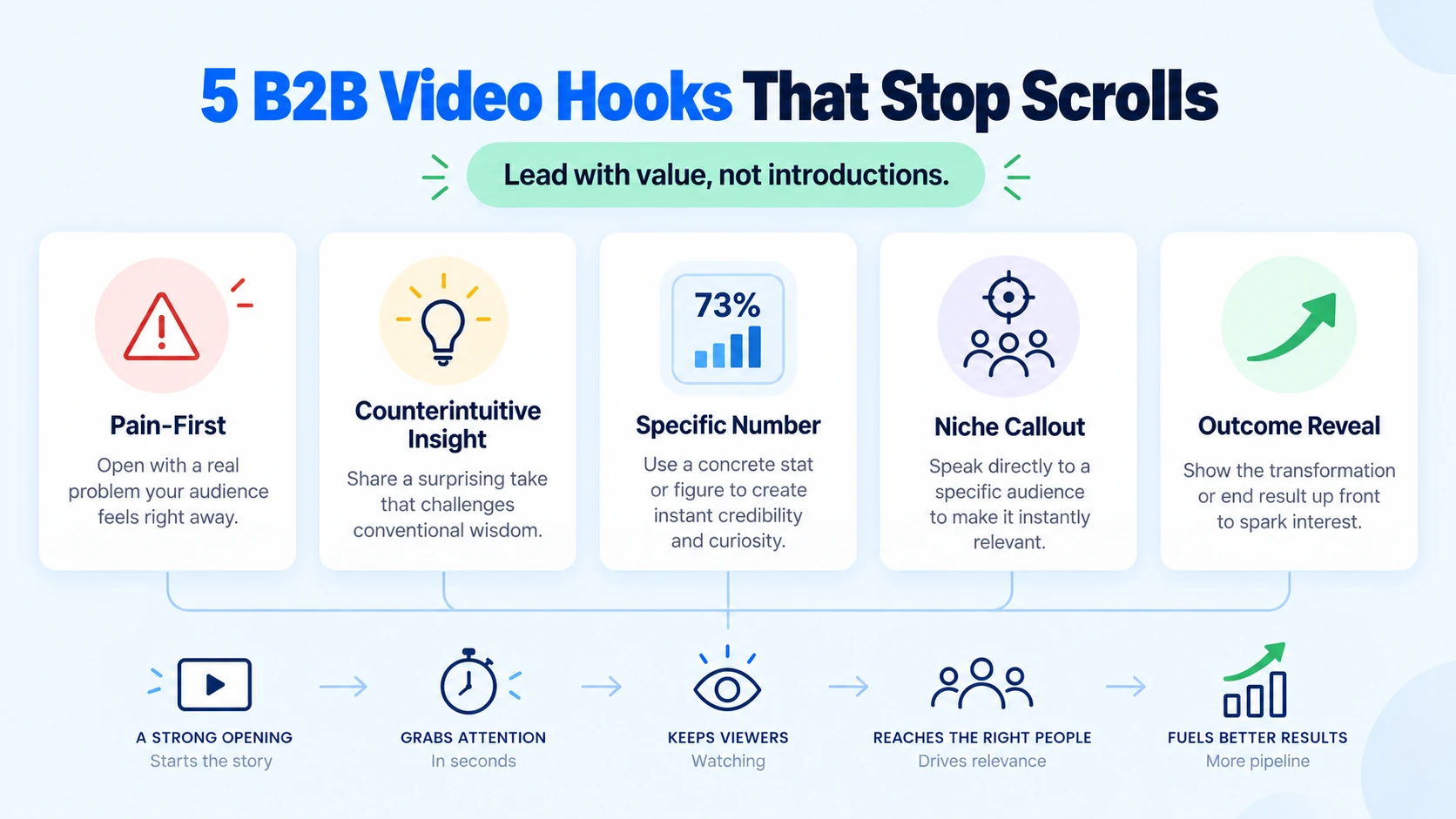
The same principle translates directly to B2B: lead with the outcome your buyer wants, not the journey you took to get there. Introduction-style openers like "Hi guys, today we're going to talk about…" consistently underperform. You don't need to introduce yourself on a platform where the viewer scrolled to you. Lead with the value, not the greeting. The five hook types that work hardest for B2B SaaS and tech:
- Pain-first: Name the exact problem your ICP faces in their own language
- Counterintuitive insight: "Most SaaS teams spend 80% of their video budget on the wrong part of the funnel"
- Specific number: A sharp stat or internal data point creates immediate credibility
- Niche callout: "If you run a Series A SaaS with a 6-month sales cycle...", specificity earns attention from the right buyer
- Outcome tease: Show the result first, then explain how you got there
The first 3 to 10 seconds are crucial. You need to capture attention immediately with a punchy hook, a surprising statistic, a question, or a strong visual. Quickly present the benefit, value, or problem the content will solve so the viewer knows immediately why they should watch. Test hooks before you test anything else.
Most high-performing brands test 2 to 4 hook variations against the same body of content. The body usually doesn't need to change. The opener almost always does. Once a hook wins, you can apply that pattern across future videos in the same content category. Our short-form video editing service is specifically built to isolate and test hooks at scale for B2B teams.
What Makes B2B Video Content High Retention: Structure, Narrative, and Cognitive Load
Getting a viewer past the hook is only half the battle. Keeping them through to the CTA requires a clear narrative arc structure and smart management of cognitive load. The most effective B2B videos follow a three-part narrative arc:
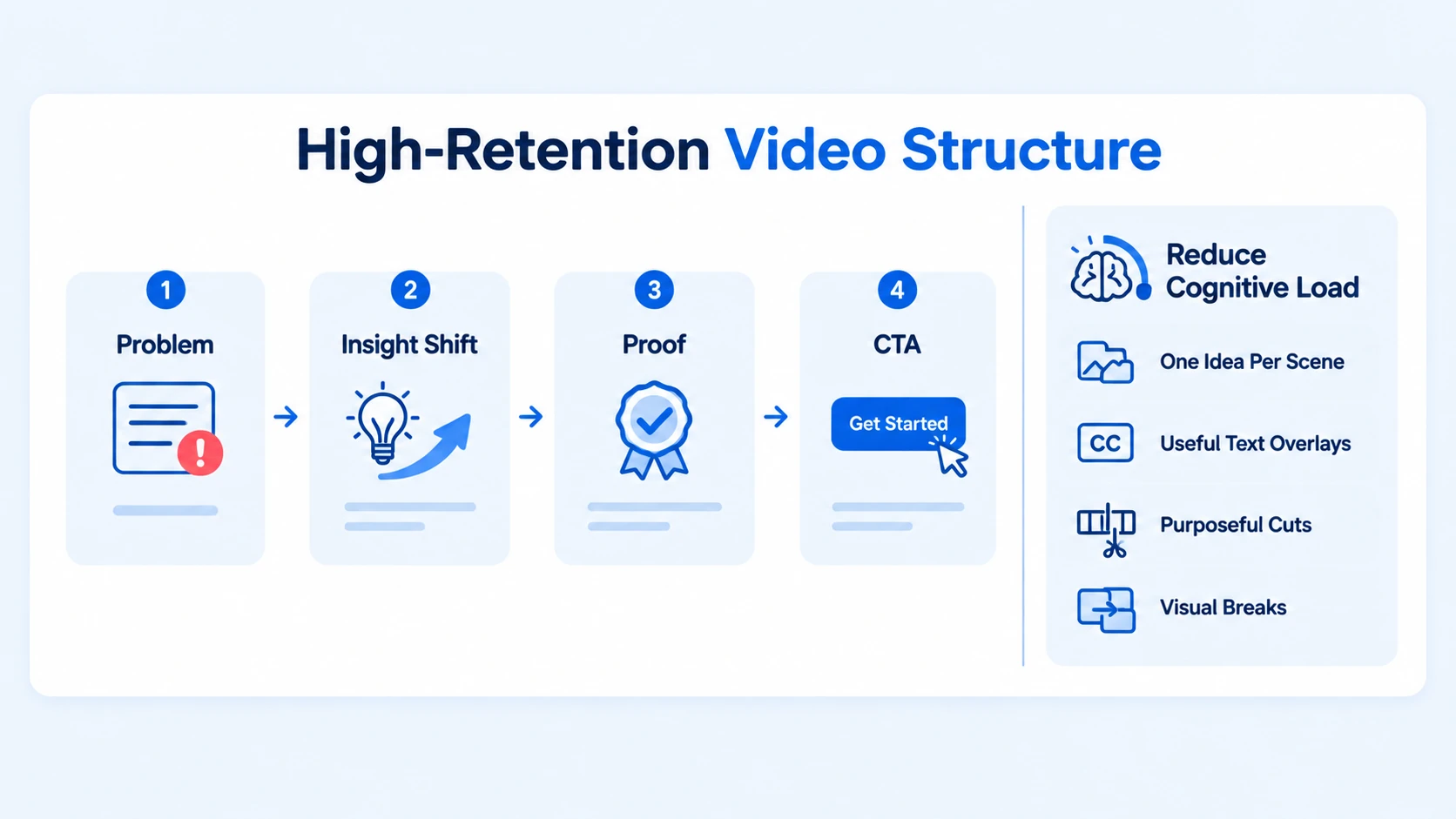
- Problem: Establish the specific pain your buyer recognizes. Make them feel seen.
- Insight or shift: Introduce a new way of seeing the problem, a reframe, a data point, a contrarian take.
- Proof and CTA: Show evidence (result, testimonial, demo moment) and give a clear, single next step.
This maps directly to the StoryBrand framework and works because it mirrors how buyers make decisions, they don't move on features, they move on recognized pain and demonstrated solution.
On cognitive load: the psychological principle of dual coding theory explains why captions and subtitles are so effective. Information is better retained when it is presented in both visual and verbal formats. Captions and subtitles simultaneously engage the viewer's auditory and visual processing channels, improving comprehension and recall.
The concept of cognitive load is central to understanding how captions and subtitles affect viewer engagement. Cognitive load refers to the amount of mental effort required to process information. High cognitive load can overwhelm viewers and lead to disengagement.
Practical cognitive load management in B2B video:
- One idea per scene, cut anything that doesn't serve the current point
- Use text overlays to reinforce (not repeat) the spoken line
- Avoid complex jargon back-to-back without a pause or visual break
- Keep B-roll transitions purposeful, not decorative
- Use pattern interrupt techniques (cut to screen recording, data callout, or a new angle) every 15–20 seconds to re-engage attention
For SaaS teams turning webinars and demos into short-form assets, or those building videos completely from scratch without an existing library, this structure serves as the editing and production brief.
Best Practices for B2B Video Engagement on LinkedIn in 2026
LinkedIn has overtaken YouTube as the top distribution channel for B2B video, with 81% of B2B teams sharing video there. If LinkedIn is in your distribution plan, you need to understand exactly how the platform rewards or punishes your content. Video content is growing on LinkedIn, which reported its third straight quarter of double-digit growth in video uploads in Q1 2026.
But more volume means more competition. By early 2026, LinkedIn reports that video content generates, on average, three times more comments than text-only posts and five times more reach than static image posts. The key distribution mechanics to know:
- Upload natively: External video links (YouTube) are penalized because LinkedIn wants users on-platform. Links in posts are algorithmically suppressed.
- Optimize the first 60 minutes: LinkedIn's algorithm evaluates professional content through three core signals: initial engagement quality within the first 60 minutes, sustained dwell time measuring how long users actually read content, and creator authenticity signals that validate genuine expertise.
- Watch completions matter more than likes: When a viewer watches more than 50% of your video, LinkedIn treats that as equivalent to a comment, a high-value interaction that triggers broader distribution.
- Always include captions: Subtitles are essential on LinkedIn because many users watch without sound.
- Leverage thought leadership formats: On LinkedIn, high-performing videos are often those that provide insight, advice, a vision, or testimony, not simply promotion. Think tutorials, best practices, experience feedback, and analyses. These formats work very well in B2B for building expertise and trust.
Posting cadence, hook quality, and native upload matter more than production budget on LinkedIn in 2026. A founder on an iPhone with a sharp hook and a clear POV will outperform a polished brand video every time.
Most Effective B2B Video Formats for Keeping Viewers Engaged
Not all video types are equal for retention. The format you choose shapes how much of your message lands. Here's how the main B2B video formats stack up against each other for the goals SaaS and AI/tech teams care about most:
B2B buyers are 34% more likely to remember product details after watching a video versus reading a datasheet, which has a retention rate of 19%. Videos featuring customer testimonials have a 44% higher conversion rate in the decision stage than videos without testimonials, which convert at 21%.
For SaaS teams specifically, the highest-leverage format combination is: a short founder-led insight clip for awareness distribution, paired with a product explainer or demo snippet for mid-funnel nurture. This maps to both the B2B buyer journey and the demand generation goals growth teams report as their top priority.
Wistia and Vidyard data both point to interactive video as an emerging retention lever, embedding chapter markers, CTAs mid-video, and clickable elements keeps buyers engaged longer and gives your team richer behavioral data. Our video marketing services are built around exactly this kind of full-funnel format architecture.
Conclusion
- The hook, structure, and format account for more of your video completion rate than production quality
- Keep distribution video under 90 seconds; save depth for consideration and decision-stage formats
- Native LinkedIn uploads, captions, and a strong narrative arc are non-negotiable in 2026
- Repurposing existing webinars and podcasts or producing content completely from scratch (including research, scripting, recording guidance, and platform-specific formatting) enables teams with or without an existing content library to maintain consistent video output
If you're a SaaS or AI/tech team ready to build a video system that actually moves pipeline, our services are built for exactly that. These tips for higher-retention B2B video in 2026 only work when they're executed consistently, and that's where a dedicated video editing and growth partner makes the difference.
Frequently Asked Questions
Q1: What is a good video completion rate for B2B content?
Videos under one minute achieve a 65% completion rate among B2B viewers. For videos between 1–3 minutes, aim for 40–50% as a healthy benchmark. Anything below 25% on a sub-2-minute video signals a structural problem, usually a weak hook or a format mismatch with the platform.
Q2: Should B2B video production be high quality or authentic?
Both, but weighted toward authenticity on distribution channels like LinkedIn. Video continues to be a strong driver of engagement on LinkedIn, especially short-form native video that delivers insight quickly and feels conversational rather than overly produced. Clarity of message matters more than production budget at the awareness stage.
Q3: How often should B2B SaaS teams post videos on LinkedIn?
Consistency beats frequency. Two to three native videos per week, with clear hooks and a single point per video, will outperform seven rushed posts. Consistency builds authority, when you stick to two or three topics, the algorithm learns your expertise and surfaces your content to the right people.
Q4: Does adding captions actually improve B2B video retention?
Yes. Most LinkedIn users watch without sound, so captions keep the message intact for silent viewers. Beyond accessibility, information is better retained when it is presented in both visual and verbal formats. Captions simultaneously engage the viewer's auditory and visual processing channels, improving comprehension and recall.
Q5: What is the best type of B2B video for generating pipelines?
62% of B2B buyers say they watch explainer videos to better understand a product before moving further in the sales process. For pipeline, a short product explainer (under 2 minutes) paired with a personalized outbound video for high-value accounts is the highest-impact combination for SaaS and tech teams.
Q6: Can I repurpose long-form content into high-retention short videos?
Absolutely, and it's one of the most efficient content strategies available to B2B teams. A single 45-minute webinar or podcast episode can produce 8–12 short clips, each structured with its own hook, insight, and CTA. For teams without existing recordings or content libraries, Komet Media also builds videos completely from scratch, covering research, scripting, recording guidance, editing, and platform-specific formatting. The tips for higher-retention B2B video in 2026 apply equally to repurposed clips as to content shot from scratch.